periodical issue
Freedom First
A Journal of Liberal Ideas
By V. V. John
Published for the Democratic Research Service by J. R. Patel, Associate Editor, Freedom First at 127, M. Gandhi Road, Bombay 1 and printed by him at Inland Printers, 55 Gamdevi Road, Bombay 7. · Bombay · 1972
16 pages
Freedom First
Summary
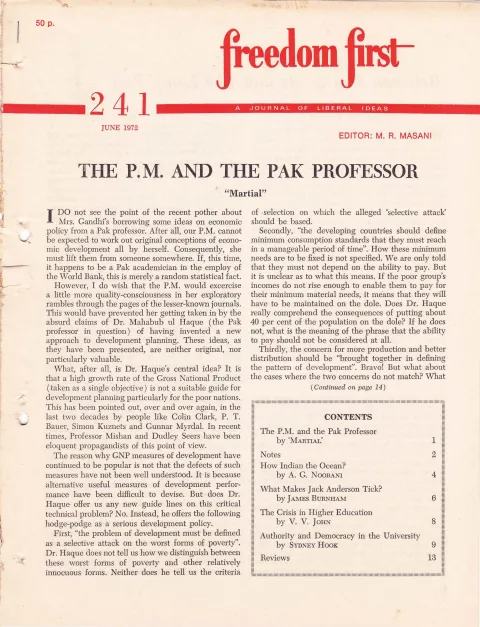
This is the June 1972 issue (No. 241) of Freedom First, the Bombay-based classical-liberal journal edited by M. R. Masani. The issue opens with an unsigned editorial (under the byline ‘Martial’) attacking Indira Gandhi’s adoption of ideas from Pakistani economist Mahbub ul Haq on ‘employment-oriented’ development planning, arguing that dropping GNP as the criterion for development is a smokescreen for collectivist planning. The regular ‘Between You & Me and The Lamp Post’ notes column comments on press freedom, the death of Kwame Nkrumah, Senator Fulbright’s opposition to funding Radio Free Europe, and USIA Director Frank Shakespeare’s admission that the US is losing the Cold War propaganda battle. A. G. Noorani contributes a long piece on great-power naval rivalry in the Indian Ocean and the incoherence of India’s non-aligned Indian Ocean policy. James Burnham analyses the motives behind Jack Anderson’s leak-driven journalism during the Nixon administration. Two education pieces follow: V. V. John (Vice-Chancellor of Jodhpur University) diagnoses a crisis in Indian higher education rooted in swelling, intellectually unprepared enrolment and declining standards; Sidney Hook, in an abridged paper originally given at a Leslie Sawhny Programme seminar, argues that faculty authority over curriculum and academic standards is distinct from, and should not be diluted by, calls for student ‘democratic’ participation in university governance. A book-reviews section covers Vinod Mehta’s Bombay: A Private View (reviewed unfavourably by J. R. Patel) and two books on Israel and the Arab-Israeli conflict (reviewed by Nitin G. Raut). The issue closes with ‘With Many Voices,’ a column of pointed quotations from the world press, and a subscription form.
Key points
-
Writing as “Martial”, the lead essay criticises Indira Gandhi’s uncritical adoption of Pakistani economist Mahbub ul Haq’s “employment-oriented” development ideas as collectivism dressed as novel economics.
-
The “Notes” column treats Kwame Nkrumah’s fall as a cautionary tale about charismatic socialist dictators and reports USIA Director Frank Shakespeare’s admission that the US is losing the Cold War propaganda struggle.
-
A. G. Noorani’s “How Indian the Ocean?” surveys expanding US and Soviet naval presence in the Indian Ocean, criticising India’s incoherent, rhetoric-heavy policy toward the region.
-
James Burnham’s “What Makes Jack Anderson Tick?” analyses the motives behind leak-driven journalism under Nixon and proposes automatic declassification reform.
-
V. V. John’s “The Crisis in Higher Education” argues Indian colleges fail to intellectually challenge students, faulting the Gajendragadkar Committee for misdiagnosing unrest as a governance problem.
-
Sidney Hook’s “Authority and Democracy in the University” distinguishes domains of university authority, arguing faculty control over curriculum should remain near-absolute against “student power” demands.
-
Reviews cover J. R. Patel’s harsh notice of Vinod Mehta’s “Bombay: A Private View” and Nitin G. Raut’s favourable notices of two books on Israel and the Arab-Israeli conflict.
Essays
The P.M. and the Pak Professor
By ‘Martial’
Writing under the byline ‘Martial,’ the author dismisses the controversy over Indira Gandhi borrowing ideas from Pakistani economist Dr. Mahbub ul Haq as unremarkable in itself, but faults the Prime Minister for uncritically adopting what the author considers a shallow and unoriginal set of development ideas. The essay’s core target is Haq’s proposal to replace GNP growth as the criterion of development planning with an ‘employment-oriented’ and minimum-needs-based approach. The author argues this idea is neither new (citing Colin Clark, P. T. Bauer, Simon Kuznets, Gunnar Myrdal, Mishan and Dudley Seers as earlier critics of GNP-centred planning) nor coherent as Haq presents it, and walks through three of Haq’s stated principles—selective attack on ‘worst forms of poverty’, minimum consumption standards independent of ability to pay, and reconciling production with distribution—showing each to be vague or question-begging. The piece, continued on page 14, goes on to argue that the demand for guaranteed full employment regardless of productivity is really an old collectivist idea (comparing it to Maoist policy) dressed up as novel development economics, and that pursuing it seriously would require freezing the population’s occupational structure into permanent backwardness or resorting to a State-dictated minimum-consumption standard. The author concludes that genuinely ‘sophisticated’ post-GNP development planning is compatible with liberal economics only if it pairs demographic/manpower planning and social-welfare provision for the poor with continued reliance on a free-market private sector for economic growth — and that Dr. Haque’s version represents regression, not progress.
- Mrs. Gandhi’s borrowing of Dr. Mahbub ul Haq’s development ideas is criticized not because borrowing is wrong, but because the ideas themselves are neither original nor well-formed.
- GNP-centred development planning has long been criticized by economists like Colin Clark, P. T. Bauer, Simon Kuznets, and Gunnar Myrdal, but alternative measures have proven hard to construct.
- Haq’s three planning principles (selective attack on poverty, minimum consumption standards, reconciling production and distribution) are each shown to be vague or to dodge hard questions (e.g., how to define ‘worst’ poverty, what to do about newly prosperous green-revolution farmers).
- The demand that the state guarantee employment for everyone regardless of productivity is an old idea already practiced by ‘Comrade Mao Tse-Tung’, not a new economic insight.
- Taking employment planning seriously, on the terms Haq and Gandhi propose, risks freezing the labour force’s skill structure into permanent backwardness or requiring a state-dictated minimum consumption standard — i.e., ‘economic totalitarianism’.
- The author’s own alternative: pair demographic/manpower/educational planning and a social welfare programme for the poor with continued reliance on a free-market private sector to drive growth — the ‘neo-liberal’ position as distinct both from GNP-only planning and from Haq’s collectivism.
Notes
The unsigned ‘Between You & Me and The Lamp Post’ notes column opens by wryly rebutting Khushwant Singh’s characterization of Freedom First as a ‘tabloid’ in the Illustrated Weekly, arguing the journal is thin in pages but not lowbrow in content. It then reflects on the death in exile of Kwame Nkrumah, treating his career as a cautionary tale about charismatic ‘socialist’ dictators who destroy democratic institutions and economic welfare while claiming to build national pride, drawing parallels to Sukarno of Indonesia and warning contemporary leaders like Suharto and Sadat about repeating the pattern. A substantial section covers USIA Director Frank Shakespeare’s admission, in an interview with U.S. News & World Report, that the United States is losing the Cold War propaganda struggle to the Soviet Union, and his argument for broadcasting truthful information to discontented populations inside the USSR (citing Solzhenitsyn’s fiction, the Sakharov letter, and Lithuanian Catholic protests as material). The column then criticizes Senator Fulbright’s push to defund Radio Free Europe as ‘vandalism,’ quoting the London Economist’s mockery of Fulbright, and closes by praising West German Chancellor Willy Brandt for rejecting Soviet pressure to shut down RFE’s Munich transmitters despite his Ostpolitik.
- Rebuts Khushwant Singh’s description of Freedom First as a ‘tabloid’ in the Illustrated Weekly, arguing thinness of pages does not mean lowbrow content.
- Treats Kwame Nkrumah’s fall and exile as an object lesson in the failures of charismatic socialist dictatorship, paralleling him with Sukarno and warning about Suharto and Sadat.
- USIA Director Frank Shakespeare admits in a U.S. News & World Report interview that the US is losing the Cold War propaganda struggle to the Soviets.
- Advocates using Solzhenitsyn’s novels, the Sakharov letter, and reports of Lithuanian Catholic protests to inform Soviet citizens of internal dissent and Western realities.
- Criticizes Senator Fulbright’s effort to cut funding for Radio Free Europe, and praises Willy Brandt for resisting Soviet pressure to close the Munich RFE transmitters.
How Indian the Ocean?
By A. G. Noorani
A. G. Noorani surveys the strategic contest for influence in the Indian Ocean, opening with Sukarno’s irate objection to the Ocean’s name and arguing that India, like the great powers, treats the region more seriously in rhetoric than in coherent policy. He documents the expanding U.S. and Soviet naval presence (the U.S. ‘chop line’ extension, Diego Garcia base-building, Soviet anchorages near Socotra Island), reviews the contradictory statements of Indian ministers Jagjivan Ram and Surinder Pal Singh on Soviet naval build-up, and surveys regional diplomatic efforts — Indonesia’s Adam Malik proposing regional co-operation, the Lusaka Non-Aligned summit’s ‘zone of peace’ declaration, and the UN General Assembly’s December 1971 resolution declaring the Indian Ocean a zone of peace (which the US and USSR both abstained from). Noorani notes Brezhnev’s dismissal of the idea that great-power navies should withdraw, the ambiguous language of the Indo-Soviet joint statement, and warns via the Mediterranean analogy that Great Power rivalry entrenches when littoral states are themselves divided. He concludes that India’s Indian Ocean policy is incoherent because it is divorced from a broader, realistic Asian security policy and criticizes India for asking great powers to remember the poor littoral states while failing to build genuine regional consensus with them.
- Sukarno’s objection that the Indian Ocean should be called the ‘Indonesian Ocean’ frames the essay’s opening point that regional naming disputes reflect larger unseriousness about the region’s security.
- The U.S. and USSR are both expanding their naval and base presence (U.S. Diego Garcia buildup and ‘chop line’ extension; Soviet anchorages near Socotra Island) even as both publicly endorsed the UN’s ‘zone of peace’ resolution.
- Indian government statements on Soviet naval buildup are internally contradictory: the Defence Minister cites ‘an increase in movement’ of Soviet ships while the Deputy Minister of External Affairs denies ‘positive evidence’ of a build-up.
- Indonesia’s Foreign Minister Adam Malik proposed regional co-operation among Indian Ocean littoral states as an alternative to Great Power involvement, which India was cool toward.
- The Lusaka Non-Aligned summit (1970) and the UN General Assembly (Dec 1971) both endorsed declaring the Indian Ocean a ‘zone of peace,’ with the US and USSR among the abstainers.
- Noorani draws a Mediterranean analogy: Great Power rivalry there grew precisely because littoral states were divided and courted rival patrons, a caution for the Indian Ocean.
- India’s Indian Ocean policy is criticized as incoherent because it is not integrated with a broader realistic Asian security strategy, and because India criticizes Diego Garcia more than growing Soviet presence.
What Makes Jack Anderson Tick?
By James Burnham
James Burnham examines why Jack Anderson’s steady stream of leaked government secrets has flourished under the Nixon administration, arguing the leaks are potentially more damaging to national security than Daniel Ellsberg’s Pentagon Papers because they concern unfinished, live operations. He catalogs the mixed motives behind such leaks — opposition to specific policies, inter-agency rivalries (State vs. Kissinger’s NSC, Pentagon vs. State or CIA), general anti-Nixon sentiment, and outright hostility to government — and dismisses media claims about ‘the people’s right to know’ as cover for commercial and political motives. Burnham argues confidential internal deliberation is essential to any organization’s functioning, tracing the principle to George Washington’s refusal to let the Senate compel testimony about treaty negotiations, and faults Nixon himself for failing to manage the bureaucracy and prevent leaks — noting Nixon is a particular target for State Department and HEW staff who resent his role in the Alger Hiss case. He closes by arguing that the sheer scale of over-classification, not merely bureaucratic leakiness, is the deeper structural problem, and proposes automatic declassification after three years except for specifically excepted material as a solution that would also save billions of dollars.
- Jack Anderson’s leaks concern live, unfinished government operations and may be more damaging to national security than Daniel Ellsberg’s Pentagon Papers, which were historical documents.
- Burnham identifies four motives behind leaking to journalists: opposition to specific policy, inter-agency rivalry, general opposition to the incumbent president, and opposition to government as such.
- Confidential internal deliberation among officials is necessary for any organization to function, a principle Burnham traces to President Washington’s refusal to let the Senate compel testimony on treaty negotiations.
- Nixon himself bears some responsibility for the scale of leaks because he has not managed the bureaucracy effectively, and is especially disliked within the State Department and by HEW staff over his role in the Alger Hiss case.
- Burnham proposes reforming classification practice — automatic declassification after three years unless specifically excepted — as a way to reduce both leaks and the enormous cost of over-classification.
The Crisis in Higher Education
By V. V. John
V. V. John, Vice-Chancellor of Jodhpur University, argues that the recurring diagnoses of crisis in Indian higher education have failed to identify the real problem: colleges are not equipped to challenge students who arrive intellectually unprepared, and too many faculty members themselves offer little scholarly substance. He rejects the idea that expanding enrolment by itself explains falling standards, noting that pre-independence ‘selective’ admission mainly reflected ability to pay rather than intellectual merit, so wider access could in principle uncover talent rather than dilute it. John criticizes the Gajendragadkar Committee Report for focusing on the size and composition of university bodies and endorsing student participation in decision-making as a response to unrest, arguing this misdiagnoses the problem: students are restive because colleges fail to intellectually engage them, not because they lack a voice in governance. He closes by arguing decision-making is a means to educational ends, not an end in itself, and that the real fix is making classroom work more demanding and significant.
- The ‘crisis’ in Indian higher education is repeatedly studied but misdiagnosed; the real problem is that colleges are not intellectually challenging enough for students, and many faculty lack scholarly substance.
- Rising enrolment alone does not explain falling standards, since pre-independence ‘selective’ admission mostly reflected ability to pay rather than intellectual merit.
- The Gajendragadkar Committee Report is criticized for focusing on university body size/composition and endorsing student participation in decision-making as a response to unrest.
- Student unrest is attributed to the lack of intellectual challenge in the classroom, not to a lack of formal power in governance.
- Decision-making should be understood as a means to the end of promoting knowledge and quality of life, not as an end in itself.
Authority and Democracy in the University
By Sydney Hook
Sidney Hook, in a paper given at a Leslie Sawhny Programme seminar, distinguishes three domains where authority and democracy intersect in the university: student social/campus life, the academic content of teaching, and all-university governance questions. He argues that a politically democratic society does not require every institution within it — army, family, orchestra, or university — to be run by majority vote; some institutions have specialized functions best served by expert or hierarchical authority. On academic matters, Hook insists faculty authority over curriculum, teaching content, and standards is properly close to absolute, since truth is not established by majority vote and the state may authorize what is taught but not how or by whom. He acknowledges that in the area of student social/campus life, students should be largely self-governing given the reduced voting age, though faculty must intervene where student conduct threatens others’ rights to learn or teach. On faculty governance and student ‘power-sharing’ demands, Hook argues that authority in academic matters should rest on rational assessment of evidence, not on the political leverage of numbers, and that submitting to sloganized demands for student co-determination in curricular decisions undermines academic standards, though this must be balanced against a genuine, non-humiliating culture of consultation between teachers and students.
- Hook distinguishes three domains of university authority: student social/campus life, academic content (teaching and curriculum), and all-university governance.
- A democratic society does not require that every institution within it (army, family, orchestra, university) be internally run by majority vote; institutions have specialized functions.
- Faculty authority over curriculum, teaching content and standards should be near-absolute because truth is not established by majoritarian procedure.
- In student social/campus life, students should largely self-govern, but faculty must intervene when student conduct threatens the rights of others to learn or teach.
- Decisions about the university’s relationship to its public/private funding sources ultimately rest with the bodies representing the public, even though faculties propose new schools or departments.
- Hook criticizes the ‘student power’ movement as importing a class-struggle political slogan into a domain (education) where teacher and student interests are not fundamentally opposed.
- Ultimately, authority for educational decisions should derive from rational assessment of evidence, not from the political weight of numbers or position, though genuine consultation with students has value.
Reviews
This reviews section contains two pieces. J. R. Patel reviews Vinod Mehta’s Bombay: A Private View harshly, describing it as a poorly-written, self-indulgent ‘rag bag’ of opinions with little literary or factual content, riddled with errors about American journalism and misjudged cultural references, and questioning why the Lucknow-raised, England-returned author chose to write about Bombay at all. Nitin G. Raut reviews two books about Israel — Facts About Israel, 1971 by Misha Louvish (a retrospective survey of Israeli history, culture, and progress) and Israel and the Arabs by Julian J. Landau (a concise reference brief on the Arab-Israeli conflict, including the Six-Day War) — describing both favourably as useful surveys.
- J. R. Patel reviews Vinod Mehta’s Bombay: A Private View unfavourably, calling it devoid of literary content and full of factual errors about the American press.
- Patel notes the book was self-published (Mehta claims to have invested his own savings) and criticizes its treatment of women’s liberation and Indian advertising culture as superficial.
- Nitin G. Raut reviews Facts About Israel, 1971 by Misha Louvish as a detailed retrospective study of Israel’s people, history, culture and scientific progress.
- Raut also reviews Israel and the Arabs by Julian J. Landau as a concise, chronologically organized handbook on the Arab-Israeli conflict including the Six-Day War.
Essay 8
The closing ‘With Many Voices’ column, epigraphed with a Tennyson quotation, is a compilation of pointed short quotations culled from the world press and public figures — including C. Rajagopalachari on treason and dictatorship (quoted from Swarajya), James Burnham (quoted from National Review) on the inevitability of human conflict, and quips about foreign perceptions of India, the Nixon-era press, communism in Hungary, and Western political figures such as Edward Heath and Harold Wilson. The issue closes with the subscription form for Freedom First and imprint details naming J. R. Patel as Associate Editor and Bombay’s Inland Printers as printer.
- A curated column of short quotations from the world press (Economist, Time, Encounter, National Review, Statesman, Hindustan Times, Swarajya, and others) on political and social topics.
- C. Rajagopalachari is quoted from Swarajya arguing that assisting the replacement of democracy by dictatorship is treasonous.
- James Burnham is quoted from National Review on the persistence of human conflict throughout history.
- The issue’s final page includes the Freedom First subscription form and imprint: published for the Democratic Research Service by J. R. Patel, printed at Inland Printers, Bombay.
Generated by the v1.5 extraction pipeline. Awaiting editorial review.
Metadata and summary are AI-extracted from the source PDF and reviewed for editorial accuracy. The original work is available via the Read PDF tab above (where present); paragraph-level citation inside the PDF is deferred to a future engagement.