periodical issue
Freedom First
A Journal of Liberal Ideas
By M. R. Masani, A. G. Noorani, Geeta Doctor, Deepa Awal, Hardayal Singh
Published for the Democratic Research Service by J. R. Patel, Associate Editor, Freedom First at 127, M. Gandhi Road, Bombay 1 (Phone: 254341) and printed by him at Inland Printers, 55 Gamdevi Road, Bombay 7. · Bombay · 1972
16 pages
Freedom First
Summary
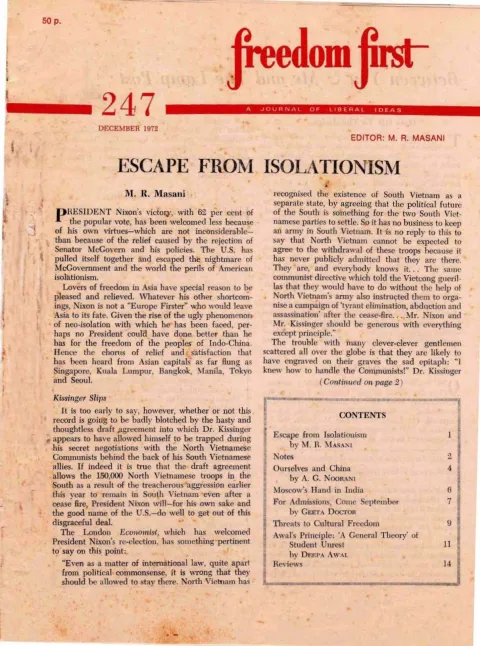
Freedom First issue 247 (December 1972), edited by M. R. Masani, is a short 16-page number of the journal dominated by foreign-policy commentary in the wake of Richard Nixon’s re-election and the Vietnam peace negotiations. Masani’s lead editorial welcomes Nixon’s victory as a repudiation of American isolationism and warns against a Vietnam settlement that leaves North Vietnamese troops in the South. The unsigned ‘Between You & Me and The Lamp Post’ notes column covers the Supreme Court’s newsprint-policy judgment, Indian domestic politics, Taiwan, and Soviet propaganda in India. A. G. Noorani’s ‘Ourselves and China’ argues that India’s dependence on Russia is leaving it isolated from China, the U.S., and Pakistan, and urges a deliberate rapprochement. A short unsigned piece, ‘Moscow’s Hand in India,’ reports the Indian government’s ban on export of a book exposing Soviet propaganda operations in India. Geeta Doctor contributes a satirical essay on the anxieties of school admissions in Bombay, and the Indian Committee for Cultural Freedom’s biennial resolutions (reprinted in full) condemn government restrictions on foreign travel for academics, press freedom violations in West Bengal and Manipur, and a Soviet UNESCO satellite-broadcast proposal. Deepa Awal offers a satirical ‘general theory’ of student unrest modelled on Keynesian economics. The issue closes with a review of Prakash Tandon’s memoir ‘Beyond Punjab’ by Hardayal Singh, and a page of quoted excerpts (‘With Many Voices’) from other publications.
Key points
-
M. R. Masani’s editorial welcomes Nixon’s re-election as a rejection of isolationism, while criticising the draft Vietnam peace agreement for allowing North Vietnamese troops to remain in the South.
-
The “Notes” column praises the Supreme Court’s ruling striking down the government’s newsprint policy, credits N. A. Palkhivala’s advocacy, and reports Congress’s loss in an Ahmedabad by-election.
-
A. G. Noorani’s “Ourselves and China” argues India’s exclusive reliance on Russia is leaving it isolated from China, the US and Pakistan, urging deliberate rapprochement.
-
An unsigned item reports the government’s ban on exporting Peter Sagar’s “Moscow’s Hand in India”, which documented Soviet propaganda channelled through the CPI’s press service.
-
Geeta Doctor’s “For Admissions, Come September” satirises the anxieties of Bombay school admissions and parents’ reliance on influence.
-
The Indian Committee for Cultural Freedom’s biennial resolutions, reprinted in full, condemn restrictions on academic foreign travel and press-freedom violations in West Bengal and Manipur.
-
Deepa Awal’s “A General Theory” parodies Keynesian economics to explain student unrest, and Hardayal Singh reviews Prakash Tandon’s memoir “Beyond Punjab” on job discrimination facing Indian managers.
Essays
Escape from Isolationism
By M. R. MASANI
M. R. Masani’s editorial welcomes President Nixon’s re-election with 62 per cent of the popular vote as a relief to lovers of freedom in Asia, arguing Nixon is not a ‘Europe Firster’ who would abandon Asia. He criticises the draft Vietnam peace agreement reportedly negotiated by Henry Kissinger, which would allow 150,000 North Vietnamese troops to remain in South Vietnam after a cease-fire, calling this a betrayal comparable to that of President Diem. He quotes the London Economist’s view that international law does not permit those troops to remain, and criticises Kissinger’s naivety about handling Communists.
- Nixon’s 62% popular-vote victory is welcomed as a rejection of Senator McGovern’s isolationist tendencies.
- Masani credits Nixon with doing more for the freedom of Indo-China’s peoples than any president could have.
- He criticises the secretly-negotiated draft Vietnam agreement for allowing North Vietnamese troops to remain in South Vietnam.
- The Economist is quoted arguing this is impermissible under international law since North Vietnam has never admitted its troops are there.
- Masani warns Nixon and Kissinger to be ‘generous with everything except principle’ in finalising any settlement.
Notes
The unsigned ‘Between You & Me and The Lamp Post’ notes column opens by praising the Supreme Court’s October 30 judgment striking down the Union Government’s newsprint policy and the ten-page ceiling on newspapers as unconstitutional, crediting N. A. Palkhivala’s advocacy. It comments on the Congress Party’s defeat in an Ahmedabad by-election (won by Acharya Kripalani, Dr. Lohia and Minoo Masani figures’ legacy), praises President Thieu of South Vietnam as having emerged from recent events with credibility, notes the Indian Committee for Cultural Freedom’s resolutions on threats to cultural freedom, criticises the banning of Peter Sagar’s book ‘Moscow’s Hand in India,’ and continues onto page 3 with items on a reversed hotel-tariff policy targeting Indian tourists, Chiang Kai-shek’s 86th birthday, Taiwan’s economic performance versus mainland China, and J. B. Kripalani’s rebuttal of the CIA-bogey raised by Indira Gandhi’s government, plus a report on North Vietnam by Prof. P. J. Honey.
- The Supreme Court’s October 30 ruling struck down the government’s newsprint policy and ten-page ceiling as unconstitutional; N. A. Palkhivala is praised for his advocacy.
- Congress’s defeat in an Ahmedabad parliamentary by-election is read as a possible turning of the tide, echoing 1967.
- President Thieu of South Vietnam is praised for resisting pressure from his American allies during the peace-agreement negotiations.
- A government move to charge Indian tourists 33% more than foreigners for hotels (while exempting Soviet visitors) was dropped after criticism.
- Chiang Kai-shek’s 86th birthday is marked with a comparison of Taiwan’s economic performance favourably against mainland China.
- J. B. Kripalani, writing in Swarajya, rebuts the government’s use of a ‘CIA bogey’ to deflect from its own failures, using the ‘Adam’s Grave’ fallacy analogy.
- Prof. P. J. Honey of London University, interviewed by U.S. News & World Report, describes tight Communist control and lack of public dissent in North Vietnam.
Ourselves and China
By A. G. NOORANI
A. G. Noorani argues that India’s exclusive reliance on Russia is the most conspicuous feature of its foreign policy, and that while the U.S., China, and Pakistan each bear blame for estrangement from India, India itself has contributed to the impasse with China particularly. He surveys reports (Kuldip Nayar’s account of Austrian journalists’ interview with Chou En-lai, an Izvestia analyst’s reading of the Indo-Soviet Treaty as an instrument of the ‘Brezhnev Plan’ to contain China, and a study by Prof. Leo Yueh-yun Liu on Chinese nuclear ambitions) to argue that China’s ideological zeal for world revolution shapes its foreign policy, that China is likely to become a major nuclear power, and that a China possessing nuclear weapons while feeling wronged is a dangerous prospect for regional stability. He urges India to pursue a calculated disengagement from Russian influence and rapprochement with China, the U.S., and Pakistan before it becomes too isolated to act.
- India’s exclusive reliance on Russia is described as the most conspicuous feature of its foreign policy.
- Both the Soviet Union and China interpret the Indo-Soviet Treaty (conceived February-March 1969) as part of a Soviet ‘Brezhnev Plan’ to contain China.
- China’s ideological commitment to world revolution, not just national interest, shapes its foreign policy, per Prof. Leo Yueh-yun Liu’s study.
- China is likely to become a major nuclear power in the foreseeable future, creating a dangerous three-way nuclear dynamic among the US, USSR, and China.
- Noorani urges India to disengage from Russian dependence and pursue rapprochement with China, the US, and Pakistan or risk pitiable isolation.
Moscow’s Hand in India
This unsigned item reports New Delhi’s ban on the export of Peter Sagar’s book ‘Moscow’s Hand in India,’ previously reviewed favourably in Freedom First and reprinted in India in 1967, on the grounds it might affect relations with the USSR. It recounts the book’s documentation of how the Soviet Information Service secretly channels propaganda through the CPI-run New Age Press Service to circumvent India’s ‘Third Country Rule,’ which forbids foreign missions from conducting hostile propaganda against other friendly nations, and criticises the External Affairs Ministry’s negligence in policing this violation.
- The Indian government banned export of Peter Sagar’s ‘Moscow’s Hand in India’ on grounds it might affect USSR relations, five years after the book’s Indian reprint.
- The book documents Soviet propaganda operations through TASS and Novosti, and details how material is secretly funneled through the CPI’s New Age Press Service.
- This practice is alleged to violate the ‘Third Country Rule’ forbidding foreign missions from hostile propaganda against other friendly nations.
- Sager’s forensic analysis (verified by the Zurich City Police Scientific Division) found stencils prepared at the USSR Information Service office and merely relabelled by New Age.
- The piece concludes that Communists in India act as agents of the Soviet government, and criticises the External Affairs Ministry’s negligence.
For Admissions, Come September
By GEETA DOCTOR
Geeta Doctor writes a satirical first-person account of the anxieties of school admissions for middle-class Bombay parents, following a child from birth-registration onward as parents scramble to secure a place through pull and influence years in advance, culminate in a tense interview process, and finally learn that the child’s admission was secured despite (or without) the family’s frantic string-pulling.
- Registering a child’s name at birth is described as merely the first step in a years-long, anxiety-ridden admissions process.
- Parents are shown resorting to influence and ‘pull’ through architects, obstetricians, or any connection who can ‘put in a word.’
- The interview process is depicted as a masterpiece of intimidation, with children and parents kept waiting for hours amid absurd bureaucratic ritual.
- The essay satirises the obsession with early literacy and numeracy even as one school announces no need for children to know their alphabets.
- The cycle repeats itself identically for the family’s second child at the story’s close.
Threats to Cultural Freedom
This item reprints in full the resolutions unanimously adopted at the Biennial General Meeting of the Indian Committee for Cultural Freedom held in Bombay on 27 October 1972. The resolutions condemn a new government rule requiring scientists and academics to seek clearance through an all-India nominating body before attending seminars abroad; condemn threats to press freedom, including West Bengal Chief Minister Siddhartha Shankar Ray’s pressure on the Hindustan Times and the arrest of Bipin Basu and forfeiture of the journal Point of View under the Punjab Security Act and Sections 153A/124A of the Penal Code; and oppose a Soviet proposal at UNESCO’s 17th General Conference session that broadcasting nations obtain prior permission before beaming television via satellite, calling instead for free access to information.
- The ICCF condemns a new rule requiring scientists, university teachers, and experts to seek clearance via an all-India body before attending seminars abroad, calling it totalitarian.
- The Committee condemns West Bengal CM Siddhartha Shankar Ray’s threats against the Hindustan Times over its Manipur/Bengal reportage.
- It condemns the arrest of Bipin Basu and the government’s forfeiture of the journal Point of View under the Punjab Security Act and Penal Code Sections 153A and 124A.
- It deplores the Government of India’s support for a Soviet UNESCO proposal requiring prior permission for satellite television broadcasts into a country.
- The Committee calls on writers, academicians and intellectuals to protest these actions and on the government to withdraw the travel rule and abolish the ‘P’ Form mechanism.
Awal’s Principle: ‘A General Theory’ of Student Unrest
By DEEPA AWAL
Deepa Awal offers a satirical ‘General Theory’ of student unrest modelled explicitly on Keynes’s General Theory of Employment, Interest and Money, positing four determinants of an equilibrium level of student unrest: the multiplier effect (as the ratio of students to teachers rises, opportunities for indiscipline multiply); the declining marginal efficiency of university staff (as staff numbers grow, rivalries and discontent increase while real wages fall); the marginal propensity to consume learning (which decreases as a student advances to higher degrees, for reasons including deteriorating student-teacher relations, permissiveness even toward cheating, and rigid unchanging syllabi); and the quantity of university funds (whose misuse breeds student questioning and unrest). Awal concludes, with tongue firmly in cheek, that a high level of student unrest is ‘highly desirable’ as evidence students retain hope and sanity to protest against what is wrong with the education system.
- The essay is styled as a parody of Keynesian economic theory applied to explain ‘equilibrium’ levels of student unrest.
- Four factors are proposed: the multiplier effect, marginal efficiency of university staff, marginal propensity to consume learning, and quantity of university funds.
- As students advance from S.S.C./H.S.L.C. to B.A./B.Sc. to M.A./M.Sc. to Ph.D., their ‘propensity to consume learning’ is said to decrease due to deteriorating student-teacher relations and rigid syllabi.
- Increased university funding is said to increase instability because it gives students cause to question its (mis)appropriation.
- The essay concludes that student unrest is ‘highly desirable’ as a sign that students retain the hope and sanity to protest against what is grossly wrong, and that the country’s salvation lies in studying student rebellion.
Reviews
Hardayal Singh reviews Prakash Tandon’s memoir ‘Beyond Punjab’ (Thomson Press India, pp. 222, Rs. 32.50), focusing on Tandon’s difficult early career as a qualified Chartered Accountant navigating job discrimination in 1930s India, where European firms had no place for Indian managers and Indian family firms had no use for outsiders. The review recounts Tandon’s eventual success at Levers, the discomfort of being the first Indian manager among European colleagues, his exclusion from European clubs even years after Independence, and lighter anecdotes including a Hyderabadi nobleman’s daily ‘exercise’ ritual and the elaborate segregation of Indian train compartments by class, community, and sex during the 1930s.
- Tandon, a Chartered Accountant trained in England, found neither European firms (which imported their own managers) nor Indian family firms had use for him.
- He eventually succeeded at Levers/Unilever, rising to Chairman, but felt uneasy as the first Indian manager among European colleagues who addressed superiors by first name while he called them ‘sir.’
- The review compares Tandon’s experience to Paul Scott’s fictional character Hari Kumar (Harry Coomer), an English-raised Indian who could not get a job with an English company in India.
- Tandon was barred from European clubs and hospital benefit schemes even years after Independence, and refused invitations from Europeans who had once excluded him.
- The review includes lighter anecdotes: a Hyderabad nobleman’s daily exercise ritual, and the elaborate segregation of Indian trains into eleven categories by class, community (Anglo-Indian), and sex during the 1930s.
Generated by the v1.5 extraction pipeline. Awaiting editorial review.
Metadata and summary are AI-extracted from the source PDF and reviewed for editorial accuracy. The original work is available via the Read PDF tab above (where present); paragraph-level citation inside the PDF is deferred to a future engagement.