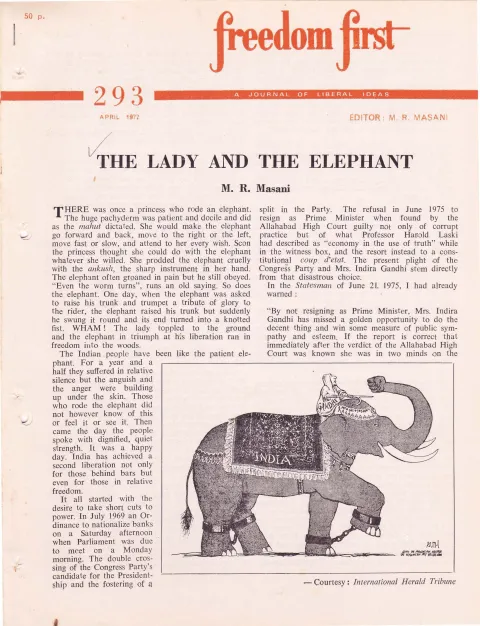
periodical issue
Freedom First
A Journal of Liberal Ideas
By C. R. Irani, James Burnham, Ruzbeh Antia, George H. Nash, Manjula Padmanabhan, Nicholas Ridley, M.P., A. G. Noorani, Aziz Madni
Published for the Democratic Research Service by J. R. Patel, Associate Editor, Freedom First, at 127, M. Gandhi Road, Bombay 1 ... and printed by him at Inland Printers, 57 Ganesh Road, Bombay 7. · Bombay · 1975
16 pages
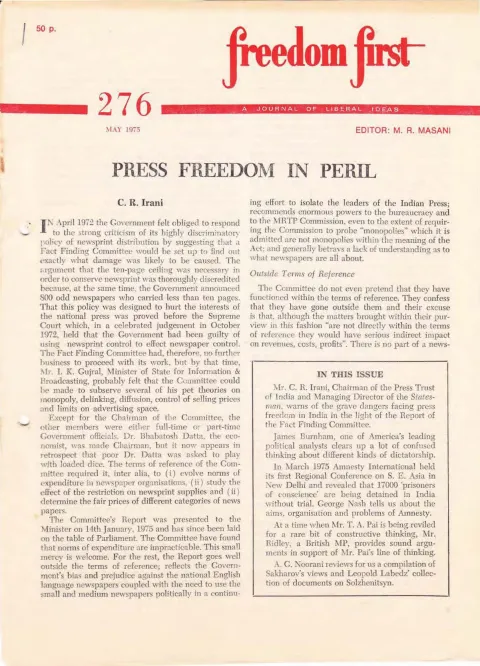
Freedom First
Summary
Freedom First No. 276 (May 1975), edited by M. R. Masani, opens with C. R. Irani’s sustained attack on the government-appointed Fact Finding Committee on newspapers, arguing that its report on newsprint allocation and pricing exceeds its terms of reference and is driven by ministerial hostility toward the national English-language press. James Burnham contributes a theoretical piece distinguishing ‘authoritarian’ from ‘totalist’ dictatorships, drawing on Brian Crozier’s typology to argue this distinction matters more than the conventional democracy-versus-dictatorship binary. Lighter contributions include Ruzbeh Antia’s satirical essay on India’s disproportionate hockey-victory euphoria and customs-duty controversy, and Manjula Padmanabhan’s humorous sketch of a school sports day. George H. Nash offers a critical appraisal of Amnesty International, arguing that despite its claims to impartiality the organisation’s personnel and practical focus skew it toward the political Left. British MP Nicholas Ridley makes the case for denationalisation and against public-sector wage settlements. The issue closes with two book reviews — A. G. Noorani on a Sakharov anthology and a Solzhenitsyn documentary collection assembled by Leopold Labedz, and Aziz Madni on Alastair Buchan’s Reith Lectures collection Change Without War — and a page of quoted aphorisms, ‘With Many Voices’.
Key points
-
C. R. Irani’s “Press Freedom in Peril” attacks the government-appointed Fact Finding Committee on newspapers for exceeding its terms of reference under Minister I. K. Gujral’s steering, proposing controls on monopoly and selling prices while showing “excessive solicitude” for small and “bogus” newspapers.
-
James Burnham’s “Two Alternatives to Democracy” proposes replacing the democracy-versus-dictatorship binary with Brian Crozier’s tripartite scheme of democratic-pluralist, authoritarian, and “totalist” regimes, arguing Chile and Portugal show the real contest was between two kinds of dictatorship.
-
Ruzbeh Antia’s “Fools’ Paradise” satirises Indians’ disproportionate hockey-victory euphoria after the 1975 World Cup win over Pakistan, criticising the Prime Minister’s request to refund customs duties on the team’s goods as undermining equality before the law.
-
George H. Nash’s critical appraisal of Amnesty International argues its membership and personnel skew left despite claims of impartiality, though he concludes it does not practice a deliberate double standard, since structural factors simply make repression easier to document in authoritarian right-wing states.
-
Manjula Padmanabhan’s “Sportsday Revisited” is a light satirical sketch of a Junior School Sports Day, centred on the comic “Parents’ Race” and a xenophobic remark from one competitive father.
-
British MP Nicholas Ridley’s “How to Denationalise” argues open-ended public-sector wage settlements, not nationalisation itself, are Britain’s chief economic defect, proposing to break the Coal Board, Steel Corporation and Airways Board monopolies by allowing private competition.
-
A. G. Noorani reviews Sakharov Speaks and Solzhenitsyn: A Documentary Record, quoting Sakharov’s warning that “detente without democratization” would be dangerous capitulation, and praising both dissidents’ courage.
-
Aziz Madni reviews Alastair Buchan’s Reith Lectures collection Change Without War, highlighting Buchan’s pessimistic forecast that only the US, USSR and China will retain true strategic capability through the century’s end.
Essays
Press Freedom in Peril
By C. R. Irani
C. R. Irani, identified in the issue’s front-page notice as Chairman of the Press Trust of India and Managing Director of The Statesman, attacks the Report of the Fact Finding Committee on newspapers (presented to the Minister on 14 January 1975). He argues the Committee, chaired by economist Dr Bhabatosh Datta but stacked with government officials, was set up in April 1972 ostensibly to assess damage from discriminatory newsprint distribution, but was steered by I. K. Gujral (then Minister of State for Information and Broadcasting) toward recommending controls on monopoly, delinking, diffusion, selling prices, and advertising space. Irani goes point by point through the Report’s findings on monopolies, advertisement-to-news ratios, delinking and diffusion, and ‘bogus newspapers,’ arguing each recommendation lacks evidentiary support and is biased against large English-language dailies (especially the Indian Express group) while being unduly protective of small and ‘bogus’ newspapers. He closes by noting The Statesman’s court challenge in the Calcutta High Court, and warns that the government and the National Herald are working to erode Article 19(1)(a) and (2) of the Constitution, the free-press guarantee.
- The Fact Finding Committee, meant only to study newsprint-related damage, was expanded by Minister I. K. Gujral into a vehicle for controls on monopoly, delinking, diffusion, and advertising.
- Irani argues the Committee explicitly admits it went outside its terms of reference, on the excuse that other matters have ‘serious indirect impact’ on newspaper finances.
- The Committee’s monopoly findings are inconsistent: it concedes provincial/local papers compete successfully with metropolitan dailies, yet still recommends new bureaucratic and MRTP Commission powers to probe ‘monopolies’ that are ‘not monopolies within the meaning of the Act.’
- The Committee recommends government control of selling prices for ‘the leaders’ (large English dailies) while showing excessive solicitude for small and admittedly ‘bogus’ newspapers.
- Irani accuses the Committee of ignoring inter-locking of newspaper finance with other industries (e.g., rubber plantations) while dwelling at length on the Indian Express group’s investments.
- The Statesman took the underlying legal question — whether orders can be passed fixing selling prices or expenditure norms — to the Calcutta High Court, which held the case premature pending actual orders.
- Irani frames the episode as part of a broader government effort to undermine the constitutional guarantee of press freedom under Article 19(1)(a) and (2).
Two Alternatives to Democracy
By James Burnham
James Burnham argues that the conventional ‘democracy versus dictatorship’ dichotomy, while logically permissible, is less useful now than a tripartite classification borrowed from British journalist and historian Brian Crozier: democratic-pluralist, authoritarian, and ‘totalist’ (Crozier’s preferred term over ‘totalitarian,’ a word Mussolini adapted from philosopher Giovanni Gentile). The key distinction is that authoritarian regimes seek to abolish politics while totalist regimes seek to involve the entire population in politics, integrating economic, cultural, social and personal life into a single power system; authoritarian regimes typically leave some non-political freedoms (economic, intellectual, religious, travel) intact, whereas totalism swallows them all. Burnham contends this distinction is now decisive not just for peripheral states but for the Western ‘Heartland’ itself, citing Italy, Britain, and France as places where citizens debate the real possibility of democratic collapse, and Chile and Portugal as cases where the operative political question was never democracy-versus-dictatorship but rather which kind of dictatorship (Allende’s Chile: right-wing authoritarian versus a totalist Left victory; post-coup Portugal: totalism from a Communist-dominated Left versus an alternative authoritarian government).
- Burnham proposes replacing the ‘democracy vs dictatorship’ binary with Brian Crozier’s tripartite scheme: democratic-pluralist, authoritarian, and totalist.
- Totalist regimes integrate all aspects of life (economic, cultural, social, personal) into a single power system; authoritarian regimes leave some non-political freedoms exempt.
- The word ‘totalist’ is used as a less cumbersome substitute for ‘totalitarian,’ a term Mussolini adopted from philosopher Giovanni Gentile.
- Burnham argues democratic government may be a parochial feature of advanced Western civilization, already lost across most of the world, with the live question being whether authoritarian regimes will be swallowed by totalism.
- He cites Chile under Allende and post-coup Portugal as cases where the real alternatives were two forms of dictatorship, not democracy versus dictatorship.
- He extends the argument to advanced Western nations themselves — Italy, Britain, and France — where citizens now debate the real possibility of democratic collapse.
Fools’ Paradise
By Ruzbeh Antia
Ruzbeh Antia satirizes the Indian public’s disproportionate emotional response to India’s World Cup Hockey victory over Pakistan at Kuala Lumpur, arguing that Indians magnify sporting triumphs into ‘sacred memories’ and use them to paper over real problems of rising prices, unemployment, and corruption. He describes the hero’s-welcome given the hockey team and then pivots to a controversy: customs duties of Rs 43,975 were levied on the team’s imported goods at Madras, and the Prime Minister (Indira Gandhi, unnamed by name in the rendered text but identified as ‘our Prime Minister, the head of the Indian Government’) asked the Madras Government to refund the duties on the grounds that ‘national heroes should not be treated as smugglers or thieves.’ Antia argues this undermines equality before the law and sets a troubling precedent for government opportunism.
- Antia argues Indians turn routine sporting wins into ‘sacred memories’ through excessive celebration and hero-worship, contrasted with public breast-beating after defeats.
- He uses India’s 1975 World Cup Hockey victory over Pakistan at Kuala Lumpur as his case study, describing the team’s triumphant homecoming and state governments competing to announce cash rewards.
- The Madras Customs levied Rs 43,975 in duties on the team’s goods; the Prime Minister asked for a refund on the grounds that ‘national heroes’ should not be treated as smugglers.
- Antia argues this move undermines the constitutional principle that all citizens are equal before the law and raises the question of where such opportunism will end.
- He quotes Jean Anouilh’s Antigone on the special obligation of lawmakers to obey the law themselves.
The Ordeal of Amnesty International
By George H. Nash
George H. Nash examines Amnesty International, founded in 1961, describing its ‘adoption group’ model for advocating on behalf of ‘prisoners of conscience’ and noting its rapid growth to nearly 40,000 members in about sixty countries by the mid-1970s. While Amnesty insists it is nonpolitical and ‘independent of any government, political party, or religious creed,’ Nash argues its membership and personnel are overwhelmingly of the Left (with West German members skewing New Left and the rest largely liberal; only William F. Buckley stands out as a prominent conservative on its National Advisory Council). He probes Amnesty’s definition of ‘prisoner of conscience,’ noting a growing internal faction that wants to extend the label to violent revolutionaries, and criticizes the organisation’s ‘dangerously elastic’ theoretical position that no one should be punished for actions taken in the name of conscience, regardless of consequence. He quotes Professor Ivan Morris (chairman of Amnesty’s American section) and columnist William Rusher on the limits of conscience as a legal defense. Nash concludes, however, that after surveying the evidence he does not believe Amnesty practices a systematic double standard — it adopts prisoners in Communist countries too — but that practical asymmetries (authoritarian right-wing regimes being more exposed to Western liberal pressure than totalitarian left-wing ones) produce a distorted, disproportionate picture of where repression is worst.
- Amnesty International, founded 1961, works through local ‘adoption groups’ of 5-25 members advocating for named ‘prisoners of conscience,’ and had over 3,500 prisoners under adoption and had freed roughly half of more than 13,000 adopted since founding.
- Nash argues that despite claims of nonpolitical impartiality, Amnesty’s membership and leadership are unmistakably left of center, with West German members skewing New Left.
- William F. Buckley is noted as the only prominent conservative on Amnesty’s National Advisory Council.
- A vocal minority within Amnesty pushes annually to classify violent revolutionaries as ‘prisoners of conscience,’ testing the organisation’s traditional exclusion of those who use or advocate violence.
- Nash criticizes Amnesty’s position, voiced by Professor Ivan Morris, that any law imprisoning someone for their opinion is unjust and that violators of such laws should face no consequences at all.
- Nash concludes Amnesty does not practice a deliberate double standard, since it also adopts prisoners in Communist countries, but structural factors make it easier to document repression in authoritarian right-wing states than in totalitarian left-wing ones, distorting the public perception of where repression is worst.
Sportsday Revisited
By Manjula Padmanabhan
Manjula Padmanabhan offers a light, satirical sketch of a Junior School Sports Day attended by her nephew, observing the anthropological variety of ‘Proud Parents’ present (Indians, Americans, Europeans), their competitive commentary on their children’s performance, and the fussy, over-styled outfits worn by the children. The piece dwells on a xenophobic remark by one father about foreign children dressing themselves, and closes with an account of the raucous ‘Parents’ Race,’ in which paired-off mothers and fathers stumble through a three-legged-style event holding books on their heads, ending the day with a Teachers’ Novelty Race and ice-cream for the children.
- Padmanabhan describes the ‘vast conference of Proud Parents’ at her nephew’s Junior School Sports Day, characterizing distinct national behaviors among Indian, American, and European parents.
- One father remarks with ‘a superior sneer’ that ‘these foreign children are all made to dress themselves-that’s why they can do it better than our boys.’
- The children themselves are described as better-behaved than the parents, sitting quietly in class clusters while parents fuss over their outfits.
- The comic centerpiece is the Parents’ Race, in which about a hundred mothers and fathers, paired off, race across the field carrying books on their heads.
- The event closes with a Teachers’ Novelty Race and ice-cream for the children.
How to Denationalise
By Nicholas Ridley, M.P.
British Conservative MP Nicholas Ridley argues that despite Britain’s political climate of nationalisation threats (National Enterprise Boards and similar ‘Wedgwood-Bennery’), the public sector’s chief defect — open-ended commitment to excessive wage settlements in nationalised industries — is becoming clear to all. He argues that curbing inflation and labour-market demand will not by itself relieve pressure on public-sector wages, citing Edward Heath’s failed attempt at statutory wage control in the coal mines. Ridley proposes breaking the monopolies held by the National Coal Board (N.C.B.), British Steel Corporation (B.S.C.), and the British Airways Board (B.A.B.) by allowing private competition in coal-mining, steel-making, and aviation, subject only to safety regulation, arguing this is a politically attractive, non-dogmatic policy that would be very difficult to resist. He concludes that ‘reprivatisation’ can only succeed once workers in these industries themselves want to move to the private sector, and cites the British Steel Corporation’s own views as now pointing that way.
- Ridley identifies open-ended public-sector wage settlements, not nationalisation itself, as the chief current defect of Britain’s mixed economy.
- He cites Edward Heath’s failed attempt to impose statutory wage control on coal miners as proof that direct government dictat cannot succeed without Communist-style coercive apparatus.
- Ridley’s proposed remedy is to break the monopolies of the National Coal Board, British Steel Corporation, and British Airways Board by allowing private-sector competition subject only to safety regulation.
- He frames this as a non-dogmatic, politically attractive policy combining economic freedom, increased competition, and greater customer choice.
- Reprivatisation, in his view, can only succeed once industry workers themselves want to move to the private sector, and he cites the British Steel Corporation’s own views as now pointing in that direction.
Reviews: Detente and Liberty (Sakharov Speaks; Solzhenitsyn: A Documentary Record)
By A. G. Noorani
A. G. Noorani reviews two books on Soviet dissent: Sakharov Speaks, edited with a Foreword by Harrison Salisbury (Collins and Harvill Press), and Solzhenitsyn: A Documentary Record, edited with an Introduction by Leopold Labedz (Penguin Books). Noorani opens by situating both within the October 1973 statement by West European intellectuals (including Raymond Aron, Denis de Rougemont, Günter Grass, and Leopold Labedz) warning that East-West détente was being pursued without regard to intellectual freedom in Eastern Europe. He quotes at length from Andrei Sakharov’s own 1973 interview and later writings — collected by Salisbury and covering 1968-1974 — on the incompatibility of genuine détente with continued Soviet suppression of dissent, psychiatric persecution of prisoners, and the forced-labour camp system. Noorani then turns to Labedz’s Solzhenitsyn volume, which documents the writer’s persecution from his 1956 legal rehabilitation to his February 1974 banishment, including reactions to The Gulag Archipelago and testimony likening Solzhenitsyn’s stature to Tolstoy, Dostoyevsky, and Chekhov. Noorani closes by praising both Solzhenitsyn’s and Sakharov’s courage in speaking out despite personal risk.
- Noorani frames both books around the question of whether détente is reconcilable with support for individual liberty inside Russia, invoking the October 1973 statement by West European intellectuals including Raymond Aron, Denis de Rougemont, Günter Grass, and Leopold Labedz.
- He quotes extensively from Sakharov’s August 1973 interview warning that ‘detente without democratization’ would be dangerous capitulation to Soviet strength.
- Salisbury’s collection in Sakharov Speaks covers the physicist-dissident’s writings from 1968 to 1974, including his essay Progress, Coexistence and Intellectual Freedom, and documents his emergence as a human-rights campaigner.
- Sakharov’s own words, quoted at length, describe Soviet psychiatric repression, the forced-labour ‘conditional release’ system, and an appeal to international organisations (especially the Red Cross) to abandon non-intervention regarding Soviet human-rights abuses.
- Labedz’s Solzhenitsyn documentary volume spans the writer’s 1956 rehabilitation by the USSR Supreme Court to his February 1974 banishment, and includes Sakharov’s own tribute comparing Solzhenitsyn to Tolstoy, Dostoyevsky, and Chekhov.
- Noorani concludes by praising both men as ‘examples lovers of liberty the world over would forget only at their peril.‘
Reviews: Outstanding Work (Change Without War by Alastair Buchan)
By Aziz Madni
Aziz Madni reviews Change Without War by Alastair Buchan (Chatto & Windus), a collection of six half-hour Reith Lectures broadcast by Buchan, then Professor of International Relations at Oxford, on the BBC in 1973 and updated to reflect the fourth Arab-Israeli war and the subsequent oil embargo crisis. Madni summarises Buchan’s argument that the emergence of the US and USSR as superpowers, alongside China’s re-emergence, Japan’s economic rise, and slow European coherence, has transformed world politics such that another world war would risk extinguishing not just the superpowers but the world. Madni highlights the chapter ‘Maintaining Peace in Asia’ as of special interest to Indian readers, quoting Buchan’s pessimistic answers to whether Asian regions can develop their own order and whether great powers can agree tacit rules of conflict — both ‘no.’ The review closes with Buchan’s forecast of five great powers (US, USSR, China, Japan, Europe) but only three (US, USSR, China) with true strategic capability, and his warning about the enduring vulnerability created by nuclear weapons even amid detente.
- Change Without War collects six Reith Lectures broadcast by Alastair Buchan on BBC in 1973, updated for the fourth Arab-Israeli war and the Arab oil embargo.
- Buchan’s central claim is that superpower emergence, China’s re-emergence, Japan’s economic rise, and evolving European coherence have structurally transformed world politics, making major war existentially catastrophic.
- Madni singles out the chapter ‘Maintaining Peace in Asia’ as of special interest to Indian readers.
- Buchan answers ‘no’ to both whether Asian regions can develop their own order and whether great powers can agree tacit rules governing their conflicts in Asia.
- Buchan forecasts five great powers in the world (US, USSR, China, Japan, Europe) but only the first three retaining true strategic capability, determining the world’s fate through the century’s end.
- The review closes on Buchan’s warning that nuclear weapons’ continued existence leaves the world with an ‘inescapable fact: the mutual vulnerability of our societies.’
Generated by the v1.5 extraction pipeline. Awaiting editorial review.
Metadata and summary are AI-extracted from the source PDF and reviewed for editorial accuracy. The original work is available via the Read PDF tab above (where present); paragraph-level citation inside the PDF is deferred to a future engagement.