periodical issue
Freedom First
A Journal of Liberal Ideas
FREEDOM FIRST, C/o Democratic Research Service, 127, Mahatma Gandhi Road, Bombay 1. · Bombay · 1976
6 pages
Freedom First
Summary
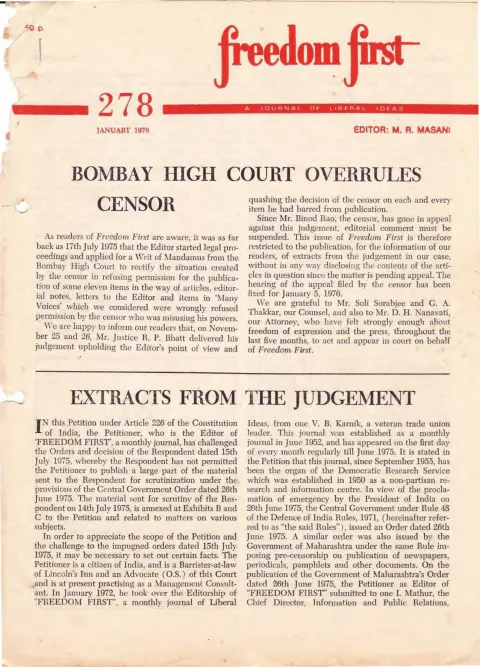
This issue of Freedom First (No. 278, January 1976, edited by M. R. Masani) is devoted almost entirely to reporting a legal victory for the journal against Emergency-era press censorship. The lead piece, “Bombay High Court Overrules Censor,” recounts how the Editor petitioned the Bombay High Court in mid-1975 for a Writ of Mandamus after the government’s censor disallowed eleven items — articles, editorial notes, letters, and “Many Voices” entries — submitted for pre-publication scrutiny under the Central Government’s Rule 48 Order of 26th June 1975. On 25-26 November 1975, Mr. Justice R. P. Bhatt ruled in the Editor’s favour, quashing the censor’s decision on every disallowed item. Because the censor, Mr. Binod Rao, had appealed the ruling (hearing fixed for 5 January 1976), the magazine states it is suspending editorial comment on the substance and instead publishing extracts from the judgment itself, without disclosing the censored material.
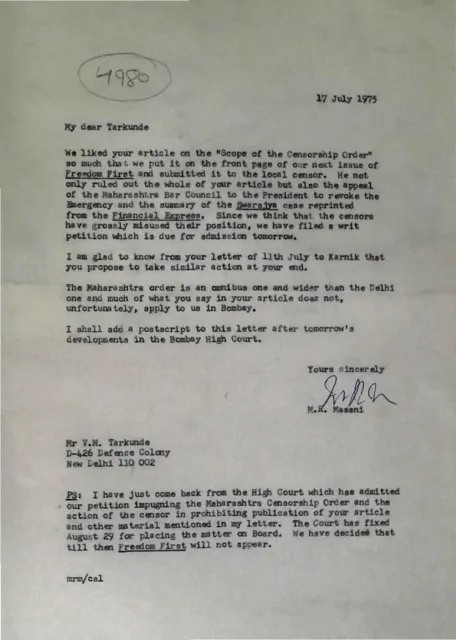
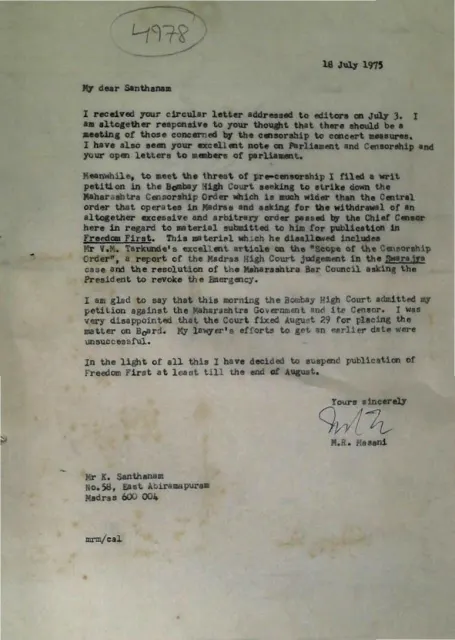
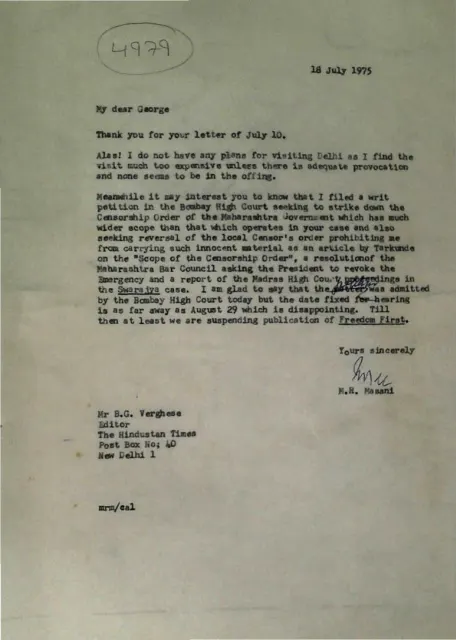
The bulk of the rendered pages (pp. 2-6) reproduce these judgment extracts verbatim. They lay out the procedural history — the Editor’s petition, the government’s 26 June 1975 emergency order under Rule 48 of the Defence of India Rules 1971, the censor Mathur’s scrutiny and deletions, the Editor’s blank-space protest and subsequent withdrawal of an earlier petition, and the list of censored items (including a piece by former Justice V. N. Tarkunde on the “Scope of the pre-censorship Order,” extracts from the Financial Express, and material on the Bar Council of Maharashtra’s resolution against the emergency proclamation). Justice Bhatt then works through the legal reasoning: that pre-censorship power must be read narrowly, confined to the statutory objects of defence, civil defence, public safety, and public order; that a stray sentence cannot be read out of context; and that criticism of an elected government, however unpopular, is constitutionally permitted so long as it does not seek to subvert the rule of law — quoting the Prime Minister’s own Lok Sabha assurance that there was “no doubt about the need for a regulated expression of public discontent.” The judgment finds that the censor and the government’s own supplementary guidelines (dated 5 and 6 August 1975) exceeded the scope of the original Rule 48 order, that the censor took into account “extraneous matters and irrelevant factors,” and that he therefore acted without jurisdiction. The Court allows the petition, quashes the censor’s order of 15th July 1975, and awards costs to the Editor against the Respondent.
The rendered pages end with the judgment’s conclusion and a subscription coupon for Freedom First, alongside period advertisements (Macmillan’s promotion of Masani’s own book “Is J.P. the Answer?”, Andhra Pradesh Paper Mills, Alembic’s Glycodin cough syrup, Lakshmi Mills sarees, Raymond’s Woollens, and ACC Cement) that are not part of the editorial content.
Key points
-
The Editor of Freedom First won a Bombay High Court writ petition (Article 226) against the Emergency-era censor, who had disallowed eleven items from the journal under the Central Government’s 26 June 1975 Rule 48 order.
-
Mr. Justice R. P. Bhatt delivered judgment on 25-26 November 1975, quashing the censor’s decision on every item and awarding costs to the Editor.
-
The censor (Mr. Binod Rao) filed an appeal, with hearing fixed for 5 January 1976; pending that appeal, Freedom First withholds editorial comment and instead prints extracts from the judgment itself without revealing the censored content.
-
The judgment holds that pre-censorship power under Rule 48 of the Defence of India Rules, 1971 must be confined to its stated objects — defence of India, civil defence, public safety, and maintenance of public order — and cannot be used against merely unpopular or distasteful but constructive criticism.
-
The Court quotes the Prime Minister’s own Lok Sabha speech of 22 July 1975 conceding a right to “regulated expression of public discontent” against government policy.
-
The judgment finds that the censor considered extraneous and irrelevant factors and improperly relied on later guidelines (5-6 August 1975) that postdated and exceeded the scope of his 15 July 1975 decision, rendering that decision jurisdictionally invalid.
-
Censored items named in the judgment include a piece by former Justice V. N. Tarkunde on the pre-censorship order’s scope, a Financial Express extract on a Madras High Court writ petition, and coverage of the Bar Council of Maharashtra’s resolution against the Emergency proclamation.
-
The petition was brought by the Editor personally, a Bombay-based Barrister-at-Law of Lincoln’s Inn who took over the editorship of Freedom First in January 1972; the journal itself is described as the organ of the Democratic Research Service since September 1955.
Generated by the v1.5 extraction pipeline. Awaiting editorial review.
Metadata and summary are AI-extracted from the source PDF and reviewed for editorial accuracy. The original work is available via the Read PDF tab above (where present); paragraph-level citation inside the PDF is deferred to a future engagement.