periodical issue
Freedom First
A Journal of Liberal Ideas
By Fredoon P. Antia, Bryan Magee, M.P., a Special Correspondent, Victor Zorza, Peter Hazelhurst, Nitin G. Bafna
Published for the Democratic Research Society by J. B. Patel, Associate Editor, Freedom First, 127, [Mahatma] Gandhi Road, Bombay 1 · Bombay · 1976
16 pages
Freedom First
Summary
Freedom First No. 282 (May 1976), edited by M. R. Masani, is a full issue of the Bombay-based liberal monthly, rendered here in its entirety (16 of 16 pages). The lead piece reprints, in abridged form, an article by Polish commentator Wieslaw Gornicki from the Communist Party journal Kultura, presented by the editors as an unexpected echo of Daniel Moynihan’s critique of Third World solidarity rhetoric at the UN; it interrogates the economic incoherence and moral posturing of the Group of 77’s claim to unified Third World interests. The regular editorial column, “Between You & Me and the Lamp Post,” covers a run of short items: Indian governors’ and the CBI’s push to curb High Court writ jurisdiction under Article 226, a contrasting British push for a Bill of Rights, the fall of Thai PM Kukrit Pramoj to his brother Seni Pramoj, factional strife inside the British Labour Party over Roy Jenkins’s foreign-secretary bid, the Communist campaign to discredit Alexander Dubcek, and Malcolm Muggeridge’s doubts about the coherence of “majority rule.” Dr. Fredoon P. Antia contributes a feature essay, “Dying with Dignity,” arguing for a legal and moral right to die, built around the Karen Ann Quinlan case and a Florida transfusion-refusal case, and proposing that the right to end one’s own life be treated as a fundamental right on par with Article 19. British MP Bryan Magee’s syndicated piece “Why Marxism Is Left Behind” reports two prominent ex-Marxists’ verdicts that Marxism as a body of thought is exhausted, illustrated with Djilas, Soviet dissident alienation, and the argument that Marxist revolutions succeed only when concealed under nationalism. The “World News” section compiles wire-service items: a NATO study warning that a conventional Warsaw Pact surprise attack could overrun Western Europe before nuclear response is authorized; Egypt’s stalled debt-rescheduling talks with the USSR contrasted with debt forgiveness for Somalia and South Yemen; a Victor Zorza piece on the ageing Soviet Politburo gerontocracy; Taiwanese commentary on Egypt’s break with Moscow; British trade-union opposition to state ownership of newspapers; a revisiting of the Hiss-Chambers case following historian Allen Weinstein’s turnabout; a report on the cult of personality around Kim Il Sung in North Korea; and news of Diosdado Macapagal breaking three years of silence against Ferdinand Marcos’s martial law. A book review by Nitin G. Raut covers Golda Meir’s autobiography My Life, tracing her path from Kiev to Milwaukee to Palestine and her tenure as Israeli foreign minister and prime minister. The issue closes with “With Many Voices,” a page of topical quotations from public figures (Idi Amin, Brezhnev, JFK, Kukrit Pramoj, and others) and a subscription form.
Key points
-
An abridged Polish Communist journal article by Wieslaw Gornicki, presented as an unexpected echo of Moynihan’s UN critique, argues the Group of 77’s claimed Third World solidarity is economically incoherent given the vast income gap between Kuwait’s $11,000 and Haiti’s under $100 per head.
-
The “Between You & Me and the Lamp Post” column criticises Indian state governors and the CBI for pushing to curb High Court writ jurisdiction under Article 226, contrasting this with a simultaneous British debate over adopting a Bill of Rights, and reports Thai PM Kukrit Pramoj’s election defeat by his own brother Seni Pramoj.
-
Dr. Fredoon P. Antia’s “Dying with Dignity” argues for a legal right to die, built around the Karen Ann Quinlan case and a Florida transfusion-refusal ruling, proposing India recognise the right to end one’s own life as a Fundamental Right akin to Article 19.
-
British MP Bryan Magee’s “Why Marxism Is Left Behind” reports two prominent ex-Marxists independently telling him Marxism is intellectually exhausted, arguing communist-led national liberation movements succeeded only by concealing themselves under nationalism.
-
A “World News” digest covers a NATO study warning a Warsaw Pact conventional attack could overrun Western Europe before nuclear response is authorised, Victor Zorza’s analysis of the ageing Soviet Politburo, and historian Allen Weinstein’s reversal concluding Alger Hiss lied for nearly thirty years.
-
Nitin G. Raut reviews Golda Meir’s autobiography My Life, recounting her clandestine wartime visit to Amman disguised as an Arab woman and Ben Gurion’s description of her as “the only man” in his cabinet.
-
The closing “With Many Voices” page quotes John F. Kennedy arguing Communism has succeeded only as “a scavenger of disruption” caused by war or repression, never as a leader in its own right.
Essays
s editors as a striking echo — from behind the Iron Curtain — of Daniel Moynihan
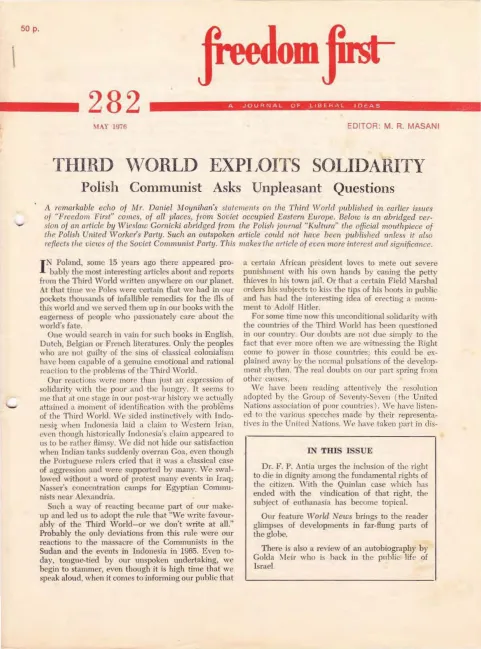
An abridged reprint of an article by Polish journalist Wieslaw Gornicki, originally published in the Polish Communist Party journal Kultura, presented by Freedom First’s editors as a striking echo — from behind the Iron Curtain — of Daniel Moynihan’s earlier critiques of Third World rhetoric in the magazine. Gornicki recalls Poland’s postwar identification with anti-colonial causes (Indonesia over Western Irian, India’s annexation of Goa, Iraq, Nasser’s camps for Egyptian Communists) under an unspoken rule of never criticizing the Third World, and argues this reflexive solidarity is now breaking down. He interrogates the economic incoherence of the Group of 77: enormous income disparities between members (Kuwait at $11,000 per head versus Haiti and Ethiopia near $100), the arbitrary and moralized use of the term “industrialised countries,” and proposals like a universal tax on national income that would in practice make the world’s poor subsidize its oil-rich elites while its actual poor (Java, Brazilian shantytowns) go unhelped.
- Poland’s postwar left-wing writers had an unspoken rule: write favourably of the Third World or not at all, with the massacre of Sudanese Communists and events in Indonesia in 1965 as rare deviations.
- The Group of 77 is economically incoherent, with member incomes ranging from Kuwait’s $11,000 to Haiti’s and Ethiopia’s under $100 per head.
- The article questions why redistribution proposals aimed at ‘industrialised countries’ should not begin within the Group of 77 itself, given internal disparities.
- Treating all industrialised countries as an undifferentiated bloc, e.g. via a flat tax on national income, produces morally perverse outcomes that would burden ordinary citizens of Warsaw-Pact and Western states alike while doing nothing for the truly poor.
- The piece frames its critique as reflecting genuine Polish self-doubt about decades of uncritical Third World solidarity, made more credible by having passed Communist censorship.
Essay 2
The regular unsigned editorial column surveys several current-affairs items. It criticizes moves by Indian state governors and the Central Bureau of Intelligence to curb or abrogate Article 226 writ jurisdiction of the High Courts, reading this as evidence the governors serve as mouthpieces of the Union government, and contrasts this with a contemporaneous British debate over adopting a Bill of Rights (with Lord Hailsham, the Liberal Party, and Lord Feather’s Commission on Human Rights all engaged). It reports Thai PM Kukrit Pramoj’s electoral defeat by his own brother Seni Pramoj, praising both as long-standing liberal intellectuals, and comments on turmoil inside the British Labour Party over the vetoing of Roy Jenkins’s prospective appointment as Foreign Secretary. It notes the intensifying Communist campaign to discredit Alexander Dubcek by alleging CIA links, framing this as a reductio ad absurdum of Communist paranoia, and closes by relaying Malcolm Muggeridge’s public letter to the Times airing his doubts about what ‘majority rule’ coherently means across different political contexts (Northern Ireland, Uganda, Haiti, South Vietnam).
- Indian state governors and the CBI are reported to favour curbing Article 226, which lets High Courts hear writ petitions against executive and legislative action.
- Britain is simultaneously debating adoption of a Bill of Rights, with proposals floated across the Conservative, Labour and Liberal parties.
- Thailand’s PM Kukrit Pramoj lost a general election to his own brother Seni Pramoj; both are described as committed liberals who upheld free-society values under authoritarian pressure.
- The column reports internal Labour Party strife after the ‘Tribunite’ left successfully vetoed Roy Jenkins’s move to Foreign Secretary.
- Communist propaganda against Alexander Dubcek now alleges he maintained CIA links, which the column treats as absurd given his standing as a genuine, if heterodox, communist.
- Malcolm Muggeridge’s letter to the Times is cited questioning what ‘majority rule’ means in Northern Ireland, Uganda, Libya, Malawi, Haiti, South Vietnam, Laos and Cambodia.
Dying with Dignity
By Fredoon P. Antia
Dr. Fredoon P. Antia’s feature essay ‘Dying with Dignity’ argues for legal recognition of a right to die. It opens with the burden of prolonging life in incurable, chronic cases, citing a Florida court case in which a judge ruled a 72-year-old patient could refuse further blood-transfusion treatment causing her pain, on the ground that ‘a person has a right to live or die in dignity.’ The essay then turns to the recent Karen Ann Quinlan case in New Jersey, in which the parents of a 21-year-old in an irreversible coma sought a court order to switch off her respirator; the essay was written before, and a ‘Stop Press’ box appended to the piece notes, the New Jersey Supreme Court’s subsequent reversal in the parents’ favour. Antia surveys nurses’ opinions (a ‘Nursing 75’ survey found 96% in favour of withdrawing life support on patient request), the Euthanasia Educational Fund’s ‘Living Will’ concept, the 250 intellectuals (including Andrei Sakharov and Julian Huxley) who signed a statement asserting individuals’ rights over their own bodily destiny including euthanasia and suicide, and closes by arguing India in particular should legally recognize a right to die as a Fundamental Right akin to Article 19, and that failed-suicide prosecution should be abolished.
- A Florida court ruling upheld a 72-year-old patient’s right to refuse painful blood transfusions, establishing ‘a person has a right to live or die in dignity.’
- The Karen Ann Quinlan case is presented in detail: her parents sought to have her respirator switched off after five months in an irreversible coma; the original judge refused, but a Stop Press addendum reports the New Jersey Supreme Court later reversed this and granted the parents the right to decide on her behalf.
- A ‘Nursing 75’ survey of 15,000 US nurses found 96% in favour of withdrawing life-sustaining treatment from patients who requested it.
- Organisations such as the Euthanasia Educational Fund and the Euthanasia Society of America promote the ‘Living Will,’ by which a person pre-specifies a wish not to be kept alive by artificial or heroic means.
- 250 intellectuals including Andrei Sakharov and Julian Huxley signed a statement asserting the individual’s absolute right to control their own bodily destiny, including euthanasia and suicide.
- Antia argues that in India, given widespread poverty and suffering, the right to end one’s own life should be recognized as a Fundamental Right on par with Article 19, and that attempted suicide should not be a penal offence.
Why Marxism Is Left Behind
By Bryan Magee, M.P.
A short syndicated piece by British MP Bryan Magee, courtesy of the Times, reporting that two prominent men who came to world fame as Marxists or communists separately told him ‘Marxism is dead,’ meaning its intellectual contribution is exhausted and it no longer produces significant thinkers, artists, or scientific progress. Magee largely credits the claim, drawing on Djilas’s ‘The New Class’ and the near-total alienation of the Soviet intelligentsia from Marxist ideology, and notes both informants argued that Marxist-led revolutions (Mao, Tito, Ho Chi Minh, Castro) succeeded only when the cause was nationalism rather than communism itself, since rank-and-file support for communism as such was consistently weak.
- Two men who achieved world fame as Marxists or communists independently told Magee ‘Marxism is dead,’ meaning it is intellectually exhausted even if it retains institutional power.
- Magee cites Djilas’s ‘The New Class,’ published nearly twenty years earlier, as having already acknowledged Marxism’s limitations from within the communist world.
- Soviet intelligentsia alienation from the regime’s ideology is described as ‘virtually complete.’
- Both informants argued that communist-led national liberation movements (Mao, Tito, Ho Chi Minh, Castro) succeeded by concealing themselves under nationalism, since mass enthusiasm for communism itself was consistently weak.
World News
The ‘World News’ section compiles several wire-service and syndicated items. ‘NATO Study on Surprise Attack’ reports Washington concern over a NATO report concluding the Warsaw Pact could successfully attack Western Europe using conventional forces alone, exploiting speed to preempt NATO’s tactical nuclear response, and citing 16,000 active Soviet agents in West Germany. ‘How Soviets Use Foreign Debts’ details stalled Egypt-USSR debt rescheduling talks alongside the USSR’s cancellation of Somalia’s and South Yemen’s debts. Victor Zorza’s ‘Kremlin’s Ageing Wheeler-Dealers’ (from the Guardian) analyzes the rising average age of the Soviet Politburo (now 70, versus 49 in 1952) as a sign of institutional sclerosis. ‘Taiwan on Cairo’ and a Chung Yang Jih Pao item cover Taipei and Chinese press reactions to Egypt’s break with Moscow. A TUC item reports British trade unions oppose state ownership of newspapers. ”Hiss Has Been Lying” (Time) reports historian Allen Weinstein’s reversal on the Alger Hiss-Whittaker Chambers case after reviewing 15,376 pages of FBI files, concluding Hiss lied for nearly thirty years. ‘Kim Thoughts Increase Fish Catch’ (Peter Hazelhurst, Tokyo) describes the personality cult of Kim Il Sung and the doctrine of ‘Kimilsungism’ in North Korea. ‘Macapagal Breaks 3-Year Silence’ reports former Philippine president Diosdado Macapagal’s clandestine paperback book demanding Ferdinand Marcos convene the Interim National Assembly and end martial law, plus a boxed ‘Socialist Record in U.K.’ table contrasting Conservative and Labour economic performance 1951-1976 from the Economist.
- A NATO study warns that chronic Western conventional-force weakness combined with Soviet military build-up could tempt a Warsaw Pact surprise attack succeeding before nuclear response could be authorized.
- 16,000 Soviet agents are reported active in West Germany, some trained to seize radio, television, and early-warning infrastructure in a surprise attack scenario.
- Egypt’s debt-rescheduling talks with the USSR stalled over grace periods and interest terms, while Soviet debts owed by Somalia and South Yemen were separately cancelled.
- Victor Zorza’s analysis shows the average age of Politburo members has risen from 49 (1952) to 70, which he interprets as either forcing rejuvenation or risking a sudden Kremlin collapse.
- Historian Allen Weinstein, after reviewing over 15,000 pages of FBI files, reversed his prior belief in Alger Hiss’s innocence and concluded Hiss had been lying for nearly 30 years about his relationship with Whittaker Chambers.
- North Korea’s state press promotes ‘Kimilsungism’ as a doctrine superseding Communism, crediting Kim Il Sung’s ‘thoughts’ even for increased fish catches and industrial output.
- Diosdado Macapagal broke three years of silence with a clandestinely distributed book demanding Ferdinand Marcos convene the National Assembly and end martial law in the Philippines.
- A boxed Economist table contrasts UK economic performance under 13 Tory years (1951-1964) and 13 years including Wilson’s government (1963-76), showing much higher retail-price inflation and unemployment growth under the latter period.
Review: The “Only Man” (My Life by Golda Meir)
By Nitin G. Bafna
A book review, signed Nitin G. Raut, of Golda Meir’s autobiography ‘My Life’ (Cox & Wyman, 388 pages). The review traces Meir’s life from a childhood in Kiev marked by pogroms, through emigration to Milwaukee, her political awakening and marriage, her 1920s migration to Palestine and life on Kibbutz Merhavia, her rise through Israeli politics (Foreign Minister, then Prime Minister after Levi Eshkol’s death in 1969), and her navigation between the hawkish and dovish factions of her own party. The review highlights episodes including her clandestine wartime visit to Amman disguised as an Arab woman, her relations with African states and the rupture that followed the Yom Kippur War, anecdotes about Nasser and the PLO, and closes praising the book’s simple prose and its resonance with the historic Jewish struggle, while noting its commercial success and Golda’s own modest living circumstances despite royalties to come.
- Golda Meir’s autobiography traces her path from a Kiev childhood marked by pogroms, to Milwaukee, to emigration to Palestine in 1920 and life on Kibbutz Merhavia.
- Ben Gurion called her the ‘only man’ in his cabinet during the 1973 crisis, a description the reviewer treats as high praise of her leadership under pressure.
- The book recounts a clandestine wartime visit to Amman, disguised as an Arab woman, intended to dissuade King Abdullah of Transjordan from joining a combined Arab attack on Israel.
- Golda was elected Prime Minister in 1969 after Levi Eshkol’s death, serving as a ‘balancing wheel’ between the dovish Allon and hawkish Dayan factions within her party.
- The review notes Israel’s rupture in diplomatic relations with African states after the Yom Kippur War, which the book treats as a bitter setback given Israel’s earlier aid relationships in Africa.
- The reviewer praises the book’s simple, unadorned English prose, comparing its core message to the Jewish plea ‘Let my people live.‘
With Many Voices
The closing page, ‘With Many Voices,’ is a compilation of topical quotations from public figures, framed by an epigraph from Tennyson, followed by the subscription form and publication imprint (Registered No. MH By South/264, published for the Democratic Research Society by J. R. Patel).
- The page compiles short quotations on current affairs from figures including Abraham Lincoln, Idi Amin, Sharaf R. Rashidov, John F. Kennedy, James Callaghan, Kukrit Pramoj, Senator Jackson, President Park, Yun Po Sun, and others, sourced from The Economist, Time, The Times, and other publications.
- One quotation from The Economist calls Portugal’s swing to democracy proof there is nothing like a bungled revolution to give a country a taste for liberty.
- President John F. Kennedy is quoted arguing Communism has succeeded only as a scavenger of disruption caused by war or internal repression, never as a leader in its own right.
- The page closes with the subscription form for Freedom First, priced at Rs. 5.00 annually (Rs. 3.00 for students).
Generated by the v1.5 extraction pipeline. Awaiting editorial review.
Essay 6
No summary was extracted for this article. Listed for completeness.
Essay 7
No summary was extracted for this article. Listed for completeness.
Metadata and summary are AI-extracted from the source PDF and reviewed for editorial accuracy. The original work is available via the Read PDF tab above (where present); paragraph-level citation inside the PDF is deferred to a future engagement.