periodical issue
Freedom First
A Journal of Liberal Ideas
By M. R. Masani, Andrei Amalrik, Sir Keith Joseph, M. P., Collin Welch, A. G. Noorani
Published for the Democratic Research Service by J. R. Patel, Associate Editor, Freedom First at 127, M. Gandhi Road, Bombay 400 023 ('Phone: 273914) and printed by him at H. R. Mohan & Co., 9-B Cawasji Patel St., Bombay 400 001. · Bombay · 1976
16 pages
Freedom First
Summary
Freedom First No. 286 (September 1976), edited by M. R. Masani, opens with Masani’s own editorial “On Discipline,” tying the slogan of “discipline” then current in Indian public life to Walter Lippmann’s warning about the choice between incompetent representative government and authoritarian rule without representation, and to Masani’s own long-standing complaints about civic indiscipline in India. The “Between You and Me and the Lamp Post” column that follows continues Masani’s editorial voice on Bombay municipal failings and the first anniversary of the Helsinki Final Act, leading into two reprinted foreign pieces: Andrei Amalrik’s account (from The Observer) of his own forced emigration and a bleak assessment of Soviet compliance with the Helsinki human-rights provisions, and, from British Conservative politician Sir Keith Joseph, a defence of the free market as resting on a view of human beings as rational, choice-making agents rather than “machines.” A reprinted Daily Telegraph piece by Collin Welch praises the Entebbe raid and criticises Western governments’ timidity toward terrorism, followed by a “World News” digest of short wire items (Chinese Communist Party privilege, Soviet dissidents, Pakistani lawyers against the Defence of Pakistan Act, South African press censorship, and Egyptian torture revelations from the Nasser era). The issue closes with A. G. Noorani’s review of Rajeshwar Dayal’s Congo memoir Mission for Hammarskjold, and a closing page of miscellaneous quotations (“With Many Voices”) plus the subscription form and imprint.
Key points
-
M. R. Masani’s “On Discipline” argues Indian public life suffers chronic civic indiscipline, invoking Walter Lippmann’s warning that a public faced with an incompetent representative assembly will choose authoritarian government over freedom instead.
-
The “Between You and Me and the Lamp Post” column marks the first anniversary of the Helsinki Final Act, names Soviet dissidents monitoring Soviet compliance, and condemns the politicisation of the 1976 Montreal Olympics over Taiwan and South Africa-linked boycotts.
-
Andrei Amalrik, writing after his forced emigration, challenges Western complacency about Helsinki’s effects, describing a KGB shift toward pressuring dissidents into emigration and deniable tactics like staged accidents rather than mass legal arrests.
-
Sir Keith Joseph argues defenders of the free market have obscured its true moral basis — the view of humans as rational, choice-making agents — while socialism denies individuality by treating people as interchangeable productive factors.
-
Collin Welch praises Israel’s Entebbe rescue as a rare complete victory over terrorism, criticising Britain’s tepid response despite possessing comparable military capability, and attributing Western timidity to an excess of competing considerations rather than lack of means.
-
A “World News” digest reports Chinese officials including Teng Hsiao-ping accused of “capitalist roader” privilege, fourteen Soviet political prisoners sending Bicentennial greetings to America, and former Egyptian secret-police chief Saleh Naser’s ten-year sentence for torturing journalist Moustapha Amin.
-
A. G. Noorani reviews Rajeshwar Dayal’s Congo memoir Mission for Hammarskjold, highlighting Dayal’s paired profiles of Lumumba and Hammarskjold and his balanced verdict that UN failures in the Congo were real but should not obscure its achievements.
Essays
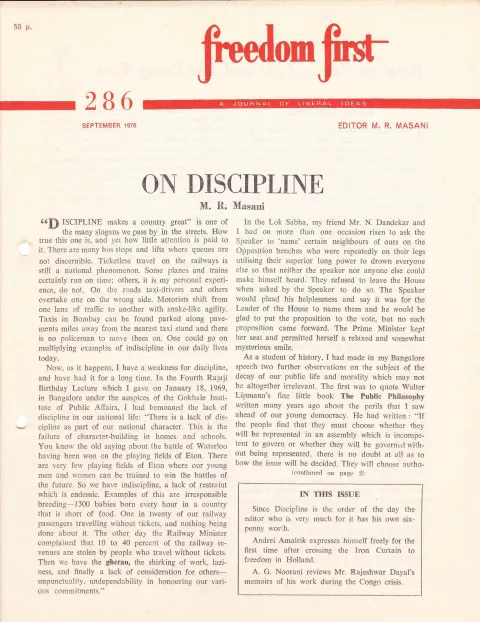
On Discipline
By M. R. Masani
M. R. Masani’s editorial argues that Indian public life suffers from a chronic lack of discipline — visible in ticketless rail travel, reckless driving, unruly queues, and the gherao — and traces this back to failures of character-building in homes and schools. He recalls his 1969 Rajaji Memorial Lecture on the same theme and an anecdote from the Lok Sabha where the Speaker proved powerless to control unruly opposition members while the Prime Minister looked on with a “mysterious smile.” He then invokes Walter Lippmann’s The Public Philosophy to frame the deeper danger: a public that concludes it must choose between an incompetent representative assembly and government without representation will, Lippmann warned, choose authority over freedom. Masani recalls making this same argument at Ahmedabad’s Harold Laski Institute in 1962, forecasting that politicians’ continued misbehaviour would drive people to abandon faith in representative government — a forecast he says history has since confirmed.
- Masani opens by cataloguing everyday examples of Indian civic indiscipline: ticketless rail travel, traffic violations, unruly queues, and the gherao.
- He cites his own 1969 Fourth Rajaji Birthday Lecture bemoaning the lack of discipline as part of India’s national character.
- He recounts a Lok Sabha episode in which opposition MPs shouted down proceedings while the Speaker pleaded helplessness and the Prime Minister smiled.
- He quotes Walter Lippmann’s The Public Philosophy on the risk that a people faced with an incompetent assembly will choose authoritarian government instead.
- He recalls forecasting in a 1962 Ahmedabad speech that continued political misbehaviour would drive the public toward disbelief and cynicism, and asserts this forecast has already been borne out.
- The essay continues on page 2 under ‘Between You and Me and the Lamp Post,’ concluding the Lippmann argument and Masani’s own 1962 warning about deep-rooted defects requiring deeper remedies than new laws.
Between You and Me and The Lamp Post
The editorial column “Between You and Me and the Lamp Post” (unsigned, in Masani’s editorial voice) covers three items in the rendered pages: a complaint, drawing on Times of India correspondence, about the squalid condition of Bombay’s electric crematorium and the Municipal Commissioner’s promise to build new crematoria in Bandra, Khar and Santacruz; a note marking the first anniversary of the Helsinki Final Act and naming Soviet dissidents (General Pyotr Grigorenko, Dr Malva Landa, Dr Vitaly Rubin, Dr Yuri Orlov) monitoring Soviet compliance; and a piece welcoming Andrei Amalrik’s arrival in Holland after years of persecution in the USSR, alongside a sharp commentary on the politicisation of the 1976 Montreal Olympics, criticising the boycotts of the Taiwanese and South African-linked teams and quoting a satirical Times of London letter on the absurdity of boycott chains.
- Bombay’s electric crematorium is criticised for its squalid, dirty conditions; the Municipal Commissioner has promised new crematoria for Bandra, Khar and Santacruz, and fees have been cut from Rs. 100 to Rs. 50.
- The column marks the first anniversary (1 August 1976) of the Helsinki Final Act and names Soviet dissidents monitoring the USSR’s compliance with its human-rights commitments.
- Andrei Amalrik’s arrival in Holland on 15 July after years of KGB harassment and Siberian exile is described as a victory comparable to Solzhenitsyn’s.
- The column condemns the politicisation of the 1976 Montreal Olympics — the Canadian government’s exclusion of Taiwan, boycotts linked to South Africa, and the case of Guyanese sprinter James Gilks — quoting a Times of London letter satirising the boycott chain.
A Dissident’s Challenge to the West
By Andrei Amalrik
Andrei Amalrik, writing shortly after his forced emigration from the USSR, challenges Western complacency about the Helsinki Agreement’s effects. He argues that neither the promise on West Berlin nor the supposed easing of East-West contact has produced real improvement inside the Soviet Union: dissidents are still persecuted (though increasingly through subtler means such as forced emigration, murder disguised as accident, and continued though decreasing use of psychiatric incarceration), Western radio broadcasts remain jammed, samizdat dissemination is still criminalised, and ordinary citizens’ access to non-Soviet information has, if anything, worsened. He also describes the difficulty Western journalists face working in Moscow. He closes with recommendations: Western governments should press for an end to jamming, defend citizens’ rights to bring in foreign books, ensure diplomats maintain contact with independent as well as official Soviet figures, and support foreign correspondents in resisting Soviet pressure.
- Amalrik rejects Western officials’ claims that the Helsinki Agreement has meaningfully improved Soviet human-rights practice, citing his own forced emigration as evidence of continuing repression.
- He notes a shift in KGB tactics: rather than long prison terms, dissidents like himself are pressured into emigration, while others (Sergei Kovalev, Vladimir Bukovsky) remain imprisoned or in psychiatric detention.
- He describes escalating deniable tactics — murder, assault, poisoning, arson, staged accidents — used against dissidents to avoid the appearance of mass ‘legal’ arrests.
- Jamming of Radio Liberty, the BBC, Voice of America and Deutsche Welle continues unabated, and dissemination of samizdat remains a criminal offence.
- He proposes practical steps: Western pressure to end jamming, defence of citizens’ rights to import foreign books, sustained diplomatic contact with independent Soviet figures such as Andrei Sakharov and Yuri Orlov, and stronger solidarity among Western correspondents in Moscow.
The Right to Choose
By Sir Keith Joseph, M. P.
Sir Keith Joseph, the British Conservative MP, argues that defenders of the free market have obscured its true moral basis by talking in technocratic language of ‘the market mechanism’ rather than affirming its foundation: the view of human beings as rational, choice-making agents rather than mere instruments of social engineering. He contends that socialism’s essential inhumanity lies in reducing people to ‘productive factors’ and erasing individuality in the name of equality, whereas defenders of the market value human dignity and the capacity to choose — including the capacity to choose against material self-interest. Joseph insists this is not a case for anarchic laissez-faire but for a specific, limited conception of government as a maker of rules for free individuals rather than a director of their lives, contrasting the efficiency of a free economy (serving individual choices) with the coercive ‘permanent war economy’ logic of socialism.
- Joseph argues defenders of the market have wrongly relied on technical language (‘market mechanism’, ‘price mechanism’) rather than stating its core moral premise.
- The core premise: humans are rational, choice-making ends in themselves, not machines or instruments of social engineering.
- He accuses socialism of denying human individuality by treating people as interchangeable productive factors and pursuing ‘equality’ as sameness.
- He distinguishes his position from laissez-faire anarchism: government should make rules for free individuals, not direct their lives.
- He contrasts market efficiency (satisfying individual choice) with socialist efficiency modelled on wartime command economies, calling a socialist economy ‘a permanent war economy.‘
Israel Reverses the Tide
By Collin Welch
Collin Welch, writing in the Daily Telegraph, praises Israel’s Entebbe rescue operation as a triumph over terror achieved at minimal cost, and rebukes Western governments — particularly Britain’s — for lacking the will to respond similarly to terrorism despite having comparable military means (Hercules and Belfast transports, the S.A.S.). He argues Western nations, unlike Israel, are paralysed by an excess of competing considerations (oil, Nigeria, the balance of payments, Ulster) rather than by any true difficulty of the threat, and warns that the West’s dangers, while less immediate than Israel’s, are comparably serious and interconnected — a lesson he says the Israelis understand better than Western governments do.
- Welch celebrates the Entebbe raid as a rare, complete victory against terrorism, rescuing hostages at minimal cost and destroying much of the hijackers’ air support.
- He criticises Britain’s tepid response to terrorism despite possessing comparable military capability (Hercules and Belfast transports, the S.A.S.).
- He argues Western governments are paralysed not by lack of means but by an excess of competing considerations — oil, Nigeria, balance of payments, Ulster — that prevent decisive action.
- He contends Israel’s example shows that acute, clearly perceived danger concentrates resolve, while Western dangers, though comparably serious, are less obvious and immediate and therefore less well managed.
World News (news digest: Some Chinese More Equal Than Others; Russian Dissidents Salute U.S.; Pakistani Lawyers on Defence of Pak Act; S. Africa Censor Changes His Mind; Life in Egypt Under Nasser)
The “World News” digest reprints short wire items from international papers. A Times item (30 June) reports that unnamed senior Chinese Communist Party officials have been accused, in the Peking newspaper Kuang Ming Daily, of enjoying high salaries, cars, servants and superior housing as ‘capitalist roaders,’ with Teng Hsiao-ping named as a target of the accusation. Reprinted stories from the International Herald Tribune and other papers cover: fourteen Soviet political prisoners sending Bicentennial greetings to the American people; Pakistani lawyers demanding an end to the Defence of Pakistan Act’s emergency provisions, particularly restrictions on High Court bail powers, in the context of the Wali Khan tribunal; South Africa’s lifting, after a seven-year ban, of its prohibition on importing The Sunday People, amid a broader account of the arbitrary and extensive South African censorship regime (Jacobsen’s Index fo Objectionable Literature); and an extended piece on life under Nasser-era Egypt, centred on the conviction of former secret-police chief Saleh Naser for torture and on journalist Moustapha Amin’s account of his own imprisonment and torture, along with Amin’s reflections on Nasser’s mixed legacy.
- Chinese officials, including Teng Hsiao-ping, are accused in Kuang Ming Daily of enjoying high salaries, cars, servants and superior housing as ‘capitalist roaders’ despite official socialist principles.
- Fourteen Soviet political prisoners in labour camps sent a statement congratulating the American people on the Bicentennial.
- Pakistani lawyers passed a resolution demanding repeal of the Defence of Pakistan Act’s emergency provisions, citing curtailment of High Court and Supreme Court bail powers in the Wali Khan tribunal case.
- South Africa lifted a seven-year ban on The Sunday People while maintaining an extensive censorship regime documented in Jacobsen’s Index fo Objectionable Literature, banning works ranging from Private Eye to novels by Vladimir Nabokov.
- Saleh Naser, former head of Egypt’s ‘Al Mokhabarat’ secret service under Nasser, was sentenced to 10 years with hard labour for torturing journalist Moustapha Amin, who described being whipped and mutilated in detention and later published a memoir, My First Year in Prison.
UNESCO’s Assault on News
A. G. Noorani reviews Rajeshwar Dayal’s Congo memoir Mission for Hammarskjold (Oxford University Press), praising it as a diligently researched, restrained account that will rank among essential sources on the Congo crisis. Dayal served as the U.N. Secretary-General’s Special Representative and Head of UNOC from September 1960 to May 1961, a period of chaos following Belgium’s abrupt, unprepared withdrawal, mutiny within days of independence, and Katanga’s secession under Tshombe. Noorani highlights Dayal’s balanced profiles of Patrice Lumumba and Dag Hammarskjold, quoting Dayal’s judgment that Lumumba’s suspicious nature and hostility to the U.N. contributed to his own downward spiral, while crediting Hammarskjold’s death as a personal catastrophe whose ‘gifts were eroded by fatal defects of character and temperament.’ The review closes by endorsing Dayal’s own summation, borrowing Hammarskjold’s aphorism about a single speck of dirt on a clean tablecloth, that the U.N.’s Congo achievements were real but were overshadowed by mistakes for which the Secretary-General bore ultimate responsibility.
- Noorani praises Dayal’s memoir for its diligence, restraint, and reliance on hitherto-unpublished correspondence with the U.N. Secretary-General, contrasting it favourably with the more flamboyant memoirs of K. P. S. Menon and Conor Cruise O’Brien.
- The review summarises the Congo’s chaotic post-independence collapse: Belgium’s abrupt withdrawal, army mutiny within four days, Belgian military intervention, and Katanga’s secession under Tshombe.
- Dayal’s account attributes much post-independence corruption to unprepared Congolese politicians who took over colonial privileges (mansions, chauffeured limousines, inflated salaries) with little capacity to govern.
- The review highlights Dayal’s paired profiles of Lumumba and Hammarskjold, quoting Dayal on the fatal, mutually destructive rift between Lumumba’s suspicion of the U.N. and Hammarskjold’s insistence on procedural limits.
- Noorani endorses Dayal’s balanced verdict that U.N. failures in the Congo were real but should not obscure its achievements, closing with Hammarskjold’s own aphorism about a speck of dirt on a clean tablecloth.
Congo Revisited (Review of ‘Mission for Hammarskjold’ by Rajeshwar Dayal)
By A. G. Noorani
The closing page, “With Many Voices,” is a compilation of short quotations drawn from various publications (Economic & Political Weekly, Time, The Statesman, The Guardian, National Review, and others), touching on Soviet-Indian relations, Chinese politics, censorship, Western politicians, and Third World rhetoric toward the West, framed by an epigraph from Tennyson. The page also carries the Freedom First subscription form and the issue’s imprint, noting publication by the Democratic Research Service and printing by H. R. Mohan & Co.
- The page collects wry, aphoristic quotations from contemporary publications on topics including Soviet-Indian relations, Chinese politics, censorship, and Western leaders.
- Includes a quotation from Henry Kissinger (‘A government that tramples on the rights of its citizens denies the purpose of its existence’) and one attributed to Daniel Patrick Moynihan on Third World rhetoric toward the West.
- Carries the Freedom First subscription form addressed to the Democratic Research Service, 127 Mahatma Gandhi Road, Bombay.
- The imprint records publication for the Democratic Research Service by J. R. Patel, Associate Editor, and printing by H. R. Mohan & Co., Bombay.
Generated by the v1.5 extraction pipeline. Awaiting editorial review.
Metadata and summary are AI-extracted from the source PDF and reviewed for editorial accuracy. The original work is available via the Read PDF tab above (where present); paragraph-level citation inside the PDF is deferred to a future engagement.