periodical issue
Freedom First
A Journal of Liberal Ideas
Edited by S. V. Raju
Published for the Democratic Research Service by J. R. Patel, Associate Editor, Freedom First at 127, M. Gandhi Rd., Bombay 400 023 (Phone: 273914) and printed by him at States' People Press, Ghoga Street, Fort, Bombay-400 001. · Bombay · 1978
17 pages
Freedom First
Summary
Freedom First No. 307 (June 1978) is a monthly issue of the Bombay-based journal of liberal ideas, edited by S. V. Raju and Geeta Doctor. The issue opens with M. R. (Mehra) Masani’s critique of the Verghese Working Group’s proposal for a monolithic National Broadcast Trust (NBT), arguing that a single autonomous corporation would simply replace government monopoly with a different kind of monopoly and that competition, not mere autonomy, is what safeguards broadcasting freedom. K. S. Venkateswaran defends the constitutional right to property against calls for its deletion from the Fundamental Rights chapter, tracing the amendments (31A, 31B, 31C) that have eroded it since 1951. Geeta Doctor contributes a first-person account of being caught in a Dawoodi Bohra community protest march in Bombay. Bernard Levin’s syndicated piece on the Taj Mahal is reprinted. M. R. Masani (writing separately as Minoo Masani in the table of contents) argues in “Back to 1967?” that India’s post-Emergency political drift echoes the instability after 1967. The issue’s regular “Frankly Speaking” editorial column (signed SVR and GD) comments on the Azamgarh by-election, prohibition policy, press freedom, advertising, and the Afghan coup. Book reviews cover Jiri Pelikan’s account of socialist dissent in Czechoslovakia and Paul Erdman’s financial thriller The Crash of ‘79. A World News page covers Sino-Soviet relations, the World Food Programme, and Mexican land reform, plus a UK item on political education grants for youth clubs. A page of facts about the Verghese Working Group on broadcasting autonomy supplements the Masani piece. The issue closes with “With Many Voices,” a page of quotations from the world press, a subscription form, and the printer’s colophon.
Key points
-
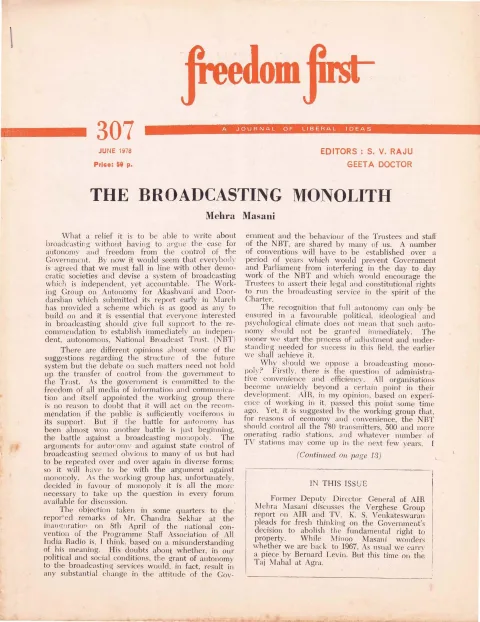
Mehra Masani’s “The Broadcasting Monolith” welcomes the Verghese Working Group’s proposal for an independent National Broadcast Trust but warns that concentrating all of AIR’s transmitters and future TV stations into one monopoly body would remain unaccountable, calling instead for competition between multiple broadcasting units.
-
K. S. Venkateswaran defends the constitutional right to property against calls for its deletion, tracing its erosion through Articles 31A, 31B, and 31C, and citing Nani Palkhivala’s warning against a “perpetual and deliberate distortion” of the Fundamental Rights chapter.
-
Geeta Doctor recounts a first-person, wry account of being swept up in a Dawoodi Bohra community protest march in Bombay against the Nathwani Commission.
-
Bernard Levin’s syndicated column on the Taj Mahal describes its perfect symmetry, its illusion of floating weightlessness, and an optical device in its Koranic inscriptions, comparing the emotional effect to Beethoven’s Ninth Symphony.
-
M. R. Masani’s “Back to 1967?” argues India’s post-Emergency drift mirrors the disillusionment following the 1967 elections, warning the pendulum could swing back toward authoritarianism as it did in 1975, and lamenting that Jayaprakash Narayan’s ill health prevents him from leading people “from Rajniti to Lokniti”.
-
S. P. Aiyar reviews Jiri Pelikan’s Socialist Opposition in Eastern Europe on Czechoslovak dissent after the 1968 Soviet invasion, drawing explicit parallels to India’s own Emergency-era repression and underground press.
-
K. V. Padmanabhan reviews Paul Erdman’s financial thriller The Crash of ‘79, praising its factual grounding in oil geopolitics and its unusual use of real public figures as characters.
Essays
The Broadcasting Monolith
By Mehra Masani
Mehra Masani, former Deputy Director General of All India Radio, welcomes the general consensus that broadcasting should be freed from direct government control, and praises the Working Group on Autonomy for Akashvani and Doordarshan (the Verghese Group) for its recommendation to create an independent National Broadcast Trust (NBT). But he argues a second, harder battle remains: opposing the concentration of all broadcasting — AIR’s 780 transmitters and 500-plus radio stations, plus future TV stations — into a single monolithic Trust. He contends monopoly breeds inefficiency and unaccountability regardless of who controls it, defends the case against monopoly on grounds of administrative convenience, and (in the continuation on pages 13-14) elaborates that competition between autonomous public bodies, or between public and private/commercial stations as in Australia, Japan, Canada, Britain, and New Zealand, is essential; that local community stations under the NBT would have no independent editorial personality; and that concentrating power over information in one body’s hands is inherently dangerous to a free society, more so than press monopoly because broadcasting reaches the largely uneducated majority. He proposes splitting funding and structure by audience: commercially-financed services for educated urban listeners versus licence-fee and government-financed services for the rural, less-educated majority, with multiple competing units and more than one Board of Trustees.
- Argues the Verghese Working Group’s autonomy proposal (an independent National Broadcast Trust, NBT) is sound but that a second battle — against broadcasting monopoly — remains largely unfought.
- Warns that a single monolithic NBT controlling all transmitters, radio stations, and future TV stations would be as unaccountable and inefficient as the current government-controlled system.
- Cites international precedent (Australia, Japan, Canada, Britain, New Zealand) for competition between autonomous public and private/commercial broadcasters.
- Criticizes the plan to subordinate ~350 local community stations to Akashvani, denying them independent editorial identity and barring them from broadcasting their own news.
- Argues concentrated control of broadcasting is more dangerous to liberty than press monopoly because radio/TV reach a much wider, less-educated audience and shape public thinking more subtly.
- Proposes segmenting broadcasting funding: commercial/advertising-financed services for urban educated audiences, licence-fee and government-financed services for the rural majority needing education and instruction.
- Calls for more than one Board of Trustees/Directors to guard against any single body dictating ‘what is good broadcasting.‘
The Right to Property — Why This Clamour?
By K. S. Venkateswaran
K. S. Venkateswaran, addressing the ongoing debate over deleting the right to property from the Fundamental Rights chapter of the Indian Constitution, argues the clamour for deletion is misguided. He traces the constitutional history: Article 19(1)(f) guaranteed citizens the right to acquire, hold, and dispose of property, while Article 31 governed compulsory state acquisition with compensation; these were meant to work alongside the Directive Principles in Article 39 to prevent concentration of wealth while still protecting individual property rights. He then narrates the successive amendments that eroded this protection — Article 31A (1951, agrarian reform), Article 31B and the Ninth Schedule (First Amendment, 1951, immunising scheduled laws from fundamental-rights challenge), and Article 31C (Twenty-fifth Amendment, 1971), which one constitutional expert called ‘a monstrous outrage on the Constitution’ for depriving ‘so many hundreds of millions’ of fundamental rights at one stroke, though the Supreme Court upheld its validity in the Kesavananda Bharati case. Venkateswaran concludes that what remains of the right to property is merely ‘the skeleton, after the body has been… mutilated,’ and that its complete abolition — as Nani Palkhivala has warned — would only worsen, not correct, this distortion of fundamental freedoms.
- Frames the debate over deleting the constitutional right to property (Article 19(1)(f)) as a ‘ridiculous clamour’ growing more intense despite other pressing national problems.
- Explains Article 19(1)(f) and Article 31’s original design: guaranteeing property rights while allowing compensated state acquisition for public purposes.
- Traces the progressive erosion of property rights via Article 31A (1951), Article 31B/Ninth Schedule (First Amendment, 1951), and Article 31C (Twenty-fifth Amendment, 1971).
- Cites a constitutional expert’s characterization of Article 31C as depriving ‘so many hundreds of millions’ of fundamental rights ‘at one fell swoop.’
- Notes the Supreme Court upheld Article 31C’s validity in the Kesavananda Bharati case (AIR 1973 SC 1461).
- Quotes Nani Palkhivala’s view that full removal of the property right from the Fundamental Rights chapter might be a lesser evil than a ‘perpetual and deliberate distortion’ of the chapter.
- Concludes with Joseph Story’s warning that government is not free where property rights depend solely on the will of an unrestrained legislature.
The Charge of the Dawoodi Bohras
By Geeta Doctor
Geeta Doctor recounts, in a wry first-person narrative, how she was caught up in a protest march by the Dawoodi Bohra community in Bombay while driving through Bhendi Bazaar. Encountering streets filled with Dawoodi Bohras protesting the Nathwani Commission and demanding freedom to pursue their religious practices without interference, she found herself, almost by accident, leading a contingent up Malabar Hill toward a police cordon at Chowpatty, before fleeing the scene when a lathi charge broke out and being rescued by a chivalrous stranger in an Ambassador car.
- Describes stumbling into a Dawoodi Bohra community protest march in Bombay demanding freedom to pursue religious duties without interference and denouncing the Nathwani Commission.
- Recounts inadvertently leading a ‘Malabar Hill detachment’ of protesters toward a police cordon at Chowpatty.
- Describes fleeing when police staged what seemed to be a lathi charge amid a crowd of fleeing Bohras.
- Closes with a comic anecdote of being rescued by a courteous stranger in a car who never discussed the protest with her.
Fear Not, This Is a Wonder That Really Does Stir the Spirit
By Bernard Levin
Bernard Levin, in a syndicated Times Newspapers piece reprinted from the London press, describes his visit to the Taj Mahal, confessing to initial fear that the monument’s reputation could not survive the reality, and concluding that the experience surpassed all expectation. He praises its perfect symmetry, its illusion of weightlessness (‘it floats’), and its subtle optical devices (including inscribed Koranic verses whose lettering grows larger toward the top to appear uniform in size from the ground, akin to the ‘bulge’ in the Parthenon’s platform). In the continuation, he compares the emotional effect of the Taj Mahal to the Wieskirche near Munich, Beethoven’s Ninth Symphony, and late Rembrandt self-portraits, describing a mounting ‘cosmic sadness’ during his three-day stay and a final departure so overwhelming he could not bear to look back through the arch.
- Levin confesses to fearing the Taj Mahal could not live up to its reputation, but finds the reality surpasses all expectation.
- Highlights the monument’s perfect four-way symmetry and its illusion of floating weightlessness.
- Describes an optical illusion in the inscribed Koranic lettering around the central arch, which grows larger toward the top to appear uniform from the ground — comparable to the ‘bulge’ in the Parthenon’s platform.
- Credits Shah Jahan as the probable architect, remarking that this would make him a real-life embodiment of Plato’s philosopher-king.
- In the continuation, compares his emotional reaction to hearing the adagio of Beethoven’s Ninth Symphony, viewing Rembrandt self-portraits, and visiting the Wieskirche near Munich, describing a mounting ‘cosmic sadness.’
- Ends with a vow to return, having found it impossible to arrange one last glimpse before leaving India.
Back to 1967?
By M. R. Masani
M. R. Masani (rendered in the byline as ‘M. R. Masani,’ distinct from Mehra Masani’s broadcasting piece; the table of contents identifies the author as Minoo Masani) argues, in a talk summarized from the Spring Lecture Series, Vasant (Vyakyanmala), delivered in Poona on 2 May 1978, that India in mid-1978 resembles the situation after the 1967 general elections: the Congress monolith broken, coalition governments in various states, and the same pattern of jubilation followed by disillusionment and defections. He traces the ‘Indira Wave’ of 1971 to disappointment with the fractious SVD coalitions, and worries the pendulum could swing back toward authoritarianism as it did in the Emergency of June 1975, citing the Janata Party’s declining vote share from the March 1977 general election through the February 1978 state assembly elections. He blames excessive concentration of political and economic power in politicians’ and bureaucrats’ hands, calls for public education toward less statism and more citizenship, laments that Jayaprakash Narayan’s ill health prevents him from leading people ‘away from Rajniti to Lokniti,’ and closes urging courage and truth-telling to prevent discontent from flowing to Congress (I) and CPI channels.
- Argues India in 1978 mirrors the post-1967 political landscape: Congress’s monolithic hold broken, multi-party coalition governments, followed by disillusionment.
- Traces the ‘Indira Wave’ of 1971 to popular disappointment with the fractious S.V.D. coalition governments.
- Warns the political pendulum could swing from today’s permissive, disorderly climate back toward authoritarian rule as occurred in the June 1975 Emergency.
- Cites the declining Janata vote share (from the March 1977 general election through February 1978 state assembly polls, including a collapse in Karnal’s majority) as evidence of a developing backlash.
- Attributes the crisis to excessive concentration of political and economic power in the hands of politicians and bureaucrats (‘the New Class’).
- Calls for public education toward reduced statism and increased grassroots citizenship and vigilance.
- Laments that Jayaprakash Narayan’s health prevents him from leading people from ‘Rajniti to Lokniti’ (from power-politics to people’s polity).
- Frames the piece as a summarized talk from the Spring Lecture Series, Vasant (Vyakyanmala), Poona, 2 May 1978.
Reviews (Socialist Opposition in Eastern Europe; The Crash of ‘79)
By S. P. Aiyar; K. V. Padmanabhan
S. P. Aiyar reviews Jiri Pelikan’s Socialist Opposition in Eastern Europe (Allison and Busby, London, 1976), which documents the samizdat literature of dissent that emerged in Czechoslovakia after the 1968 Soviet-led invasion crushed ‘socialism with a human face.’ Aiyar recounts the book’s account of purges, show trials on trumped-up ‘economic offences,’ and state propaganda branding dissidents as reactionaries and foreign agents, drawing an explicit parallel to India’s own Emergency-era repression and underground press. He notes the socialist opposition described in the book rejects Western-style liberalism in favour of decentralizing ownership of the means of production while still rejecting private property, and closes by citing Edward Taborsky’s account of how Czechoslovak ‘normalization’ drained the country’s cultural and professional talent — a dynamic Aiyar compares to the failed ‘Don’t let the Light go out on Indian Democracy’ counter-signature campaign during the Emergency, when Indira Gandhi’s government could secure only 130 signatories to a pro-regime manifesto.
- Reviews Jiri Pelikan’s Socialist Opposition in Eastern Europe, an account of dissident literature and organizing in Czechoslovakia following the 1968 Soviet invasion.
- Describes state tactics of denouncing dissidents via show trials for ‘economic offences’ and propaganda branding them as reactionaries or foreign agents.
- Draws an explicit parallel between Czechoslovak ‘normalization’ and India’s own Emergency-era censorship, detentions, and underground samizdat press.
- Notes the socialist opposition rejects Western liberalism, instead favouring decentralized/cooperative rather than state or private ownership of production.
- Cites Edward Taborsky’s account of the ‘drain of talent’ from Czechoslovak media and professions under normalization.
- Compares this to the failed Indian counter-signature campaign against ‘Don’t let the Light go out on Indian Democracy’ during the Emergency, which secured only 130 signatures.
World News
K. V. Padmanabhan reviews Paul E. Erdman’s financial thriller The Crash of ‘79, praising it as a first-class thriller grounded in meticulous factual research on oil geopolitics and high finance. The review summarizes the plot: an American banker, Bill Hitchcock, engineers a grand US-Saudi financial and military scheme that collapses amid a coup rumor in Riyadh, a Shah-of-Iran nuclear conspiracy, and a resulting global financial crisis. Padmanabhan notes approvingly that Erdman uses real living public figures as fictional characters, remarking on how far publishing norms have shifted from the era when authors avoided giving offence to real persons.
- Reviews Paul E. Erdman’s The Crash of ‘79 (Simon & Schuster, Pocket Books edn., 1977), a financial thriller about a US-Saudi oil and finance scheme that collapses into global crisis.
- Summarizes the plot involving banker Bill Hitchcock, a US-Saudi alliance scheme, an anti-Khalid coup in Riyadh, and the Shah of Iran’s secret nuclear ambitions.
- Praises the book’s meticulous factual grounding in real oil-market and geopolitical history since the 1973 embargo.
- Remarks on Erdman’s unusual use of real living public figures (including the Shah of Iran) as characters, noting this marks a shift from past publishing caution about offending real persons.
Generated by the v1.5 extraction pipeline. Awaiting editorial review.
Metadata and summary are AI-extracted from the source PDF and reviewed for editorial accuracy. The original work is available via the Read PDF tab above (where present); paragraph-level citation inside the PDF is deferred to a future engagement.