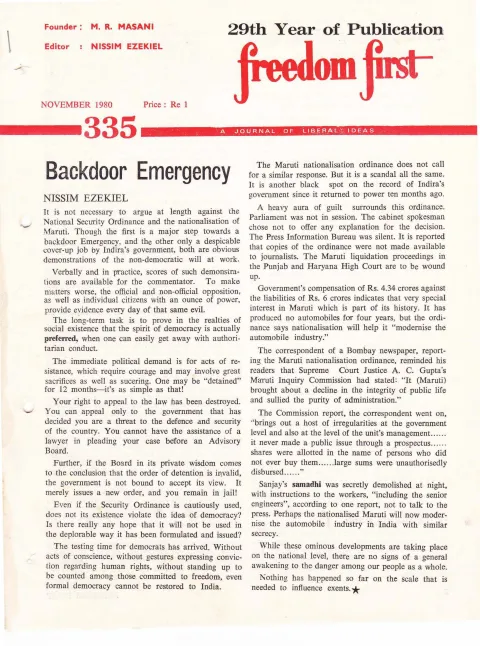
periodical issue
Freedom First
A Journal of Liberal Ideas
By NISSIM EZEKIEL, S. RAJARATNAM, A MAHARASHTRIAN, RAHUL SINGH, ZERIN ANKLESARIA, V. B. KARNIK, ATTAR CHAND, ALOO DALAL
Published for the Democratic Research Service by J. R. Patel, Associate Editor, Freedom First at 127, Mahatma Gandhi Road, Bombay 400023 (Phone: 273914) and printed by him at Kaiser-E-Hind Publishers & Printers 300, Perin Nariman Street Bombay 400001 · Bombay · 1980
16 pages
Freedom First
Summary
Freedom First No. 331 (July 1980) is a monthly issue of the Bombay-based journal of liberal ideas, founded by M. R. Masani and edited by Nissim Ezekiel, marking the journal’s 29th year of publication. The issue opens with Ezekiel’s own editorial on the mood of fear and non-democratic tendencies following Indira Gandhi’s return to power, followed by a reprinted speech by Singapore’s Foreign Minister S. Rajaratnam warning that detente has let the Soviet Union expand its influence unchecked. Two ‘Voices’ opinion pieces address the minority-institution loophole in Maharashtra’s education policy and the authoritarian temptations exposed by South Korea’s political violence. A rationalist-association statement (with the 192-scientist ‘Objections to Astrology’ declaration) attacks astrology’s hold on Indian public life, a World Bank item highlights that health spending in developing countries bypasses the poorest, book reviews cover Ved Mehta’s Daddyji and Jadunath Sarkar’s House of Shivaji, an essay by Attar Chand surveys the persistence of rural poverty and unemployment despite Integrated Rural Development schemes, and the issue closes with the second half of Aloo Dalal’s two-part investigative piece on Bombay’s Municipal Corporation, concluding with a warning against central government supersession of elected civic bodies.
Key points
-
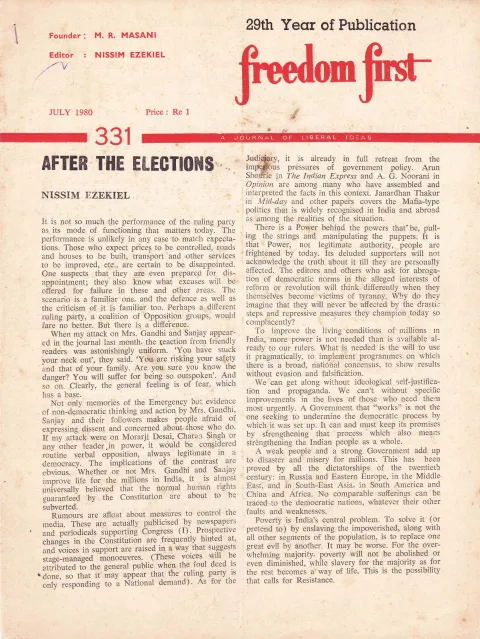
Nissim Ezekiel’s editorial “After the Elections” argues that fear, not disagreement, now shapes public reaction to criticism of Mrs. Gandhi and Sanjay Gandhi, warning of an unaccountable “Power behind the powers” while insisting a working democracy remains preferable to any authoritarian alternative.
-
Singapore Foreign Minister S. Rajaratnam’s reprinted Tokyo speech, “Soviet World in the Making,” argues detente has systematically favoured Soviet expansion into Vietnam, Cuba, Angola, Ethiopia, Mozambique, South Yemen, Kampuchea and Afghanistan through Western self-deception rather than Soviet trickery.
-
Two “Voices” pieces address a Maharashtra circular letting colleges self-declare “minority” status to bypass merit admissions, and Rahul Singh’s warning, drawn from South Korea’s 1980 political violence, against Indian intellectuals romanticising authoritarian “strong leadership.”
-
A joint statement from the Bombay Rationalist Association reproduces the 192-scientist “Objections to Astrology” declaration and calls on newspapers to stop publishing horoscopes as corrosive to rational, self-reliant citizenship.
-
A short news item reports a World Bank finding that modern hospital-based health systems bypass 80 per cent of the poor in developing countries, prompting the Bank’s first direct financing of health projects.
-
The World of Books section reviews Ved Mehta’s biography Daddyji and the fourth edition of Jadunath Sarkar’s House of Shivaji, which the reviewer credits with correcting earlier dismissive views of Shivaji.
-
Attar Chand’s “Let Us Remember Rural Poverty” cites World Bank data placing India among a “fourth world” of impoverishing countries and warns of a potential “explosive class-war” unless rural priorities shift, while Aloo Dalal concludes her two-part series on municipalities by warning that Bombay’s Corporation could be the next target of central government supersession after Delhi’s.
Essays
After the Elections
By NISSIM EZEKIEL
Nissim Ezekiel’s editorial argues that the substance of the ruling party’s performance matters less than its mode of functioning, and that fear — not mere disagreement — now colours public reaction to criticism of Mrs. Gandhi and Sanjay Gandhi. He notes that friends warned him he was risking his safety by attacking them, evidence of a chilling effect he says would not exist for criticism of other leaders. He surveys rumours of press controls, warns of a ‘Power behind the powers’ manipulating events, and argues that India’s central problem, poverty, cannot be solved by trading one form of enslavement for another; a government that ‘works’ democratically remains preferable to authoritarian alternatives.
- Argues fear, not disagreement, characterises public reaction to criticism of Mrs. Gandhi and Sanjay Gandhi
- Notes friends warned him of personal danger for criticizing the ruling family
- Describes rumours of media controls and constitutional changes as stage-managed
- Warns of an unaccountable ‘Power’ manipulating political puppets behind the scenes
- Frames poverty as India’s central problem, warning against solving it by enslaving the population
- Calls for using existing government power pragmatically rather than seeking more power or propaganda
Soviet World in the Making
By S. RAJARATNAM
S. Rajaratnam, Singapore’s Foreign Minister, argues in a Tokyo speech that detente and peaceful coexistence have, over the preceding fifteen years, worked systematically to the Soviet Union’s advantage while the non-Communist world has grown weaker. He traces Soviet gains from Vietnam, Cuba, Angola, Ethiopia, Mozambique, South Yemen, Kampuchea and Afghanistan, and contends that Brezhnev has been open, not deceptive, about the USSR’s revolutionary aims; the West deceived itself through complacency. He concludes that unless non-Communist nations match Soviet foreign-policy coherence and resolve, the century will belong to a Soviet-led world order.
- Argues detente has systematically favoured Soviet expansion since the mid-1960s
- Lists Soviet-aligned gains: Vietnam, Cuba, Angola, Ethiopia, Mozambique, South Yemen, Kampuchea, Afghanistan
- Contends Brezhnev’s revolutionary intentions were openly stated, not concealed
- Characterises Western/non-Communist response as self-deception rather than Soviet trickery
- Warns the non-Communist world’s military and strategic superiority has been squandered since 1965
- Calls for the non-Communist bloc to match Soviet policy coherence or risk a ‘Soviet century’
Voices I: Minority Colleges
By A MAHARASHTRIAN
A short ‘Voices’ letter signed ‘A Maharashtrian’ criticises a 1979 Maharashtra government circular that let colleges self-declare as ‘minority institutions’ to bypass merit-based admission rules, resulting in reservation quotas being manipulated by non-Maharashtrian managements in Bombay even though Maharashtrians are a local minority. The writer warns that such distortions of the constitutional minority-rights provision (Article 31) breed resentment and could fuel sons-of-the-soil agitation and violence, citing Assam as a warning sign.
- Criticises the 1979 Maharashtra circular allowing colleges to self-declare ‘minority’ status
- Notes the irony that Maharashtrians are themselves a minority in cosmopolitan Bombay
- Argues the reservation and minority-institution rules have been legally gamed by managements
- Warns of sons-of-the-soil backlash and violence, citing Assam as a precedent
Voices II: Lessons from South Korea
By RAHUL SINGH
In a second ‘Voices’ piece, Rahul Singh draws lessons from South Korea’s 1980 political violence, arguing that authoritarian strongman rule — even when personally honest, as with General Park Chung Hee — exacts a heavy long-term price, breeds corruption among associates, and tends to entrench itself indefinitely. He warns Indian liberals and intelligentsia who flirted with authoritarianism during the Emergency against romanticising ‘strong leadership’ models like South Korea’s, arguing India’s slower democratic path, though frustrating, has avoided the violent reckonings seen in Korea, Iran, Pakistan, the Philippines and Indonesia.
- Uses Park Chung Hee’s assassination and its aftermath as a cautionary tale about strongman rule
- Argues authoritarian rulers who start honest often become corrupt or shield corrupt associates
- Criticises Indian intellectuals who considered authoritarianism attractive during the Emergency
- Contrasts India’s ‘slow and cumbersome’ democracy favourably against Korea, Pakistan, Philippines, Indonesia
- Warns that suppressed dissent eventually explodes, citing South Korea and Bangladesh (Mujib’s assassination)
Astrology and Rationalism
A joint statement from the Bombay Rationalist Association and Suvichardharak Mandal, followed by the 192-scientist ‘Objections to Astrology’ declaration (signatories including Hans Bethe, Francis Crick, Linus Pauling and other Nobel laureates), argues that astrology has no scientific basis, that astrological forecasts are unreliable and internally inconsistent, and that newspapers publishing horoscopes promote irrationalism at the expense of critical thinking and self-reliance in a democratic society.
- Bombay Rationalist Association argues astrology has no verified basis in astronomy or science
- Calls on newspapers to stop publishing astrological forecasts
- Reproduces the 1975 ‘Objections to Astrology’ statement signed by 192 scientists, many Nobel laureates
- Statement argues belief in astrology undermines self-reliance and rational decision-making
Modern Health Systems Bypass 80 per cent of poor in Developing Countries
By New Delhi: U.N. Weekly Newsletter, April 11, 1980
A short news item summarising a World Bank policy paper (published 21 March 1980) reports that a large share of the roughly $75,000 million spent annually on health by developing countries goes to modern hospital-based systems that bypass 80 per cent of the poor. The Bank announces it will begin financing health projects directly, and the report criticises the neglect of preventive and primary care in favour of urban, elite-oriented hospital care.
- World Bank paper finds 80% of the poor in developing countries are bypassed by modern health systems
- Bank will begin direct financing of health projects for the first time
- Report faults over-emphasis on hospital-based care over preventive and primary care
- Attributes the neglect partly to health policy being shaped by urban elites
The World of Books: Daddyji by Ved Mehta
By ZERIN ANKLESARIA
Zerin Anklesaria reviews Ved Mehta’s Daddyji (OUP, 1980), a biography of the author’s father originally published abroad in 1972. The review praises the book’s fragmentary, vignette-based structure, its lack of sentimentality despite Mehta’s blindness, and its portrait of a principled, unconventional Punjabi patriarch, calling it a work of reportage-like restraint and visual clarity.
- Reviews Ved Mehta’s Daddyji, a biography of his father, newly available in India via OUP
- Praises the book’s fragmentary vignette structure and lack of narcissism or sentimentality
- Highlights the father’s principled, anti-superstition, anti-dowry character
- Notes the visual clarity of Mehta’s prose despite his blindness
- Closes wishing the book were longer
The World of Books: House of Shivaji by Jadunath Sarkar
By V. B. KARNIK
V. B. Karnik reviews the fourth edition of Jadunath Sarkar’s House of Shivaji (Orient Longman, 1978), noting the enduring popularity of Shivaji in Maharashtra and the book’s broader focus on Shivaji’s father, sons and contemporaries rather than Shivaji alone. Karnik credits Sarkar’s objective historical method with correcting earlier dismissive views of Shivaji as a mere plunderer, while regretting that an authoritative biography of Shivaji himself remains unwritten.
- Reviews the fourth edition (1978) of Jadunath Sarkar’s House of Shivaji
- Notes the book covers Shivaji’s father, sons and contemporaries more than Shivaji himself
- Credits Sarkar’s objective historical method for revising dismissive views of Shivaji
- Regrets that no authoritative Shivaji biography yet exists
Let Us Remember Rural Poverty
By ATTAR CHAND
Attar Chand surveys the persistence of rural poverty in India three decades after independence, citing World Bank data placing India among a ‘fourth world’ of fast-impoverishing countries, and government statistics showing rising numbers of poor, unemployed and indebted rural households despite Mahalanobis Committee warnings since 1964. He reviews the Integrated Rural Development (IRD) programme’s targets and expansion but concludes that little real progress has been made, warning of a potential ‘explosive class-war’ involving Dalit Panthers, landless labourers and the rural jobless unless government priorities shift.
- Cites World Bank data placing India, Pakistan, Bangladesh and others in a ‘fourth world’ income bracket
- Reports 46.33% of Indians (about 290 million) lived below the poverty line in 1977-78
- Notes registered rural unemployment rose from 5 million (1961) to 12.1 million (1978)
- Describes the Integrated Rural Development Programme’s target of covering 3,500 blocks by 1982-83
- Warns of potential ‘explosive class-war’ if rural disparities are not addressed
- Concludes success depends on government priority, sincerity and resource transfer
Investigations: The Municipalities-2
By ALOO DALAL
Aloo Dalal concludes a two-part investigative series on Bombay’s Municipal Corporation, describing its wide-ranging civic responsibilities (health, education, fire, markets, transport) and the citizen estrangement caused by bureaucratic rigidity, migrancy, and poor public communication. The piece closes with a pointed warning: following the supersession of the Delhi Metropolitan Council and Delhi Municipal Corporation by the central government in 1980, Bombay’s Corporation may be next, and Dalal calls on citizens to resist what she frames as an anti-democratic centralising trend that threatens India’s federal structure.
- Describes the Bombay Municipal Corporation’s budget and civic responsibilities, including a health budget larger than many state governments’
- Notes the Corporation runs 1,102 municipal schools and major hospitals with free treatment
- Diagnoses citizen estrangement from civic government due to migrancy, bureaucracy and poor communication
- Recounts the 1980 supersession of the Delhi Metropolitan Council and Delhi Municipal Corporation by central government order
- Warns Bombay’s Corporation could be the next target of central government supersession
- Calls for citizen vigilance to defend local self-government and the federal structure
Generated by the v1.5 extraction pipeline. Awaiting editorial review.
Metadata and summary are AI-extracted from the source PDF and reviewed for editorial accuracy. The original work is available via the Read PDF tab above (where present); paragraph-level citation inside the PDF is deferred to a future engagement.