periodical issue
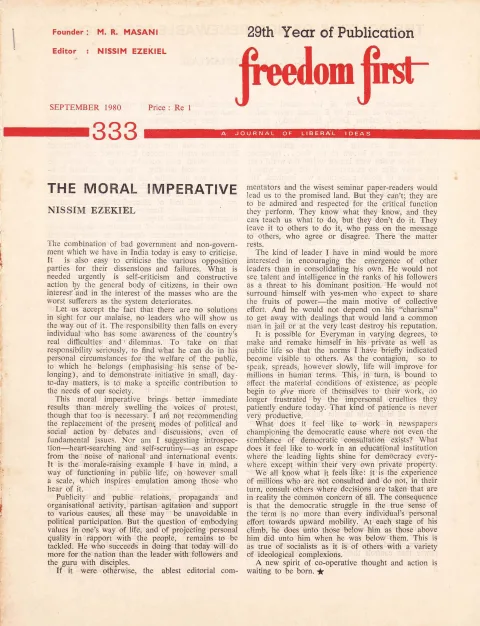
Freedom First
A Journal of Liberal Ideas
By NISSIM EZEKIEL, K. S. VENKATESWARAN, THE IRANIAN COMMITTEE FOR DEMOCRATIC ACTION & HUMAN RIGHTS, A. E. GUNAWARDENA, HUTOXI MEHENTI, Geeta Doctor, N. C. ZAMINDAR, M. VENKATESWARLU, PREETH I. BIDDAPA, RAMNI TANEJA, JONATHAN FENBY, S. K. OOKERJEE
Published for the Democratic Research Service by J. R. Patel, Associate Editor, Freedom First at 127, Mahatma Gandhi Road, Bombay 400 023 (Phone: 273914) and printed by him at Kaiser-E-Hind Publishers & Printers 300, Perin Nariman Street Bombay 400 001 · Bombay · 1980
16 pages
Freedom First
Summary
Freedom First No. 332 (August 1980), edited by Nissim Ezekiel and founded by M. R. Masani, opens with an unsparing editorial on Sanjay Gandhi’s death, arguing that his political career combined the worst of leftist and rightist authoritarianism and that the cult forming around his memory threatens to obscure this. The issue’s other pieces extend the magazine’s standing preoccupation with authoritarianism abroad: a detailed account of Amnesty International’s report on Soviet abuse of psychiatric confinement and prison conditions, and an open letter from an Iranian exile group to Austria’s chancellor protesting Western legitimisation of Khomeini’s theocracy. Domestic concerns include two first-person ‘Voices’ pieces on economic ideology and white-collar work, a satirical parliamentary sketch, a set of book reviews covering contemporary Indian politics, Hindu religious literature, women’s labour, and English law, a media-studies piece questioning the ‘bad news from the Third World’ thesis, and an essay on the crisis of Indian higher education pedagogy. A short notice announces the new J. P. Awards for writing on democracy.
Key points
-
Nissim Ezekiel’s editorial on “Sanjay’s Death - & After” argues Sanjay Gandhi’s political rise rested on scandal and cult rather than achievement, calling his politics “crypto-fascist,” and criticises Indira Gandhi’s government for echoing Soviet propaganda on the Afghanistan invasion.
-
K. S. Venkateswaran’s “Amnesty’s Indictment of Soviet Savagery” details Amnesty International’s report on Soviet political prisoners, citing the cases of Balys Gajankas and poetess Yuliya Okulova and the abuse of psychiatric confinement to silence dissenters.
-
The Iranian Committee for Democratic Action and Human Rights’ open letter to Austria’s Chancellor Bruno Kreisky protests his Tehran visit, citing over 1,200 executions without fair trial and 50,000 political prisoners under Khomeini’s theocracy.
-
Two “Voices” pieces cover A. E. Gunawardena’s argument that capitalist inflation is a “myth” in efficient Western democracies, and Hutoxi Mehenti’s first-person account of the gap between a promised “challenging” office job and the reality of routine clerical work.
-
Geeta Doctor’s satirical “The Week In Parliament” imagines MPs demanding caste quotas on Nobel-laureate sperm donations, with the twist that the disguised fifth candidate turns out to be the Prime Minister herself.
-
The World of Books section reviews Barun Sengupta’s exposé of the Janata government’s collapse, Surabhi Sheth’s study of the Brahma Purana, Gail Omvedt’s account of Maharashtra women workers, and Lord Denning’s The Due Process of Law.
-
Jonathan Fenby’s “Third World Aversion To Bad News” largely debunks the thesis that Western media disproportionately emphasise Third World disasters, citing a University of North Carolina study finding disaster coverage a small share of total news everywhere.
-
S. K. Ookerjee opens an “Investigations” series on higher education, examining Bombay University’s new lecture-attendance rules and proposing a three-semester structure and greater pedagogic freedom for teachers.
Essays
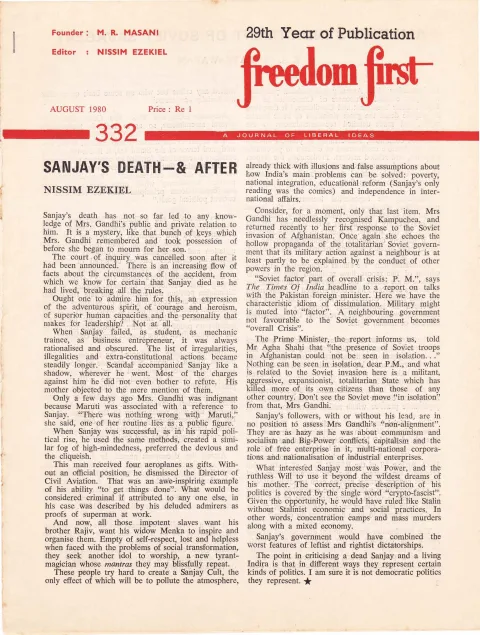
Sanjay’s Death - & After
By NISSIM EZEKIEL
Nissim Ezekiel’s editorial argues that Sanjay Gandhi’s death produced no reckoning with his mother’s public and private relationship to him, and that his political rise was built on scandal, extra-constitutional action, and an admiring cult of personality rather than genuine achievement. Ezekiel contends Sanjay’s politics were ‘crypto-fascist’ in character, combining leftist and rightist authoritarian tendencies, and pivots to criticise Indira Gandhi’s response to the Soviet invasion of Afghanistan as an echo of Soviet propaganda, citing her government’s line that Soviet troop presence could not be judged ‘in isolation.’
- Sanjay Gandhi’s death led to no public accounting of Mrs Gandhi’s relationship to him.
- The court of inquiry into the circumstances of his death was cancelled soon after being announced.
- Ezekiel rejects any admiration for Sanjay’s ‘adventurous spirit,’ cataloguing his failures as student, mechanic, and businessman and the scandals that followed his political rise.
- He describes Sanjay’s politics as ‘crypto-fascist,’ arguing he would have ruled like Stalin without Stalinist economic practice.
- The piece pivots to criticise Indira Gandhi’s government for describing Soviet military action in Afghanistan as explainable and not to be seen ‘in isolation.’
- Ezekiel states that Sanjay’s followers are as confused about non-alignment, communism, and free enterprise as he was.
Amnesty’s Indictment of Soviet Savagery
By K. S. VENKATESWARAN
K. S. Venkateswaran summarises and endorses a revised, enlarged Amnesty International report on Soviet treatment of ‘prisoners of conscience,’ describing the legal basis for politically motivated detention under Article 58 and successor Soviet criminal codes, the show-trial character of proceedings against dissidents such as Balys Gajankas and poetess Yuliya Okulova, the abuse of psychiatric confinement to silence dissent, and appalling prison conditions including deliberate starvation. The essay closes by reproducing at length a dialogue recorded by historian Mikhail Bernstam with a Soviet psychiatric official, Dr L. D. Fedoseyava, illustrating how KGB political judgments substitute for medical diagnosis in committing dissenters.
- Amnesty International’s revised report documents continued arrest and imprisonment of dissenters under Soviet civil legislation restricting non-violent exercise of human rights.
- Article 58 of the 1926 RSFSR Code and its successors permit ‘blanket charges’ against those merely suspected of opposing Bolshevik rule.
- Case studies include Balys Gajankas (10 years for possessing Solzhenitsyn’s Gulag Archipelago) and poetess Yuliya Okulova (5 years exile for ‘false fabrications’).
- Prison conditions include deliberate underfeeding; a Mordovia camp account describes prisoners eating rotten fish, gruel, and scraps.
- Psychiatric confinement is used against dissenters classified as ‘socially dangerous’ under a 1971 directive with vague, discretionary criteria.
- A reproduced dialogue between historian Mikhail Bernstam and psychiatric official Dr Fedoseyava shows KGB officials making political judgments that substitute for medical evaluation in committing dissenter Ponomaryov.
An Open Letter To Chancellor Bruno Kreisk Of Austria On Khomeini’s Tyrannical Theocracy And The Flaunting Of Human Rights In Iran
By THE IRANIAN COMMITTEE FOR DEMOCRATIC ACTION & HUMAN RIGHTS
An open letter dated June 12, 1980, from the Iranian Committee for Democratic Action and Human Rights to Austrian Chancellor Bruno Kreisky, protesting his visit to Tehran and the legitimacy it lent to Khomeini’s theocracy. The letter catalogues mass executions, bombing of Kurdish and other regions, banning of leftist and socialist parties, press suppression, and calls on Kreisky to use his influence with the Socialist International to establish a commission of inquiry into the Iranian regime’s human rights record.
- The letter protests Chancellor Kreisky’s Tehran visit as lending legitimacy to Khomeini’s ‘medievalist’ theocracy.
- It cites over 1,200 executions without fair trial and military action including napalm bombing in Kurdistan, Khuzestan, and the Gorgan plain.
- It reports 50,000 political prisoners and 160,000 people on an official ‘black list’ barred from travel or public positions.
- All progressive and socialist parties, including the League of Iranian Socialists, have been banned; 37 Socialists and Social Democrats have been executed.
- Over 2,000 newspapers and periodicals have reportedly been banned, with writers and editors imprisoned without charge.
- The letter calls for a Socialist International commission of inquiry to investigate the theocracy’s record.
Voices 1: Myth Of Capitalism And Inflation
By A. E. GUNAWARDENA, President: Ceylonese Liberal Party
In the first of two short ‘Voices’ pieces, A. E. Gunawardena, President of the Ceylonese Liberal Party, argues that capitalist economies are not inherently more prone to inflation than planned ones, that utility rather than profit alone drives entrepreneurial choice, and that in developed capitalist countries like Britain, the US, and Japan capitalism has produced broad-based infrastructure and prosperity, making claims of capitalist waste or inefficiency a ‘myth’ in advanced democratic states.
- Argues it is a fallacy to assume capitalist economies are inherently more inflation-prone than socialist or centrally planned ones.
- Contends utility, not just profit, guides entrepreneurial and societal priorities toward essentials like food, clothing, and shelter.
- Claims developing countries lack the industrial revolution’s creative impact and remain focused on agriculture with archaic methods.
- Argues Western inflation stems from production of luxury goods and is ‘not so intolerable’ as inflation in some Asian countries.
- Concludes that in efficient capitalist democracies (Britain, Canada, USA, Japan), capitalism ‘becomes a myth’ rather than a reality of exploitation.
Voices 2: The Routine Job
By HUTOXI MEHENTI
In ‘The Routine Job,’ Hutoxi Mehenti gives a first-person account of the gap between the promise of a ‘challenging’ post-graduate office job and the reality of routine clerical work, contrasting her own frustration with the resignation of longer-serving stenographers who have waited years to ‘rise.’ She criticises employers and India’s theoretical educational system for producing graduates equipped for neither meaningful work nor basic office skills, and argues that awareness of this disparity, coupled with courage, is the first step toward change.
- The author describes landing a ‘prize’ secretarial job that promised challenge but delivered filing, registers, and clerical monotony.
- She questions why post-graduate hires are screened for business acumen and political awareness yet given only rote clerical tasks.
- Blames India’s ‘impossibly theoretical’ educational system for leaving graduates both overqualified and practically unprepared.
- Notes some secretaries have ‘risen’ to Assistant Executive titles but with less real income after losing overtime pay.
- Concludes that awareness of one’s plight, combined with the courage to act on it, is the necessary first step to becoming ‘a SOMEBODY.‘
The Week In Parliament (Geeta Doctor Reports)
By Geeta Doctor
Geeta Doctor’s satirical column imagines an uproarious Indian Parliament debate after news that Nobel laureates have donated sperm to a fertility bank, with MPs demanding reservation quotas for scheduled classes, Piloo Mody providing comic relief, and party leaders jockeying to be chosen as India’s ‘representative’ donor, before the twist that the only candidate seated in silence throughout is revealed to be the Prime Minister herself.
- The sketch parodies a real Daily Telegraph report on Nobel-laureate sperm donation to a fertility bank.
- MPs demand a caste-based quota (33%) of the donated sperm be reserved for scheduled classes.
- Charan Singh’s faction frames the fertility-bank debate around ‘who tills the soil,’ while professing Gandhian objection to mechanisation.
- A consensus bars anyone over sixty from the Fertility Bank in deference to the ‘Father of the Nation’s’ embrace of brahmacharya.
- The twist ending reveals the Prime Minister, quietly knitting throughout, as the disguised ‘fifth’ candidate who has fooled the assembled members.
The World Of Books (reviews of Last Days of the Morarji Raj; Religion and Society in the Brahma Purana; We Will Smash This Prison; The Due Process of Law)
By N. C. ZAMINDAR; M. VENKATESWARLU; PREETH I. BIDDAPA; RAMNI TANEJA
The World of Books section carries four reviews: N. C. Zamindar reviews Barun Sengupta’s ‘Last Days of the Morarji Raj,’ calling it a lucid, cartoon-illustrated exposé of political intrigue during the Janata government’s collapse; M. Venkateswarlu reviews Surabhi Sheth’s ‘Religion and Society in the Brahma Purana,’ praising its critical study of Puranic social structure and marriage institutions but noting its high price and gaps on ancient Hindu polity; Preeth I. Biddapa reviews Gail Omvedt’s ‘We Will Smash This Prison,’ on the anger of Indian working women, finding it journalistically vivid but analytically thin and confined to a leftist-class framework; and Ramni Taneja reviews Lord Denning’s ‘The Due Process of Law,’ summarising his treatment of contempt of court, judicial inquiries, and landmark cases including the Thalidomide/Sunday Times litigation.
- Zamindar’s review calls Sengupta’s book on Morarji Desai’s government fall ‘a murky play’ exposing corruption among Rajaji, JP, Indira, and Sanjay’s circle.
- Venkateswarlu praises Sheth’s scholarly treatment of the Brahma Purana but flags its Rs. 100 price as a ‘major deterrent’ by Indian standards.
- Biddapa finds Omvedt’s account of Maharashtra women’s labour organising vivid but undermined by an unresolved, class-focused analytical frame.
- Taneja’s review of Denning covers his rulings on contempt of court, the Thalidomide/Sunday Times case, the Mareva Injunction, and ‘deserted wife’s equity.’
- Denning’s own definition of ‘due process of law’ is quoted directly as the review’s framing device.
Third World Aversion To Bad News
By JONATHAN FENBY
Jonathan Fenby, a former Reuters World Service editor, examines and largely debunks the widely accepted ‘bad news’ thesis that Western media disproportionately emphasise disasters, coups, and violence in Third World reporting. He contrasts a partisan 1970s UNESCO study with a more rigorous University of North Carolina study covering 35 newspapers, broadcasters, and news agencies across the Americas, Europe, Asia, and Africa, which found disaster coverage a small share of total coverage everywhere and that political conflict, not calamity, dominates Third World news coverage in a manner proportionate to real instability.
- The ‘bad news’ thesis holds that Western agencies disproportionately relay disasters, coups, and strife from developing nations to audiences in Europe, North America, and Japan.
- A mid-1970s UNESCO-commissioned study lumped together political/military violence with crime to conclude Third World coverage skewed toward ‘bad news.’
- A University of North Carolina study found negative disaster/accident coverage was only about 3% of news studied worldwide, with no evidence of disproportionate Third World emphasis.
- The North Carolina study found political conflict dominates Third World coverage roughly in proportion to the real instability of those regions.
- Fenby argues Western media give comparable heavy coverage to disruption in the West (terrorism in Italy/West Germany, Northern Ireland, US racial violence).
- He concludes that complaints about ‘bad news’ emphasis are shared by observers in Britain (e.g., Spiro Agnew) and that this is a genuinely complex debate, not simple media bias.
Investigations: Patterns In Higher Education 1
By S. K. OOKERJEE
In the first part of an ‘Investigations’ series on ‘Patterns in Higher Education,’ S. K. Ookerjee discusses the University of Bombay’s new requirement that students attend at least three-quarters of lectures and satisfy principals’ standards to sit final exams, following a Bombay High Court ruling upholding principals’ authority to withhold exam forms. Ookerjee argues attendance rules alone are insufficient without reform of the essay-type exam system and of student attitudes, proposing a three-semester structure with intermediate testing and greater pedagogic freedom for teachers to make courses engaging, illustrated by a closing dialogue from Plato’s Meno on the teacher-student relationship.
- Bombay University now requires 3/4 lecture attendance and ‘satisfactory’ progress as a precondition for sitting final exams, following a High Court ruling upholding principals’ discretion.
- Ookerjee argues attendance and testing rules are necessary but insufficient without reform of the outdated essay-type examination.
- He proposes breaking the academic year into three semesters, each with its own test, to align with students’ documented preference for short, intense study bursts before exams.
- He calls for greater ‘pedagogic freedom’ for teachers to design engaging courses (‘cut the coat according to the cloth’) rather than being bound to fixed, often outdated syllabi.
- The essay closes with an extended quotation from Plato’s Meno illustrating Socratic teaching as joint inquiry rather than one-way transmission of facts.
- A companion notice announces the J. P. Awards for the best book and articles on democracy, administered by the Yusuf Meherally Centre with a panel including Justice V. M. Tarkunde.
Generated by the v1.5 extraction pipeline. Awaiting editorial review.
Metadata and summary are AI-extracted from the source PDF and reviewed for editorial accuracy. The original work is available via the Read PDF tab above (where present); paragraph-level citation inside the PDF is deferred to a future engagement.