periodical issue
Freedom First
A Journal of Liberal Ideas
Published for the Democratic Research Service by J. R. Patel, Associate Editor, Freedom First at 127, Mahatma Gandhi Road, Bombay 400 023 (Phone: 273914) and printed by him at Kaiser-E-Hind Publishers & Printers 300, Perin Nariman Street, Bombay 400 001 · Bombay · 1980
16 pages
Freedom First
Summary
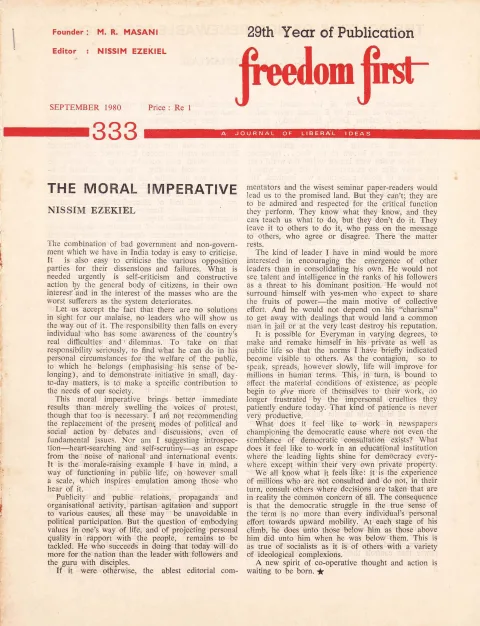
Issue No. 333 of Freedom First (September 1980), edited by Nissim Ezekiel and founded by M. R. Masani, opens with Ezekiel’s editorial ‘The Moral Imperative,’ urging individual Indians to embody liberal values in daily conduct rather than rely on absent political leadership. The issue’s centre of gravity is anti-Soviet and anti-totalitarian commentary: K. V. Subrahmanyam surveys Soviet resource-driven imperialism from Eastern Europe to Afghanistan; Andrei Sakharov’s message to the Sakharov Hearings indicts Soviet legal abuses; a Thomas Hamm piece (reprinted from the International Herald Tribune) profiles defector Truong Nhu Tang’s disillusionment with Vietnamese communism; and Preeth I. Bidappa argues that the Moscow Olympics boycott exposed the fiction that sport and politics can be separated. Alongside this, the issue carries its regular ‘Voices’ reader-contributed column, book reviews under ‘The World of Books,’ a profile of Statesman editor Cushrow Irani’s press-freedom battles with Indira Gandhi’s government, and S. K. Ookerjee’s continuing ‘Investigations’ series on Indian higher education reform.
Key points
-
Nissim Ezekiel’s editorial “The Moral Imperative” calls on individual Indians to embody liberal values in daily conduct through self-criticism and small constructive acts rather than relying on absent political leadership.
-
K. V. Subrahmanyam’s “The Politics of Non-Renewable Resources” traces Soviet resource-driven interventions from Eastern Europe through Cuba, Guinea, Chile and Angola to bauxite deposits in Orissa-Andhra Pradesh, linking the invasion of Afghanistan to the region’s untapped gas fields.
-
William Frankel profiles Statesman managing director Cushrow Irani, the first Indian chairman of the International Press Institute, recounting his defiance of Emergency-era government pressure including passport impoundment and threats to nationalise newspaper ownership.
-
Andrei Sakharov’s message to the International Sakharov Hearings argues Soviet law itself, not merely its abuse, violates human rights, citing the death penalty for non-violent offences and the “anti-parasite law.”
-
A three-part “Voices” column covers the neglect of deaf education in India, satire of performative bohemianism in Baroda’s arts scene, and the WHO’s October 1980 declaration that smallpox has been eradicated worldwide.
-
The World of Books section reviews Indira Mahindra’s The Rebellious Home-Makers on Indian women’s domestic resistance and the Sunday Times Insight Team’s account of the 1980 Iranian Embassy siege in London.
-
An essay on “End of the Olympics” argues the Moscow Games boycott exposes the fiction that sport and politics can be separated, tracing politicised Olympics back to Berlin 1936.
-
Thomas Hamm’s reprinted profile of Truong Nhu Tang, a founding NLF member turned boat-person exile, describes Vietnam’s Communist Party betraying its nationalist ideals and its near-total dependence on Soviet aid.
-
S. K. Ookerjee’s continuing “Investigations” essay argues the college teacher should be an explorer of ideas rather than a mere instructor, criticising large lecture classes and calling tutorials “the harijans of our system.”
Essays
The Moral Imperative
By NISSIM EZEKIEL
In this editorial, Nissim Ezekiel argues that criticising bad government and fractious opposition parties is easy but insufficient. He calls for a ‘moral imperative’ of self-criticism and individual constructive action, distinct from mere protest or introspective escapism, in which each citizen demonstrates initiative in small, day-to-day matters. He contrasts self-serving leaders who hoard power and ‘yes-men’ with a more admirable kind of leader who encourages the emergence of others. Ezekiel closes by describing the democratic struggle in India as reduced to individuals’ personal upward mobility, with each rung of the ladder replicating the domination of those above, and calls for ‘a new spirit of co-operative thought and action.’
- Bad government and opposition dissension are both easy targets for criticism, but the real responsibility falls on individual citizens.
- Ezekiel calls for a ‘moral imperative’ of self-criticism and constructive small-scale action rather than more debate or introspection.
- He distinguishes admirable leadership (encouraging others’ talent) from self-consolidating leadership reliant on charisma and yes-men.
- Publicity, propaganda, and partisan agitation are described as insufficient substitutes for embodying values in one’s way of life.
- The democratic struggle in India is characterised as reduced to individuals’ private upward mobility, replicating power relations at every level.
- The piece ends on a call for a ‘new spirit of co-operative thought and action’ to be born.
The Politics of Non-Renewable Resources
By K. V. SUBRAHMANYAM
K. V. Subrahmanyam argues that international disputes increasingly turn on the politics of non-renewable resources, and that the Soviet Union has systematically pursued mineral and energy security since the Bolshevik revolution, when it surveyed its own resource deficits (notably bauxite) and set out to secure supply from abroad. He traces Soviet resource-driven interventions from Eastern Europe (Hungary, Czechoslovakia, Poland, GDR) through Cuba, Guinea, Chile, and Angola, to the discovery of bauxite in Orissa-Andhra Pradesh and the Soviet-brokered alumina deal with India. The essay extends into the rupee-payment barter trade as a new form of colonialism, the political economy of uranium enrichment (Tarapur), and closes by linking these resource ambitions to the invasion of Afghanistan and the region’s oil, gas, and tin reserves, drawing on a Singapore minister’s analysis of the ‘political version of Soviet diplomacy.’
- International disputes over non-renewable resources are inversely tied to their scarcity and geographic distribution, per the piece’s opening framework.
- The USSR conducted an early, systematic survey of its mineral deficits after the Bolshevik revolution and has pursued external resource security since.
- Soviet interventions in Hungary, Czechoslovakia, Poland, and the GDR are read through their bauxite, coking coal, and lignite deposits.
- The USSR’s rupee-payment barter trade with India is characterised as ‘a new type of colonialism’ benefiting from India’s political immaturity.
- Soviet uranium enrichment capacity and collaboration with West German and Japanese firms is contrasted with its refusal to help India with Tarapur.
- The essay ties the invasion of Afghanistan to the region’s untapped natural gas fields (Katawaz, Khwaja Gorgerdak) and broader Soviet resource ambitions.
- It cites Singapore’s Foreign Minister S. Rajaratnam’s analysis (from Freedom First, July 1980) of Soviet diplomacy’s economic motivations.
Indian Champion for World Press
By WILLIAM FRANKEL
William Frankel profiles Cushrow Irani, managing director of The Statesman, who was elected the first Indian chairman of the International Press Institute. The piece recounts Irani’s defiance of Indira Gandhi’s Emergency-era pressure on the press, including passport impoundment, harassment, and threats to nationalise or ‘de-link’ newspaper ownership, and situates The Statesman’s independence within its history since 1818 as a supporter of the Indian National Congress and the underdog.
- Cushrow Irani, managing director of The Statesman, became the first Indian chairman of the International Press Institute.
- During the Emergency his passport was impounded and he faced threats of imprisonment for resisting government interference.
- The government attempted to pack The Statesman’s board, withhold advertising, and confiscate its Delhi printing presses.
- Mrs Gandhi’s government later proposed ‘de-linking’ newspapers from industrial ownership via a Public Trustee scheme, which was retracted after public outcry.
- The Statesman, founded in 1818, is described as historically a supporter of the Indian National Congress and the underdog.
Law in the Soviet Union
By ANDREI SAKHAROV
A short excerpt from Andrei Sakharov’s message to the International Sakharov Hearings (Third Session, U.S.A.) argues that Soviet legality itself violates human rights: the death penalty for non-violent crimes, restrictions on free exchange of information and movement, anti-parasite laws, and persecution of religious belief. Sakharov describes receiving letters documenting beatings, torture, and forged criminal charges used as political reprisals, and calls the moral and ethical level of Soviet criminal procedure ‘extremely low.’
- Sakharov argues that serious human-rights violations are built into Soviet law itself, not just its abuse.
- He cites the death penalty for non-violent offences and the ‘anti-parasite law’ as examples of legally sanctioned rights violations.
- He describes receiving numerous letters documenting beatings, torture, and forged charges used as political reprisals.
- The piece is drawn from a message to the International Sakharov Hearings, Third Session, U.S.A.
Voices 1: Teaching the Deaf
By UMA RANGANATHAN
A three-part ‘Voices’ reader column. Uma Ranganathan writes on the neglect of deaf education in India, noting about 33 million people with hearing disorders and only around 10,000 deaf children served by existing schools, and argues the field needs better pay and professional recognition rather than being treated as charity. Sandhya Bordewekar satirises the affected ‘aesthetic crowd’ in Baroda’s Fine Arts scene who perform bohemian nonconformity as a substitute for genuine talent, contrasting it with a formerly tomboyish acquaintance now performing dutiful-wife respectability. Harish Kumar reports on the WHO’s October 1980 declaration that smallpox has been eradicated worldwide, recounting the disease’s history, the search-and-containment vaccination strategy that eliminated it (including a major campaign in Bihar), and warns that continued rural surveillance remains necessary.
- Uma Ranganathan: about 33 million Indians have hearing disorders, but only ~10,000 deaf children are served by existing special schools.
- Ranganathan argues teaching the deaf is treated as charity work with poor pay rather than a properly professionalised field.
- Sandhya Bordewekar satirises performative bohemianism among the ‘aesthetic crowd,’ contrasting authentic artists like Bhupen Khakhar and Jyoti Bhatt with poseurs.
- Bordewekar’s second vignette describes a young married woman now performing dutiful, dignified wifeliness after an earlier tomboyish adolescence.
- Harish Kumar reports the WHO’s October 26 declaration that smallpox has been eradicated worldwide, including from Africa.
- Kumar credits a ‘search and containment’ vaccination strategy, citing a Bihar campaign of 20,000 health workers covering 70,000 villages.
- Kumar warns continued rural surveillance is needed to prevent any resurgence, given past illiteracy- and poverty-driven under-reporting.
Voices 2: Who’s Genuine?
By SANDHYA BORDEWEKAR
Havovi Anklesaria reviews ‘The Rebellious Home-Makers’ by Indira Mahindra (S.N.D.T. Women’s University), a study of Indian women who live within traditional domestic settings while quietly resisting them. The reviewer finds the book’s social-history chapters on the Hindu system of marriage its strongest but criticises its repetitive structure, its conservative preference for preserving the Indian family system, its claim that Indian women fare better than their American counterparts absent ‘male chauvinism,’ and its failure to address domestic violence or offer alternatives such as divorce.
- The book studies ‘women who live in a traditional setting, yet strain at the ropes to loosen the bond,’ favouring preservation of the Indian family system.
- Anklesaria praises its treatment of the historical development of the Hindu system of marriage as its best material.
- She criticises repetitive, poorly organised chapters and Mahindra’s failure to define what ‘tradition’ women are meant to preserve.
- The reviewer challenges the book’s claim that Indian women are better off than American women due to protection from ‘male chauvinism,’ noting wife-burning, wife-beating and rape remain common.
- The review concludes the book is a useful but analytically thin first introduction to the subject.
Voices 3: Small-Pox in Rural Areas
By HARISH KUMAR
Rashmi Taneja reviews ‘Siege!’ by the Sunday Times Insight Team, an account of the 1980 Iranian Embassy siege in London by gunmen from the Democratic Revolutionary Front for the Liberation of Arabistan, culminating in the SAS storming of the building. The review praises the book’s well-crafted, diligently reported narrative of the six-day standoff, the failed negotiations, and the eventual assault.
- The book covers the six-day siege of the Iranian Embassy in London by gunmen demanding release of prisoners held in Arabistan.
- It details police strategy, failed mediation attempts by Arab ambassadors, and the SAS’s storming of the embassy.
- Taneja praises the book as ‘ingeniously well-crafted’ and an example of ‘brilliant and diligent journalism.‘
The World of Books: The Rebellious Home-Makers (review)
By HAVOVI ANKLESARIA
Preeth I. Bidappa argues that the 1980 Moscow Olympics, and the U.S.-led boycott over the Soviet invasion of Afghanistan, expose the myth that sport and politics can be separated. The essay traces the politicisation of the Olympics back to 1936 Berlin, argues that competing at Moscow implicitly endorses Soviet suppression of Afghan freedom, and criticises the Soviet state’s own propaganda for celebrating the Games as testimony to its ‘historic importance’ while claiming sport is apolitical.
- Bidappa argues the Moscow Olympics boycott debate reveals that sport and politics can never truly be separated.
- The 1936 Berlin Olympics, used by Hitler for propaganda, is cited as a historical precedent for politicised Games.
- The essay criticises India’s decision to attend the Games despite otherwise appealing for Soviet withdrawal from Afghanistan.
- Lord Killanin’s attempt to allow individual athletes to compete regardless of national boycotts is described as ultimately undermined by IOC politics.
- The USSR’s own 1980 Party Militants’ Handbook is quoted as proof that the Soviet state itself treats the Games as a political statement of its ‘historic importance.‘
Siege! (book review)
By RASHMI TANEJA
A reprint from the International Herald Tribune (originally New York Herald Tribune, 28 June 1980) by Thomas Hamm profiles Truong Nhu Tang, a founding member of South Vietnam’s National Liberation Front and former justice minister of the Provisional Revolutionary Government, who escaped Vietnam as a boat person after growing disillusioned with the Communist Party’s betrayal of nationalist ideals. Tang denounces the Vietnamese Communists as having conducted ‘a policy of vengeance and repression’ instead of reconciliation, describes Vietnam’s deepening dependence on and isolation from all but the Soviet Union, and outlines four structural contradictions (ideological, economic, political, social) facing the regime, while warning of possible unrest if ‘war and misery continue.’
- Truong Nhu Tang, a founder of the NLF and former PRG justice minister, escaped Vietnam as a boat person, disillusioned with the Communist takeover.
- Tang accuses the Vietnamese Communist Party of betraying the NLF/PRG’s original goal of a ‘neutral and prosperous’ unified Vietnam via negotiation.
- He describes Vietnam’s total dependence on Soviet military and economic aid (an estimated $3 million per day) and its resulting isolation from the rest of the world.
- Tang outlines four contradictions facing Vietnam’s leadership: ideological, economic, political, and social (a corrupt bureaucrat class widening the gap with the people).
- He describes popular sentiment as one of ‘discontent’ but only ‘passive resistance,’ while warning of possible explosion if conditions worsen.
- Tang states his goal in temporary exile is to ‘organize resistance.‘
End of the Olympics
By PREETH I. BIDAPPA
The second installment of S. K. Ookerjee’s ‘Investigations’ series on patterns in Indian higher education argues that the college teacher should function as an explorer of ideas rather than a mere purveyor of information, but that low pay fails to attract sufficiently dedicated talent to the profession. Ookerjee makes the case for small tutorial-style classes over the lecture method, criticises the university system and government policy for favouring large lecture classes and restricting subject departments to a minimum enrollment of 15 students, and calls tutorials ‘the harijans of our system’ — necessary but neglected. He closes noting the university has taken ‘two steps forward’ but questioning whether it will ‘march further.’
- Ookerjee argues the college teacher should be ‘an explorer of ideas’ rather than a mere instructor delivering ready-made information.
- He argues low pay fails to attract sufficiently able and dedicated teachers to higher education in India.
- The essay advocates small tutorial classes (‘morsel feeding’) over large lecture classes to allow individual student contact.
- Government and university policy is criticised for favouring large lecture classes and disallowing subject departments with under 15 enrolled students.
- Ookerjee proposes giving individual colleges more autonomy (‘home rule’) over curriculum and teaching method as a feasible reform.
- He closes acknowledging his repeated criticisms may have had only a ‘cumulative effect’ on an otherwise timid and conservative university system.
Generated by the v1.5 extraction pipeline. Awaiting editorial review.
Metadata and summary are AI-extracted from the source PDF and reviewed for editorial accuracy. The original work is available via the Read PDF tab above (where present); paragraph-level citation inside the PDF is deferred to a future engagement.