periodical issue
Freedom First
A Journal of Liberal Ideas
By M. R. MASANI, K. S. VENKATESWARAN, RAMA SWARUP, GORDON BROOK-SHEPHERD, HAVOVI ANKLESARIA, ADAM ADIL, V. B. KARNIK
Published for the Democratic Research Service by J. R. Patel, Associate Editor, Freedom First at 127, Mahatma Gandhi Road, Bombay 400 023 (Phone: 273914) and Printed by him at The Popular Press (Bom.) Pvt. Ltd., 35C Tardeo Road, Bombay 400 034 · Bombay · 1982
16 pages
Freedom First
Summary
Issue No. 352 of Freedom First (June 1982, 30th year of publication), edited by Nissim Ezekiel and founded by M. R. Masani, opens with Ezekiel’s editorial “The Peace-Mongers,” which attacks Western disarmament campaigners for a double standard that ignores Soviet militarism and totalitarianism while condemning only Western and American defence build-ups. The issue’s center of gravity is the Cold War: pieces on the Falklands conflict analyse Soviet opportunism (Rama Swarup) and rebut equivalence between Poland and El Salvador (Gordon Brook-Shepherd, reprinted from the Sunday Telegraph), while M. R. Masani’s column defends Freedom First’s record on Sikkim and Nagaland against a reader’s charge of double standards on imperialism. Other contributions include K. S. Venkateswaran’s miscellany on intellectual hostility to markets, the Hayflick cell-ownership case, and Polish martial-law persecution; book reviews of two accounts of the Soviet occupation of Afghanistan and of an edited volume of Indian journalists’ essays; the ICFTU’s May Day message on labour rights and disarmament; a compiled digest, “Glimpses of Our World Today,” covering North Korean labour camps, Solidarity’s underground testimony, Cuban-Argentine relations, Soviet anti-Western-culture campaigns, and conditions in Delhi’s Tihar jail; and the recurring “With Many Voices” quotations column.
Key points
-
Nissim Ezekiel’s “The Peace-Mongers” attacks Western disarmament campaigners for a double standard that condemns NATO rearmament while giving unchallenged Soviet military build-up a pass.
-
K. S. Venkateswaran’s “A Variety of Comment” covers a Heritage Foundation collection on intellectuals’ hostility to free markets, the Hayflick cell-ownership dispute, and the harsh martial-law sentencing of Polish unionist Ewa Kubasiewicz.
-
M. R. Masani, responding to a reader’s charge of double standards, concedes Freedom First’s inconsistency on India’s 1975 annexation of Sikkim while citing his and JP’s efforts on Kashmir and Nagaland.
-
Rama Swarup’s “The Falkland Islands Issue: How the Soviets Gain” argues Argentina’s junta and the Soviet Politburo are using each other opportunistically, with Moscow gaining grain trade, arms sales and strategic advantage from the crisis.
-
Gordon Brook-Shepherd’s reprinted “Why Salvador is not Reagan’s Poland” rebuts Moscow’s equivalence between Poland and El Salvador, arguing the West never armed guerrillas as the Soviet bloc armed Salvadoran ones.
-
Three book reviews cover Soviet propaganda on Afghanistan, a lawyers’ committee report tracing Afghanistan’s political history to the Soviet-installed Karmal government, and an edited volume of Indian journalists unanimously favouring expansion of freedom and decentralisation.
-
The ICFTU’s May Day message demands the release of Solidarity members and withdrawal of Soviet SS-20 missiles, while a compiled digest covers North Korean labour camps, smuggled Solidarity testimony, and degrading conditions in Delhi’s Tihar jail.
Essays
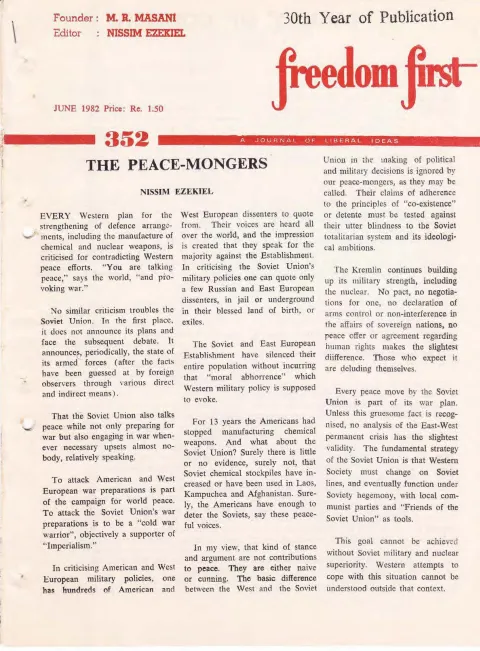
The Peace-Mongers
By NISSIM EZEKIEL
In the lead editorial, Nissim Ezekiel argues that Western peace campaigners who condemn NATO and American rearmament while giving the Soviet Union a pass are practising a double standard, since Soviet military build-up and expansionism proceed unannounced and unchallenged by internal debate. He contends every Soviet ‘peace’ initiative is part of a broader war strategy aimed at extending Soviet hegemony, and that Western disarmament advocates who ignore this are either naive or disingenuous.
- Western critics attack American and NATO rearmament as warmongering while treating Soviet military build-up as beyond criticism.
- The Soviet Union avoids public debate on its defence plans, unlike Western democracies.
- For 13 years the US halted chemical weapons manufacture; no comparable Soviet restraint is evidenced.
- Ezekiel calls the peace-movement stance ‘naive or cunning’ and rejects moral equivalence between Western and Soviet military policy.
- He frames every Soviet peace gesture as part of a strategy to achieve military and ideological superiority over the West.
A Variety of Comment (Intellectual Predisposition; The Hayflick Case; Polish Persecution)
By K. S. VENKATESWARAN
K. S. Venkateswaran’s miscellany column covers three unrelated items: a review of a Heritage Foundation essay collection (featuring economist Peter Bauer) on intellectuals’ hostility toward free markets; a recap of the Leonard Hayflick cell-ownership dispute with the US National Institutes of Health; and a report on the harsh sentencing of Polish trade unionist Ewa Kubasiewicz under martial law.
- A Heritage Foundation essay collection explores why intellectuals are predisposed against the free market despite market economics reducing statist horrors.
- Peter Bauer is praised for a ‘brilliant analysis’ demolishing arguments for state intervention in developing countries.
- The Hayflick case (1962-1981) pitted microbiologist Leonard Hayflick against the NIH over ownership of human cell lines WI-38 and WI-26, settled out of court with Hayflick retaining $90,000 in proceeds.
- Ewa Kubasiewicz, a Solidarity union organiser at a maritime college in Gdynia, was sentenced to 10 years imprisonment and 5 years’ loss of civil rights by Polish martial-law authorities.
Letter: Invitation to a Play
By M. R. MASANI
A published letter from M. R. Masani, in his capacity as Chairman of the Society For The Right To Die With Dignity, invites Freedom First readers in Bombay to attend a production of the play Whose Life Is It Anyway?, staged to mark the Society’s first year and to build public understanding of voluntary euthanasia.
- The Society For The Right To Die With Dignity completed one year of existence.
- The Society sponsored a production of Whose Life Is It Anyway? by Hosi Vasunia Productions, directed by Vijay Crishna.
- Shows were scheduled for 7 p.m. on Saturday 3rd and Sunday 4th July, with booking opening at Rhythm House from 23rd June.
Sikkim - Through Other Eyes
By M. R. MASANI
M. R. Masani responds to a reader’s letter accusing Freedom First of a double standard for condemning Western and Soviet imperialism while overlooking India’s 1975 annexation of Sikkim. Masani concedes the criticism has merit, noting his own past objections to the Sikkim takeover, and cites his and Jayaprakash Narayan’s efforts on Kashmir and Nagaland as evidence the magazine has not been silent on Indian actions, while acknowledging that prominent Indian critics of foreign imperialism are rare when it comes to India’s own conduct toward smaller neighbours.
- A reader living in Asia praised Freedom First’s editorials on Poland but challenged it to apply the same standard to India’s annexation of Sikkim.
- Masani states he was ‘quite disgusted’ by the Sikkim takeover and welcomed Morarji Desai’s later admission that it could not be justified.
- Masani cites his membership in the India-Pakistan Conciliation Group (with Mrs. Malati Singh) and Jayaprakash Narayan’s role in negotiating a Nagaland ceasefire as evidence of consistency.
- He concludes that Indian public figures rarely apply anti-imperialist principles to India’s own conduct, quoting the reader’s letter extensively.
- Masani acknowledges the magazine has ‘never lowered our flag’ on Kashmir or Nagaland even while conceding the broader point about double standards.
The Falkland Islands Issue: How the Soviets Gain
By RAMA SWARUP
Rama Swarup analyses how the Falklands crisis has benefited the Soviet Union, arguing that Argentina’s right-wing junta under Galtieri and the Soviet Politburo are using each other opportunistically despite ideological incompatibility, with Moscow gaining grain and arms trade, nuclear material sales, and strategic advantage from the resulting rift between Britain/the US and Latin America.
- Argentina, despite being anti-Communist, has become open to Soviet support during the Falklands dispute, including a possible arms deal.
- The Soviet Union has become Argentina’s largest grain customer, with 80 percent of Argentine grain and oil-seed exports going to the USSR in 1982.
- Moscow has agreed to send Argentina $500 million in oil equipment and supply enriched uranium and heavy water for its nuclear programme, worrying Washington about proliferation.
- The crisis threatens to unseat Margaret Thatcher, a vocal anti-Communist, and could disrupt Reagan’s Latin American Cold War strategy.
- A Western diplomat is quoted saying the Soviets are ‘the only winners in this crisis.‘
Why Salvador is not Reagan’s Poland
By GORDON BROOK-SHEPHERD
Gordon Brook-Shepherd, reprinted from the Sunday Telegraph, rebuts the ideological equivalence Moscow draws between Poland and El Salvador, arguing that the West has never militarily intervened to support Solidarity the way the Soviet bloc has armed and advised Salvadoran guerrillas, and that Reagan’s application of the Monroe Doctrine differs fundamentally from the Brezhnev Doctrine’s use of force to preserve the socialist camp.
- Moscow accuses Washington of doing worse in Central America than the Kremlin has done in Poland, a comparison Brook-Shepherd rejects.
- The West honoured the Helsinki Pact’s acceptance of Europe’s post-war boundaries; the Soviet Union did not honour its counter-pledge to extend liberties.
- Cuban, Czech and East German advisers actively support Salvadoran guerrillas, unlike the restraint shown by the West toward Solidarity.
- The article draws a contrast between Afghanistan (Soviet military intervention) and El Salvador (US-backed elections), arguing the moral weight favours the West.
- Britain’s pro-American stance on the Falklands has opened a diplomatic gap that France, under Mitterrand, is filling by restoring the Paris-Bonn axis.
Book Reviews (The Truth About Afghanistan; Report on Afghanistan; The India of Our Dreams)
By HAVOVI ANKLESARIA / ADAM ADIL / V. B. KARNIK
Three book reviews: Havovi Anklesaria reviews The Truth About Afghanistan (Novosti Publishing House), a Soviet propaganda volume she finds repetitive, evasive, and unconvincing as a justification for the Russian occupation; Adam Adil reviews the Asian Lawyers’ Legal Inquiry Committee’s Report on Afghanistan, chaired by P. N. Lekhi, which documents the Soviet-backed political history from the 1964 constitutional monarchy through Daoud’s, Taraki’s, and Amin’s regimes to the Soviet-installed Babrak Karmal government; and V. B. Karnik reviews The India of Our Dreams, an edited volume of essays by Indian journalists (edited by M. V. Kamath) united in advocating expansion of freedom and decentralisation of power, followed by a short excerpt from The Economist titled ‘Nation In Search Of Role?’ on India’s international image.
- Anklesaria calls The Truth About Afghanistan hollow propaganda that ‘arouses anger for the destruction of an innocent nation’ rather than vindicating Soviet presence.
- The book claims 30,000 peasants received land under agrarian reform without addressing what happened to previous owners.
- Adam Adil’s review of the Lawyers’ Committee report traces Afghanistan’s history from the 1964 constitutional monarchy through Daoud’s 1973 coup, Taraki’s Communist takeover, Amin’s ascension, and the Soviet-backed installation of Babrak Karmal.
- V. B. Karnik notes the contributors to The India of Our Dreams disagree on remedies but unanimously favour expansion of freedom and decentralisation of power over tightening state control.
- An Economist excerpt observes India is perceived abroad as ‘a poor and faraway corner of a lost empire’ still ‘in search of a role’ after more than 20 years.
Nation in Search of Role? (reprinted from The Economist, March 27, 1982)
The International Confederation of Free Trade Unions’ May Day message, marking its motto ‘Bread, Peace and Freedom,’ surveys global threats to workers’ rights — from Solidarity’s suppression in Poland to trade-union persecution in Turkey, Latin America, and apartheid South Africa — and calls on governments to abandon nuclear and conventional arms build-up, resume disarmament negotiations, and honour ILO-protected labour rights.
- The ICFTU represents 130 affiliated organisations in 91 countries with 85 million members.
- The message demands the release of all Solidarnosc members and observance of Polish freedom-of-association commitments under ILO conventions.
- It cites 52 Turkish trade unionists at risk of death sentences for union activity.
- It calls for withdrawal of Soviet SS-20 missiles and abandonment of US/NATO Cruise, Pershing II, and neutron weapons production.
- The statement links unemployment, hunger, poverty and oppression to the case for disarmament and a new international economic order.
May Day Message of the International Confederation of Free Trade Unions
A compiled digest of excerpted news reports under six headings: North Korea’s political labour camps (from The Guardian), smuggled Solidarity testimony from Jacek Kuron and Adam Michnik warning of Polish bloodshed (The Observer), an American ‘new isolationism’ critiqued by Max Lerner (The New Republic), a Soviet crackdown on Western-style youth fashion in Ukraine (The Times), improving but morally troubling Cuban-Argentine relations amid the Falklands war (Swiss Press Review), and a first-hand account of degrading conditions in Delhi’s Tihar jail (PUCL Bulletin).
- South Korean intelligence estimates North Korea holds at least 105,000 political prisoners in labour camps, some reportedly former high-ranking officials.
- Solidarity advisers Kuron and Michnik smuggled out documents from Bialoleka prison warning martial law could end in a ‘Polish bloodbath’ absent compromise.
- Max Lerner’s New Republic piece is quoted describing an emerging American isolationist stance toward Soviet expansionism.
- Soviet ‘clean-cut Communist vigilantes’ in Ukraine are reported rounding up youths wearing Western jeans and T-shirts as ideologically subversive.
- Cuba pivoted from criticizing to fully supporting Argentina’s Falklands invasion within days, while Argentina is separately noted to hold roughly 800 political prisoners without trial.
- A PUCL Bulletin account describes overcrowding, poor food, absent medical care, and abuse of prisoners at Tihar jail, contrasted with conditions during the Emergency.
Glimpses of Our World Today (North Korea; Poland; America; Russia; Cuba and Argentina; India)
The recurring ‘With Many Voices’ column closes the issue with a set of pointed quotations on the Falklands crisis, Cold War rhetoric, and ideology, drawn from figures including Tennyson, President Reagan, Jean-Francois Revel, Lenin, P. W. Botha, and Bernard Shaw, followed by the subscription form and the issue’s printer/publisher imprint.
- A Times of London quote suggests Reagan could better afford to lose General Galtieri than Mrs. Thatcher.
- Jean-Francois Revel is quoted linking the French Gaullist right and Socialist left through shared xenophobia and isolationism.
- Lenin is quoted (Party Congress, 20 April 1921) conceding socialism is better than capitalism, but capitalism better than medievalism.
- Bernard Shaw is quoted calling America the only country to go from barbarism to decadence without an intervening period of civilisation.
- The page also carries the Freedom First subscription order form and the publication’s legal imprint naming J. R. Patel as Associate Editor and printer.
Generated by the v1.5 extraction pipeline. Awaiting editorial review.
Metadata and summary are AI-extracted from the source PDF and reviewed for editorial accuracy. The original work is available via the Read PDF tab above (where present); paragraph-level citation inside the PDF is deferred to a future engagement.