periodical issue
Freedom First
A Journal of Liberal Ideas
By K. S. Venkateswaran, Alexander Solzhenitsyn, Rashmi Taneja, Rama Swarup, Shanti Saroop Bansal, Shankar Raj, S. S. Bankeshwar
Published for the Democratic Research Service by J. R. Patel, Associate Editor, Freedom First at 127, Mahatma Gandhi Road, Bombay 400 023 (Phone: 273914) and Printed by him at The Popular Press (Bom.) Pvt. Ltd, 35C Tardeo Road, Bombay 400 034 · Bombay · 1982
16 pages
Freedom First
Summary
Freedom First No. 353 (July 1982) is a monthly issue of the Bombay-based liberal journal founded by M. R. Masani, edited at this point by Nissim Ezekiel. Marking the magazine’s 30th year of publication, the issue opens with Ezekiel’s own editorial lamenting a ‘cultural vacuum’ in Indian public life, then moves through a mix of domestic and international commentary: a three-part comment column on the BBC’s Falklands coverage and press freedom, judicial activism over Bombay pavement-dweller evictions, and Amnesty International’s findings on Uganda; a syndicated Alexander Solzhenitsyn polemic against Western complacency in the face of Soviet expansion; reporting on the Iran-Iraq war’s regional fallout, on Indian diplomatic drift toward the Soviet-backed Kabul regime, and on alleged KGB funding of Western European peace movements; a book review of an interdisciplinary poverty-studies volume; and a satirical ‘Open Letter’ mocking political defectors amid the Haryana/Himachal Pradesh floor-crossing crisis. The issue closes with the ‘With Many Voices’ quotations column and the magazine’s own subscription appeal.
Key points
-
Nissim Ezekiel’s “The Cultural Vacuum” argues India’s institutional dysfunction stems from the absence of a shared democratic culture beneath the formal machinery of politics, calling for organic cultural revival rather than Westernisation.
-
K. S. Venkateswaran’s “A Variety Of Comment” praises the BBC’s defence of its Falklands coverage against government pressure, criticises continued opposition to Bombay’s pavement-dweller clearances, and summarises an Amnesty report finding Uganda’s human rights record unimproved under Milton Obote.
-
Alexander Solzhenitsyn’s reprinted polemic attacks Western media’s enforced cheerfulness and one-sided reporting for blinding it to communism’s advance, arguing Western capitalism is unwittingly arming the “communist monster.”
-
Rashmi Taneja’s “The Middle-East In Flames” argues Iraq’s real war aim against Iran was overthrowing Khomeini and pre-empting Shiite unrest, tracing the Gulf Arab states’ alarmed formation of the Gulf Co-operation Council.
-
Rama Swarup criticises India’s Kabul ambassador for defending Soviet “war aims” more zealously than the Soviets themselves, as Kabul Radio brands India an “enemy of the Afghan people.”
-
Shanti Saroop Bansal reports defector Stanislav Levtjenko’s claims that the KGB funds and directs Western European peace movements, detailing a Danish Communist Youth “Catalog” of disinformation tactics.
-
A review of an interdisciplinary poverty-studies volume appears alongside S. S. Bankeshwar’s satirical “Open Letter” mocking rebel MLAs and professional defectors amid the 1982 Haryana and Himachal Pradesh floor-crossing crisis.
Essays
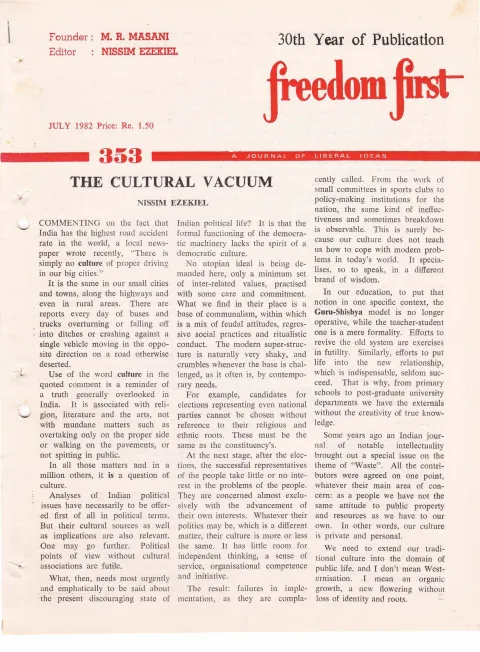
The Cultural Vacuum
By Nissim Ezekiel
In this lead editorial, Nissim Ezekiel argues that India’s chronic failures — from traffic chaos to dysfunctional democratic institutions — stem from a ‘cultural vacuum’: a democratic culture has never taken root beneath the formal machinery of politics. He contends that Indian political life is instead undergirded by communalism, feudal attitudes, and ritualistic conduct, which explains the ineffectiveness of everything from sports-club committees to national policy bodies. He extends the critique to education, arguing the old Guru-Shishya model has collapsed without a working substitute, and to public ethics, noting Indians treat public property with a carelessness they would never show their own. He closes by calling for an organic revival of traditional culture into public life, distinguishing this from mere Westernisation.
- India’s high accident rates and institutional dysfunction are traced to an absence of shared democratic culture, not lack of law.
- Election candidates cannot be chosen without appeal to religious and ethnic roots matching the constituency.
- Elected representatives show little interest in constituents’ problems once in office, regardless of party.
- The Guru-Shishya educational model is defunct and has not been replaced by a genuine teacher-student relationship.
- A national magazine’s special issue on ‘Waste’ found consensus that Indians treat public property differently from private property.
- Ezekiel calls for organic cultural growth into public life, explicitly not Westernisation.
A Variety Of Comment (Courageous Stand / Judicial Activism / Amnesty on Uganda)
By K. S. Venkateswaran
K. S. Venkateswaran’s ‘A Variety of Comment’ column covers three unrelated items. The first praises BBC Chairman George Howard’s defence of the corporation’s Falklands War coverage against government pressure, comparing it to Director-General John Reith’s resistance to Winston Churchill’s demand that the BBC serve as a government mouthpiece during the 1926 General Strike. The second criticizes Bombay’s civil-rights activists and the Supreme Court for obstructing the state’s clearance of unauthorised pavement dwellings, arguing the activists’ opposition is ‘meaningless and disquieting’ given the government’s now-lawful, notice-based approach. The third summarises an Amnesty International report, sourced to defector-turned-informant testimony, describing extra-legal killings, torture, and detention without due process under Milton Obote’s Uganda, arguing conditions have not improved since Idi Amin.
- BBC Chairman George Howard’s defence of Falklands coverage is likened to Reith’s 1926 stand against Churchill.
- Reith’s diary is quoted refusing to let the BBC become a government propaganda instrument during the General Strike.
- The column argues Bombay’s pavement-dweller clearance now follows due legal process (notice, alternative arrangement) and faults activists for continued opposition.
- It cites a Supreme Court-quoted anonymous judge questioning what legal basis trespassers have to alternative accommodation.
- An Amnesty International report on Uganda under Milton Obote describes mass executions, torture, and abductions, including named victim J. Mawange.
- The column concludes Uganda’s human rights record has not improved despite the change of regime from Idi Amin to Obote.
Why Can’t The West See This Is No Time To Smile?
By Alexander Solzhenitsyn
Alexander Solzhenitsyn’s polemic, reprinted from The Times (May 11, 1982), attacks Western media and public culture for an enforced cheerfulness that he says blinds it to the advance of totalitarianism, contrasting this with the East’s inherited resignation to suffering. He accuses Western television crews of one-sided reporting that undermines besieged anti-communist governments (citing Vietnam and El Salvador) while ignoring repression in Soviet-aligned states like Nicaragua and Afghanistan. He extends this into a broader argument that communism has swallowed roughly 40 countries, mocks Eurocommunists like Santiago Carrillo and Enrico Berlinguer for claiming distance from the Soviet model without renouncing Marxism, and argues Western capitalism, in pursuit of profit, is unwittingly arming the ‘communist monster.’ He closes warning that time is short to find a ‘third road’ grounded in spiritual renewal rather than economic dogma, and warns of the danger of a Sino-Soviet rapprochement.
- Solzhenitsyn contrasts enforced Western cheerfulness with the East’s honest, ‘downcast’ demeanor born of accumulated suffering under totalitarianism.
- He accuses Western TV networks of one-sided coverage that supports losing anti-communist governments’ opponents (Vietnam, El Salvador) while sparing Sandinist Nicaragua and Soviet Afghanistan similar scrutiny.
- He argues roughly 40 countries have already been ‘swallowed’ by communism and predicts continued American retreat until communists reach Texas.
- He imagines how film crews would have covered Trotsky, Denikin, and Kolchak in the 1917-1922 Russian Civil War, arguing Western media would have sided against the anti-Bolshevik forces.
- He mocks Eurocommunist leaders Carrillo and Berlinguer as insufficiently distinct from the Soviet model despite their claimed independence.
- He argues Western capitalists, driven by profit, are arming the ‘communist monster’ that will destroy them, and calls for a ‘third road’ focused on spiritual foundations rather than economic combinations.
- He warns that a Soviet-Chinese reconciliation would make the communist threat even more dangerous.
The Middle-East In Flames
By Rashmi Taneja
Rashmi Taneja’s report surveys the regional consequences of the Iran-Iraq war after Iran’s recapture of Khorramshahr. She argues Iraq’s stated aim of controlling the Shatt-al-Arab masked its true objective of overthrowing Ayatollah Khomeini and forestalling Shiite unrest within Iraq itself, a strategy that backfired badly on President Saddam Hussein as Iraqi casualties mounted and Iran’s Islamic clergy consolidated power domestically. She surveys the alarm this has caused among Gulf Arab states with sizable Shi’ite minorities, their formation of the Gulf Co-operation Council, and their turn toward Egypt for security despite Egypt’s isolation over its peace treaty with Israel. She also notes the U.S.’s weakened regional position after the Shah’s fall and Secretary of State Alexander Haig’s inconclusive new diplomatic initiative, closing with the observation that the Soviet Union has armed both sides while gaining leverage in the Gulf.
- Iraq’s real war aim, per Taneja, was overthrowing Khomeini and pre-empting Shiite unrest at home, not merely securing the Shatt-al-Arab.
- At least 30,000 Iraqis are reported dead and 35,000 taken prisoner, with a substantial reduction in Iraqi oil output.
- Gulf Sunni monarchies, alarmed by Iranian victories, formed the Gulf Co-operation Council (Saudi Arabia, Kuwait, Qatar, Bahrain, UAE) to coordinate policy.
- These states are turning to Egypt for military backing despite Egypt’s Arab-world isolation after its Israel peace treaty.
- U.S. Secretary of State Alexander Haig’s May diplomatic initiative did not spell out how the war’s resolution would be achieved.
- The Soviet Union has supplied arms to both Iran and Iraq and is positioned to gain influence in the Gulf.
Kabul Radio Shows India As “Enemy Of The Afghan People”
By Rama Swarup
Rama Swarup criticizes the Indian government’s diplomatic posture toward the Soviet-installed Karmal regime in Kabul, arguing the Indian Ambassador in Afghanistan appears to be defending Soviet ‘war aims’ more zealously than the Soviets themselves, at the cost of stoking anti-Indian sentiment in Afghan bazaars fuelled by Kabul Radio’s characterization of India as an ‘enemy of the Afghan people.’ Swarup insists India must publicly clarify that it does not endorse Soviet expansionism despite its friendship treaty with Moscow, and cites an International Institute of Strategic Studies appraisal concluding the Karmal government lacks popular support and has failed both politically and militarily.
- Swarup argues India’s ambassador in Kabul is offering explanations of Soviet ‘war aims’ more assiduously than Soviet diplomats themselves.
- Kabul Radio broadcasts describe India as a ‘standard bearer of international communism,’ which the article says India must publicly reject.
- The article calls for India to clarify there is no linkage between its dealings with the Karmal regime and broader Soviet ideological hegemony.
- The International Institute of Strategic Studies is cited concluding the Karmal government lacks a domestic political base and has failed to improve security or popularity.
- Armed opposition to the Karmal regime is described as remaining ‘active’ despite Soviet military presence.
Western Peace Movements Influenced By The KGB
By Shanti Saroop Bansal
Shanti Saroop Bansal reports on claims by former KGB Major Stanislav Levtjenko, now granted U.S. asylum, that the KGB channels funding and strategic direction to Western European peace movements opposing NATO’s planned deployment of medium-range missiles. The article details a Danish Communist Youth ‘Catalog of Ideas for the Peace Struggle’ describing disinformation tactics, including a forged letter attributed to NATO Secretary General Joseph Luns, methods for staging panic through fake emergency broadcasts, and instructions for obtaining American military surplus uniforms. It closes noting Danish Progress Party figure Uffe Thorndal’s push for government disclosure of Soviet funding to Danish peace groups.
- Former KGB Major Stanislav Levtjenko, granted U.S. asylum, alleges direct KGB funding and coordination of Western European peace movements.
- A Danish Communist Youth organization’s ‘Catalog of Ideas for the Peace Struggle’ outlines disinformation tactics against NATO’s missile deployment.
- A forged letter attributed to NATO Secretary General Joseph Luns to U.S. Secretary of State Haig was circulated to a West German newspaper to alarm the German public.
- The Catalog advises using NATO’s own propaganda material against it and details how to obtain American military surplus uniforms.
- Danish Progress Party figure Uffe Thorndal has petitioned government ministers to disclose Soviet financial support for Danish peace movements.
Book Review: Poverty: An Interdisciplinary Approach (eds. B. Sarveswara Rao and V. N. Deshpande)
By Shankar Raj
Shankar Raj reviews ‘Poverty: An Interdisciplinary Approach’ (edited by B. Sarveswara Rao and V. N. Deshpande, Madras Institute of Development Studies/Somaiya Publications), a compilation of papers from three South Indian workshops held in 1974-76. The review notes the book draws on economics, philosophy, anthropology, geography, sociology, psychology, and nutrition, organized around ‘Who are the Poor?,’ regional planning against poverty, and rural living-standard indicators. Raj highlights editor C. T. Kurien’s candid evaluation that many participants lacked genuine interdisciplinary engagement, with late-coming and early-leaving common despite advance circulation of papers, and concludes the volume, while not path-breaking, offers valuable interdisciplinary breadth for general readers.
- The reviewed volume compiles papers from three workshops (1974, 1975, 1976) held at various South Indian centres, mostly by Southern delegates.
- Disciplines represented include economics, philosophy, anthropology, geography, sociology, psychology, and nutrition.
- Editor-evaluator C. T. Kurien notes many participants showed little genuine interest in interdisciplinary discussion despite advance circulation of papers.
- The review judges the papers individually unremarkable (‘none…makes a path-breaking contribution’) but the volume’s interdisciplinary breadth valuable for general readers.
- The reviewer recommends the book primarily to non-economist general readers over specialists.
Open Letter: An Open Letter to Rebel M.L.A.’s of All Parties and Professional Defectors in Haryana and Himachal Pradesh
By S. S. Bankeshwar
S. S. Bankeshwar’s satirical ‘Open Letter’ addresses rebel MLAs and ‘professional defectors’ amid the 1982 floor-crossing crisis in Haryana and Himachal Pradesh, where no party held a clear majority (Himachal: Congress-I 29, BJP 29, Janata 2, Independents 6; Haryana: Congress 34, BJP 5, Lok Dal 31, others 16). Framed as an advertisement for a satirical ‘University of Defectors,’ the piece mocks the moral rationalizations used to justify political defection — including invoking Ramayana and Mahabharata figures like Sugriva and Vibhishana as precedent — and lists mock ‘subjects for specialisation’ such as justifying defection as pragmatism and using Trojan Horse tactics to destroy a party from within.
- The piece satirizes the 1982 hung-assembly floor-crossing crisis in Haryana and Himachal Pradesh with precise seat tallies for each party.
- It frames defection as a mock academic ‘University of Defectors’ with admissions open only to ‘persons with a smooth record of successful defection’.
- It mockingly invokes Ramayana/Mahabharata figures Sugriva, Vibhishana, and Balarama as mythological precedents for defection.
- Mock curriculum subjects include justifying defection as pragmatism and using a ‘Trojan Horse’ strategy to destroy a party from within.
- The satire closes noting that fighting the official candidate invites disciplinary action, but winning invites recruitment by rival parties.
Generated by the v1.5 extraction pipeline. Awaiting editorial review.
Metadata and summary are AI-extracted from the source PDF and reviewed for editorial accuracy. The original work is available via the Read PDF tab above (where present); paragraph-level citation inside the PDF is deferred to a future engagement.