periodical issue
Freedom First
A Journal of Liberal Ideas
Published for the Democratic Research Service by J. R. Patel, Associate Editor, Freedom First at 127, Mahatma Gandhi Road, Bombay 400 023 (Phone: 273914) and Printed by him at The Popular Press (Bom.) Pvt. Ltd. 35C Tardeo Road, Bombay 400 034 · Bombay · 1982
16 pages
Freedom First
Summary
Freedom First No. 355 (September 1982, 30th year of publication) is the monthly journal of liberal ideas published by the Democratic Research Service, founded by M. R. Masani and edited by Nissim Ezekiel. In the rendered pages, the issue opens with S. A. A. Pinto’s essay “The Root of All Evil,” which traces India’s epidemic of corruption and black money to the Industries (Development and Regulation) Act, licensing controls, and socialist planning, and calls for a new political party willing to tell the poor that the socialist system has failed. K. S. Venkateswaran’s regular “A Variety of Comment” column covers President Mobutu’s defiance of Arab-African pressure over Zaire’s ties with Israel, praises George Gilder’s Wealth and Poverty as a defence of free enterprise, and reports on mass executions under Iran’s post-1979 regime. Arvind Deshpande poses a series of open questions on federalism, state autonomy, and constitutional design in “The Autonomy Demand.” The editorial board pays tribute to the Australian journal Quadrant on its 25th anniversary. A reprinted Kenyan editorial by George Githii, “Speaking Out of Turn in Kenya” (introduced by M. R. Masani), protests preventive detention and the harassment of a lawyer and university lecturers, and is followed by commentary linking Kenya’s situation to India’s own constitutional bill of rights and its tension with preventive-detention law. Rama Swarup’s “The Elusive Sino-Soviet Detente” analyses Brezhnev’s 1982 Tashkent overture to China and the mutual distrust between Moscow and Beijing. Also included are a reader’s letter (P. S. Daver) proposing that programme booklets carry inspirational citations, with a reply from Masani; a report on a seminar on ageing (“The Aged and Society”); and the “With Many Voices” column of aphoristic quotations from the world press.
Key points
-
S. A. A. Pinto’s “The Root of All Evil” traces India’s corruption and black money to the Industries (Development and Regulation) Act and licensing controls, calling for a new political party to tell the poor that socialism has failed.
-
K. S. Venkateswaran’s “A Variety of Comment” praises Zaire’s President Mobutu for defying Arab-African pressure over Israel ties, welcomes George Gilder’s Wealth and Poverty as a defence of free enterprise, and reports mass executions under Iran’s post-1979 regime exceeding official figures.
-
Arvind Deshpande’s “The Autonomy Demand” poses open questions about how far India should devolve autonomy to states, warning greater autonomy could worsen parochialism and citing Kashmir, Punjab’s Akalis and Kerala/West Bengal’s Marxists as cautionary examples.
-
A tribute marks the Australian journal Quadrant’s 25th anniversary, crediting Polish emigre Richard Krygier as its guiding figure since founding.
-
A reprinted Kenyan editorial by George Githii protests preventive detention and self-censorship in Kenya, explicitly likened by the accompanying commentary to India’s own Emergency-era experience.
-
Rama Swarup’s “The Elusive Sino-Soviet Detente” analyses Brezhnev’s 1982 Tashkent overture to China and Beijing’s dismissive response, concluding neither side genuinely seeks reconciliation.
-
A symposium report, “The Aged and Society,” surveys the health, psychological and social dimensions of ageing in India, noting the erosion of elderly family members’ traditional decision-making role despite the nominal persistence of joint families.
Essays
The Root of All Evil
By S. A. A. PINTO
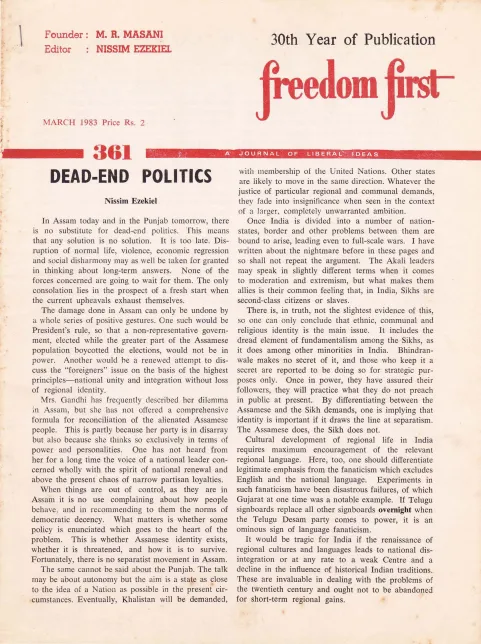
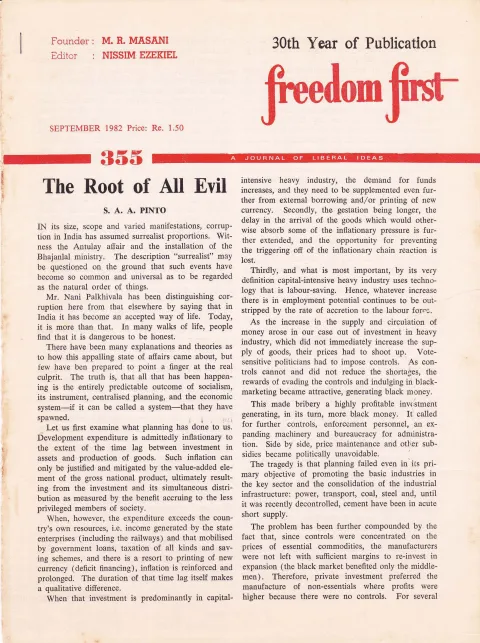
S. A. A. Pinto argues that India’s rampant corruption and black money are not aberrations but the predictable outcome of socialism and centralised planning. He traces a causal chain from the Industries (Development and Regulation) Act of 1951 and the Industrial Policy Resolution, through artificial scarcity created by licensing, to bribery, evasion, and the corrupting nexus between politicians and businessmen who fund elections with black money. He concludes that a new political party is needed to organise the poor and unemployed outside the shrinking “tent” of the existing economy and to make the case that socialism has failed.
- Corruption in India (citing the Antulay affair and the Bhajanlal ministry) is presented as an entirely predictable outcome of socialism and centralised planning, not an isolated moral failure.
- The Industries (Development and Regulation) Act of 1951, built on the Industrial Policy Resolution, enforced licensing that created artificial scarcity (‘excess production’ becomes punishable).
- Scarcity created by licensing makes bribery for licences and permits highly profitable, which in turn fuels black money and tax evasion.
- Businessmen become dependent on political favour and are pressured to fund the re-election of politicians, often financing rival candidates as insurance.
- Because political donations were regulated and then banned, all such funding had to move into black money, deepening the cycle.
- Nationalisation is described as a mechanism that transfers private wealth into a government ‘cess pool,’ expanding patronage, inefficiency, and corruption.
- The author calls for a new political party to organise the growing population outside the shrinking economic ‘tent’ — unemployed and below the poverty line — around the message that the socialist system has failed and an alternative offering ‘bread with freedom’ is possible.
A Variety of Comment
By K. S. VENKATESWARAN
K. S. Venkateswaran’s regular column “A Variety of Comment” runs three short items. The first praises Zaire’s President Mobutu Sese-Seko for resuming diplomatic ties with Israel despite Arab pressure, quoting his rebuke of Arab-African ‘solidarity’ as a one-way ‘wagon and locomotive’ arrangement. The second welcomes George Gilder’s Wealth and Poverty as a rare lucid defence of free-enterprise philosophy against a demoralised consensus that capitalism suffers inherent moral and social contradictions. The third reports on mass executions in Iran since the 1979 revolution, citing Amnesty International’s estimate that the true toll exceeds the regime’s own figure of 4,400, and recounts the case of Omid Gharib, executed despite a lighter official sentence.
- Zaire’s President Mobutu is praised for defying Arab-African pressure by maintaining ties with Israel, and for calling Arab-African solidarity a one-sided ‘wagon and locomotive’ arrangement.
- George Gilder’s Wealth and Poverty is described as an important defence of free enterprise against a widespread, largely unrebutted consensus (shared by left and right) that capitalism has deep moral and social flaws.
- Gilder is credited with influence on Reagan-era ‘supply-side’ economic policy.
- Iran’s post-revolutionary regime is reported to have executed far more people than its official figure of 4,400, per Amnesty International.
- The case of Omid Gharib — arrested for a private letter, indicted for having been ‘Westernised,’ and executed despite a three-year sentence — is cited as an example of the regime’s arbitrary brutality.
The Autonomy Demand: Some Questions
By ARVIND DESHPANDE
Arvind Deshpande’s “The Autonomy Demand: Some Questions” poses a series of open, numbered questions about how far India should devolve autonomy to states and regions. He surveys India’s history of de facto regional autonomy even under strong central rulers, the British-era balance of autonomy with accountability, and the risk that greater autonomy could either broaden or narrow citizens’ horizons, worsening parochialism, intolerance of dissent, or minority repression. He raises comparisons to Switzerland, Canada, Australia and West Germany, questions B. K. Nehru’s proposal for direct rural-level elections with indirect elections above the district level, and asks what role a Governor should play in more autonomous states, concluding that any workable model of autonomy must lead to a more open, democratic, and accountable polity rather than parochial insularity.
- India has historically been a ‘quasi-federal polity with strong unitary overtones,’ with regions retaining de facto autonomy even under strong central rulers like Ashoka or Akbar.
- The British combined disarming the princely states with a degree of openness and autonomy-with-accountability, which the author treats as a template.
- Greater regional autonomy risks worsening parochialism, intolerance of dissent, and administrative corruption, citing examples like Kashmir, the Akalis in Punjab, and Marxists in Kerala/West Bengal.
- The author asks whether lessons on balancing autonomy and unity can be drawn from federal systems in Switzerland, Canada, Australia, and West Germany.
- B. K. Nehru’s proposal for direct elections only at the rural unit level, with indirect elections upward, is questioned as potentially entrenching local bosses without accountability.
- The piece asks what role a Governor or ‘umpire’ figure should play in protecting minority interests within more autonomous states.
- The author insists any move toward autonomy must be judged by whether it produces a more open, responsible, and democratic polity, not merely reservation-minded parochialism.
Tribute to Quadrant
No summary was extracted for this article. Listed for completeness.
Speaking Out of Turn in Kenya
By George Githii (editorial reprinted from The Standard, Kenya; introductory note by M. R. Masani)
A short editorial note from the Freedom First editorial board congratulates the Australian journal Quadrant, published by the Democratic Research Service’s Australian counterpart, on its 25th anniversary, praising its sustained commitment to freedom and intellectual inquiry alongside journals like Encounter, and paying particular tribute to Richard Krygier, the Polish emigre who has been its mainstay since founding.
- Freedom First offers congratulations to Quadrant (Australia) on its 25th anniversary.
- Quadrant is compared favourably to Encounter as a journal sustaining freedom-oriented intellectual inquiry.
- Richard Krygier, a Polish emigre to Australia, is credited as the guiding figure behind Quadrant across 25 years.
- Australian Prime Minister Malcolm Fraser reportedly attended and spoke at the anniversary dinner.
- The tribute recalls the late Jayaprakash Narayan and Minoo Masani as past readers who valued Quadrant.
[Untitled continuation re: Constitution, bill of rights, preventive detention act]
Freedom First reprints, with an introductory note by M. R. Masani, the full text of an editorial by George Githii, editor of Kenya’s The Standard, protesting the climate of fear created by preventive detention in Kenya — including the reported detention of lawyer John Khaminwa and the resignations of university lecturers afraid to express views. Masani notes that Githii’s own newspaper disowned the editorial and that Githii himself faced possible arrest for ‘treason.’ The piece, and the commentary that follows it, draws an explicit parallel to India’s own experience with the Emergency (1975-77) and its Constitution’s Bill of Rights, arguing that preventive detention law contradicts the Constitution’s guarantees of personal liberty and due process, and calls for repealing or strictly limiting such laws to wartime.
- The reprinted Kenyan editorial by George Githii protests detention without trial, self-censorship among university lecturers, and intimidation of journalists and lawyers in Kenya.
- Masani’s introduction notes that Githii’s own paper, owned by Lonrho, disowned the editorial as ‘provocative’ and sacked him, and that he faced arrest on a charge of ‘treason.’
- The lawyer John Khaminwa was reportedly detained for defending dissidents and questioning executive power, not for any recognised crime.
- The commentary explicitly likens Kenya’s situation to India’s Emergency period (1975-1977).
- India’s Constitution’s Bill of Rights (chapter five) protects personal liberty and due process, but is said to directly contradict Section 85 and Section III of the Preservation of Public Security Act, which allow detention without due process.
- The author proposes three remedies: release of those detained without evidence, trial of those with evidence against them, and repeal or strict wartime-only limitation of preventive detention law.
The Elusive Sino-Soviet Detente
By RAMA SWARUP
Rama Swarup’s “The Elusive Sino-Soviet Detente” analyses Leonid Brezhnev’s March 1982 Tashkent speech proposing unconditional resumption of Sino-Soviet dialogue, and China’s cool, largely dismissive response. The essay traces the diplomatic back-and-forth through Chinese Foreign Ministry statements, Soviet media commentary (TASS, Novosti, Xinhua), the April 1982 trade agreement, and the ongoing Sino-Soviet border dispute, concluding that neither side genuinely seeks detente but each is manoeuvring for advantage — China wary of jeopardising its US relationship over Taiwan, and the USSR seeking to exploit US-China friction, while distrust and troop concentrations along the border persist.
- Brezhnev’s March 24, 1982 Tashkent speech proposed resuming Sino-Soviet dialogue ‘without prior conditions’ in a conciliatory tone.
- China’s Foreign Ministry spokesman Qian Qichen firmly rejected the overture on March 26, while pointedly not addressing the resumption-of-talks proposal itself.
- Soviet media (Novosti, TASS) emphasised Soviet goodwill while criticising China’s rejection as irresponsible; Chinese media (Xinhua) cited continued Soviet troop concentration on the border as evidence Brezhnev’s assurances were hollow.
- An April 16 Sino-Soviet trade agreement, estimated near $300 million, merely restored trade to 1980 levels rather than signalling a real thaw.
- The Far Eastern Economic Review is quoted arguing China cannot respond positively without risking its security relationship with the US over Taiwan.
- The Soviet Union reportedly demanded China return occupied territory near New Delhi during India-China talks, complicating any rapprochement.
- The essay concludes that neither the USSR nor China genuinely seeks detente; each seeks diplomatic advantage from the other’s difficulties, with world peace treated as a secondary consideration.
A Suggestion
By P. S. DAVER
In a letter titled “A Suggestion,” reader P. S. Daver praises the programme booklet for the play Whose Life Is It Anyway?, sponsored by the Society for the Right to Die with Dignity (founded and chaired by Minoo Masani), for including substantive reading matter rather than only advertisements. Daver proposes that advertisers sponsoring such programmes be encouraged to include inspiring citations instead of plain ‘With Best Compliments’ notices, illustrating the idea with a quoted suicide note from Charlotte Perkins Gilman on the right to choose death over prolonged suffering from cancer. Masani appends a brief editorial comment endorsing the suggestion for future souvenir programmes.
- The letter praises the programme for Whose Life Is It Anyway?, sponsored by the Society for the Right to Die with Dignity, founded and chaired by Minoo Masani.
- Daver suggests that advertisers in such programmes replace generic ‘With Best Compliments’ notices with inspiring citations relevant to the cause.
- He quotes at length Charlotte Perkins Gilman’s suicide note defending the right to choose ‘a quick and easy death’ over prolonged suffering from cancer.
- Masani replies briefly, endorsing Daver’s idea for future souvenir programmes.
The Aged and Society,
A book-review-section report, “The Aged and Society,” summarises a symposium held on April 7, 1982 (World Health Day), organised jointly by SNDT Women’s University’s Department of Continuing and Adult Education and the Tata Institute of Social Sciences, to mark 1982 as ‘The Year of the Aged.’ Experts including Dr. M. S. Gore, Dr. K. G. Desai, Dr. J. D. Pathak, Dr. (Mrs.) Neera Desai, Mrs. Leela Moolgaonkar, and Prof. A. N. Kothare discussed health, psychological, and social dimensions of ageing in India, noting faster ageing among Indians, rising numbers of elderly living alone or feeling alienated despite the nominal persistence of joint families, and the need for social security and health insurance schemes for the retired.
- The symposium, held April 7, 1982 on World Health Day, was organised by SNDT Women’s University and the Tata Institute of Social Sciences to mark the UN’s ‘Year of the Aged.’
- Dr. J. D. Pathak noted that Indians age faster, while reduced infant mortality and better disease control have increased the senior population.
- Dr. K. G. Desai discussed socio-psychological problems of the aged, noting Western patterns of isolation are increasingly appearing in urban India.
- Dr. Neera Desai observed that although the joint family structure persists nominally, elderly members have lost their traditional decision-making role, reversing to a situation where parents live with the children rather than the other way round.
- Mrs. Leela Moolgaonkar highlighted the role of the elderly in childcare within families and the traditional role of religious groups like bhajans and kirtan mandals in providing tranquility, alongside the need for social security and health insurance schemes.
- Prof. A. N. Kothare argued that active engagement, close family ties, and post-retirement pursuit of earlier unfulfilled ambitions were key to solving problems of old age.
- Dr. M. S. Gore called for strategies tailored to India’s cultural context to address the unique problems of the aged.
The Aged and Society: Report of a Seminar
The regular “With Many Voices” column collects short quotations from the international press and public figures on the theme of the issue’s news cycle, including remarks from The Economist, a Soviet radio broadcast, Lenin, Salman Rushdie, and commentary on Zia ul-Haq, feminism in politics, the IRA, and China’s economic aspirations.
- Quotes span British railway unions, Soviet Arabic-language broadcasting, Lenin on peace as an instrument of power, Salman Rushdie on British colonial legacy, and Trevor Fishlock on Zia ul-Haq.
- Includes Janet Watts’s observation that a token woman leader would not necessarily challenge the political status quo.
- Includes a Beijing People’s Daily quote on the acceptance of unequal enrichment as part of getting rich together.
- The column functions as a collection of pointed, often ironic, aphorisms rather than a single argument.
Generated by the v1.5 extraction pipeline. Awaiting editorial review.
Metadata and summary are AI-extracted from the source PDF and reviewed for editorial accuracy. The original work is available via the Read PDF tab above (where present); paragraph-level citation inside the PDF is deferred to a future engagement.