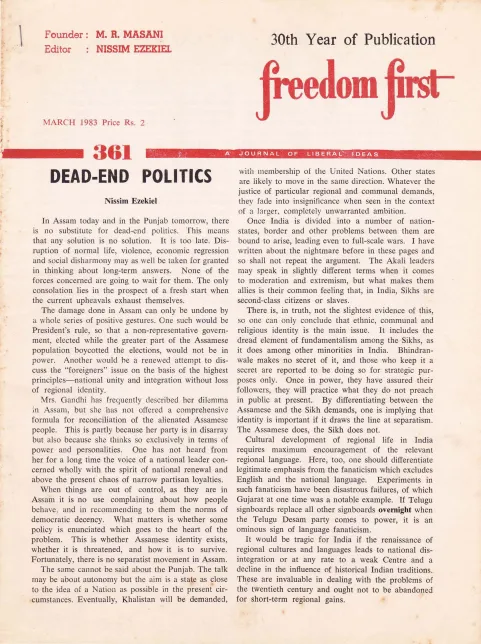
periodical issue
Freedom First
A Journal of Liberal Ideas
By NISSIM EZEKIEL, ALEXANDER SOLZHENITSYN, K. S. VENKATESWARAN, M. R. Masani, AZIZ MADNI, S. S. BANKESHWAR, RAMA SWARUP
Published for the Democratic Research Service by J. R. Patel, Associate Editor, Freedom First at 127, Mahatma Gandhi Road, Bombay 400 023 (Phone: 273914) and Printed by him at The Popular Press (Bom.) Pvt. Ltd., 35C Tardeo Road, Bombay 400 034 · Bombay · 1982
16 pages
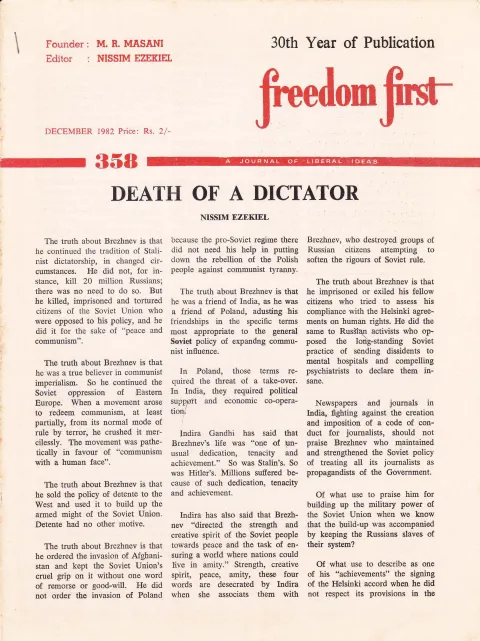
Freedom First
Summary
This December 1982 issue (No. 358, Rs. 2, 30th year of publication) of Freedom First, edited by Nissim Ezekiel and founded by M. R. Masani, opens with Ezekiel’s own editorial on the death of Soviet leader Leonid Brezhnev, followed by the full text of a speech by Alexander Solzhenitsyn delivered in Taipei warning free China and the West against complacency toward communist expansion. The issue’s recurring theme is anti-communist and anti-corruption critique: K. S. Venkateswaran’s regular “A Variety of Comment” column covers rural repression in Guatemala and El Salvador, a Bangladeshi drug-pricing ordinance, and the perils of welfarism via Tamil Nadu’s Nutritious Meal Scheme; Aziz Madni surveys corruption within the Soviet elite by drawing on Konstantin Simis’s book; and Rama Swarup details how the Soviet occupation is extracting Afghan natural gas as debt repayment. Also featured is S. S. Bankeshwar’s personal tribute to the late parliamentarian H. V. Kamath, a book review of Manohar Malgaonkar’s spy novel The Bandicoot Run, a reader’s letter responding to a prior interview with Morarji Desai on Islam and democracy, a publisher’s note from Chairman M. R. Masani announcing a subscription price increase, and the regular “With Many Voices” page of press quotations.
Key points
-
Nissim Ezekiel’s editorial “Death of a Dictator” rejects world leaders’ eulogies for Leonid Brezhnev, cataloguing his continuation of Stalinist repression, the invasion of Afghanistan, and non-compliance with the Helsinki accords, and criticises Indira Gandhi’s praise of his “dedication, tenacity and achievement.”
-
Alexander Solzhenitsyn’s Taipei speech, reprinted as “Free China and the Peoples of Asia,” praises Taiwan as proof of what China could have achieved without communist rule and condemns the West’s and the UN’s abandonment of Taiwan to appease Peking.
-
K. S. Venkateswaran’s “A Variety of Comment” covers Amnesty International reports of rural repression in Guatemala and El Salvador, a Bangladeshi ordinance banning 1,707 drugs, and Milton Friedman’s “no free lunch” critique applied to Tamil Nadu’s Nutritious Meal Scheme.
-
Aziz Madni’s “Corruption in the Communist Fatherland” surveys endemic Soviet elite corruption drawing on Konstantin Simis’s book, describing “Kremlin Canteens,” bribery for hospital admission and university entrance, and the diamond-smuggling scandal implicating Brezhnev’s daughter Galina.
-
S. S. Bankeshwar’s tribute “H. V. Kamath — a true Karma Yogi” remembers the late parliamentarian as an uncompromising politician who moved through the Forward Bloc, PSP and Janata Party without ever holding ministerial office by choice.
-
Sandhya Hariharan reviews Manohar Malgaonkar’s spy novel “The Bandicoot Run,” judging it a disappointment relative to his earlier acclaimed novels despite praising its morally ambivalent central character.
-
Rama Swarup’s “Kabul’s Debt To Moscow Requires Piping Out Of Its Gas For 10 Years” details how the Soviet occupation deducts the value of Afghan natural gas exports, priced well below world rates, from Afghanistan’s mounting war debt.
-
A reader’s letter from Adam Adil disputes Morarji Desai’s claim that Islamic countries are inherently undemocratic, arguing the early Khilafat was elected by democratic consensus and that India’s own democratic institutions derive from British rather than Hindu tradition.
-
In a publisher’s note titled “A Fair Deal,” M. R. Masani discloses that per-issue costs have risen to Rs. 1.66 against a Rs. 1.25 subscriber price and announces an increase to Rs. 20 a year to keep the journal financially viable.
Essays
Death of a Dictator
By NISSIM EZEKIEL
Nissim Ezekiel’s editorial “Death of a Dictator” is a polemical obituary of Soviet leader Leonid Brezhnev, rejecting the eulogies offered by world leaders including Indira Gandhi. Ezekiel catalogues Brezhnev’s record: continuation of Stalinist repression (though without mass killings on Stalin’s scale), the crushing of the Prague-era “communism with a human face” movement, the use of detente to build Soviet military strength, the invasion of Afghanistan, indifference to Poland’s Solidarity movement, imprisonment and psychiatric confinement of dissidents, and non-compliance with the Helsinki human-rights accords despite having signed them. He criticises Indira Gandhi’s praise of Brezhnev’s “dedication, tenacity and achievement,” noting the same words could describe Stalin or Hitler, and argues Indian journalists opposing press-code restrictions at home should not simultaneously praise a leader who imposed total control over the Soviet press. The piece closes by predicting Brezhnev’s historical image will be that of an oppressor, not a liberator.
- Argues Brezhnev continued Stalinist-style dictatorship in changed circumstances, killing fewer but still imprisoning and torturing dissidents.
- Cites the crushing of Czechoslovakia’s ‘communism with a human face’ movement and non-intervention rhetoric toward Poland’s uprising as evidence of Soviet imperialism.
- Contends detente was used solely to build Soviet military might, alongside the invasion of Afghanistan.
- Criticises Indira Gandhi’s tribute to Brezhnev as ‘dedication, tenacity and achievement,’ equating the phrase with descriptions that could apply to Stalin or Hitler.
- Calls out Indian press hypocrisy: opposing domestic press curbs (the Bihar Press Bill) while praising a leader who imposed total control over Soviet media.
- Concludes Brezhnev’s legacy will be as oppressor, not liberator.
Free China and the Peoples of Asia
By ALEXANDER SOLZHENITSYN
This is the full text of a speech by Alexander Solzhenitsyn delivered in Taipei on October 23, reproduced by Freedom First for its relevance to all peoples of Asia. Solzhenitsyn praises Taiwan (the Republic of China) as proof that a fragment of China spared communist rule could achieve prosperity and development, contrasting it with the destruction wrought by communism across the Soviet Union, Eastern Europe, mainland China, Vietnam, Cambodia and North Korea. He accuses the Western world, the United Nations (which expelled Taiwan), and third-world countries of cowardice and betrayal in abandoning free nations to appease communist powers, citing the abrogation of U.S.-Taiwan diplomatic relations and reduced American arms support. He warns against the myth of “good” versus “bad” communism, argues Taiwan’s 18 million people face a threat comparable to the Jewish people’s historical predicament, and urges Taiwan not to let prosperity soften its will to resist. He closes by expressing hope for eventual liberation of both Chinese and Russian peoples from communist rule, while cautioning that no outside power can be relied upon.
- Frames Taiwan/Republic of China as living proof of what China could have achieved without communist rule.
- Condemns the UN’s 1971 expulsion of the Republic of China and the West’s progressive ‘senility’ in defending free nations.
- Criticises the US abrogation of diplomatic relations with Taiwan and reduced military support as a betrayal driven by the illusion of an alliance with communist China.
- Rejects the notion of ‘good’ communism (attributed to some Western and South Korean sympathies toward Peking) as despair-driven myth-making.
- Warns that prosperity and complacency could weaken Taiwanese resistance and urges vigilance among the youth.
- Argues the communist system’s core hostility to Taiwan is ideological (fear of a ‘deviant’ free-Chinese model), not merely economic.
- Expresses hope that world communism will eventually be outlived by ordinary Chinese and Russian people working toward mutual liberation.
A Variety of Comment (Rural Repression; Drug Reforms in Bangladesh; The Perils of Welfarism)
By K. S. VENKATESWARAN
K. S. Venkateswaran’s regular column “A Variety of Comment” addresses three unrelated topics. First, “Rural Repression” surveys Amnesty International’s Prisoners of Conscience Week supplement documenting mass killings and torture of peasants in Guatemala and El Salvador, including a graphic account of the murder of a pregnant woman, Adelaida Aleman. Second, “Drug Reforms in Bangladesh” criticises a Bangladeshi martial-law Ordinance banning 1,707 pharmaceutical products (including proven drugs like ampicillin and tetracycline) as an arbitrary measure that will raise consumer prices and reduce availability, arguing many banned products are made by local firms, not multinationals. Third, “The Perils of Welfarism” invokes Milton Friedman’s ‘no free lunch’ argument to criticise Tamil Nadu’s Nutritious Meal Scheme, a large child-feeding programme launched without legislative debate, warning that such welfare schemes foster dependency and institutionalised corruption.
- Documents Amnesty International reports of mass torture and killing of rural populations in Guatemala and El Salvador in 1981-82.
- Criticises a Bangladeshi martial-law Ordinance removing 1,707 drugs from sale as arbitrary and likely to raise prices and reduce availability of proven medicines.
- Notes many banned Bangladeshi drug products are locally, not multinationally, manufactured, undercutting the stated rationale of curbing MNC influence.
- Uses Milton Friedman’s ‘no free lunch’ principle to critique Tamil Nadu’s Nutritious Meal Scheme as a costly, undebated welfare measure.
- Argues welfarism breeds a ‘culture of dependence’ and institutionalised corruption, citing the Tamil Nadu scheme as an example of unchecked state expansion.
Corruption in the Communist Fatherland
By AZIZ MADNI
Aziz Madni’s “Corruption in the Communist Fatherland” surveys allegations of endemic corruption in the Soviet Union, framed against the common view that corruption is a Third World phenomenon. The essay draws heavily on Konstantin Simis’s book U.S.S.R.: Secrets of a Corrupt Society (Dent & Sons, forthcoming), quoting extracts on the vast income gap between the Soviet ruling elite and ordinary workers, exclusive access to goods via ‘Kremlin Canteens,’ bribery required for hospital admission and university entrance, and a black market in cemetery plots. It also cites Michael Binyon of The Times on Brezhnev’s own anti-corruption campaign and the scandal implicating his daughter Galina in a diamond-smuggling affair linked to a Bolshoi performer known as ‘Boris the Gypsy.’
- Frames Soviet corruption as contradicting the popular belief that communism guarantees against it, citing Khrushchev’s 20th Congress revelations about Stalin as an early precedent.
- Draws on Konstantin Simis’s book to detail the income and privilege gap between the Soviet ruling elite (via ‘Kremlin Canteens’) and average workers earning 164 roubles a month.
- Describes bribery required for maternity/hospital care, university admission, and even burial arrangements in major Soviet cities.
- Recounts the case of Ekaterina Furtseva, whose rapid rise in the Party apparatus was rumored to involve Khrushchev.
- Cites Michael Binyon (The Times Moscow correspondent, 1978-82) on Brezhnev’s crackdown on corruption and the scandal involving his daughter Galina’s link to a diamond-smuggling ring.
H. V. Kamath - a true Karma Yogi
By S. S. BANKESHWAR
S. S. Bankeshwar’s personal tribute “H. V. Kamath — a true Karma Yogi” remembers the recently deceased parliamentarian and freedom fighter H. V. Kamath (known familiarly as ‘Vishnumam’). Drawing on decades of personal correspondence and family friendship dating to 1954, Bankeshwar portrays Kamath as an uncompromising, principled politician who moved through the Forward Bloc, the PSP and the Janata Party without ever holding ministerial office by choice, having been influenced early in life by a meeting with Subhas Chandra Bose. The piece includes several of Kamath’s letters commenting on Bankeshwar’s Freedom First articles on non-alignment, Gandhian socialism, and ‘a national alternative,’ revealing his views that nationalization is mere ‘governmentalization’ and ‘bureaucratization,’ and closes by likening Kamath to Acharya Kripalani and Jayaprakash Narayan as politicians who fought for freedom and justice rather than power.
- Portrays H. V. Kamath as a principled ‘Karma Yogi’ who declined ministerial office to avoid compromising on corruption and inefficiency.
- Notes Kamath’s political path through the Forward Bloc, PSP and Janata Party, driven by value-based rather than power-based politics.
- Recounts Kamath’s claim that meeting Subhas Chandra Bose diverted him from a bureaucratic (ICS) career into politics.
- Reproduces Kamath’s critical correspondence on Bankeshwar’s Freedom First essays regarding non-alignment and Gandhian socialism.
- Records Kamath’s view that nationalization is ‘nothing but governmentalization… bureaucratization,’ with ‘socialism’ having become a term meaning all things to all men.
- Closes by comparing Kamath to Acharya Kripalani, S. M. Joshi and J.P. Narayan as exemplars of principled political life.
Book Review: The Bandicoot Run by Manohar Malgaonkar
By SANDHYA HARIHARAN
Sandhya Hariharan reviews Manohar Malgaonkar’s espionage novel The Bandicoot Run (Vision Books, 338 pages, Rs. 60), calling it a disappointment from an author of Malgaonkar’s stature (best known for A Bend in the Ganges and Distant Drum). The novel concerns a court-martial file revealing a British mercenary-turned-Pakistani-spy, Brian Gilchrist, whose theft and sale of military secrets implicates General Shamlal Behl and ensnares two amateur investigators, retired army captain ‘Kite’ Nadkar and serving Colonel Pulla Reddy. The reviewer criticises the book’s lack of tension and ‘complete placidity’ despite its dramatic premise of post-Partition espionage, though notes Gilchrist himself is the most interesting character, a morally ambivalent Englishman who ultimately decides selling secrets to Pakistan is less dangerous for the subcontinent than to the CIA.
- Reviews The Bandicoot Run as a spy novel set against post-Partition India-Pakistan military distrust.
- Criticises the book for lacking narrative tension despite an eventful plot involving blackmail and stolen military secrets.
- Praises the character of Brian Gilchrist as the novel’s most compelling figure, a leftover Englishman who steals then redirects secrets from the CIA to Pakistan.
- Judges the book a disappointment relative to Malgaonkar’s earlier acclaimed novels A Bend in the Ganges and Distant Drum.
Kabul’s Debt To Moscow Requires Piping Out Of Its Gas For 10 Years
By RAMA SWARUP
Rama Swarup’s “Kabul’s Debt To Moscow Requires Piping Out Of Its Gas For 10 Years” details how, since the Soviet occupation of Afghanistan, the USSR no longer pays for Afghan natural gas but instead deducts its value from Afghanistan’s mounting debt to Moscow, a debt the article estimates at about 50 million dollars and priced well below world rates. The piece documents the broader economic damage of the occupation: a 50 per cent drop in Afghan GNP in 1980, collapsed customs revenue, disrupted trade with India and Pakistan, Soviet takeover of Afghan mining and mineral development, and a 1981 wheat sale from the USSR to Afghanistan whose cost is likewise being added to the Afghan debt — all of which the author presents as evidence of a deepening Soviet economic stranglehold over Afghanistan.
- Describes the Soviet practice of deducting the value of Afghan natural gas exports from Afghanistan’s war-occupation debt to Moscow rather than paying for it.
- States the debt is roughly 50 million dollars, and would take 10 years of gas exports to discharge even without further increase.
- Notes Afghan natural gas is priced by the USSR at about half the world rate.
- Documents a 50 per cent fall in Afghan GNP in 1980 and steep declines in Kabul customs revenue since 1978.
- Reports Soviet takeover of Afghan mining and mineral survey operations following the occupation.
- Notes a 1981 Soviet wheat sale to Afghanistan whose cost is also being added to the Afghan debt, reinforcing Soviet economic control.
Letters (re: Morarji Desai interview and Islam)
By ADAM ADIL
A reader’s letter from Adam Adil (Bombay) responds to a previously published Freedom First interview between Sumant Bankeshwar and Morarji Desai, disputing Desai’s claim that Muslim countries are undemocratic because they are Islamic. The letter argues early Islamic Khilafat was elected by democratic consensus among the first four Khalifs, that Islam’s social system is inherently egalitarian and casteless, and that later dynastic corruption (beginning with Mawiya) departed from this democratic tradition. The author further argues India’s democratic institutions derive from British colonial legacy rather than Hindu tradition, and that Hindu social structure, particularly caste, has in fact fragmented Indian society.
- Disputes Morarji Desai’s claim (made in an earlier Freedom First interview) that Islamic countries are inherently undemocratic.
- Argues the first four Khalifs were elected by democratic consensus among early Muslims, paralleling Desai’s own democratic election as Prime Minister.
- Contends Islamic social structure is casteless and egalitarian, contrasting it with the influence of Hindu caste divisions on some Indian Muslim communities.
- Attributes Mawiya’s shift to dynastic rule (with the exception of Umar-Bin-Abdul Aziz) as the point where early Islamic democratic practice broke down.
- Argues India’s democratic institutions are a legacy of British rule rather than of Hindu tradition, which the author says fragmented society via caste.
A Fair Deal
By M. R. Masani
In a signed publisher’s note titled “A Fair Deal,” M. R. Masani (Chairman, Democratic Research Service) informs readers that the true cost of printing, paper and postage per issue of Freedom First has risen to Rs. 1.66, against a subscriber price of Rs. 1.25, and announces an immediate subscription increase to Rs. 20 per year (Rs. 1.66 per issue) for renewals and new subscriptions, framing the increase as necessary to keep the journal financially viable.
- Discloses that direct per-issue costs (paper, printing, postage) have risen to Rs. 1.66 against a subscriber price of Rs. 1.25.
- Announces an immediate subscription increase to Rs. 20 per year (Rs. 1.66 per issue).
- Notes the new price still does not cover office overheads, staff honoraria, and other costs, which will continue to be met through advertising and donations.
- Frames the increase as essential to keep Freedom First financially sustainable, invoking the line that the journal is ‘better read than dead.’
Generated by the v1.5 extraction pipeline. Awaiting editorial review.
Metadata and summary are AI-extracted from the source PDF and reviewed for editorial accuracy. The original work is available via the Read PDF tab above (where present); paragraph-level citation inside the PDF is deferred to a future engagement.