periodical issue
Freedom First
A Journal of Liberal Ideas
By NISSIM EZEKIEL, K. S. VENKATESWARAN, NITIN G. RAUT, A Report, A. KUMAR, M. R. MASANI, Mrs. J. Mandana (KCSS), Arvind Deshpande (L.S.P.), RAMA SWARUP, FLORA LEWIS, Shankar Raj
Published for the Democratic Research Service by J. R. Patel, Associate Editor, Freedom First at 127, Mahatma Gandhi Road, Bombay 400 023 (Phone: 273914) and Printed by him at The Popular Press (Bom.) Pvt. Ltd, 35C Tardeo Road, Bombay 400 034 · Bombay · 1983
16 pages
Freedom First
Summary
Freedom First issue 360 (February 1983, in its 30th year of publication) is a Bombay-based monthly journal of liberal ideas, founded by M. R. Masani and edited by Nissim Ezekiel. This issue opens with Ezekiel’s own editorial distinguishing legitimate criticism of American life from Soviet-orchestrated anti-American propaganda and the double standard applied to criticism of capitalist versus socialist states. It continues with K. S. Venkateswaran’s roundup column on Afghanistan, the Mishra bank case verdict, and repression in China; Nitin G. Raut’s polemic against a Muslim MPs’ memorandum that he argues weaponises the language of secularism; a report on a Forum/Indian Liberal Group luncheon address by LSE economist Prof. A. R. Prest on public finance in developing economies; A. Kumar’s comparative piece on food shortages in Soviet-bloc and Indo-Chinese communist states; M. R. Masani’s regular column on Andropov’s KGB background and India’s non-aligned-summit handling of Kampuchea’s seat; a report on an Asian consumer-education seminar in Bangalore; a reader’s letter on Chinese naval power; Flora Lewis’s review of a Soviet satirical novel (The Kangaroo); and a book review of The Media Crisis on UNESCO’s ‘New World Information Order’ debates. The issue closes with the regular ‘With Many Voices’ quotations page, subscription form, and colophon.
Key points
-
Nissim Ezekiel’s editorial “Criticising America” distinguishes legitimate criticism of American policy from Soviet-orchestrated anti-American propaganda, arguing a double standard credits socialist states with peace and justice while presuming capitalist ones exploitative.
-
K. S. Venkateswaran’s “A Variety of Comment” covers an Asian Lawyers’ Legal Inquiry Committee finding the Soviet invasion of Afghanistan an act of armed aggression, the Supreme Court’s contested 2-1 ruling clearing Bihar Chief Minister Jagannath Mishra in the Patna bank case, and the 15-year sentence given Chinese dissident editor Xu Wenli.
-
An unsigned report notes that an Amnesty International conference of 120 participants from 30 countries in Amsterdam condemned extrajudicial political killings carried out by or with the complicity of governments worldwide.
-
Nitin G. Raut’s “In the Name of Secularism” attacks a memorandum by 45 Muslim MPs demanding a ban on the RSS and Vishwa Hindu Parishad as itself communal, citing the Minakshipuram conversions and the Jammu and Kashmir Resettlement Act as evidence of selective secularism.
-
A report on a December 1982 Indian Liberal Group luncheon records LSE economist A. R. Prest’s address “Model for Public Finance in a Developing Society,” arguing market forces generally outperform government intervention, with M. R. Masani closing by praising Sri Lanka’s Jayawardene tax reforms.
-
A. Kumar’s “Food Crisis In Socialist Countries” cites Norman Borlaug and FAO data to argue the USSR, China and Vietnam suffer chronic food deficits from ideological neglect of agriculture, while capitalist producers such as the United States post grain surpluses.
-
M. R. Masani’s “Two Insights” column examines Andropov’s KGB background, including his role in the 1956 Hungarian crackdown, and criticises India’s refusal to invite Prince Sihanouk’s coalition to the March 1983 non-aligned summit as a pro-Soviet tilt.
-
A reader’s letter from Rama Swarup warns that China’s test-firing of a submarine-launched missile near Taiwan shows Beijing pursuing big-power nuclear status despite disavowing hegemony, citing the 1979 invasion of Vietnam as precedent for its willingness to use force.
-
Flora Lewis reviews the underground Soviet satirical novel “The Kangaroo” by Iouz Alechkowski, comparing it to Candide and Orwell’s 1984, and Shankar Raj reviews “The Media Crisis: A Continuing Challenge,” contrasting defenders and critics of UNESCO’s New World Information Order.
Essays
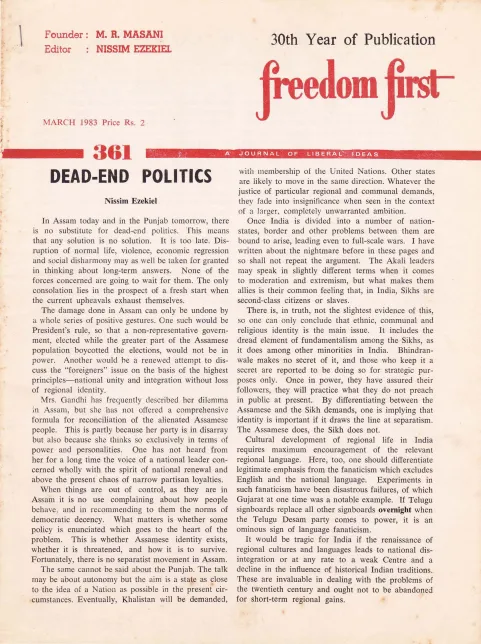
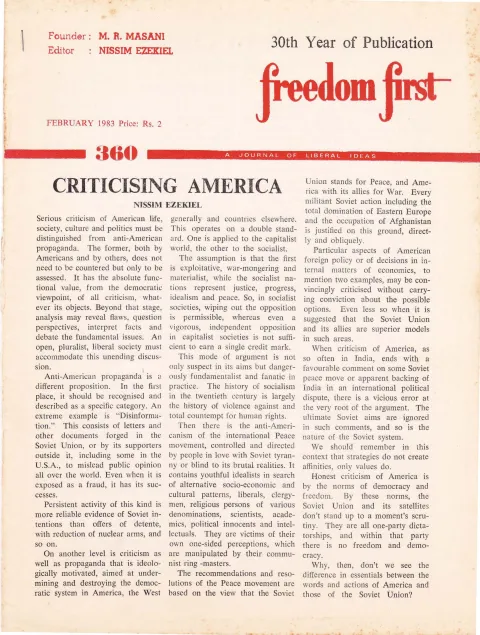
Criticising America
By NISSIM EZEKIEL
Nissim Ezekiel’s editorial argues for distinguishing genuine, functionally valuable criticism of American society and policy from Soviet-directed anti-American propaganda, including outright disinformation. He contends that Western discourse applies a double standard, crediting socialist states with peace and justice while treating capitalist ones as inherently exploitative, and that the international Peace movement is manipulated by pro-Soviet organisers despite attracting sincere idealists. He closes by asking why observers fail to see the gap, in essentials, between American and Soviet conduct on democracy and freedom.
- Distinguishes serious criticism of American life/policy (legitimate, no need to counter, only to assess) from anti-American propaganda (a distinct, often Soviet-linked category).
- Cites ‘Disinformation’ — forged letters/documents attributed to the Soviet Union and sympathisers, including some in the U.S., to mislead world opinion.
- Argues a double standard operates: socialist nations are credited with peace/justice/progress while capitalist nations are presumed exploitative and war-mongering.
- Describes the international Peace movement as controlled by pro-Soviet organisers who manipulate idealists, clergy, academics and intellectuals with one-sided perceptions.
- Notes that criticism of America in India often pairs with favourable comments on Soviet ‘peace moves’, which he calls a vicious error given actual Soviet aims.
- Closes with the framing claim that strategies do not create affinities, only shared values do, and that by democratic norms the Soviet Union and its satellites fail as one-party dictatorships.
A Variety of Comment (Report on Afghanistan; The Mishra Case; Repression in China)
By K. S. VENKATESWARAN
K. S. Venkateswaran’s ‘A Variety of Comment’ column covers three items: an Asian Lawyers’ Legal Inquiry Committee report finding the Soviet invasion of Afghanistan an unjustified act of armed aggression under the UN Charter and documenting Karmal-regime human rights violations; the Indian Supreme Court’s 2-1 ruling (Justice Tulzapurkar dissenting) upholding the withdrawal of prosecution against Bihar Chief Minister Dr. Jagannath Mishra in the Patna Urban Co-operative Bank case, which the author calls poorly reasoned; and reports of political repression of unofficial journal editors in China, including the 15-year sentence given to Xu Wenli.
- The Asian Lawyers’ Legal Inquiry Committee (convened by Pran Nath Lekhi, seven lawyers from South/Southeast Asia) investigated Afghanistan in May 1981 and found the Soviet entry in December 1979 an act of armed aggression under UN Resolution 3314 (XXIX).
- The Committee also documented human rights violations, including acts of genocide, by the Karmal regime and Soviet forces, despite Pakistan’s refusal to grant camp access.
- The Supreme Court of India’s majority (2-1) accepted the ‘political and personal vendetta’ defence to uphold withdrawal of Dr. Jagannath Mishra’s prosecution in the Patna bank case, a decision the column calls a disturbing lack of appreciation of the evidence.
- Justice Tulzapurkar’s dissent is praised as exceptionally well-argued.
- Chinese authorities are reported to have tried and sentenced dissident editor Xu Wenli (15 years plus 4 years’ deprivation of political rights) for organising an unofficial ‘counter-revolutionary’ group, which the column reframes as retaliation for calls for liberalisation and advocacy for released activist Lin Quing of the April Fifth Forum.
Essay 3
A short unsigned news item reports that an Amnesty International conference in Amsterdam, bringing together 120 participants from 30 countries, called for an end to extrajudicial political killings by governments worldwide, describing such killings as unlawful and deliberate acts carried out by or with the complicity of governments, militaries, police, and death squads.
- Human rights workers from 30 countries convened in Amsterdam on ‘Extrajudicial Executions’, organised by AI’s Dutch Section.
- The conference stated hundreds of thousands had died over the past 10 years from unlawful, government-complicit killings.
- Perpetrators cited include regular military and police forces, special death squads, and assassins operating in other countries.
- The conference statement warned such killings continue outside judicial process and in denial of legal protection.
In the Name of Secularism
By NITIN G. RAUT
Nitin G. Raut attacks a memorandum issued by 45 Muslim MPs (December 9, 1982) demanding a ban on organisations like the Vishwa Hindu Parishad and RSS in the name of secularism, arguing the memorandum is itself communal, ignores provocations behind the Meerut and Baroda riots, and reflects a broader pattern of Muslim communalism (including the Minakshipuram conversions and Kashmir’s Resettlement Act) being shielded under secularist rhetoric while Hindu organisational responses are branded chauvinist.
- 45 Muslim MPs’ memorandum demanded a ban on the VHP and RSS as organisations ‘preaching communal hatred’, which the author calls reeking of communalism itself.
- The memorandum is described as silent on triggering incidents (stabbing of a Hindu priest, attack on a Navratri procession in Baroda) behind the riots it references.
- Raut criticises proposals for religion-based restructuring of police forces as effectively communalising law enforcement, drawing a comparison to Lebanon’s militia-fractured state.
- He argues the Minakshipuram conversions had political overtones and that VHP/RSS reform activity is mischaracterised as ‘chauvinism’ under the memorandum’s framing.
- He criticises Syed Shahabuddin’s remarks to The Sunday Observer calling Hindu reform activity ‘chauvinist, extremist, militant’.
- He cites the Jammu & Kashmir Resettlement Act (permitting return of Pakistan emigres) and disenfranchisement of 45,000 Hindu refugees in J&K as examples of selective application of ‘secularism’.
The Economic Malaise in India (A Report)
An unsigned report on a December 17, 1982 Indian Liberal Group luncheon meeting in New Delhi, chaired by M. R. Masani, at which LSE professor A. R. Prest addressed ‘Model for Public Finance in a Developing Society’. Prest argued economic theory does not differ for developing countries, that market forces generally outperform government intervention, criticised high marginal tax rates, wealth taxes and slow tax administration in India, and Masani closed by pointing to Sri Lanka’s Jayawardene government as a positive example of tax cuts and liberalisation succeeding electorally.
- Meeting organised by the Indian Liberal Group, attended by about 170 people including officials, economists, businessmen and journalists.
- Masani, presiding, cited the Liberal International’s Hague resolution ‘From the Welfare State To a Truly Human Society’ and India’s pattern of excessive taxation and deficit finance.
- Prest argued there is no separate economic theory for developing countries and that government enterprises rarely outperform private ones.
- Prest criticised India’s high marginal income/corporate tax rates as driving evasion and a parallel economy, and called the wealth tax unjustifiable given its low revenue yield and disincentive to savings.
- Prest also criticised slow tax assessment leading to massive litigation, and excessive complexity benefiting lawyers.
- Masani closed by praising Sri Lankan President Jayawardene’s tax cuts, decentralisation and pro-competition reforms as an electorally successful liberalising model.
Food Crisis In Socialist Countries
By A. KUMAR
A. Kumar’s article, citing Nobel laureate Norman Borlaug and FAO/UN data, argues that socialist and communist states — the USSR, China, Vietnam, Kampuchea, Laos — face chronic food deficits because ideological priorities and militarisation crowded out agricultural investment, forcing the USSR and its allies into heavy grain imports even as capitalist producers like the US, Canada, Argentina, Australia and Brazil post surpluses.
- Norman Borlaug is cited as attributing socialist countries’ food deficiency to ideological prioritisation over agricultural investment since the 1917 revolution.
- FAO estimates the USSR will import around 15m tonnes of grain this year and China a million tonnes more than Russia.
- The US is cited as producing a near-record 268.8m tonnes of grain in 1980 with 73m tonnes of exports expected this year.
- Vietnam, despite a 1.5m-strong military, is described as food-deficient, with rice production falling short of targets and UNICEF citing malnutrition as the most common childhood illness there.
- The piece frames the contrast as evidence against the socialist system’s capacity to feed its own people without capitalist-world imports.
Two Insights (Andropov; Non-Alignment)
By M. R. MASANI
M. R. Masani’s ‘Two Insights’ column (reprinted from The Statesman’s ‘As I See It’) covers two topics: the significance of Andropov’s KGB background and his history of broken promises (citing his role in the 1956 Hungarian crackdown and the killing of General Pal Maleter) for judging Soviet trustworthiness on arms and detente; and India’s ‘dubious’ non-alignment stance in refusing to invite Prince Norodom Sihanouk’s anti-Vietnamese coalition to the March 1983 non-aligned summit in Delhi despite majority support in the movement, which Masani calls a pro-Soviet tilt.
- Masani notes commentary in The Observer and The Guardian questioning whether Andropov’s ascent and Brezhnev’s death/Lech Walesa’s release were coincidental.
- He cites the promotion of KGB figure Geidar Aliyev as evidence Andropov is moving KGB cadres into key positions.
- He recounts Andropov’s 1956 conduct as Soviet ambassador to Hungary, assuring Imre Nagy of no re-occupation while tanks entered Budapest, and the later killing of General Pal Maleter after a safe-conduct invitation.
- He quotes Bernard Levin’s warning against assuming Soviet negotiators share the same interests/attitudes as Western counterparts, and asks rhetorically about withdrawing Soviet troops from Afghanistan.
- On non-alignment, Masani criticises India’s recognition of the Vietnamese-installed Kampuchean government and its December 13 refusal to invite Prince Sihanouk to the March Delhi summit, despite the Malaysian PM’s and UN majority’s support for the anti-Vietnamese coalition.
- He cites UN experts from Egypt, Kenya, Peru and the Philippines finding evidence of Vietnamese use of toxic-chemical weapons in Kampuchea and Laos.
Consumer Education in Schools
By M. R. Pai
An unsigned report on the conclusions of the Asian Seminar on Consumer Education in Schools, held in Bangalore (Nov 22-25, 1982) by the International Organisation of Consumers Unions with the Karnataka Consumer Service Society and Leslie Sawhny Programme, recommending consumer education be integrated into school curricula from ages 10-12 onward and extended to rural populations via mass media.
- Seminar organised by IOCU with KCSS and the Leslie Sawhny Programme of Training for Democracy, Bombay, in Bangalore.
- Participants came from Malaysia, Bangladesh, Fiji, UK, USA, Holland and India (multiple cities).
- Working groups recommended formal consumer education for ages 10-12 and non-formal education throughout school years, with a trained teacher per school.
- Recommended rural and women’s consumer awareness via radio, theatre, folk music and film.
- Recommendations to be sent to the Prime Minister and all state governments; Indira Gandhi and the Karnataka government reportedly already receptive.
- An institute for training consumer activists and teachers is proposed near Bangalore.
A Letter (on Chinese naval/missile capability)
By RAMA SWARUP
A reader’s letter from Rama Swarup (New Delhi) argues that Communist China’s successful test-firing of a medium-range submarine-launched missile in the East China Sea shows Beijing pursuing big-power nuclear status despite its claims to reject hegemony, warning this poses a serious threat to Taiwan and the broader Asia-Pacific region and that the free world should have no illusions about Chinese Communist willingness to use force, citing the 1979 invasion of Vietnam as precedent.
- Letter reports a Chinese medium-range missile test-fired from a submarine in the East China Sea, roughly 300 miles north of Taiwan.
- Argues the test contradicts China’s claims to reject hegemony and superpower status.
- Warns of threat to Taiwan, Penghu, Kinmen, Mastu and the wider Western Pacific/Asia-Pacific region.
- Cites China’s 1979 invasion of Vietnam (‘to teach the Vietnamese a lesson’) as evidence of willingness to use armed force to settle disputes.
Soviet Satirical Novel Underlines a Crucial Truth
By FLORA LEWIS
Flora Lewis reviews The Kangaroo, a satirical underground Soviet novel by dissident writer Iouz Alechkowski (published in France, an American edition forthcoming), praising its brutal, street-slang humour depicting a petty crook/KGB informer protagonist caught in an absurdist bureaucratic show-trial, calling it comparable in impact to Candide, Schweik, and 1984, and arguing its central truth is that ordinary Soviet citizens endure and survive the system rather than overthrow it.
- The novel, The Kangaroo, was written in Moscow, circulated underground, and recently published in France by dissident author Iouz Alechkowski.
- It is written in unvarnished Russian street slang, making it difficult to translate, per Lewis.
- Its protagonist is a petty crook/KGB informer who claims to have raped and killed the Moscow zoo’s oldest kangaroo to avoid a more damning propaganda confession.
- Lewis compares its impact to Candide, Schweik, and Orwell’s 1984 in stripping away Soviet historical pretensions.
- The review’s central takeaway: Soviet citizens’ ‘happy ending’ is simply persisting in avoiding disaster, not overthrowing the system.
Book Review: The Media Crisis … A Continuing Challenge
By Shankar Raj
Shankar Raj reviews The Media Crisis: A Continuing Challenge, a World Press Freedom Committee compilation of essays on press freedom, UNESCO’s New World Information Order, and related debates, highlighting Statesman managing director C. R. Irani’s attack on UNESCO’s information-order proposals and the Macbride Commission, contrasted with defences from Gabon’s Jean Ping and UNESCO’s Amadou-Mahtar M’Bow, and Carmel Budiardjo’s account of press controls in Indonesia.
- Book published by the World Press Freedom Committee (Rex Rand Fund, Washington D.C.), 150 pages.
- C. R. Irani (managing director, The Statesman, Calcutta, and past IPI chairman) contributes a forthright attack on UNESCO’s proposals as providing ‘philosophical justification’ for government control of media, and criticises the Macbride Commission report.
- Jean Ping (Gabon’s ambassador, president of the African States group at UNESCO) and Amadou-Mahtar M’Bow (UNESCO director-general) defend the new information order, which the reviewer criticises as evasive given their countries lack a free press.
- Carmel Budiardjo (editor, Tapol bulletin) contributes an account of press controls and a ‘newspapers-to-the-villages’ project in Indonesia limiting content that expresses cynicism or negative city-life portrayals.
- The review is skeptical of Indonesia’s and UNESCO’s commitment to genuine press pluralism.
With Many Voices (quotations column)
The regular ‘With Many Voices’ column collects short quotations from public figures on communism, detente, and politics, drawn from Modern Liberalism, The Times, and the Observer, including Joe Grimond, Reagan, Bernard Levin, Giovanni Malagodi, Peter Sager, Fritz Bolkestein, Elizabeth Taylor, Margaret Thatcher, and Henry Kissinger.
- Quotes Joe Grimond (Modern Liberalism) on communist belief that the next communist state will be heaven, and on enjoying politics more than being a minister.
- Quotes President Reagan (The Times, Nov 13) on detente needing deeds, not just words.
- Quotes Bernard Levin (The Times, Nov 26) on the danger of assuming Soviet negotiators share Western interests/attitudes.
- Quotes Giovanni Malagodi (Modern Liberalism) calling Social Democrats ‘by now barren’.
- Quotes Peter Sager (Swiss Press Review) on hard lines by democracies restraining dictatorships, and Fritz Bolkestein (Modern Liberalism) on welfare states needing a functioning economy.
- Quotes Margaret Thatcher and Henry Kissinger from the Observer (Jan 2), plus Elizabeth Taylor.
Generated by the v1.5 extraction pipeline. Awaiting editorial review.
Metadata and summary are AI-extracted from the source PDF and reviewed for editorial accuracy. The original work is available via the Read PDF tab above (where present); paragraph-level citation inside the PDF is deferred to a future engagement.