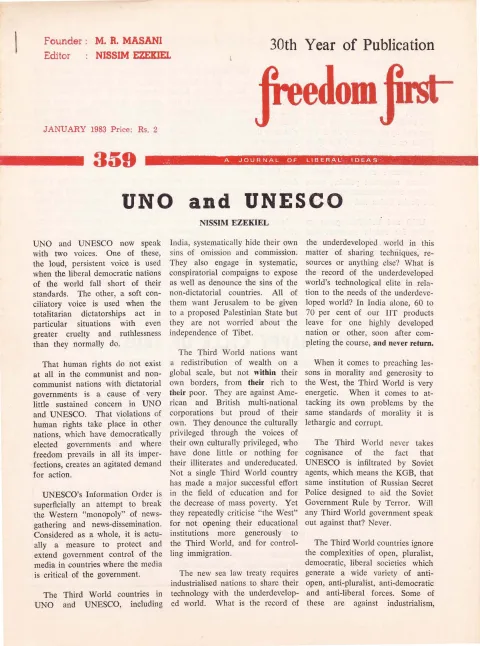
periodical issue
Freedom First
A Journal of Liberal Ideas
By Minoo Masani, Arvind Deshpande
Published for the Democratic Research Service by J. R. Patel, Associate Editor, Freedom First at 127, Mahatma Gandhi Road, Bombay 400 023 (Phone: 273914) and Printed by him at The Popular Press (Bom.) Pvt. Ltd. 35C Tardeo Road, Bombay 400 034 · Bombay · 1983
16 pages
Freedom First
Summary
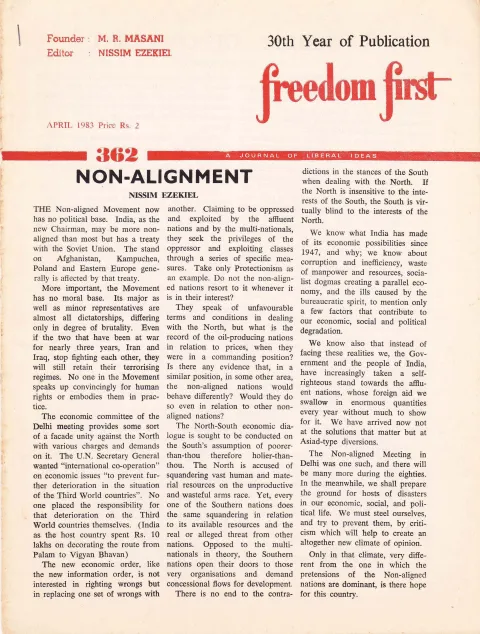
Issue No. 362 of Freedom First (April 1983, price Rs. 2), in its 30th year of publication, edited by Nissim Ezekiel and founded by M. R. Masani. In the rendered pages the issue opens with Ezekiel’s own editorial excoriating the Non-Aligned Movement as devoid of political or moral coherence and as a facade of anti-Western unity papering over the members’ own dictatorships and double standards, before turning to India’s specific failures of governance and development. K. S. Venkateswaran’s regular “A Variety of Comment” column covers the aftermath of the Kahan Commission report on the Beirut massacre, a satirical dispatch on sycophancy toward Ceausescu in Romania, and a report on torture in Iranian jails drawn from Amnesty International findings. A long unsigned investigative report, credited to the Asiad Virodh Samiti (“Asian Games Opposition Committee”), itemises the runaway cost of the 1982 Delhi Asian Games (put at Rs. 725.5 crores against an official Rs. 67 crore estimate), documents labour exploitation of migrant construction workers, environmental damage to Delhi’s tree cover and the Ridge forest, and contrasts the expenditure with poverty, floods, and bonded labour elsewhere in India. The issue carries the translated text of a World Freedom Day address by Sun Yun-suan, Premier of the Republic of China (Taiwan), calling for a unified global anti-Communist strategy alongside the Reagan administration’s push for the ‘democratization of Communist nations.’ Minoo Masani’s column “From the Sublime to the Ridiculous” pays tribute to the recently deceased Arthur Koestler, recounting Masani’s friendship with him and Koestler’s views on euthanasia and India, before pivoting to a sharply satirical account of the March 1983 Non-Aligned Summit in New Delhi, cataloguing its contradictions as a set of ‘myths.’ A reader’s letter from Arvind Deshpande of the Trusteeship Foundation criticises the 1983-84 Budget’s withdrawal of Section 35CCA tax incentives for rural development contributions. The issue closes with the “With Many Voices” page of quotations from the international press, and publication/printing details.
Key points
-
Nissim Ezekiel’s editorial argues the Non-Aligned Movement has no political or moral coherence, since its mostly-dictatorial members condemn the West selectively while excusing each other’s abuses, and turns the critique on India’s own corruption and dependence on foreign aid.
-
K. S. Venkateswaran’s “A Variety of Comment” contrasts selective outrage over Israel’s Kahan Commission findings with the unexamined records of the PLO and Syria, satirises Romanian sycophancy toward Ceausescu, and details Amnesty International findings on torture in Iranian prisons.
-
An investigative report attributed to the Asiad Virodh Samiti tallies the true cost of the 1982 Delhi Asian Games at Rs. 725.5 crores against an official Rs. 67 crore estimate, documenting exploitation of roughly 125,000 migrant labourers and the felling of 1,342 trees in the Ridge forest.
-
A translated address by Sun Yun-suan, Premier of the Republic of China, frames the 1980s as a global struggle between democracy and communist tyranny and calls for free nations to reject “peaceful coexistence” with communist states.
-
Minoo Masani’s “From the Sublime to the Ridiculous” pays tribute to the late Arthur Koestler, recalling his charitable fund for Bombay’s homeless and his role in the Voluntary Euthanasia Society, before satirising the “myths” of the March 1983 Non-Aligned summit in Delhi.
-
A reader’s letter from Arvind Deshpande of the Trusteeship Foundation criticises the 1983-84 Budget’s repeal of Section 35CCA of the Income Tax Act, which had let companies redirect tax liability to rural development trusts.
Essays
Non-Alignment
By NISSIM EZEKIEL
Nissim Ezekiel’s editorial argues that the Non-Aligned Movement has lost any political or moral coherence: its members are overwhelmingly dictatorships that invoke anti-imperialist rhetoric selectively, condemning the West while giving each other a pass (citing the Iran-Iraq war, Poland, Afghanistan and Eastern Europe). He turns the critique inward, faulting India’s own record of corruption, inefficiency, socialist economic dogma, and self-righteous posturing toward wealthy nations even as it depends on their foreign aid, closing with a call for sustained domestic criticism as the only route to a healthier political climate.
- The Non-aligned Movement has no political base and, per the author, no moral base either.
- Almost all major and minor NAM members are dictatorships differing only in degree of brutality.
- The Delhi NAM meeting’s economic committee is characterised as a facade of unity against ‘the North’.
- Non-aligned nations are accused of practising protectionism and squandering resources while blaming the North.
- India’s own economic and political degradation is attributed to corruption, inefficiency, waste, and socialist planning.
- The government and people of India are accused of a self-righteous stance towards affluent nations despite depending on their aid.
- The author calls the Delhi summit an ‘Asiad-type diversion’ from real solutions.
A Variety of Comment (1. The Aftermath of Beirut; 2. The Limits of Sycophancy; 3. Torture Tales from Iran)
By K. S. VENKATESWARAN
K. S. Venkateswaran’s ‘A Variety of Comment’ column (three items in the rendered pages): first, a piece on the hypocrisy surrounding reactions to the Kahan Commission report on the Sabra and Chatila massacre, noting that critics of Israel such as the PLO, Syria and other Arab regimes have far worse records of violence against civilians and no comparable self-scrutiny; second, a satirical piece on sycophancy toward Romanian dictator Nicolae Ceausescu, quoting a party official’s fawning comparison of Ceausescu to Julius Caesar, Alexander, Cromwell and Napoleon; third, a harrowing account, drawn from an Amnesty International report, of torture and arbitrary detention in Iranian prisons under the post-revolutionary regime, including a detailed first-person account of a man tortured after being wrongly accused of Fedayeen membership.
- Critiques the selective outrage over Israel’s Kahan Commission findings on the Beirut/Sabra-Chatila massacre.
- Cites Robert Fisk’s reporting that Arafat and Assad have far worse records with no equivalent inquiry.
- Satirises Romanian Communist Party sycophancy toward Ceausescu, quoting a 1980s propaganda speech.
- Summarises a fresh Amnesty International report on ill-treatment, torture and arbitrary detention in five Iranian jails.
- Details methods of torture and detention conditions in Evin and the ‘Komiteh’ prison (‘hen house’).
- Recounts one prisoner’s account of being whipped and beaten after being mistaken for a Fedayeen member.
Looting the Gold
By A Report by The Asiad Virodh Samiti
An unsigned investigative report attributed to the ‘Asiad Virodh Samiti’ (Asian Games Opposition Committee) that tallies the true cost of the Ninth Asian Games held in New Delhi in November 1982, arguing the government’s official figure of Rs. 67 crores masks a real cost of at least Rs. 725.5 crores (and, with items like the INTELSAT satellite and import duty concessions on TV sets, potentially ten times the official figure). It documents the exploitation of roughly 125,000 migrant construction workers in violation of labour laws, environmental destruction including the felling of over 1,342 trees and encroachment on Delhi’s Ridge forest, and politically motivated allocation of prime real estate to Congress (I)-linked developers such as Charanjit Singh and Sagar Suri. It contrasts the Games’ expenditure with concurrent floods in Orissa, starvation deaths in Bihar, Rajasthan and elsewhere, and bonded and child labour nationally, concluding the Games were ‘a crime against the people of India.’
- Total Asiad-related expenditure is itemised at Rs. 725.5 crores against an official estimate of Rs. 67 crores.
- Additional uncounted costs include the INTELSAT satellite programme (Rs. 130 crores) and concessional-duty TV imports.
- About 125,000 migrant labourers, mostly tribal and nomadic, were employed under alleged violations of the Minimum Wages Act, Bonded Labour Act, and other labour laws.
- 1,342 full-grown trees were felled and the Ridge forest was encroached upon for roads.
- Prime real estate near Connaught Place was allotted to Congress (I)-linked developers (Charanjit Singh and Sagar Suri) via waived tender procedures.
- The report contrasts the Games’ cost with contemporaneous floods in Orissa, starvation deaths in several states, and bonded/child labour nationwide.
- It concludes the Games amounted to a ‘false notion of prestige’ pursued at the expense of development priorities.
A Future for Freedom
By Address by H.E. Sun Yun-suan, Premier of the Republic of China, at the 1983 World Freedom Day Meeting of the Republic of China, Taipei, January 23, 1983. Translated from Chinese
A translated address, ‘A Future for Freedom,’ delivered by H.E. Sun Yun-suan, Premier of the Republic of China (Taiwan), at the 1983 World Freedom Day meeting in Taipei on 23 January 1983. Sun frames the era as one of a global struggle between the forces of freedom/democracy and Communist tyranny, arguing Communism is bankrupt and headed for collapse while democratic movements are gaining strength worldwide. He links Taiwan’s campaign to ‘reunify China under the Three Principles of the People’ with President Reagan’s calls for a ‘world movement for democracy and peace’ and the ‘democratization of Communist nations,’ and calls on free nations to reject peaceful coexistence with Communist states, strengthen collective defence, and unite against Marxism-Leninism.
- Frames the 1980s as a period of confrontation between the forces of freedom/democracy and Communist totalitarianism.
- Argues Communism is in crisis across the USSR, China, Eastern Europe, North Korea, Vietnam and Cuba.
- Links Taiwan’s ‘unifying China under the Three Principles of the People’ campaign to Reagan’s ‘world movement for democracy and peace.’
- Calls for free nations to reject the concept of ‘peaceful coexistence’ with Communist states.
- Calls for strengthened bilateral and multilateral defence and a unified global anti-Communist strategy.
- Closes with an appeal for the US and the free world to uphold treaty and defence commitments.
From the Sublime to the Ridiculous (Arthur Koestler; The Non-Aligned Summit)
By MINOO MASANI
Minoo Masani’s column combines two pieces. The first is a personal tribute to Arthur Koestler following his and his wife Cynthia’s death by suicide on 2 March 1983; Masani recounts meeting Koestler in Philadelphia in 1951, Koestler’s visits to India in search of a spiritual alternative to Zionism and Communism (recounted in The Lotus and the Robot, 1961), his shock at Bombay’s pavement dwellers, his subsequent charitable fund for India’s homeless, his role as Vice-Chairman of the Voluntary Euthanasia Society (‘Exit’), and his 1981 letter to Masani supporting the founding of an Indian right-to-die society. The second piece, ‘The Non-Aligned Summit,’ is a satirical catalogue of what Masani calls the ‘myths’ of the March 1983 Delhi Non-Aligned summit — its claimed independence, unity, and moral authority — contrasted with the war between Iran and Iraq, the Soviet occupation of Afghanistan, and Mugabe’s suppression in Matabeleland, alongside praise for Mrs. Gandhi’s chairmanship and a closing anecdote about meeting Sri Lankan President Jayewardene.
- Tribute to Arthur Koestler and his wife Cynthia following their joint suicide on 2 March 1983.
- Recounts Koestler’s visits to India (1958-59) seeking a spiritual substitute for Zionism and Communism, documented in The Lotus and the Robot (1961).
- Describes Koestler’s shock at Bombay’s pavement dwellers and his subsequent fund, backed by David Astor, to help India’s homeless.
- Notes Koestler’s role as Vice-Chairman of the Voluntary Euthanasia Society (‘Exit’) and his 1981 letter supporting Masani’s founding of an Indian right-to-die society.
- Satirises five ‘myths’ of the March 1983 Non-Aligned summit in Delhi: independence, unity, indivisibility of peace and freedom, imminent nuclear catastrophe, and world attention.
- Cites the Iran-Iraq war, Soviet occupation of Afghanistan, and Mugabe’s Fifth Brigade violence in Matabeleland as contradictions of NAM’s claims.
- Praises Mrs. Gandhi’s chairmanship of the summit as an effective public-relations exercise, and Natwar Singh and K. S. Bajpai for their handling of it.
- Closes with an anecdote about meeting Sri Lankan President Jayewardene, who discussed his country’s economic concerns rather than the summit.
A Letter
By ARVIND DESHPANDE, Director, Trusteeship Foundation
A reader’s letter from Arvind Deshpande, Director of the Trusteeship Foundation, Bombay, criticising the 1983-84 Union Budget’s withdrawal of Section 35CCA of the Income Tax Act, which had allowed companies to redirect a portion of their tax liability to approved rural development trusts and voluntary organisations. Deshpande traces the provision’s introduction by H. M. Patel in 1977 and its strengthening under Charan Singh, arguing that its repeal reverses 25 years of centralised development policy’s one small decentralising opening and forecloses grassroots, company- and citizen-led rural development initiatives in favour of channelling all such contributions through the Prime Minister’s Fund.
- Criticises the 1983-84 Budget’s repeal of Section 35CCA of the Income Tax Act.
- 35CCA had let companies direct 42 paise of profit to rural development trusts in lieu of 58 paise of tax otherwise due.
- Traces the provision’s introduction by H. M. Patel in June 1977 and its expansion under Charan Singh.
- Argues the provision was a rare decentralising step after 25 years of centralised development financing via taxation.
- Argues the repeal forecloses opportunities for companies, workers, and voluntary organisations to pursue grassroots rural development.
- Notes contributions can now only be made to the Prime Minister’s Fund instead.
Generated by the v1.5 extraction pipeline. Awaiting editorial review.
Metadata and summary are AI-extracted from the source PDF and reviewed for editorial accuracy. The original work is available via the Read PDF tab above (where present); paragraph-level citation inside the PDF is deferred to a future engagement.