periodical issue
Freedom First
A Journal of Liberal Ideas
By Minoo Masani
Published for the Democratic Research Service by J. R. Patel, Associate Editor, Freedom First at 127, Mahatma Gandhi Road, Bombay 400 023 (Phone: 273914) and Printed by him at The Popular Press (Bom.) Pvt. Ltd, 35C Tardeo Road, Bombay 400034 · Bombay · 1983
16 pages
Freedom First
Summary
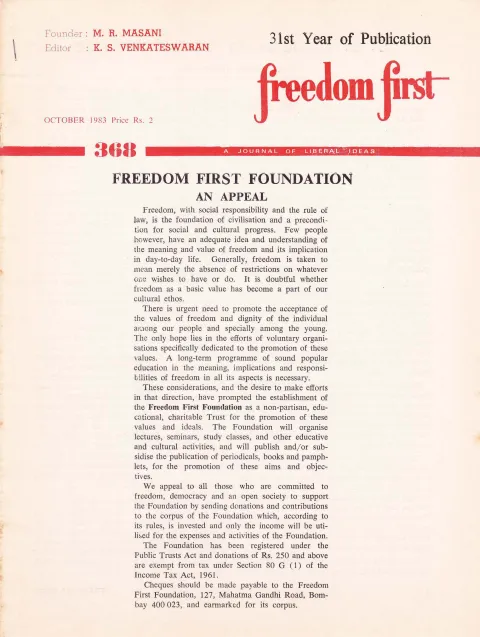
This is the October 1983 issue (No. 368, 31st year of publication) of Freedom First, the Bombay-based journal of liberal ideas founded by M. R. Masani and edited by K. S. Venkateswaran. The issue opens with an appeal on behalf of the newly established Freedom First Foundation, a charitable trust meant to fund lectures, seminars, and publications promoting freedom and the rule of law. The editorial core of the issue addresses Cold War geopolitics and Indian governance: K. S. Venkateswaran examines the Reagan administration’s dilemma in Central America amid Soviet/Cuban-backed military build-up in Nicaragua, and Minoo Masani’s regular “As I See It” column condemns the Soviet shooting down of Korean Air Lines Flight 007 and the Indian government’s muted response, alongside remarks on Joshua Nkomo’s return to Zimbabwe. A satirical courtroom sketch by Miles Kington (reprinted from The Times, London) lampoons Yuri Andropov. The issue carries two substantial book reviews: Thomas Gay reviews Arun Shourie’s “Mrs. Gandhi’s Second Reign,” and K. S. Venkateswaran reviews the third edition of H. M. Seervai’s “Constitutional Law of India.” A historical document, the 1950 “Manifesto of Freedom” (associated with the Congress for Cultural Freedom, with an editorial note on Arthur Koestler, A. J. Ayer, and Hugh Trevor-Roper’s roles in drafting it), is reprinted across pages 13-14. The issue also includes a reader’s letter on the Mandal Commission’s caste-reservation report, and the recurring “With Many Voices” column of aphoristic quotations drawn from the international press.
Key points
-
K. S. Venkateswaran’s “U.S. Dilemma In Central America” surveys the Reagan administration’s response to Soviet- and Cuban-backed militarisation of Nicaragua under the Sandinistas, citing intelligence reports of Soviet arms shipments.
-
Minoo Masani’s “As I See It” condemns the Soviet downing of Korean Air Lines Flight 007, criticises the Indian government’s use of “deplore” rather than “condemn,” and reports on Joshua Nkomo’s risky return to Zimbabwe.
-
Miles Kington’s satirical “A Close Shave For Andropov,” reprinted from The Times, imagines Yuri Andropov cross-examined in a leaked “trial transcript” to mock Soviet paranoia and propaganda.
-
Thomas Gay reviews Arun Shourie’s “Mrs. Gandhi’s Second Reign,” praising its rigorous documentation of administrative corruption, misuse of the National Security Act and the Bhagalpur blindings while finding its concluding recommendations comparatively tentative.
-
K. S. Venkateswaran reviews the third edition of H. M. Seervai’s “Constitutional Law of India,” praising it as a pre-eminent reference while highlighting Seervai’s criticism of Justice Bhagwati’s expansive reading of Article 14.
-
A reprint of the 1950 “Manifesto of Freedom,” a foundational liberal-anticommunist statement associated with the Congress for Cultural Freedom, holds intellectual freedom to be an inalienable right and warns against emergency restrictions degenerating into permanent tyranny.
-
S. S. Bankeshwar’s letter “A Blueprint For Ruining India” criticises the Mandal Commission Report’s caste-based reservations as entrenching rather than dissolving the caste system and rewarding vote-bank politics.
Essays
U.S. Dilemma In Central America
By K. S. Venkateswaran
K. S. Venkateswaran’s lead article surveys the Reagan administration’s response to escalating Soviet- and Cuban-backed militarisation in Central America, particularly Nicaragua under the Sandinistas. He frames the Reagan initiatives (including Henry Kissinger’s appointment to chair a Bipartisan Commission on Central America) as controversial but grounded in intelligence reports of Soviet arms shipments, and quotes President Reagan and William Buckley to argue that the U.S. faces a genuine strategic threat it cannot responsibly ignore.
- Opens with an epigraph from FDR’s 1941 State of the Union on pre-empting hostile footholds near American shores.
- Notes the irony that Reagan’s Central America policy echoes Roosevelt-era strategic logic despite ideological distance from Roosevelt.
- Cites a U.S. inter-agency intelligence study describing Soviet ‘active measures’ (forgeries, front groups, disinformation) in the region.
- Reports Soviet cargo vessels and a failed Libyan arms shipment (disguised as medical supplies) routed through Brazil.
- Details the scale of Sandinista militarisation: 138,000 men under arms, Soviet tanks, and thousands of Cuban, Soviet, East German, Bulgarian, North Korean and PLO advisers.
- Closes by citing William Buckley’s National Review remark on the burdens of superpower responsibility.
As I See It
By Minoo Masani
Minoo Masani’s “As I See It” column condemns the Soviet downing of Korean Air Lines Flight 007, quoting cockpit-tape transcripts of the attacking MiG pilot and criticising the Indian government’s reluctance to condemn (rather than merely ‘deplore’) the killing of an Indian national among the victims. He contrasts this with Western press reactions from The Times and Sunday Times, and closes with a note on Joshua Nkomo’s dangerous return to Zimbabwe amid tension with Robert Mugabe’s government.
- Quotes intercepted Soviet pilot transcripts confirming a deliberate, unprovoked attack on the KAL airliner.
- Criticises the Indian government spokesman’s use of ‘deplore’ rather than ‘condemn’, paralleling India’s past reticence over Soviet actions in Hungary (1956), Czechoslovakia, and Afghanistan.
- Cites K. R. Sunder Rajan’s charge in the Sunday Observer that hypocrisy is central to Indira Gandhi’s foreign policy.
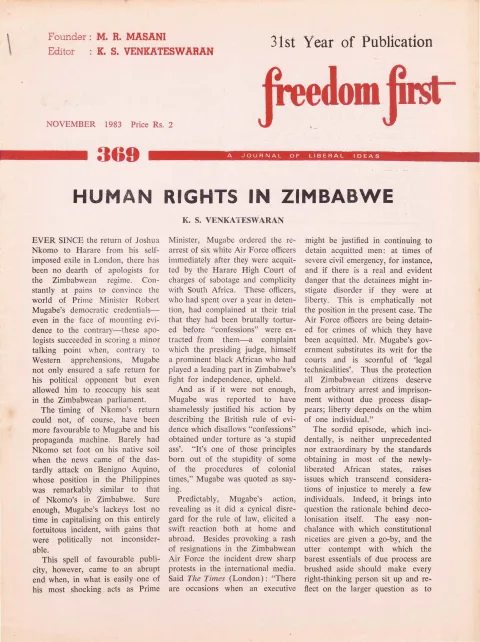
- Reports on Joshua Nkomo’s return to Zimbabwe from exile and the ridicule he faced in Parliament from Mugabe’s Treasury benches despite the risk to his safety.
- Draws a comparison between Nkomo’s situation and that of Benigno Aquino in the Philippines.
A Close Shave For Andropov
By Miles Kington
A satirical courtroom sketch by Miles Kington, reprinted from The Times of London, imagines Yuri Andropov on trial over correspondence with an American teenage girl, mocking Soviet paranoia and propaganda through absurdist cross-examination.
- Presented as a leaked ‘trial transcript’ of Yuri Andropov being cross-examined over letters to an American girl.
- Uses absurdist humour to satirise Soviet secrecy and propaganda.
- Reprinted from The Times, London, as a piece of political satire rather than reportage.
Book Reviews: Mrs. Gandhi’s Second Reign by Arun Shourie
By Thomas Gay
Thomas Gay reviews Arun Shourie’s “Mrs. Gandhi’s Second Reign” (Vikas Publishing House, 1983), describing it as a grim but essential indictment of India’s governing class. The review walks through the book’s nine chapters, which document administrative corruption, misuse of the National Security Act, judicial politics (including Bhagwati J.’s dissensions), the Bhagalpur blindings, and communal politics, before noting the author’s comparatively tentative concluding recommendations rooted in Gandhian ideals.
- Shourie’s book is praised for rigorous documentation, including quoted ‘Top Secret’ government documents.
- Chapter-by-chapter summary covers the Prime Minister’s reliance on ineffective subordinates, corruption enquiry commissions, misuse of the National Security Act, judicial infighting, the Bhagalpur blindings scandal, and unequal justice for rich and poor.
- The review credits Shourie, as a ‘reformed Empire-builder’, for refusing to blame India’s problems on British colonial legacy.
- The reviewer finds the book’s final prescriptive chapters (on what citizens should do) comparatively weak, resting on a hesitant return to Gandhian ideals of patience and self-sacrifice.
- The review ends on a qualified note of hope, citing Shourie’s reliance on scattered individuals of goodwill who reject collaboration with corrupt power.
Book Reviews: Constitutional Law of India: A Critical Commentary by H. M. Seervai
By K. S. Venkateswaran
K. S. Venkateswaran reviews the third edition, Volume 1, of H. M. Seervai’s “Constitutional Law of India” (N. M. Tripathi Pvt. Ltd., 1983), calling it a pre-eminent reference work whose commentary extends beyond legal technicality into questions of constitutional morality. The review highlights Seervai’s criticism of the Supreme Court’s expansive Article 14 jurisprudence and of judges (naming Krishna Iyer J.’s verbosity) who denounce the very colonial-derived system they administer, while praising the book’s comprehensiveness and lamenting the long gap before its next volume.
- Describes Seervai’s treatise as a standard reference increasingly relied upon by practitioners and academics.
- Notes Seervai’s consistent defence of freedom and rule of law, of particular value to ‘libertarians’ among the journal’s readers.
- Highlights Seervai’s critique of Justice Bhagwati’s expansive reading of Article 14 (right to equality) as narrowing rather than enlarging the right.
- Criticises members of the higher judiciary who denounce the constitutional system as a ‘colonial legacy’ while being among the most long-winded in their own judgments, singling out Krishna Iyer J.
- Notes the long time-lag between volumes of Seervai’s work as its one drawback.
Manifesto of Freedom (1950)
A reprint of the fourteen-point “Manifesto of Freedom” (1950), a foundational liberal-anticommunist statement holding intellectual freedom to be an inalienable right, condemning totalitarianism’s suppression of dissent, and calling for international oversight to preserve peace and freedom together. An editorial footnote records Arthur Koestler’s observation (from the Danube Edition of The Trail of the Dinosaur) that the bracketed passages in points 11 and 14 were added by British committee members A. J. Ayer and Hugh Trevor-Roper.
- Article 1 holds intellectual freedom, defined as the right to hold and express opinions (including dissent from rulers), to be an inalienable right of man.
- Articles 3-4 argue freedom and peace are inseparable and that wars can be waged even under the banner of peace absent real accountability.
- Articles 7-9 address the danger of emergency restrictions degenerating into permanent tyranny, and describe totalitarian regimes as representing restrictions on freedom falsely dressed as civilisational progress.
- Article 14 addresses the manifesto to all who seek to regain lost liberties and preserve or extend those they retain.
- An editorial footnote attributes certain bracketed additions to the manifesto’s British drafting committee members, Alfred J. Ayer and Hugh Trevor-Roper, per Arthur Koestler’s account.
A Letter: A Blueprint For Ruining India
By S. S. Bankeshwar
A reader’s letter from S. S. Bankeshwar of Bombay criticises the Mandal Commission Report as a ‘blueprint for ruining India’, arguing that caste-based reservation entrenches rather than dissolves the caste system, rewards vote-bank politics over merit, and is perpetuated by politicians who have a vested interest in maintaining caste divisions even while publicly condemning them.
- Argues the Mandal Commission Report risks instigating caste-war and institutionalising backwardness as a caste-based category.
- Questions whether reservation ends the caste system or perpetuates it by rewarding claimed caste status.
- Charges that most Indian politicians have a vested interest in preserving caste divisions for vote-bank purposes.
- Argues movements based purely on merit and talent face little chance of success given widespread ignorance and vote-bank incentives.
Generated by the v1.5 extraction pipeline. Awaiting editorial review.
Metadata and summary are AI-extracted from the source PDF and reviewed for editorial accuracy. The original work is available via the Read PDF tab above (where present); paragraph-level citation inside the PDF is deferred to a future engagement.