periodical issue
Freedom First
A Journal of Liberal Ideas
By Minoo Masani
Published for the Democratic Research Service by J. R. Patel, Associate Editor, Freedom First at 127, Mahatma Gandhi Road, Bombay 400 023 (Phone: 273914) and Printed by him at The Popular Press (Bom.) Pvt. Ltd., 35C Tardeo Road, Bombay 400 034 · Bombay · 1983
16 pages
Freedom First
Summary
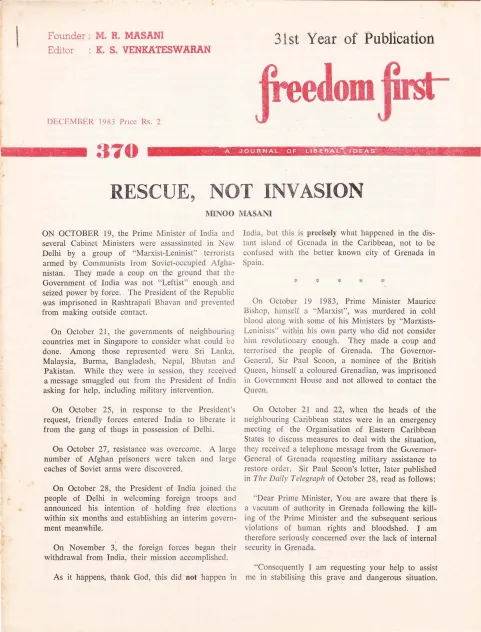
This is issue No. 370 of Freedom First (December 1983, Rs. 2, 31st year of publication), founded by M. R. Masani and edited by K. S. Venkateswaran. The issue opens with Masani’s own polemic defending the U.S.-Caribbean intervention in Grenada as a legitimate rescue rather than an invasion, followed by K. S. Venkateswaran on the government’s abuse of Ordinance-making power (particularly around the Bombay textile mills takeover and in Bihar), Manfred Schonfeld on Soviet strategic penetration of Latin America, M. B. Shah’s critique of the PUCL’s advocacy for Bombay’s pavement and hutment dwellers, Roger Boyes (reprinted from The Times, London) on Lech Walesa and the Nobel Peace Prize’s effect on Polish politics, a book review by David Davidar of Salman Rushdie’s Shame, and a closing page of quotations (‘With Many Voices’) plus the subscription order form and imprint.
Key points
-
Minoo Masani’s “Rescue, Not Invasion” defends the U.S.-Caribbean intervention in Grenada as a legitimate rescue at the invitation of Governor-General Sir Paul Scoon, criticising the Indian government’s vote for a UN resolution condemning the action.
-
K. S. Venkateswaran’s “Rule by Ordinance” argues the Constitution’s Ordinance-making power has been chronically abused, citing the October 1983 midnight takeover of 13 Bombay textile mills and D. C. Wadhwa’s study of Bihar re-promulgating Ordinances for up to 13 years.
-
Manfred Schonfeld’s “Latin America and the Soviet Strategy” argues Moscow’s interest in Colombia, Peru and Bolivia is geopolitical destabilisation via drug-fuelled corruption and guerrilla movements rather than economic gain.
-
M. B. Shah’s “The Shunned and the Shunted?” criticises the PUCL’s advocacy for Bombay’s pavement dwellers as populist overreach, quoting Nani Palkhivala’s rebuttal that the Municipal Commissioner is merely performing a statutory duty.
-
Roger Boyes’s “Poland’s Prize Predicament,” reprinted from The Times, profiles Lech Walesa after his Nobel Peace Prize, noting his decision to donate the prize money to the Church’s private-farmers fund as a sign he will wait rather than escalate.
-
David Davidar reviews Salman Rushdie’s “Shame,” identifying its thinly veiled real-world referents, including Raza Hyder as General Zia-ul-Haq and Iskander Harappa as Bhutto, and calling it an absorbing political satire.
Essays
Rescue, Not Invasion
By MINOO MASANI
Minoo Masani argues, through an extended point-by-point parallel, that the U.S.-Caribbean military intervention in Grenada following the murder of Prime Minister Maurice Bishop by Marxist-Leninist hardliners was a legitimate ‘rescue’ at the invitation of Governor-General Sir Paul Scoon, not an invasion. He constructs a hypothetical in which foreign forces liberate India from a coup, then reveals the actual Grenada timeline (October 19 to November 3, 1983), quotes Sir Paul Scoon’s request for assistance, cites British and American press and legal opinion validating the action’s constitutionality, quotes Margaret Thatcher’s support in the House of Commons, and closes by criticising the U.N. General Assembly’s condemnatory resolution and the Government of India’s abstention on a British amendment calling for early elections in Grenada.
- Frames the piece as a hypothetical (a coup in Delhi) before revealing it describes the actual events in Grenada, October-November 1983
- Governor-General Sir Paul Scoon’s letter requesting military assistance is quoted at length, as published in the Daily Telegraph of October 28
- Cites The Times, The Observer, The Herald Tribune, and The Sunday Times reporting that Grenadians welcomed the intervening troops and that a Soviet-Cuban arms buildup was discovered
- Rejects accusations that the action violated international law, invoking the maxim ‘inter armes leges silent’ and comparing critics’ logic to excusing Idi Amin or Bacha-e-Saqqo
- Quotes Margaret Thatcher’s defence of the U.S. action in the House of Commons despite Britain’s own public disapproval
- Criticises the Government of India for voting for the U.N. resolution deploring the action and for abstaining on a British amendment calling for early Grenadian elections
- Notes the irony that the NAM chairperson did not mourn Maurice Bishop’s assassination
Rule by Ordinance
By K. S. VENKATESWARAN
K. S. Venkateswaran, the magazine’s editor, argues that the Ordinance-making power under the Indian Constitution has been chronically abused by governments at the Centre and in the states, citing the October 1983 takeover of 13 Bombay-based textile mills by midnight Ordinance as the most recent flagrant example. Drawing on D. C. Wadhwa’s study Re-promulgation of Ordinances: A Fraud on the Constitution of India, he details how the Bihar government re-promulgated Ordinances for as long as 13 years without ever converting them into legislation, including 56 Ordinances issued in a single day (18 January 1976), and laments that the Supreme Court has twice (in the Bank Nationalisation Case and the National Security Ordinance Case) declined to rule on the justiciability of the practice.
- Identifies the October 19, 1983 Ordinance-based takeover of 13 Bombay textile mills as the most recent example of Ordinance-power abuse
- Cites D. C. Wadhwa’s Poona-based study documenting 1,958 Ordinances promulgated between 1971 and 1982 alone, with Bihar accounting for 163 versus the legislature’s own enactments
- Describes the modus operandi: proroguing the legislature before six weeks elapse, then re-promulgating an identical Ordinance to bypass the constitutional lapse requirement
- Notes 56 Ordinances were promulgated by the Bihar Governor on a single day, 18 January 1976
- Reports that the Supreme Court avoided ruling on Ordinance justiciability in both the Bank Nationalisation Case (1970) and the National Security Ordinance Case (1981)
- Calls for the judiciary to set strict guidelines curbing the executive’s Ordinance-making power
Latin America and the Soviet Strategy
By MANFRED SCHONFELD
Manfred Schonfeld surveys Soviet strategic interest in Latin America, arguing that Moscow’s aim is not economic (oil) but geopolitical destabilisation of Western-aligned states, with Colombia, Peru and Bolivia identified as the countries most vulnerable to Soviet-backed subversion via drug-trafficking-fuelled corruption and leftist guerrilla movements. The piece (courtesy of Antar-Sanchar) surveys Chile, Brazil, Argentina, El Salvador, and Nicaragua, concluding that the Soviet strategy, while patient and flexible, may ultimately fail to overcome the ‘irrational element’ peculiar to each Latin American nation.
- Argues Soviet interest in Central America and the Caribbean is geopolitical/coercive leverage over Western industrialised countries, not a need for oil
- Identifies Colombia, Peru, and Bolivia as the countries most susceptible to Soviet penetration via corruption and drug trafficking
- Describes El Salvador as an exception to the ‘rich oligarchy vs poor mass’ narrative, having an industrious middle class the Marxists specifically target
- Criticises the U.S. government for lacking a clear policy by refusing arms to Salvadorean forces resisting communist guerrillas
- Notes the Sandinista government in Nicaragua faces anti-Sandinista guerrillas spanning the political spectrum from right to left
- Concludes Soviet strategy in the region is patient, flexible, and works ‘unceasingly, heavily and slowly’ but may be undone by the distinct national character of each Latin American country
The Shunned and the Shunted?
By M. B. SHAH
M. B. Shah criticises the People’s Union for Civil Liberties (PUCL) for its advocacy on behalf of Bombay’s pavement and hutment dwellers, arguing the organisation has abandoned legal rigor for populist appeals since facing backlash (including the resignation of Durgabai Bhagwat) over its Supreme Court writ petitions. He cites Nani Palkhivala’s rebuttal that the Municipal Commissioner is merely performing a statutory duty, and quotes the PUCL’s own pamphlet ‘The Shunned and the Shunted’ as internally conceding that hutment dwellers have no fundamental right to occupy pavements or open land.
- PUCL described as an ‘elitist organisation’ that adopted a populist stance to rebuild mass support after backlash over its hutment-dweller writ petitions
- Durgabai Bhagwat’s resignation from PUCL is cited as evidence of internal dissent against its position
- PUCL’s own pamphlet, The Shunned and the Shunted: The Slum and Pavement Dwellers of Bombay, is quoted as conceding no fundamental right to live on pavements exists
- Nani Palkhivala is quoted rebutting PUCL: the Municipal Commissioner is performing an indisputable statutory duty that courts cannot be used to prevent
- Criticises PUCL for rhetorically comparing hutment-dweller removal to the deportation of Jews in Nazi Germany and Blacks in South Africa
Poland’s Prize Predicament
By ROGER BOYES
Roger Boyes, reprinted from The Times of London, profiles Lech Walesa in the aftermath of his Nobel Peace Prize, arguing the prize forces both Walesa and the Jaruzelski government into an awkward standoff: Walesa can either wait for renewed worker discontent or capitalise on the prize’s prestige, while the government’s strategy of discrediting him has left the ‘institutionalisation’ option unused. The piece notes Walesa’s decision to donate the prize money to the Church’s private-farmers fund as a sign he will choose the waiting option, and closes on the ‘frankly absurd situation’ of a Nobel laureate still working as a maintenance electrician in the Lenin shipyards.
- Frames the Nobel Prize as forcing a strategic choice on Walesa: wait for worker discontent to rebuild, or become more active in opposition
- Notes the government’s chosen tactic was a propaganda campaign to discredit Walesa among fellow workers rather than institutionalise him
- Cites Walesa’s donation of prize money to the Catholic Church’s private-farmers fund as evidence he will choose patience and cement Church ties
- References Pope John Paul II’s June meeting with Walesa as a warning signal to the Polish government of his continued significance
- Contrasts Walesa’s situation with Andrei Sakharov’s, noting Walesa has not been exiled and still works as an electrician in the Lenin shipyards
- Describes the government’s handling of Walesa as a ‘failure of political imagination’
Book Review: Shame by Salman Rushdie; Rupa & Co., Rs. 30
By David Davidar
David Davidar reviews Salman Rushdie’s novel Shame (Rupa & Co., Rs. 30), summarising its allegorical treatment of modern-day Pakistan through the intertwined Hyder and Harappa families, and identifying its thinly veiled real-world referents (Raza Hyder as General Zia-ul-Haq, Iskander Harappa as Bhutto, Arjumand as Benazir Bhutto, Haroun Harappa as the leader of the Al-Zulfikar terrorist gang). Davidar calls it an absorbing, apocalyptic political satire that, alongside Grimus and Midnight’s Children, cements Rushdie’s reputation for reshaping the literary map of the subcontinent.
- Identifies the novel’s real-world referents: Raza Hyder as Zia-ul-Haq, Iskander Harappa as Bhutto, Arjumand as Benazir, Haroun Harappa as the Al-Zulfikar terrorist leader
- Summarises the plot centered on the Hyder and Harappa families and the character Omar Khayyam Shakil
- Notes Rushdie’s own claim that his fictional country exists ‘like myself, at a slight angle to reality’
- Quotes Rushdie on why he reshapes English language for postcolonial purposes rather than following ‘the studied elegance of a Naipaul or the flowery imagery of a Marquez’
- Concludes the novel addresses three preoccupations: Pakistan’s ruin under army autocrats, Rushdie’s own immigrant status in England, and British ill-treatment of Asians
- Calls the novel an absorbing book that sets new standards for other authors
Generated by the v1.5 extraction pipeline. Awaiting editorial review.
Metadata and summary are AI-extracted from the source PDF and reviewed for editorial accuracy. The original work is available via the Read PDF tab above (where present); paragraph-level citation inside the PDF is deferred to a future engagement.