periodical issue
Freedom First
A Journal of Liberal Ideas
By Minoo Masani
Published for the Democratic Research Service by J. R. Patel, Associate Editor, Freedom First at 127, Mahatma Gandhi Road, Bombay 400 023 (Phone: 273914) and Printed by him at The Popular Press (Bom.) Pvt. Ltd., 35C Tardeo Road, Bombay 400 034 · Bombay · 1984
16 pages
Freedom First
Summary
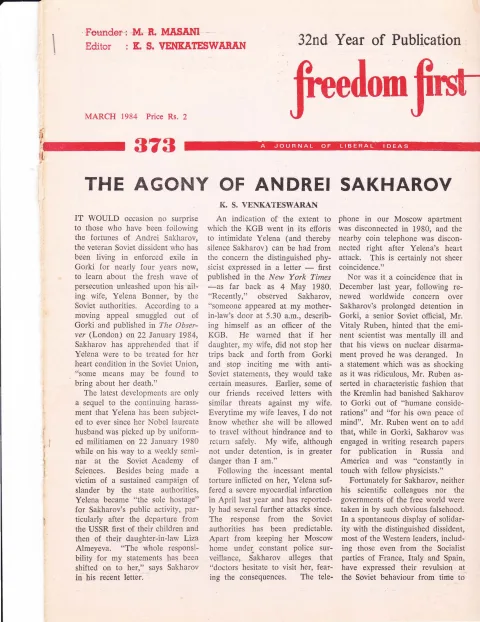
This is the March 1984 issue (No. 373, 32nd year of publication) of Freedom First, the Bombay-based monthly journal of liberal ideas founded by M. R. Masani and edited by K. S. Venkateswaran. The issue opens with an editorial account of the persecution of Soviet dissident Andrei Sakharov and his wife Yelena Bonner, followed by Minoo Masani’s regular “As I See It” column touching on Farooq Abdullah and Kashmir politics, Queen Elizabeth’s Commonwealth Christmas broadcast and its economic-egalitarian assumptions, Ronald Reagan’s re-election bid and Cold War posture, and the constitutionality of the government broadcasting monopoly over All India Radio and Doordarshan. A historical piece by Aloo Dalal profiles the philanthropist Jamsetjee Jejeebhoy and his role in building civic and educational institutions in colonial Bombay. Dr. Otto Count Lambsdorff, the West German economics minister, contributes a piece on protectionism and competing state-versus-market visions of world trade. S. I. Clerk reviews Bombay’s cultural scene (a Shavian stage adaptation of Saint Joan and an international dance encounter) and also reviews two books, alongside a review by Komala Sarathy of The Book of Lech Walesa. The issue closes with a reader’s letter on the Society for the Right to Die with Dignity, a correction notice, publisher/subscription details, and the regular “With Many Voices” page of quoted aphorisms from the world press.
Key points
-
K. S. Venkateswaran’s “The Agony of Andrei Sakharov” recounts the Nobel laureate’s internal exile in Gorki and escalating KGB harassment of his wife Yelena Bonner following her heart attack.
-
Minoo Masani’s “As I See It” praises Governor B. K. Nehru’s resistance to New Delhi’s attempts to topple the Farooq Abdullah ministry and endorses an Andhra Pradesh High Court ruling that the government’s AIR/Doordarshan broadcasting monopoly is unconstitutional.
-
Aloo Dalal’s “Jamsetjee Jejeebhoy And The City of Bombay” profiles the Parsi merchant-philanthropist who founded the J. J. School of Art and J. J. Hospital and treated wealth as a “trust” anticipating Gandhian trusteeship.
-
West German economics minister Dr. Otto Count Lambsdorff’s “Two Views of the World Market” warns against government-directed industrial targeting and protectionism, calling instead for strengthening GATT.
-
S. I. Clerk’s “Cultural Roundabout” reviews a Bombay production of Shaw’s “Saint Joan” and the third “East-West Dance Encounter,” pairing Indian classical dancers with Western performers.
-
Komala Sarathy reviews “The Book of Lech Walesa,” and S. I. Clerk reviews “Voices of Emergency,” a 280-poem anthology of protest verse from the 1975-77 Emergency, criticising its indiscriminate literary quality.
-
M. R. Masani, writing as Chairman of the Society for the Right to Die with Dignity, describes the Society’s two draft bills to decriminalise attempted suicide and protect physicians assisting voluntary euthanasia.
Essays
The Agony of Andrei Sakharov
By K. S. Venkateswaran
K. S. Venkateswaran’s editorial piece recounts the continued persecution of Nobel laureate physicist Andrei Sakharov, held in internal exile in Gorki since 1980, and the escalating KGB harassment of his wife Yelena Bonner, including surveillance, threats, and the disconnection of their telephone after her heart attack. The piece cites Sakharov’s own smuggled letters and appeals published in The Observer and The New York Times, notes Soviet official Vitaly Ruben’s claim that Sakharov was mentally ill, and closes by quoting a Times (London) editorial on how Sakharov’s dissent strips away the self-satisfaction of Soviet leaders.
- Sakharov has lived in enforced exile in Gorki for nearly four years as of March 1984.
- Yelena Bonner has become the target of sustained KGB intimidation, including threats delivered by an officer claiming KGB identity at 5:30 a.m.
- Bonner suffered a severe myocardial infarction in April 1983, reportedly followed by further attacks, amid continued denial of medical access.
- Soviet official Vitaly Ruben asserted Sakharov was mentally ill and that his exile was for his own ‘peace of mind’ and out of ‘humane considerations’.
- Western scientists, including Philip Handler of the US National Academy of Sciences, threatened to sever scientific exchanges with the USSR over the treatment of Sakharov.
- The piece closes with a Times (London) editorial framing Sakharov’s dissent as unmasking the moral bankruptcy of Soviet Communist rule.
As I See It
By Minoo Masani
Minoo Masani’s regular column ranges across four items: praise for Jammu & Kashmir Governor B. K. Nehru for reportedly threatening to resign rather than dismiss the Farooq Abdullah ministry; a rebuttal of Queen Elizabeth’s Christmas Commonwealth broadcast, which Masani (echoing the London Times) criticises for assuming a ‘gap’ between rich and poor nations and for embracing an egalitarian view that redistribution of income is an end in itself; a defence of President Reagan’s re-election bid and his hardline Cold War posture towards the Soviet Union, crediting Reagan’s firmness (not Andropov’s ‘moderation’) for movement on nuclear arms talks; and support for a Andhra Pradesh High Court ruling that the government monopoly over All India Radio and Doordarshan is unconstitutional under Article 19(1)A.
- Masani praises J&K Governor B. K. Nehru for standing up to New Delhi’s attempts to topple the Farooq Abdullah government.
- Masani, citing Michael Hamlyn’s profile in the London Times, calls Farooq Abdullah ‘attractive’ and ‘ebullient’ and backs his position after a vote of confidence in the Assembly.
- Masani criticises Enoch Powell’s claim that the Queen’s Commonwealth speech reflected only ministerial advice, while separately criticising the substance of the Queen’s remarks on global economic inequality as naive.
- He argues there is no genuine ‘gap’ between rich and poor nations, only a continuous range of per capita incomes, and rejects the premise that equality of opportunity should produce equality of income.
- He credits President Reagan’s firmness for prompting apparent Soviet flexibility (Andropov’s ‘Russia ready for dialogue’ statement) on missile talks, arguing this is being wrongly credited to Andropov’s moderation instead.
- He endorses Justice P. A. Choudary’s Andhra Pradesh High Court view that the government broadcasting monopoly (AIR/Doordarshan) is unconstitutional, and calls for the Supreme Court to rule on the matter.
Jamsetjee Jejeebhoy And The City of Bombay
By Aloo Dalal
Aloo Dalal’s historical essay profiles Jamsetjee Jejeebhoy (1783-1859), the Parsi merchant whose fortune, built through hazardous trade voyages to China, funded much of colonial Bombay’s civic and educational infrastructure. The essay traces his rags-to-riches trajectory, his philanthropic model of wealth as a ‘trust’ anticipating Gandhian trusteeship, his sponsorship of girls’ education among Parsees, the founding of the J. J. School of Art and J. J. Hospital, his funding of the Poona causeway and waterworks, and his political role as an early advocate for Indian representation and honorary president of the Bombay Association.
- Jamsetjee Jejeebhoy, born 1783 in Navsari to an impoverished weaver family, built a fortune through hazardous China trade voyages between 1800 and 1808.
- He treated wealth as a ‘trust’ for the benefit of the poor, a view the essay likens to Gandhi’s later theory of trusteeship.
- By 1850 he had started girls’ schools in Bombay in the face of orthodox opposition, and by the turn of the century more than 75 per cent of Parsee women were educated as a result of his institutions.
- He founded the J. J. School of Art (1857), later divided into three branches, and endowed the J. J. Hospital, the first civilian hospital in Bombay.
- He funded major public works including the Poona Bund and waterworks and the Mahim-Bandra causeway (with his wife Lady Jamsetjee funding the approach road) after a fatal 1841 ferry disaster.
- He petitioned the British House of Commons for Indians’ right to serve as jurors and be appointed Justices of the Peace, and became honorary president of the Bombay Association when it was formed in 1852.
Two Views of the World Market
By Dr. Otto Count Lambsdorff
West German economics minister Dr. Otto Count Lambsdorff argues that the world faces a fundamental choice between treating the world market as an arena for competition among individual companies versus one for competition among national economies pursuing industrial policy. He warns against government-directed ‘industrial targeting’ and ‘laser beaming’ of favoured sectors, arguing such strategies provoke retaliatory protectionism and could sever the industrialised countries from the Third World’s trade and debt interests, and calls instead for strengthening GATT and pursuing positive adjustment policies.
- Lambsdorff frames a choice between viewing world trade as competition among companies (fair, rules-based) versus among national economies (state-subsidised industrial policy).
- He warns that when governments coordinate whole industrial sectors under ‘administrative guidance’ against foreign markets, industrial structures are dramatically and quickly altered.
- EEC-Japan trade tensions are cited as a reflection of such state-directed industrial targeting strategies.
- He argues a spiral of retaliatory protectionism would harm all parties, including the initiators, and could sever industrialised countries’ trade ties from the Third World, worsening debt problems.
- He calls for strengthening GATT and pursuing a ‘positive adjustment policy’ instead of defensive growth strategies.
Cultural Roundabout
By S. I. Clerk
S. I. Clerk’s cultural column reviews a Bombay stage production of Hosi Vasunia’s Saint Joan (praising Scheherzade Mody’s title performance and the design team, alongside performances by Homi Daruwala, Vijay Crishna, and Vasunia himself), and reports on two January 1984 cultural events: the third ‘East-West Dance Encounter’ co-organised by Max Mueller Bhavan and the NCPA at the Little Theatre and Tata Theatre, featuring Indian classical dancers (Yamini Krishnamurti, Sonal Mansingh, Mrinalini Sarabhai’s troupe and others) alongside Western dancers and cross-cultural experimental pieces by Uttara Asha Coorlawala and Astad Deboo; and a folk-music evening, ‘The Boys of the Lough’, presented by the Bombay Madrigal Singers’ Organisation and NCPA.
- Hosi Vasunia’s production of Shaw’s Saint Joan is praised for capturing both the play’s ethos and its Shavian wit, with sets by Urshila Kerkar and Arti Joshi and lighting by Alyque Padamsee.
- Scheherzade Mody’s performance in the title role is singled out as central to the play’s success.
- The ‘East-West Dance Encounter’ (its third edition, after music in 1983 and philosophy in November) paired Indian classical dance forms (Bharata Natyam, Odissi, Chhau, Kathak) with Western dancers and hybrid pieces.
- Uttara Asha Coorlawala’s ‘Winds of Shiva’ and Astad Deboo’s ‘Mangalore Street’ are highlighted as notable East-West assimilation experiments.
- ‘The Boys of the Lough’, a four-piece traditional Scottish/Irish folk act, performed at the Tata Theatre to an audience that participated enthusiastically.
Book Reviews: The Book of Lech Walesa; Voices of Emergency: An All India Anthology of Protest Poetry of the 1975-77 Emergency
By Komala Sarathy; S. I. Clerk
Two book reviews appear on pages 13-14. Komala Sarathy reviews The Book of Lech Walesa (Penguin), a collective portrait of the Polish Solidarity leader, praising his diligence, truthfulness, restraint and non-violent approach while situating his movement within the longer Polish struggle against Russian dominance. S. I. Clerk reviews Voices of Emergency: An All India Anthology of Protest Poetry of the 1975-77 Emergency (ed. John Oliver Perry, Popular Prakashan), finding the roughly 280-poem, 14-language anthology politically significant as evidence that the Emergency could not suppress dissent, but criticising its literary quality and indiscriminate inclusion of substandard verse.
- The Book of Lech Walesa is described as a ‘collective portrait’ emphasising Walesa’s broad-based, non-narrow trade-union vision for Polish society.
- The review highlights Walesa’s restraint and rejection of strikes as an unavoidable tactic, preferring alternatives such as worker expropriation of output without state benefit.
- The review situates the Solidarity movement within the centuries-old Polish struggle against Russian dominance, cautioning that its stated aims are limited to liberalisation, not full break with the Soviet Union.
- Voices of Emergency collects about 280 poems from 14 regional languages plus English, with a foreword by David Selbourne, preface by John Oliver Perry, an introduction by K. Ayyappa Paniker, and a postscript on the Emergency by Aloo Dastur.
- Clerk criticises the anthology for prioritising political over literary criteria, noting the inclusion of poems by both A. B. Vajpayee and Jayaprakash Narayan, and judges many included poems substandard.
A Letter (Society for the Right to Die with Dignity)
By M. R. Masani, Chairman, Society for the Right to Die with Dignity
M. R. Masani, writing as Chairman, publicises the Society for the Right to Die with Dignity, established in May 1981 as India’s first such body, affiliated with the World Federation of Right to Die Societies. The letter clarifies the Society advocates voluntary euthanasia (not mercy killing), describes two draft bills it has prepared (to decriminalise attempted suicide under IPC Section 309, and to protect physicians assisting voluntary euthanasia for the terminally ill), and cites Vinoba Bhave and Arthur Koestler as examples of voluntary death by refusing treatment.
- The Society for the Right to Die with Dignity was founded in May 1981 as India’s first organisation of its kind, affiliated with the World Federation of Right to Die Societies.
- It sponsored the Bombay production of Whose Life Is It Anyway? and an Indian premiere event attended by the Governor of Maharashtra in September 1983.
- The Society has drafted two bills: one to delete IPC Section 309 (criminalising attempted suicide), another to protect physicians/surgeons assisting voluntary euthanasia for the terminally ill.
- The letter explicitly distinguishes voluntary euthanasia from mercy killing.
- Vinoba Bhave and Arthur Koestler are cited as recent examples of individuals who chose to refuse medication/sustenance at the end of life.
Generated by the v1.5 extraction pipeline. Awaiting editorial review.
Metadata and summary are AI-extracted from the source PDF and reviewed for editorial accuracy. The original work is available via the Read PDF tab above (where present); paragraph-level citation inside the PDF is deferred to a future engagement.