periodical issue
Freedom First
A Journal of Liberal Ideas
By Minoo Masani
Published for the Democratic Research Service by J. R. Patel, Associate Editor, Freedom First at 127, Mahatma Gandhi Road, Bombay 400 023 (Phone: 273914) and Printed by him at The Popular Press (Bom.) Pvt. Ltd., 35C Tardeo Road, Bombay 400 034 · Bombay · 1984
16 pages
Freedom First
Summary
This is issue No. 375 of Freedom First (May 1984, Rs. 2), the Bombay-based journal of liberal ideas founded by M. R. Masani and edited by K. S. Venkateswaran, in its 32nd year of publication. The issue opens with Cushrow Irani’s critique of UNESCO’s New World Information Order as a cover for Third World and Soviet-bloc governments to legitimize press controls, followed by K. S. Venkateswaran on the Sarah Tisdall Official Secrets Act case in Britain and the resulting debate over press freedom versus state secrecy. Minoo Masani’s regular column recounts Arun Shourie’s M. N. Roy Memorial Lectures exposing wartime collusion between the Communist Party of India’s leadership and British colonial authorities during the 1941-45 ‘People’s War’ period. The second and final instalment of Vladimir Voinovich’s memoir describes his persecution by the Soviet Writers’ Union bureau, culminating in his effective break from the Union. Shorter items include a cultural review of a Bombay stage production of ‘All the King’s Men,’ a roundup of quotable press excerpts (‘With Many Voices’), and a brief obituary for Shantilal H. Shah. The issue is heavily interspersed with commercial advertisements (Godrej, Raymond’s, Sundaram Finance, Hindustan Construction, textile mills, etc.).
Key points
-
Cushrow Irani’s “UNESCO and the New World Information Order” argues UNESCO has let itself be used by Soviet-bloc and Third World governments to legitimise press curbs, and welcomes the United States’ withdrawal from the body.
-
K. S. Venkateswaran’s “The Tisdall Affair” examines the jailing of Foreign Office clerk Sarah Tisdall for leaking documents on Cruise missile deployment, noting it reignited debate over reforming Britain’s Official Secrets Act.
-
Minoo Masani’s “As I See It” recounts Arun Shourie’s M. N. Roy Memorial Lectures, which used declassified archives to argue the Communist Party of India collaborated with British colonial authorities against the 1942 Quit India movement, corroborated by Masani’s own 1954 book on the CPI.
-
Masani calls E. M. S. Namboodiripad’s denial of CPI wartime collusion a “cold-blooded lie” and criticises the Janata Party and PUCL for continuing to associate with Communist parties.
-
The second and final instalment of Vladimir Voinovich’s memoir recounts a 1973-74 disciplinary hearing of the Soviet Writers’ Union at which he was denounced and voted for expulsion, describing the moment his “soul” escaped the Union’s control.
Essays
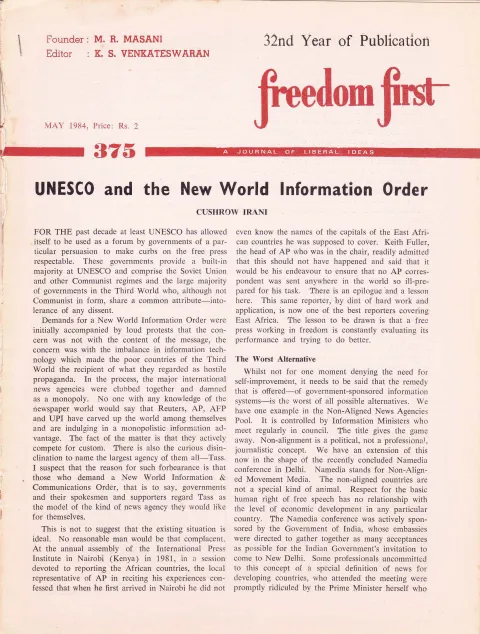
UNESCO and the New World Information Order
By CUSHROW IRANI
Cushrow Irani argues that UNESCO has for a decade let itself be used by Soviet-bloc and Third World governments to make curbs on the free press respectable, under the banner of a ‘New World Information Order.’ He rejects the claim that Western wire agencies (Reuters, AP, AFP, UPI) monopolize world news, contrasts them with the government-controlled Tass and the Non-Aligned News Agencies Pool, and criticizes India’s role in hosting and diplomatically shielding the Namedia conference. He walks through UNESCO’s shifting positions on ‘commercialisation of the media,’ a proposed ‘right of access’ to the press, and a new-minted ‘right to communicate’ that could be used to justify abridging press freedom as a mere ‘derivative’ right. He closes by welcoming the United States’ decision to withdraw from UNESCO at year’s end and urges Britain and West Germany to threaten the same unless UNESCO recommits to press freedom over government control of information.
- UNESCO’s formulations on the media are said to give philosophical cover to Third World and Communist governments suppressing press freedoms.
- Irani disputes the ‘monopoly’ charge against Reuters, AP, AFP and UPI, noting they compete for custom, unlike Tass.
- The Namedia (Non-Aligned Movement Media) conference in Delhi, sponsored by the Government of India, is criticized as politically motivated.
- UNESCO’s ‘right to communicate’ syllogism is presented as a mechanism to demote press freedom from a right to an abridgeable derivative.
- The article endorses the U.S. withdrawal from UNESCO and calls on Britain and West Germany to consider the same.
The Tisdall Affair
By K. S. VENKATESWARAN
K. S. Venkateswaran examines the public outcry over the conviction and jailing of Sarah Tisdall, a junior Foreign Office clerk who leaked confidential information about the arrival of Cruise missiles at Greenham Common, under Britain’s Official Secrets Act, Section 2. He surveys reactions ranging from Times correspondents condemning the harshness of her sentence to others insisting she got what she deserved, and quotes the sentencing judge’s rationale that any custodial leniency would fail to deter future leaks. Venkateswaran concludes that while Tisdall’s appeal to conscience was genuine, the case does not fit the classic ‘mole’ pattern of ideological or paid espionage, and that the episode has reignited the long-running debate over reforming the Official Secrets Act.
- Sarah Tisdall was jailed for leaking Foreign Office documents on Cruise missile deployment to Greenham Common.
- Her case is described as the first custodial sentence under Official Secrets Act Section 2 in a decade.
- Public reaction in The Times ranged from outrage at the harshness of the sentence to approval of it.
- The sentencing judge argued leniency would fail to deter others in possession of classified material.
- The case reinvigorated debate on reforming Britain’s official secrecy law.
As I See It
By MINOO MASANI
In his regular ‘As I See It’ column, Minoo Masani describes reconnecting with Arun Shourie, whose two M. N. Roy Memorial Lectures in Bombay (‘Ideology as an Obstacle’) drew large audiences. Shourie, drawing on newly declassified National Archives documents, detailed correspondence between P. C. Joshi (CPI General Secretary) and Sir Reginald Maxwell (Home Member of the Viceroy’s Council) allegedly showing the Communist Party’s wartime collusion with British authorities against the 1942 Quit India movement and Subhas Chandra Bose’s Azad Hind Fauj. Masani notes that he had documented similar CPI wartime conduct in his own 1954 book on the Communist Party of India, based on a 1946 confidential interview given by former CPI Central Committee member S. S. Batlivala. Masani praises Shourie’s research, calls E.M.S. Namboodiripad’s denial of the episode a ‘cold-blooded lie,’ and criticizes the Janata Party and PUCL for continuing to associate with the CPI.
- Masani recounts meeting Arun Shourie again after twenty years, following Shourie’s well-attended M. N. Roy Memorial Lectures in Bombay.
- Shourie’s lectures used c. 800 National Archives documents to argue the CPI collaborated with British colonial authorities during the 1941-45 ‘People’s War’ period.
- Masani corroborates this with his own 1954 book on the Communist Party of India and a 1946 Batlivala interview alleging CPI-Home Department collusion.
- Batlivala’s letter charged P. C. Joshi with supplying CID with information against 1942 movement activists and Azad Hind Fauj sympathizers.
- Masani calls E.M.S. Namboodiripad’s denial a ‘cold-blooded lie’ and faults the Janata Party and PUCL for continued association with Communist parties.
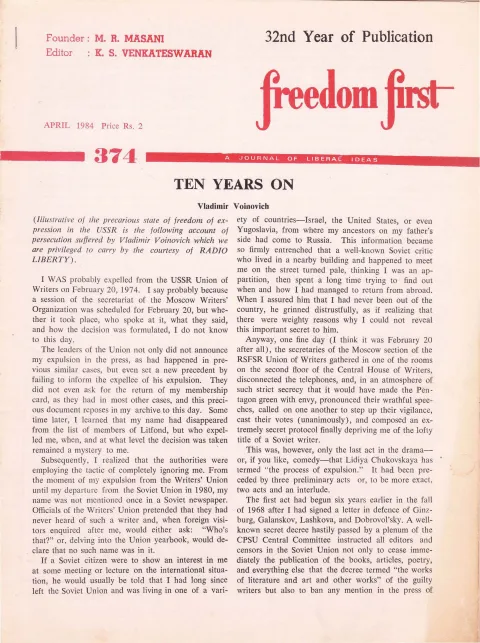
Ten Years On
By Vladimir Voinovich
In the second and final instalment of his memoir (the first appeared in the April 1984 issue), Vladimir Voinovich recounts his escalating conflicts with the Soviet Writers’ Union in 1973-74, including run-ins with KGB Colonel Ivan’ko, his signing of a joint letter defending Andrei Sakharov and Solzhenitsyn, and a December 1973/February 1974 disciplinary meeting of the prose writers’ bureau chaired by Georgii Radov, where colleagues denounced him for his novel Chonkin and for anti-Soviet correspondence. Voinovich describes the meeting’s theatrical hostility, his own defiant refusals to answer or attend further proceedings, and his declaration that he no longer recognized the Union’s authority over him, feeling for the first time that his soul had escaped their control. The instalment ends with his arrest scare via a 2 a.m. phone call from a Reuters correspondent.
- Voinovich describes KGB Colonel Ivan’ko’s attempt to seize his apartment and his own escalating acts of dissent through 1973 (Grani submission, Sakharov/Solzhenitsyn defense letter, Chonkin’s Western publication).
- A bureau meeting of the prose writers’ association, chaired by Georgii Radov, was convened to examine Voinovich’s ‘personal case’ amid the expulsions of Chukovskaya and Solzhenitsyn.
- Colleagues including Berezko, Amlinsky, and Brovman denounced Voinovich in a session he describes as theatrical and hostile.
- Voinovich refused to answer questions, calling the proceedings illegal, and declared he no longer acknowledged the Union’s authority or reprimands.
- The meeting concluded with a unanimous vote recommending Voinovich’s expulsion from the Union of Writers; he describes feeling his ‘soul’ had escaped their control.
- The piece ends with a 2 a.m. phone call from a Moscow Reuters correspondent asking if Voinovich had been arrested.
Generated by the v1.5 extraction pipeline. Awaiting editorial review.
Metadata and summary are AI-extracted from the source PDF and reviewed for editorial accuracy. The original work is available via the Read PDF tab above (where present); paragraph-level citation inside the PDF is deferred to a future engagement.