periodical issue
Freedom First
A Journal of Liberal Ideas
By Minoo Masani
Published for the Democratic Research Service by J. R. Patel, Associate Editor, Freedom First at 127, Mahatma Gandhi Road, Bombay 400 023 (Phone: 273914) and Printed by him at The Popular Press (Bom.) Pvt. Ltd., 35C Tardeo Road, Bombay 400 034 · Bombay · 1984
16 pages
Freedom First
Summary
This is the 377th issue of Freedom First (July 1984, Rs. 2, 32nd year of publication), the Bombay-based classical liberal journal founded by M. R. Masani and edited in this issue by K. S. Venkateswaran. The issue opens with Venkateswaran’s lead essay on the unresolved state of Indian parliamentary privilege law, prompted by the Andhra Pradesh Legislative Council’s confrontation with the editor of the Telugu daily Eenadu, and argues that decades of drift since the 1950 Constitution have left citizens’ free speech vulnerable to legislative bodies acting in a quasi-judicial capacity. Minoo Masani’s regular “As I See It” column takes up the Thatcher-Botha invitation controversy and a separate British press-freedom dispute between newspaper proprietors and editors (The Observer, the Daily Express), using both to argue that proprietors, not just editors, have a legitimate stake in editorial direction. A feature by Juan Fercsey chronicles the improbable survival of The Grenadian Voice, an independent Grenadian newspaper that published only one issue in its first two and a half years due to repression under the Bishop regime, and situates it within the broader story of Grenada’s 1983 crisis. The book review section covers J. B. H. Wadia’s biography M. N. Roy—The Man (reviewed by Mary Thomas) and two Indian Law Institute monographs on official secrecy and contempt of court law (reviewed by Venkateswaran), the latter arguing for narrowing Section 5 of the Official Secrets Act and for a public-interest defence in prosecutions. S. I. Clerk’s “Cultural Roundabout” column surveys current Bombay theatre, including P. L. Deshpande’s Teen Paishacha Tamasha (a Marathi adaptation of Brecht’s Threepenny Opera) and Tennessee Williams’ The Glass Menagerie. The issue closes with the “With Many Voices” quotations column and a subscription order form.
Key points
-
K. S. Venkateswaran’s lead essay on parliamentary privilege uses the 1984 Eenadu Case, in which the Andhra Pradesh Legislative Council sought to jail editor Ramoji Rao, to argue decades of drift since 1950 have left free speech vulnerable to legislative bodies.
-
Minoo Masani’s “As I See It” defends Margaret Thatcher’s invitation to South African PM P. W. Botha as less objectionable than Soviet-style “total tyranny,” and sides with Daily Express proprietors over editors in a press-freedom dispute involving Arthur Scargill.
-
Juan Fercsey’s “The Grenadian Voice” chronicles the improbable survival of an independent Grenadian newspaper suppressed for two and a half years under Maurice Bishop’s regime before resuming publication after the 1983 crisis.
-
Mary Thomas reviews J. B. H. Wadia’s biography “M. N. Roy — The Man,” tracing Roy’s path from Comintern revolutionary to founder of the Radical Humanist Movement.
-
K. S. Venkateswaran reviews two Indian Law Institute monographs on official secrecy and contempt of court, arguing for narrowing Section 5 of the Official Secrets Act and a statutory public-interest defence.
-
S. I. Clerk’s “Cultural Roundabout” highlights P. L. Deshpande’s Marathi adaptation of Brecht’s “Threepenny Opera,” “Teen Paishacha Tamasha,” as the outstanding current Bombay production.
-
The closing “With Many Voices” column quotes Farooq Abdullah defending himself as a “diwana” rather than a “gadda,” and Swaminathan Aiyar comparing Marxist economic forecasting to entrail-reading.
Essays
Parliamentary Privileges:
By K. S. VENKATESWARAN
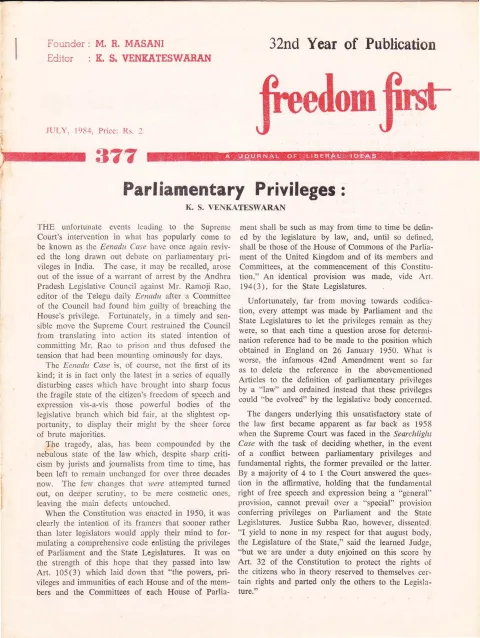
K. S. Venkateswaran’s lead essay traces the unsatisfactory state of Indian law on parliamentary privilege, using the 1984 Eenadu Case (in which the Andhra Pradesh Legislative Council sought to imprison editor Ramoji Rao for breach of privilege, before the Supreme Court intervened) as its hook. The piece reviews Article 105(3)/194(3) of the Constitution, which left privileges tied to the undefined and uncodified privileges of the House of Commons as of 1950, and criticizes the 42nd Amendment for making things worse by letting privileges be ‘evolved’ by the legislature itself rather than defined by law. It surveys the 1958 Searchlight Case (fundamental rights held subordinate to privilege by a 4-1 majority, with Justice Subba Rao dissenting) and the partial correction in Keshav Singh’s Case, before closing on a suspicious late development: the Andhra Pradesh Legislative Council chairman reportedly discussed the Eenadu matter with the Lok Sabha Speaker, Balram Jakhar, raising concerns about external influence on what should be a quasi-judicial proceeding.
- The Eenadu Case saw the Andhra Pradesh Legislative Council seek a warrant of arrest against editor Ramoji Rao for breach of privilege; the Supreme Court restrained the Council.
- Article 105(3)/194(3) tied Indian legislative privileges to the undefined privileges of the House of Commons as they stood on 26 January 1950, pending codification that never happened.
- The 42nd Amendment worsened the problem by removing the requirement that privileges be defined ‘by law’, allowing them instead to be ‘evolved’ by the legislature.
- In the 1958 Searchlight Case, the Supreme Court held 4-1 that parliamentary privilege prevails over the fundamental right to free speech; Justice Subba Rao dissented.
- Keshav Singh’s Case later held that the rights to personal liberty (Art. 21) and recourse to the Supreme Court (Art. 32) are ‘absolute’ and not subservient to privilege articles.
- A late-breaking development revealed the AP Legislative Council chairman met with Lok Sabha Speaker Balram Jakhar to discuss the pending case, raising concerns about improper external influence on a quasi-judicial proceeding.
As I See It
By MINOO MASANI
Minoo Masani’s column opens with the controversy over Margaret Thatcher’s invitation to South African Prime Minister P. W. Botha, quoting The Daily Telegraph and The Times at length in defence of Thatcher’s position against critics like Liberal leader David Steel, and siding with The Times’s view that racial tyranny in South Africa, however repugnant, is less totalizing than Soviet-style tyranny given South Africa’s independent courts and partially free press. Masani pivots to a British press-freedom dispute, describing a clash at the Daily Express between its Chairman and Editor over whether to print a reply from miners’ leader Arthur Scargill after he compared the paper’s editor to Goebels; Masani sides with the Chairman’s original refusal, endorsing arguments (via Woodrow Wyatt’s Times article) that proprietors, not just editors, have legitimate authority over their papers, since market discipline by readers—not government regulation—is what should keep editors and proprietors honest.
- Masani defends Margaret Thatcher’s invitation to South African PM P. W. Botha against ‘leftist hysteria’, citing The Daily Telegraph’s argument that Botha’s government has been dismantling apartheid structures.
- Masani sides with The Times over Liberal leader David Steel, arguing South Africa’s system, though racially unjust, allows independent courts and a partly critical press, unlike the ‘total tyranny’ of the Kremlin.
- He invokes the Sakharovs as examples of Soviet tyranny’s victims to argue moral equivalence claims against South Africa are overstated.
- A separate item covers a Daily Express dispute in which Arthur Scargill compared the paper’s editor to Goebels; the editor initially refused to print Scargill’s reply and the Chairman backed the editor.
- Masani approvingly quotes Woodrow Wyatt’s Times article arguing that proprietors have as much legitimate say as editors, and that the market (reader choice), not statutory regulation, is the proper check on both.
The Grenadian Voice: The New Beginning of a Caribbean Newspaper
By JUAN FERCSEY
Juan Fercsey’s feature recounts the extraordinary story of The Grenadian Voice, an independent Grenadian newspaper founded by 26 citizens who each contributed $100, whose first issue appeared on 13 June 1981 and whose second issue was seized and suppressed by Maurice Bishop’s People’s Revolutionary Government before it could be distributed—creating what the paper itself claimed was a record for ‘the longest time between two issues’ (nearly two and a half years) of any newspaper. The piece narrates Bishop’s 1979 coup against Eric Gairy, the PRG’s closure of the paper Torchlight and repeated jailing of journalist Alister Hughes, and then the October 1983 crisis in which Bishop was placed under house arrest and later killed along with education minister Jackeline Creff, followed by US/East Caribbean intervention. The Grenadian Voice resumed publishing on 20 November 1983 with an editorial invoking the motto of West Indian journalist Theophilus Albert Marryshow (‘The right alone is right, the wrong is always wrong’) and pledging independence from the new PRG-successor government under Governor-General Sir Paul Scoon, while depending on cross-Caribbean solidarity (printing in Trinidad, aid from Barbados and Jamaican colleagues) to keep publishing.
- The Grenadian Voice’s first issue (13 June 1981) was funded by 26 citizens contributing $100 each; its second issue, prepared for 30 June 1981, was never distributed after PRG forces seized the material and arrested editor-in-chief Leslie Pierre and two shareholders.
- Maurice Bishop’s New Jewel Movement overthrew Eric Gairy’s government on 13 March 1979, the first coup in the English-speaking Caribbean Commonwealth.
- Under Bishop, the paper Torchlight was closed and journalist Alister Hughes was repeatedly jailed for years.
- Bishop was placed under house arrest on 14 October 1983 (allegedly for plotting against Bernard and Phyllis Coard) and was killed along with education minister Jackeline Creff and others during the crisis; a Revolutionary Military Council briefly seized power.
- The Grenadian Voice resumed publication on 20 November 1983, pledging independence from government and no sponsorship of counter-revolution, and adopted the motto of West Indian journalist Theophilus Albert Marryshow.
- The paper depends on Caribbean press solidarity: it is printed in Trinidad and shipped back to St. George’s in 35 bags of 200 copies each by plane, with help from Barbadian and Jamaican colleagues.
- Governor-General Sir Paul Scoon holds full power pending elections, assisted by a nine-member Advisory Council, with continued reliance on the Commonwealth Caribbean Peace-keeping Force for law and order.
Book Reviews: M. N. Roy - The Man by J. B. H. Wadia
By Mary Thomas
Mary Thomas reviews J. B. H. Wadia’s biography M. N. Roy—The Man (Popular Prakashan, Rs. 50), which traces Roy’s life from his 1887 birth as Narendranath Bhattacharya through his career as a revolutionary, his founding of the Mexican Communist Party and (per the review) the first Communist Party outside Russia, his meetings with Lenin and later falling-out with Stalin, his imprisonment by the British on return to India, his subsequent presidency-adjacent role in the Congress, his founding of the Radical Democratic Party of India, and his eventual disillusionment with Marxism, leading him to found the Radical Humanist Movement. The review, drawing on Wadia’s personal association with Roy from 1937 until his death, praises the book’s portrayal of Roy’s intellectual range and describes his wife Ellen Roy’s central role in his life and work, while noting the book is modestly self-described by its author as ‘an incomplete Royana’.
- M. N. Roy was born Narendranath Bhattacharya in 1887 and became a revolutionary in India’s freedom movement before age fourteen.
- Roy founded the Mexican Communist Party and, per the review, the first Communist Party outside Russia; he was invited by Lenin to submit his thesis on ‘the Colonial Question’ at the Second Comintern Congress in 1920.
- Roy’s alleged failure in a China mission turned Stalin against him; he escaped to Berlin and later returned to India, where the British jailed him for five years starting in 1931.
- After release in 1936 Roy joined the Indian National Congress, later founded the League of Radical Congressmen and then the Radical Democratic Party of India (dissolved 1948), converting it into the Radical Humanist Movement.
- Roy defined freedom as ‘the progressive removal of all restrictions from the unfolding of human potentialities’.
- The review credits Roy’s wife Ellen with sustaining him materially and intellectually, noting the book gives her contribution due credit.
Official Secrecy and the Press / Contempt of Court and the Press (review of two ILI studies)
By K. S. Venkateswaran
K. S. Venkateswaran reviews two Indian Law Institute monographs commissioned for the Press Council of India: Official Secrecy and the Press by S. N. Jain (Rs. 15) and Contempt of Court and the Press by Rajeev Dhawan (Rs. 45). The first study focuses on Section 5 of the Official Secrets Act, 1923—modelled on the sweeping English Official Secrets Act of 1911—which criminalizes communication of any official document or information without authorisation, and argues this ‘catch-all provision’ should be narrowed to specific categories of protected information, with a statutory public-interest defence. The second study on contempt of court argues for reform of the 1971 Contempt of Courts Act while cautioning that courts must retain jurisdiction over ‘scandalising the judges’, citing occasions like Chief Justice M. H. Beg’s contempt proceedings against two newspapers after the Emergency. The review closes on a pessimistic note that the situation regarding press freedom and judicial protection has ‘only grown worse’ since the cited observations were written.
- Both studies were commissioned by the Indian Law Institute for the Press Council of India, prompted partly by the Morarji Desai-Sanjiva Reddy correspondence controversy.
- Section 5 of the Official Secrets Act, 1923, modelled on Section 2 of the UK’s 1911 Act, is described as a ‘catch-all provision’ criminalizing communication of official information without authorisation, with liability extending to recipients.
- The Jain study recommends narrowing Section 5 to specific categories of protected information and instituting a statutory public-interest defence in prosecutions.
- The Dhawan study on contempt of court supports narrowing disclosure/confidentiality obligations for journalists but argues judges must retain the power to punish ‘scandalising the judges’.
- The review cites Chief Justice M. H. Beg’s initiation of contempt proceedings against two newspapers after the Emergency, later dropped before hearings began, as a historical flashpoint.
- Venkateswaran closes pessimistically, noting the state of press freedom and press-judiciary relations has worsened since the studies were written.
Cultural Roundabout
By S. I. CLERK
S. I. Clerk’s ‘Cultural Roundabout’ column surveys current Bombay theatre. It highlights P. L. Deshpande’s Teen Paishacha Tamasha, an adaptation of Brecht’s Threepenny Opera presented by Theatre Academy, Pune at the Tata Theatre under NCPA auspices, directed by Jabbar Patel with a cast including rock musician Nandu Bhende, and praised as a brilliant satire on corrupt politicians and blind superstition. It also covers the IPTA production Ek Aur Dronacharya (correlating the Mahabharata’s Dronacharya to a modern college principal), Ekjut’s Hindi play Sandhya Chhaya (adapted by Kusum Kumar from a Marathi original by Jayant Dalvi, directed by Nadira), and Tennessee Williams’ The Glass Menagerie performed by ‘Creators’ at the Tata Theatre, noting the latter’s dialogue was ‘rather inaudible’ at the reviewed performance.
- Teen Paishacha Tamasha, P. L. Deshpande’s Marathi adaptation of Brecht’s Threepenny Opera, is singled out as the most outstanding current Bombay production, directed by Jabbar Patel.
- The IPTA play Ek Aur Dronacharya draws a parallel between the Mahabharata’s Dronacharya and a modern college principal, Professor Arvind, who compromises his values for status.
- Ekjut’s Hindi play Sandhya Chhaya, adapted by Kusum Kumar from Jayant Dalvi’s Marathi original and directed by Nadira, is a tear-jerker about an aged couple abandoned by their US-settled son.
- Tennessee Williams’ The Glass Menagerie (1948), performed by ‘Creators’ under NCPA auspices, is praised for its dramatic theme but criticized for inaudible dialogue at the performance reviewed.
With Many Voices (quotations column)
The closing ‘With Many Voices’ column collects short quotations from contemporary press sources on varied topics: colonial freedom (Joshua Nkomo), marriage (La Rochefoucauld), a Reagan quote censored by Chinese authorities, a comment on writing about Thatcher (Ian Aitken), music (Yehudi Menuhin), power (Henry Kissinger), selective condemnation of imperialism (Conor Cruise O’Brien), self-description by Farooq Abdullah, love and age (Edna O’Brien), and a comparison of Marxist economic forecasting to entrail-reading (Swaminathan Aiyar).
- The column is a curated set of quotations drawn from Indian and international press between March and May 1984.
- Topics range from South African and Rhodesian politics to marriage, music, and Cold War commentary.
- Swaminathan Aiyar’s quote likens Marxist economic prediction to entrail-reading, predicting ‘a sad future for all systems save communism’.
- Farooq Abdullah is quoted defending himself against being called a ‘gadda’ (donkey), instead calling himself a ‘diwana’ (madcap) who speaks the truth.
Generated by the v1.5 extraction pipeline. Awaiting editorial review.
Metadata and summary are AI-extracted from the source PDF and reviewed for editorial accuracy. The original work is available via the Read PDF tab above (where present); paragraph-level citation inside the PDF is deferred to a future engagement.