periodical issue
Freedom First
A Journal of Liberal Ideas
Published for the Democratic Research Service by J. R. Patel, Associate Editor, Freedom First at 127, Mahatma Gandhi Road, Bombay 400023 (Phone: 273914) and Printed by him at The Popular Press (Bom.) Pvt. Ltd., 35C Tardeo Road, Bombay 400034 · Bombay · 1984
16 pages
Freedom First
Summary
Freedom First issue 380 (October 1984) opens with editor K. S. Venkateswaran’s leader on child malnutrition and health policy failures in India, drawing on a UNICEF report to indict government priorities. Ashley Tellis contributes a sharply argued Cold War polemic, “The Politics of Illusion,” attacking the nuclear disarmament movement (GROUND) as naive and dangerous, defending deterrence and the balance of power as the only realistic guarantors of peace. The issue carries an exclusive interview with Juanita Castro, Fidel Castro’s estranged sister, conducted by Juan Fercsey in Copenhagen, in which she denounces her brother’s regime as a Soviet-aligned dictatorship built on opportunism rather than conviction. A substantial book-reviews section follows: Sharad Bailur reviews Stanley Kochanek’s study of Pakistani business-government relations and Ved Mehta’s Daddyji/Mamaji family biographies, while C. G. Pradeep Kumar reviews several law and politics titles (public law, administrative law, writ jurisdiction, an American presidential-election primer, and Roger Scruton’s Kant) in brief notices. The issue closes with “With Many Voices,” a page of pointed quotations culled from the contemporary press on Sikh militancy, Arthur Scargill, Kashmir, terrorism, Reagan, and Soviet isolation. A short notice reports on a Freedom First Foundation discussion event held in Delhi on 9 August 1984.
Key points
-
K. S. Venkateswaran’s “The State of Children” uses a UNICEF report to indict Indian government policy on malnutrition, citing Dr. C. Gopalan’s warning that 20 million of 23 million children born in 1983 could be physically or mentally impaired.
-
Ashley Tellis’s “The Politics of Illusion” attacks the anti-nuclear disarmament movement GROUND as naive, arguing deterrence rather than disarmament has preserved the longest peace in European history.
-
Juan Fercsey’s interview “Fidel Tried to Kidnap Me” has Juanita Castro, Fidel Castro’s estranged sister, describe him as an opportunist who “created his Marxist history” and warn of a Soviet-Cuban continental strategy extending toward Mexico and the US.
-
Sharad Bailur reviews Stanley Kochanek’s “Interest Groups and Development: Business and Politics in Pakistan,” finding its warnings about ordinance-driven governance and concentrated economic power “striking and ominous” for India.
-
Sharad Bailur also reviews Ved Mehta’s reissued “Daddyji/Mamaji,” praising its closing chapters on his parents coming to terms with his blindness as the freshest material.
-
C. G. Pradeep Kumar’s “In Brief” column gives capsule notices of five law and politics titles, including A. G. Noorani’s edited “Public Law in India” and Roger Scruton’s “Kant.”
-
The closing “With Many Voices” column includes a Jaipur police officer’s quoted claim that Harijans are “meant to be raped,” presented without comment as documentation of official attitudes.
Essays
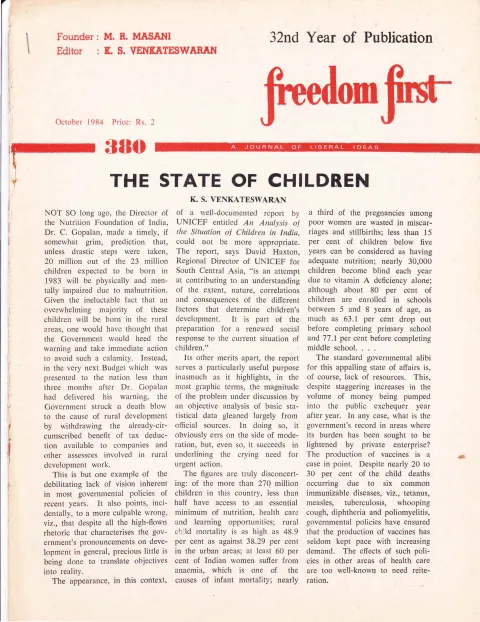
The State of Children
By K. S. Venkateswaran
In this editorial, K. S. Venkateswaran uses a UNICEF report, “An Analysis of the Situation of Children in India,” to argue that government policy is failing India’s children on a massive scale. He cites the government’s withdrawal of tax deductions for rural-development spending as emblematic of a broader gap between developmental rhetoric and action, then marshals statistics on malnutrition, child mortality, school dropout rates, and vaccine-preventable disease to indict the state’s record, contrasting it with what private enterprise could achieve if unburdened.
- Cites Dr. C. Gopalan’s warning that 20 million of 23 million children born in 1983 could be physically or mentally impaired by malnutrition.
- Criticises the government for withdrawing tax deduction benefits for rural development spending shortly after the warning.
- Draws on a UNICEF report by David Haxton to document India’s child welfare crisis with statistics on nutrition, health care, and education access.
- Notes rural child mortality of 48.9% versus 38.29% in urban areas, and that over 60% of Indian women suffer anaemia.
- Highlights educational attrition: 63.1% of children drop out before completing primary school, 77.1% before middle school.
- Argues lack of resources is a false alibi given rising government revenue, and contrasts state failure with the potential of private enterprise, citing lagging vaccine production.
The Politics of Illusion
By Ashley Tellis
Ashley Tellis attacks the Group for Nuclear Disarmament (GROUND) and the broader anti-nuclear movement as intellectually dishonest and strategically naive. He argues that nuclear deterrence, not disarmament, has preserved the longest peace in European history, and that complete disarmament is both a logical non-starter (requiring an enforcing world government) and destabilising, since asymmetric cheating would be catastrophic. He contends the real threat to peace is aggressive intent, not weapons themselves, and closes by framing deterrence as a moral necessity for defending free political communities.
- Opens by situating GROUND within a decades-long history of pacifist and appeasement movements since the World Wars.
- Critiques the film Prophecy, screened by GROUND, as one-sided propaganda that ignores the Soviet arsenal while dwelling on US weapons.
- Argues complete nuclear disarmament is a ‘logical non-starter’ since only a world government could enforce it, and such a government would itself need weapons.
- Claims a unilateral or asymmetric disarmament scenario would be more dangerous than the current balance of deterrence.
- States that aggression, not weapons, causes war, and that N-weapons raise the cost of aggression, thereby preserving peace.
- Advocates arms control negotiations with deep, balanced cuts rather than total disarmament as the realistic policy path.
- Closes with a moral defence of deterrence as necessary to preserve free political communities, rejecting the choice as being between survival and extinction.
”Fidel Tried to Kidnap Me”
By Juanita Castro (interview conducted by Juan Fercsey; courtesy Antar-Sanchar)
This is a reprinted exclusive interview (courtesy Antar-Sanchar) that journalist Juan Fercsey conducted with Juanita Castro, Fidel Castro’s sister, in Copenhagen. Juanita, who left Cuba twenty years earlier after opposing her brother’s Soviet alignment, describes Fidel as a poor loser as a child, an opportunist without genuine political conviction, and the architect of a totalitarian, Soviet-client regime with concentration camps and mass political imprisonment. She recounts the Castro family background, Fidel’s schooling and early political career in the Orthodox Party, and warns of a Soviet-Cuban continental strategy extending through Nicaragua, El Salvador, and eventually toward Mexico and the United States.
- Juanita Castro recalls Fidel as a poor loser in childhood games and describes the family’s upbringing on a sugarcane plantation in Biran.
- She left Cuba after opposing Fidel’s Soviet alignment and ‘terror-regime,’ and now lives in Miami running a pharmacy.
- Describes Fidel’s schooling at a Jesuit college and his unsuccessful bid for student leadership, followed by his role in the Orthodox Party ahead of the cancelled 1952 elections.
- Calls Fidel an opportunist who ‘created his Marxist history’ and needs the Soviet Union to sustain his power.
- Details Cuba’s network of jails and concentration camps, including the imprisonment of children of dissidents, and cites over one million exiles and 15,000 executions.
- Warns of a Soviet-Cuban ‘continental plan’ extending from Nicaragua and El Salvador toward Mexico and the US border, framing Sovietization as a spreading cancer.
Book Reviews: Interest Groups and Development; Business and Politics in Pakistan (Stanley A. Kochanek)
By Sharad Bailur
Sharad Bailur reviews Stanley A. Kochanek’s Interest Groups and Development: Business and Politics in Pakistan, praising it as a companion volume to Kochanek’s earlier Business and Politics in India and a valuable window onto the Pakistani business psyche and its parallels with India. The review summarises Kochanek’s account of how weak formal channels of access to government fostered informal lobbying, bureaucratic corruption, and the concentration of economic power among Pakistan’s twenty-two families, and highlights the book’s warning about ordinance-driven governance and a weakened legislature — parallels the reviewer finds “striking and ominous” for India.
- Frames the book as a companion to Kochanek’s earlier Business and Politics in India, forming a corpus on South Asian business-politics relations.
- Explains that weak formal representational organisations pushed Pakistani business toward informal lobbying, fostering bureaucratic corruption and ‘black money’.
- Notes that General Zia-ul-Haq’s rule has not changed the underlying pattern, leaving businesses wary of the state despite reliance on emigrant remittances and the Green Revolution.
- Highlights the reviewer’s view that the concentration of power in twenty-two families, weak legislative accountability, and executive-heavy governance parallel dangers visible in India.
- Praises Kochanek’s style and analytical precision while noting he does not examine whether the bureaucracy itself encourages factional infighting to protect its own rent-seeking.
Book Review: Daddyji/Mamaji (Ved Mehta)
By C. G. Pradeep Kumar
Sharad Bailur reviews Ved Mehta’s Daddyji/Mamaji, a reissued paperback combining Mehta’s two biographical portraits of his parents. The review credits Mehta’s meticulous, first-hand reconstruction of his parents’ lives from written records, witness testimony, and memory, noting the closing chapters — where the parents come to terms with their son’s blindness — as the freshest material, and calls the biographies a must-read for admirers of Mehta’s earlier autobiography Face to Face.
- Daddyji (1972) and Mamaji (1979) are reissued together as a Pan paperback in 1984.
- The biographies are built from written records, witness testimony, ‘fragments of memory,’ and Mehta’s grandfather’s diary.
- The review praises Mehta’s juxtaposition of an England-returned doctor father and a superstitious, traditional Indian mother.
- Notes the closing chapters on the parents coming to terms with their son’s blindness as the only genuinely new material relative to Face to Face.
- Concludes the biographies are a ‘must’ for readers of Face to Face and a representative example of Mehta’s narrative skill.
In Brief… (capsule reviews: Public Law in India; Administrative Law; Writ Jurisdiction Under the Constitution; Choosing the President 1984; Kant by Roger Scruton)
C. G. Pradeep Kumar’s “In Brief” column gives short notices of five books: A. G. Noorani’s edited Public Law in India, a collection of essays on Indian constitutional and administrative law; S. P. Sathe’s Administrative Law (4th edn.), a standard but non-exhaustive law-school text; B. L. Hansaria’s Writ Jurisdiction Under the Constitution, praised for its overview of prerogative writs but faulted for not engaging seriously with liberalised standing and public interest litigation; The League of Women Voters’ Choosing the President, 1984, an accessible primer on the US presidential process; and Roger Scruton’s Kant (Past Masters), called ‘a little masterpiece’ for its concise, incisive introduction to Kantian philosophy.
- Public Law in India (ed. A. G. Noorani) collects essays by legal scholars including Nariman, Sorabjee, Bakshi, Rashid & Yaqin, Jain, Baxi, and Jacob, with a treatment of Emergency-era jurisprudence by Anil B. Divan.
- Sathe’s Administrative Law is called a useful but non-exhaustive standard text, no match for comparable Western works like Wade or de Smith.
- Hansaria’s Writ Jurisdiction is praised for historical overview but criticised for merely echoing rhetoric on ‘standing’ and PIL rather than critically examining it.
- Choosing the President, 1984 is described as a comprehensive, non-partisan enchiridion on the American electoral process, with appendices and bibliography.
- Scruton’s Kant is praised as an excellent, concise introduction to Kant’s philosophy, including his philosophy of art.
With Many Voices
“With Many Voices” is a recurring column of pointed quotations drawn from the contemporary press, covering Sikh militancy, British trade-union politics, Kashmir, terrorism and rape in India, press ownership, Indian editorial hypocrisy on Punjab and Sri Lanka, Reagan’s political rekindling of American optimism, and Soviet international isolation.
- Quotes Inderjit Singh (The Guardian) on Sikh resistance to tyranny, and Lord Mayhew (The Times) dismissing Arthur Scargill as a law-and-order rather than political problem.
- Quotes Dr. Farooq Abdullah (The Times of India) asserting Kashmir belongs to Kashmiris.
- Includes a startling quoted claim from a Jaipur police officer (The Indian Express) that Harijans are ‘meant to be raped,’ presented without comment as a documentation of official attitudes.
- Quotes James Cameron on newspaper ownership, and Rajmohan Gandhi on the self-cancelling inconsistency of Indian press editorials on Punjab versus Sri Lanka.
- Closes with three Economist editorials: on Reagan’s restoration of American optimism compared to Kennedy and Roosevelt, on Soviet diplomatic isolation, and on the fragility of one-party rule in Africa.
Generated by the v1.5 extraction pipeline. Awaiting editorial review.
Metadata and summary are AI-extracted from the source PDF and reviewed for editorial accuracy. The original work is available via the Read PDF tab above (where present); paragraph-level citation inside the PDF is deferred to a future engagement.