periodical issue
Freedom First
A Quarterly of Liberal Ideas
By Minoo Masani
Published for the Democratic Research Service by J. R. Patel, Associate Editor, Freedom First at 127, Mahatma Gandhi Road, Bombay 400 023 (Phone: 273914) and Printed by him at The Popular Press (Bom.) Pvt. Ltd., 35C Tardeo Road, Bombay 400 034 · Bombay · 1985
56 pages
Freedom First
Summary
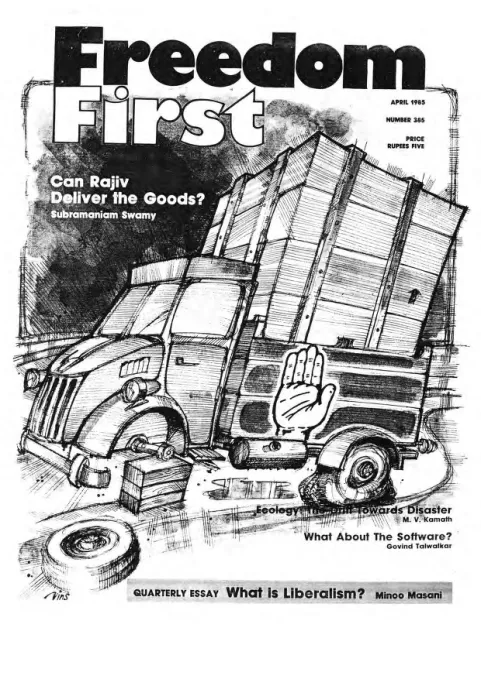
This April 1985 issue of Freedom First (No. 385) marks a turning point for the magazine: after 32 years as a monthly, it converts to a quarterly format, a change the editors frame as an effort to offer readers “better and more varied fare.” The issue opens with a note from the editorial team (S. V. Raju, K. S. Venkateswaran, and Associate Editor Jehangir Patel) announcing this shift and introducing a new recurring feature, a quarterly essay on liberal thought, inaugurated in this issue by founder Minoo Masani himself with a piece titled “What Is Liberalism?” In the rendered pages, the volume’s argumentative center is an anxious, arm’s-length assessment of the new prime minister Rajiv Gandhi following his landslide election victory: Subramaniam Swamy’s lead essay questions whether the young, untested PM can “deliver the goods,” and Govind Talwalkar’s companion piece presses him to modernize not just India’s economic “hardware” but its bureaucratic “software.” Other contributions in the rendered set include Minoo Masani on the anti-defection law (“Freezing the 400”) and on the unresolved 1984 Delhi anti-Sikh riots, Rama Swarup’s report on the Ethiopian famine and the Mengistu regime’s culpability, and M. V. Kamath’s survey of the Worldwatch Institute’s report on global ecological decline.
Key points
-
An editorial note announces Freedom First’s conversion from a monthly to a quarterly, introducing a new recurring feature inaugurated by founder Minoo Masani’s essay “What Is Liberalism?”
-
Subramaniam Swamy’s “Can Rajiv Deliver the Goods?” questions whether the untested new Prime Minister can govern effectively, warning that his economic and foreign-policy advisers are the same “timid group” his mother relied upon.
-
Govind Talwalkar’s “What About the Software?” argues India’s real bottleneck to modernisation is administrative “software,” not imported hardware, and proposes satellite-delivered mass training in new techniques.
-
Minoo Masani’s “Freezing the 400” attacks the rushed anti-defection Bill on principled and technical grounds, arguing MPs lose the right of conscience and the Speaker’s ruling amounts to a “kangaroo court.”
-
Masani separately addresses the unresolved 1984 Delhi anti-Sikh riots, noting three independent reports concluded the violence was a “politically-sponsored massacre” while the government refused a judicial enquiry.
-
Rama Swarup’s “The Agony of Ethiopia” argues dictator Mengistu Haile Mariam’s fixed-price agricultural policy and diversion of resources to war turned drought into famine, with 90 per cent of state investment going to inefficient state farms producing only 6 per cent of grain.
-
M. V. Kamath’s “Ecology—The Drift Towards Disaster” surveys a Worldwatch Institute study on global ecological decline, reporting that West German forest damage from acid rain rose from 8 per cent in 1982 to 50 per cent in 1984, and urges India to expand the Chipko movement.
Essays
Can Rajiv Deliver the Goods?
By Subramaniam Swamy
Subramaniam Swamy, writing as a former Member of Parliament, assesses whether Rajiv Gandhi, barely 41 and only four years in politics, can govern effectively as India’s new Prime Minister. He argues Gandhi lacks a clear ideological framework across three dimensions — ideology, administrative style, and party control — and that his economic and foreign policy advisers are the same “timid group” his mother Indira Gandhi relied upon, making real change unlikely. Swamy is skeptical of the wave of goodwill around Gandhi, noting his mother never enjoyed comparable popularity despite 16 years in power, and warns that the Congress (I) party organization — overrun during the Sanjay Gandhi years by “criminals, hijackers and bootleggers” — remains Gandhi’s weakest link, citing examples of tickets denied to honest candidates and given to compromised ones in Kerala, Bombay, U.P., and Bihar.
- Gandhi’s ideological moorings are unclear; unlike his mother he has not committed to state dominance of the economy but has also not committed to a market-oriented shift
- No substantive evidence yet that Gandhi will diverge from his mother’s pro-Soviet foreign-policy tilt despite his English education and Western ties
- Gandhi has shown no administrative acumen; ministerial and bureaucratic heads have rolled mainly due to the ongoing spy scandal, not from clear policy direction
- The Congress (I) party organization is riddled with corrupt and criminal elements that Gandhi has yet to confront
- Swamy predicts the PM’s economic/foreign policy advisers, inherited from Indira Gandhi, will limit any real change
What About the Software?
By Govind Talwalkar
Govind Talwalkar, editor of the Maharashtra Times, examines Rajiv Gandhi’s early months in office following the Congress (I)‘s sweeping victories in the assembly elections. He credits Gandhi with dismissing corrupt officials and legislators and enhancing his ‘Mr. Clean’ image, but argues the deeper unmet challenge is not economic ‘hardware’ — new machinery, electronics, imported technology — but ‘software’: the skills, outlook, and administrative culture needed to use it. Talwalkar criticizes ministers and bureaucrats as incapable of new thinking, cites Nani Palkhivala’s critiques of bureaucratic overreach, and calls for a mass training programme using satellite-delivered education, alongside dismantling needless regulatory restrictions — while cautioning that Thatcher-style monetarism paired with unchanged worker/leader attitudes, as in Britain, risks failure without a corresponding shift in mindset.
- Congress (I)‘s state and central sweep confirms Gandhi’s mandate but does not itself prove effective governance
- Gandhi’s dismissals of officials, non-renomination of tainted legislators, and the spy scandal fallout have burnished his ‘Mr. Clean’ image
- The real bottleneck to modernization is ‘software’ — skilled, adaptable administrators and technicians — not just imported hardware/electronics
- Bureaucrats are criticized (via Nani Palkhivala’s arguments) for ignorance or wilful narrow rule-making that stifles the economy
- Talwalkar proposes satellite/television-based mass training in electronics and new techniques, modeled partly on a Glasgow experiment he observed 15 years earlier
- Warns against copying Reagan/Thatcher-style monetarism without a parallel change in attitudes, pointing to Britain’s continued economic sickness
Freezing the 400
By Minoo Masani
Minoo Masani argues that the anti-defection Bill, rushed through Parliament and now law, is a disaster on both principled and technical grounds. As a liberal, he objects in principle to legislating morality: defection is a symptom of corruption best cured by social boycott of defectors, not statute. He then lists concrete defects — unconstitutional statutory recognition of self-appointed, undemocratic political parties; MPs reduced to voting machines with no protection for conscience (invoking Edmund Burke); no provision for abstention as in British practice; a requirement of majority state-legislature concurrence that may render the law invalid; and the exclusion of judicial review in favor of a Speaker’s ‘kangaroo court’ ruling. He closes by suggesting the Bill’s real purpose is to ‘freeze’ the current 400-member Lok Sabha in place for five years, given the Congress (I)‘s own recent record of encouraging defections in Sikkim, Kashmir, Andhra, Manipur, and Meghalaya.
- Masani opposes anti-defection legislation in principle as a liberal: law cannot cure a moral/character failing like defection; social boycott is the proper remedy
- The Bill gives unprecedented statutory recognition to political parties, which (unlike in the US) remain self-appointed coteries with no internal democracy in India
- MPs lose the right of conscience and even the right to abstain, unlike British parliamentary convention; Burke’s argument that MPs are not mere delegates is invoked
- The Bill requires majority-of-state-legislatures concurrence to be valid, which Masani says has not been obtained, rendering it potentially void
- Judicial review is excluded in favor of the Speaker’s ruling, which Masani calls a ‘kangaroo court’ arrangement
- Congress (I)‘s own history of engineering defections in several states undercuts the Bill’s stated purpose; Masani suspects its real aim is to insulate the current Lok Sabha membership for five years
The Agony of Ethiopia
By Rama Swarup
In a short, uncredited-to-TOC piece appearing between the Swamy and Masani-defection essays, Minoo Masani addresses the unresolved 1984 Delhi riots against Sikhs. Three independent reports (PUCL-PUDR, Citizens for Democracy, and the Citizens’ Commission under former Chief Justice Sikri) have all concluded the violence was a ‘politically-sponsored massacre’ involving Congress (I) figures, yet the government has refused a judicial enquiry, with the Prime Minister reportedly dismissing the matter as raising ‘issues which are really dead.’ Masani argues two basic questions remain unanswered — whether the riots were instigated by people in power, and whether authorities failed to maintain order — and warns that refusing an enquiry feeds public suspicion that senior Congressmen, including Cabinet ministers, were complicit.
- Three separate reports converge on describing the October 1984 Delhi violence against Sikhs as a premeditated, politically-sponsored massacre
- Two of the three reports explicitly name Congress (I) elements as involved; the Citizens’ Commission report abstains from naming culprits
- The Prime Minister has refused a judicial enquiry, reportedly calling the issues ‘really dead’
- Masani frames two basic unresolved questions: instigation by powerful figures, and dereliction by law-and-order authorities
- He warns that refusal to investigate damages public confidence in the new government’s ‘good start’
Ecology—The Drift Towards Disaster
By M. V. Kamath
Rama Swarup, a Delhi-based journalist, argues that while drought triggered Ethiopia’s famine, it is the political choices of dictator Mengistu Haile Mariam that turned it into a catastrophe. Since seizing power in 1974, Mengistu has outlawed traditional agricultural and trading practices, imposed fixed low prices that destroyed farmer incentives, funneled 90 percent of agricultural investment into inefficient state farms producing only 6 percent of the nation’s grain, and diverted resources to sustain Africa’s largest army and unresolved wars in Eritrea and Tigray. Swarup contends the West is not to blame for lack of charity — $80 billion in aid poured into Africa over 20 years, including $1 billion to Ethiopia between 1978-82 — but for lacking the courage to withhold aid from regimes whose ideology causes the damage, and he calls for an independent, conditional, US-led rescue mission with accountability safeguards rather than continued reliance on the UN.
- Mengistu’s 1974 land reform and fixed-price system destroyed peasant incentive to produce and market surplus food
- 90% of state agricultural investment goes to inefficient state farms producing only 6% of national grain output
- The regime outlawed traditional food-hoarding and independent food trading, replacing markets with state commissions
- War with Eritrean and Tigrayan rebels consumes one-third to one-half of the national budget and disrupts food distribution
- The regime blames the West for insufficient aid while praising the Soviets, who provided weaponry rather than food
- 60-80% of Ethiopia’s starving population is in rebel-controlled areas the regime denies relief access to, echoing the Soviet famine tactic against Ukrainians in 1933-34
- The UN is criticized as structurally unable to help: it can only deal with established governments and has a poor track record (citing Cambodia 1979-80)
- Swarup proposes a US-led ad hoc rescue mission with independent monitoring, conditional aid, and guaranteed delivery to Eritrea and Tigray regardless of Addis Ababa’s consent
The Truth About Mr. Nicechapovich
By Bernard Levin
M. V. Kamath, former editor of the Illustrated Weekly of India, surveys a Worldwatch Institute study led by Lester Brown on accelerating global ecological decline, with special attention to Africa’s famine and European forest death (‘Waldsterben’). He reports that Africa, self-sufficient in food as recently as 1970, now has 140 million people dependent on imported grain, driven by population growth, soil erosion, and agricultural neglect; in Ethiopia alone a billion tons of topsoil are lost annually. He pairs this with a warning about acid rain and fossil-fuel pollutants devastating Central European forests — West German forest damage rose from 8% in 1982 to 50% in 1984 — and about rising atmospheric CO2 potentially doubling pre-industrial levels by 2030, raising sea levels by several feet and threatening low-lying farmland including the Ganges delta. Kamath closes by urging India to expand its Chipko movement and warns against complacent dismissal of these warnings as ‘worst-case’ scenarios.
- Africa went from food self-sufficiency in 1970 to 140 million people fed by imported grain in 1984, per Worldwatch Institute research led by Lester Brown
- Ethiopia alone loses a billion tons of topsoil annually to soil erosion, worsening its famine vulnerability
- European forests are dying from acid rain and fossil-fuel pollutants; West German forest damage rose from 8% (1982) to 50% (1984), a phenomenon Germans call ‘Waldsterben’
- Unchecked fossil fuel growth could double atmospheric CO2 by 2030, raising temperatures ~3°C and sea levels by several feet, threatening rice-growing river deltas including the Ganges
- Reforestation is badly outpaced by deforestation: ratios of loss-to-planting are 29:1 in Africa, 10:1 in Latin America, 5:1 in Asia
- Kamath calls for expanding India’s Chipko movement as a model of ecological reversal and criticizes governments for dismissing long-term ecological warnings
Generated by the v1.5 extraction pipeline. Awaiting editorial review.
Metadata and summary are AI-extracted from the source PDF and reviewed for editorial accuracy. The original work is available via the Read PDF tab above (where present); paragraph-level citation inside the PDF is deferred to a future engagement.