periodical issue
Freedom First
A Quarterly of Liberal Ideas
By Minoo Masani, Sujata Manohar, Sadanand Varde, Bhanu Pratap Singh
Published by J.R. Patel for the Democratic Research Service and printed by him at Parsiana Publications Pvt. Ltd., 300 Perin Nariman Street, Bombay 400 001. Democratic Research Service, 4th floor, Maneckji Wadia Bldg., 127, Mahatma Gandhi Road, Bombay 400 001. · Bombay · 1987
52 pages
Freedom First
Summary
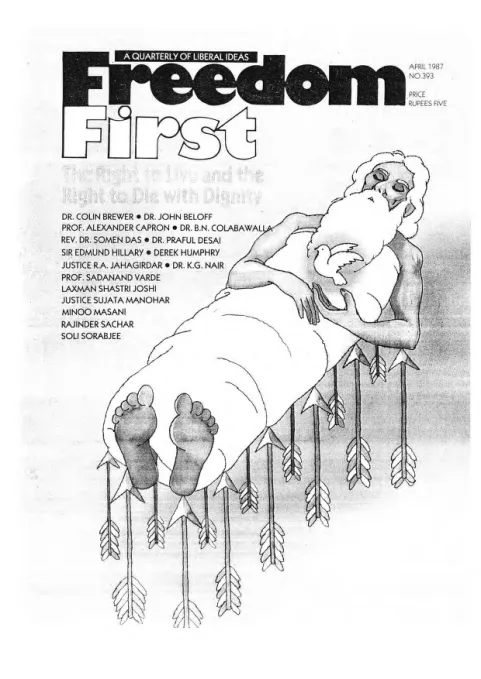
This is the April 1987 issue (No. 393) of Freedom First, the Bombay-based quarterly of liberal ideas founded by Minoo Masani. The issue is a special number devoted almost entirely to “The Right to Live and the Right to Die with Dignity,” built around extracts and summaries from the Sixth Biennial Conference of the World Federation of Right to Die Societies, held in Bombay in November 1986. In their editorial note, the editors explain the choice of theme against a backdrop of budget disappointment, the President-Prime Minister controversy, and violence in Punjab, framing the euthanasia symposium as material that “provide[s] some relief to our reader” despite concerning death and dying, and note the cover’s depiction of Bhishma choosing his hour of death as testimony to an Indian tradition of dignified dying. In the rendered pages, contributions come from Sir Edmund Hillary (New Zealand’s High Commissioner to India, recounting personal brushes with death and his views on the right to die), Minoo Masani (on the Netherlands’ court-driven euthanasia framework and Indian legal reform efforts led by Prof. Sadanand Varde’s bill and judgments by Justice Sachar and the Bombay High Court), and Prof. Alexander Capron of the University of Southern California (on the American legal history of patients’ right-to-die and three “perils” facing the movement: the gap between legal rights and actual practice, the risk of a “right to die” sliding into a “duty to die,” and the risk of passive euthanasia sliding into active, physician-assisted killing). The issue also opens with shorter regular features: Geeta Doctor’s “Acoustic Trauma” (a satirical account of a Madras anti-noise-pollution march amid loudspeaker devotional broadcasts) and the “With Many Voices” and “Of Cabbages and Kings” column pages of quotations and editorial miscellany on Indian politics, press freedom, and academic corruption.
Key points
-
The editors’ note explains the issue’s focus on “The Right to Live and the Right to Die with Dignity,” drawn from the Sixth Biennial Conference of the World Federation of Right to Die Societies held in Bombay in November 1986, and cites Bhishma’s chosen death in the Mahabharata as an Indian precedent.
-
Geeta Doctor’s “Acoustic Trauma” satirises a genteel anti-noise-pollution march by the Environmental Society of Madras, ending on the irony of blaring devotional loudspeakers resuming the moment the march concludes.
-
Sir Edmund Hillary’s “Life or Death — Not an Easy Decision” draws on his mother’s death, a near-fatal 1953 Everest crevasse fall, and Sherpa children born disabled to argue no one should be kept alive as “a helpless cabbage” once terminally ill or in great pain.
-
Minoo Masani’s “The Right to Choose” surveys the Netherlands’ judge-led euthanasia framework and Indian legal progress via Justice Sachar’s and the Bombay High Court’s rulings, and cites Prof. Sadanand Varde’s bill granting doctors immunity for honouring a patient’s wish for passive euthanasia.
-
Alexander Capron’s address sets out three “perils” facing the right-to-die movement: the gap between legal rights and clinical practice, the risk of a “right to die” becoming a perceived “duty to die,” and passive euthanasia sliding into active, physician-assisted killing.
-
The issue frames its choice of theme as offering readers “some relief” against a backdrop of budget disappointment, the President-Prime Minister controversy, and violence in Punjab.
Essays
Essay 0
The editors’ note explains why this issue is devoted to euthanasia despite pressing national concerns (the budget, the President-PM rift, Punjab violence), and introduces the cover illustration of Bhishma dying on his bed of arrows as an Indian precedent for choosing one’s hour of death with dignity.
- Frames the euthanasia theme as timely material drawn from a November 1986 Bombay conference of Right-to-Die Societies
- Cites Bhishma from the Mahabharata, depicted on the cover, as an Indian tradition of dying with dignity and choice
Acoustic Trauma
By Geeta Doctor
Geeta Doctor’s satirical column recounts an anti-noise-pollution march by the Environmental Society of Madras, contrasting its well-heeled organizers with the pavement dwellers and traffic they disrupt, and closing on the irony that a nearby temple loudspeaker starts blaring devotional songs the moment the march ends.
- Describes the yearly loudspeaker-driven “acoustic trauma” of devotional broadcasts in Madras during temple festival season
- Satirizes a genteel anti-noise-pollution march organized by the Environmental Society of Madras
- Notes the march’s disruption of traffic, street vendors, and pavement dwellers near a bus depot
- Ends with the ironic return of blaring devotional loudspeakers as soon as the march concludes
Life or Death — Not an Easy Decision
By Edmund Hillary
Sir Edmund Hillary’s address opens the euthanasia symposium with personal anecdotes — his mother’s decline and death, a near-fatal crevasse fall during the 1953 Everest expedition, and reflections on Sherpa children born disabled from iodine deficiency — building to his view that no one should be kept alive as “a helpless cabbage” once incapacitated, terminally ill, or in great pain, while affirming everyone’s right to risk their own life in adventure.
- Hillary distinguishes the right to risk one’s life in adventure from carelessly wasting it
- Describes his mother’s peaceful death from Parkinson’s and his regret at not staying longer at her bedside
- Recounts a near-fatal fall into a crevasse during the 1953 Everest expedition, saved by Tenzing Norgay’s belay
- Describes the burden borne by Sherpa parents raising a severely disabled, cretinous child for eighteen years
- States his personal conviction that if incapacitated, terminally ill, senile, or in great pain, he would want to be allowed to die rather than sustained artificially
The Right to Choose
By Minoo Masani
Minoo Masani’s address surveys the international right-to-die movement, praising the Netherlands’ judge-led (rather than legislated) framework for permissible euthanasia and recounting Indian legal progress — Justice Rajinder Sachar’s ruling against prosecuting attempted suicide in Delhi, and a 1986 Bombay High Court Division Bench ruling declaring the relevant Indian Penal Code section on attempted suicide unconstitutional in Maharashtra. He addresses two common objections (that legalizing the right to die would increase suicides, or enable murders disguised as suicide) and closes by reframing the Society’s cause as the right to choose between life and death, quoting Pope John Paul II and Pope Pius XII as supportive of passive euthanasia and citing the Hindu saint Dnyaneshwar’s chosen death at 21.
- Describes six conditions under Dutch (Rotterdam High Court) case law permitting doctor-administered euthanasia
- Contrasts progressive US state “right to die” laws and court rulings (New Jersey, Karen Quinlan case) with India’s colonial-era penal provisions against attempted suicide and abetment of suicide
- Recounts Justice Rajinder Sachar’s Delhi High Court ruling against harassing failed-suicide attempters and a 1986 Bombay High Court Division Bench ruling that the relevant IPC section is ultra vires the Constitution in Maharashtra
- Rebuts the arguments that legal suicide increases actual suicides or facilitates disguised murders, citing comparative country data
- Describes Prof. Sadanand Varde’s Bill granting immunity to doctors honouring a patient’s wish for passive euthanasia, and its strong public support in replies received by the Maharashtra government
- Cites Pope John Paul II’s 1980 declaration and Pope Pius XII’s 1957 address as compatible with passive euthanasia despite Catholic institutional opposition to the Bill
- Reframes the Society’s mission as protecting the ‘right to choose’ between life and death rather than simply a ‘right to die’, quoting William Ernest Henley’s ‘Invictus’
The Vital Issues
By Alexander Capron
Prof. Alexander Capron’s address, titled (per the text) ‘The Right to Die: Progress and Peril,’ surveys the US legal history of patient autonomy over life-sustaining treatment — from the 1976 Karen Ann Quinlan case and California’s Natural Death Act to durable powers of attorney and Living Wills — and then sets out three perils facing the right-to-die movement: (1) that legal victories may not translate into changed attitudes and behaviour among physicians and nurses; (2) that a ‘right to die’ could slide into a perceived ‘duty to die,’ particularly under pressure from rising elder-care costs; and (3) that acceptance of passive euthanasia (withholding or withdrawing treatment) could slide into acceptance of active physician-assisted killing, which he argues should remain legally and morally distinct. In the rendered portion he works through counter-arguments for maintaining that distinction, citing risks of misdiagnosis, erosion of trust in physicians, and coercion of vulnerable patients in long-term care.
- Frames the movement’s original objective as making dying ‘part of living’ and protecting patients’ right to choose their own care, not merely a ‘right to die’
- Traces US legal progress: informed consent doctrine, the 1976 Karen Ann Quinlan ruling, California’s 1976 Natural Death Act, and subsequent state statutes and case law
- Distinguishes Living Wills from durable powers of attorney as complementary legal instruments for surrogate decision-making
- Sets out three perils: (1) gap between legal rights and clinical practice/attitudes, (2) ‘right to die’ becoming a perceived ‘duty to die’ amid rising health-care costs for an aging population, referencing Governor Richard Lamm of Colorado’s controversial remarks, and (3) passive euthanasia sliding into active, physician-assisted killing
- Argues against legalizing active euthanasia on practical grounds: risk of irreversible error from mistaken terminal prognoses, erosion of trust in physicians as healers, and greater potential for abuse and subtle coercion of vulnerable, long-term patients
- Invokes V.D. Savarkar and Vinoba Bhave, both shown in photographs, as Indian examples of individuals who in their last days refused all medical aid
- Notes Arthur Koestler as an example (with photograph) of someone who championed euthanasia and ultimately chose it himself while suffering from leukaemia
Generated by the v1.5 extraction pipeline. Awaiting editorial review.
Metadata and summary are AI-extracted from the source PDF and reviewed for editorial accuracy. The original work is available via the Read PDF tab above (where present); paragraph-level citation inside the PDF is deferred to a future engagement.