periodical issue
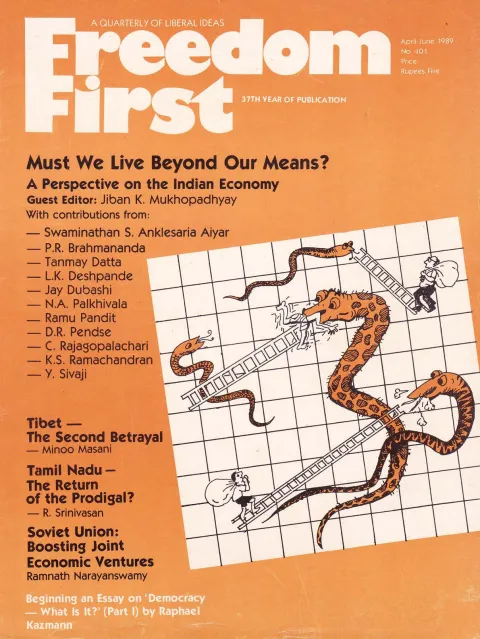
Freedom First
A Quarterly of Liberal Ideas
By D. R. Pendse, Nani Palkhivala, C. Rajagopalachari, Minoo Masani
Published by J.R. Patel for the Democratic Research Service and printed by him at Parsiana Publications Pvt. Ltd., 300 Perin Nariman Street, Bombay 400 001 · Bombay · 1989
64 pages
Freedom First
Summary
Freedom First No. 401 (April–June 1989) is a themed issue built around a symposium, ‘A Perspective on the Indian Economy — Must We Live Beyond Our Means?’, guest-edited by Jiban K. Mukhopadhyay, an economist with Tata Services. In the rendered pages, the symposium’s core contributions warn in near-unison that the Government of India is living beyond its means: Mukhopadhyay’s lead essay traces a widening fiscal deficit financed by borrowing and RBI credit rather than genuine revenue; D. R. Pendse quantifies the ‘internal debt trap’ the Centre is approaching by 1992; P. R. Brahmananda argues the Central Government fails even the ‘canon of minimal fiscal viability’; N. A. Palkhivala’s annual Budget speech (delivered in Bombay on 3 March) dismisses the 1989-90 Union Budget as ‘purely an exercise in political symbolism’; Y. Sivaji, a Telugu Desam Rajya Sabha MP, calls for perestroika of public sector enterprises and a twelve-point corrective programme; and Swaminathan S. Anklesaria Aiyar’s ‘A Tale of Two Deficits’ argues that economic liberalisation has newly linked India’s budget deficit to its trade deficit. The issue also reprints a 1960 Rajaji essay on deficit financing and a short 1960 Swatantra Party policy extract, situating the 1989 crisis within the magazine’s long-running classical-liberal critique of Congress-era planning. Beyond the symposium, the rendered pages include the regular ‘With Many Voices’ page of press quotations, subscriber-appeal and ownership-statement pages, and the opening of the table of contents pointing to further pieces (on Tibet, Tamil Nadu politics, Soviet joint ventures, Nelson Mandela, the Reagan presidency, and a serialized essay on democracy) that were not rendered in this chunk.
Key points
-
Jiban K. Mukhopadhyay’s lead essay argues non-plan expenditure has permanently outstripped revenue, describing a “statistical juggler” masking the true deficit and projecting government debt reaching Rs. 2.6 lakh crores by March 1990.
-
D. R. Pendse’s “The Internal Debt Trap — Too Close for Comfort” warns India will enter a self-perpetuating debt trap by 1992, when annual interest exceeds new borrowing, and urges selling up to 49% of shares in profitable public enterprises.
-
P. R. Brahmananda applies a “canon of minimal fiscal viability” to find the Central Government fails even to cover its inescapable expenditures, judging it, by the RBI’s own criteria, “very chronically sick.”
-
N. A. Palkhivala’s Budget speech calls the 1989-90 Union Budget “purely an exercise in political symbolism” that reverses the government’s own 1985 liberalisation planks, and calls for statutory borrowing limits under Article 292.
-
Y. Sivaji’s “An Economy in Dire Straits” lays out a twelve-point corrective programme — expenditure control, a hiring moratorium, public-sector “perestroika,” and a higher income-tax exemption limit — against a widening trade deficit and depreciating rupee.
-
C. Rajagopalachari’s reprinted 1960 essay “Deficit Financing” traces chronic Indian inflation to deficit financing since 1955-56, arguing only restoring balance between production and money flow can cure rising prices.
-
Swaminathan S. Anklesaria Aiyar’s “A Tale of Two Deficits” argues liberalisation has newly linked India’s budget and trade deficits, attributing the import surge to deficit-financing-driven over-consumption rather than loosened sectoral controls.
Essays
Must We Live Beyond Our Means? (A Perspective on the Indian Economy)
By Jiban K. Mukhopadhyay
In the rendered pages, Jiban K. Mukhopadhyay’s lead essay argues that the Government of India’s non-plan expenditure has permanently outstripped its revenue receipts, forcing ever-larger deficit financing and borrowing. He describes a ‘statistical juggler’ in the 1989-90 Budget — a Rs. 2,300 crore transfer from the Oil Development Fund used to mask the true revenue and capital account deficits — and projects total outstanding government debt reaching Rs. 2.6 lakh crores by end-March 1990, with interest payments alone of Rs. 17,000 crores. He surveys inflation trends, the external debt and debt-service ratio, and the inefficiency of state-owned enterprises, before concluding that only a sustained, whole-hearted policy of economic liberalisation — not the piecemeal liberalisation practised since the early 1980s — can restructure the economy.
- Non-plan expenditure (Rs. 54,347 crores in 1989-90) exceeds total revenue receipts (Rs. 52,630 crores), forcing deficit financing.
- The 1989-90 Budget disguises the real deficit through a Rs. 2,300 crore statistical transfer from the Oil Development Fund into revenue receipts.
- Total outstanding government debt is projected at Rs. 2.6 lakh crores by March 1990, with Rs. 17,000 crores in interest payments.
- State-owned enterprises return under 4% while government borrows at about 12%, a structurally unsound gap.
- Inflation (average 7.8% in 1980-86) and a highly protective trade regime (mean tariff over 120%) are cited as symptoms of the same fiscal indiscipline.
- Liberalisation since the early 1980s has been procedural and piecemeal rather than a genuine ‘liberalisation’ in the fundamental sense.
- The essay closes calling for a wholistic rather than ad hoc liberalisation policy, driven by conviction rather than compulsion.
The Internal Debt Trap — Too Close for Comfort
By D. R. Pendse
D. R. Pendse defines the ‘Internal Debt Trap’ as the point at which a year’s interest burden on government debt exceeds all new loans raised that year, and shows that India’s total internal debt grew from Rs. 2,533 crores in 1950-51 to a projected Rs. 224,451 crores in 1989-90 (Rs. 259,429 crores including external debt). He warns, citing senior RBI officials, that India will enter this trap by 1992, and traces the root cause to a ‘borrowing spree’ financing rising non-plan (consumption) expenditure — defence, interest payments, subsidies, and administration — rather than plan/investment needs. He cites tax evasion (Rs. 243 unassessed for every Rs. 100 assessed, per a 1985 government report on black money) and poor returns on public-sector investment (barely 3.4% after interest and tax) as root causes, and closes urging the government to sell up to 49% of shares in profitable public enterprises and to cut consumption expenditure rather than continuing to borrow.
- Internal debt trap defined: when annual interest burden exceeds new borrowing raised that year, forcing a self-perpetuating spiral.
- Total internal debt projected to rise from Rs. 2,533 crores (1950-51) to Rs. 224,451 crores (1989-90); total debt including external at Rs. 259,429 crores.
- India projected to enter the internal debt trap by 1992, per senior RBI officials’ analysis.
- 80% of consumption expenditure comes from just four items: defence, interest payments, subsidies, and administrative expenditure.
- Tax evasion is severe: for every Rs. 100 of assessed income, about Rs. 243 goes unassessed, per the government’s 1985 Black Money report.
- Government’s Rs. 71,000+ crore investment in central commercial enterprises returns barely 3.4% after interest and tax.
- Recommends selling up to 49% of shares in profitable public sector units to raise resources and reduce internal debt.
Is the Central Government Fiscally Viable?
By P.R. Brahmananda
P. R. Brahmananda applies a ‘canon of minimal fiscal viability’ — that tax revenue should at least cover a government’s minimal, inescapable expenditures (defence, police, general/social/economic services, grants, pensions, and interest) — and finds the Central Government fails this test in both 1988-89 and 1989-90, with a shortfall of roughly Rs. 6,400–4,900 crores despite tax revenues rising from Rs. 24,366 crores (1984-85) to Rs. 48,701 crores (1988-89 BE). He concludes the government is, by the RBI’s own criteria for business sickness, ‘very chronically sick’ and recommends retrenchment of staff and even partial closure of some government functions.
- Introduces a ‘canon of minimal fiscal viability’: tax revenue must at least cover minimal, inescapable expenditures.
- Minimal and inescapable outlays were Rs. 39,059 crores (1988-89 RE) and Rs. 43,314 crores (1989-90 BE).
- Own tax revenues fell short by Rs. 6,407 crores (1988-89) and Rs. 4,927 crores (1989-90).
- Tax revenues rose from Rs. 24,366 crores (1984-85) to Rs. 48,701 crores (1988-89 BE), but current expenditure rose faster, widening the shortfall by Rs. 5,548 crores.
- By RBI’s own sickness criteria for business units, the Central Government itself is ‘very chronically sick’.
- Recommends retrenchment of staff and partial closure where a government function persistently cannot cover its costs.
The Union Budget — 1989-90: An Exercise in Political Symbolism
By N.A. Palkhivala
This is a published gist of N. A. Palkhivala’s annual Budget speech, delivered in Bombay on 3 March 1989 to an audience the introduction notes typically exceeds 50,000 people. Palkhivala calls the 1989-90 Union Budget ‘purely an exercise in political symbolism’ that reverses the government’s own 1985 policy planks of low tax rates, simplification, stability, and liberalization. He attacks the 8% surcharge as an effective 4% tax increase that would be pocketed entirely by the Centre rather than shared with the states, criticizes the plan to fund a rural employment programme from surcharge revenue as ‘dangerous’ quasi-official party financing, and calls for Parliament to fix statutory limits on government borrowing under Article 292 of the Constitution, as recommended by multiple official committees since the 1960s.
- Palkhivala’s Bombay budget speech reportedly draws audiences of over 50,000, requiring the Brabourne Stadium.
- Calls the 1989-90 Budget ‘purely an exercise in political symbolism’ with no underlying policy.
- Argues the Budget reverses the government’s own 1985 planks: low tax rates, simplification, stability, and liberalization.
- The 8% surcharge is criticized as an effective 4% tax hike that the Centre would keep entirely rather than share three-fourths with the states.
- Total government liabilities projected to reach Rs. 259,729 crores, with interest burden rising to Rs. 17,000 crores, approaching the ‘debt trap’.
- Calls for Parliament to fix statutory borrowing limits under Article 292, as recommended by the Chakravarty Committee and multiple Public Accounts Committee and CAG reports since the 1960s.
An Economy in Dire Straits
By Y. Sivaji
Y. Sivaji, described as a Telugu Desam Member of the Rajya Sabha, argues the Indian economy is in ‘dire straits’ behind an officially rosy picture: reported GDP and industrial growth figures are distorted by a drought-depressed base year and by narrow gains concentrated in electronics and automobiles, while farmers face discriminatory pricing policies and urban consumers are protected at their expense. He details a widening trade deficit, a depreciating rupee (down 14% against the US dollar and 17% against the yen over two years), and an approaching debt trap, then lays out a twelve-point programme: strict expenditure control, a moratorium on new government hiring, cuts to defence and subsidies, ‘perestroika’ of loss-making public sector units, encouraging joint ventures over capital borrowing, raising the income-tax exemption limit to Rs. 25,000, and other reforms.
- Argues official GDP/industrial growth figures for 1988-89 are distorted by a drought-affected base year and narrow gains in electronics/automobiles.
- Farmers face discriminatory pricing that favors urban consumers, while inflation erodes real incomes of the poor.
- Trade deficit rose from Rs. 99 crores (1970-71) to an estimated Rs. 8,500 crores in the current year; the rupee fell 14% against the US dollar and 17% against the yen over two years (Feb 1988-Feb 1989).
- Non-plan expenditure is 66% of total 1989-90 expenditure (Rs. 82,161 crores), a ‘colossal drain’ with inflationary potential.
- Warns of an approaching debt trap: external debt-servicing ratio at 26%, projected to reach a ‘highly critical’ 30% by 1992.
- Twelve-point programme: expenditure control via an inter-ministerial watchdog committee, moratorium on government hiring, defence/subsidy review, public-sector ‘perestroika’ and closure of chronically loss-making units, preference for joint ventures over capital borrowing, and raising the income-tax exemption limit to Rs. 25,000.
Deficit Financing
By C. Rajagopalachari
This is a reprint of an essay by C. Rajagopalachari (Rajaji), originally written almost three decades earlier (per an editorial footnote, published 24 September 1960), arguing that inflation results from money supply expanding faster than the physical output of goods, and that India’s deficit financing since 1955-56 is the root cause of chronic price rises. Rajaji traces budget deficits from Rs. 97 crores (1954-55) to Rs. 225 crores (1955-56) and warns the Third Plan’s deficit financing, nominally Rs. 550 crores, is in practice about six times that figure. He argues inflation and price/import controls together enrich importers, smugglers, and corrupt officials while impoverishing wage-earners and the middle class, and calls for restoring the balance between the flow of production and the flow of money as the only real cure.
- Inflation defined as money supply expansion outpacing the physical volume of output; the general price index in India rose nearly five-fold using a 1938-39 base by August 1960.
- Traces the roots of chronic post-1955-56 Indian inflation to budget deficits, which rose from Rs. 97 crores (1954-55) to Rs. 225 crores (1955-56) and peaked at Rs. 495 crores in 1957-58.
- The Third Plan’s nominal deficit financing of Rs. 550 crores is, in Rajaji’s estimate, actually about six times that figure once foreign-aid shortfalls are accounted for.
- Argues inflation combined with price and import controls creates windfall profits for importers and smugglers (illicit gains estimated at Rs. 1,000 crores over two years) while impoverishing wage-earners.
- Rejects the idea that price rises stem from traders’ conspiracies, calling this notion ‘stupid’.
- Concludes that only restoring balance between production and money flow — ending both deficit financing and excessive state interference — can stop rising prices.
A Tale of Two Deficits
By Swaminathan S. Anklesaria Aiyar
Swaminathan S. Anklesaria Aiyar (Editor of the Financial Express) argues in ‘A Tale of Two Deficits’ that India’s budget deficit and trade deficit, historically unlinked because of high household savings and strict import controls, have become newly connected as a result of economic liberalisation in the 1980s. Despite rupee devaluation that boosted exports 24%, imports simultaneously rose about 27%, which he attributes to deficit-financing-driven over-consumption rather than to import controls being loosened for particular sectors like electronics or automobiles. He warns that reimposing import controls would only shift excess demand into higher inflation, and argues the real solution is slashing deficit financing itself — the disease, not the symptom.
- Argues budget and trade deficits, previously unlinked in India due to high savings and import controls, are now linked because of liberalisation.
- Rupee devaluation raised exports 24% but imports also rose about 27%, a puzzle attributed to deficit-financing-fueled over-consumption.
- Contrasts India (savings rate 21-24%) with Japan (savings up to 30% of GNP, no trade deficit) and the USA (savings under 5%, forced to borrow abroad).
- Detailed import data shows the import surge is broad-based (bulk commodities, project imports, miscellaneous items) rather than concentrated in luxury items like automobiles or electronics.
- Rejects reimposing strict import controls as a fix, since suppressed demand would instead fuel higher inflation.
- Concludes the government must curb its own deficit financing (‘over-consumption’) rather than continuing to lecture states on fiscal profligacy while being guilty of it itself.
Generated by the v1.5 extraction pipeline. Awaiting editorial review.
Metadata and summary are AI-extracted from the source PDF and reviewed for editorial accuracy. The original work is available via the Read PDF tab above (where present); paragraph-level citation inside the PDF is deferred to a future engagement.