periodical issue
Freedom First
A Quarterly of Liberal Ideas
By Minoo Masani, Arvind Deshpande
Democratic Research Service, 4th floor, Maneckji Wadia Bldg., 127, Mahatma Gandhi Road, Bombay 400 001. Published by J.R. Patel for the Democratic Research Service and printed by him at Parsiana Publications Pvt. Ltd, 300 Perin Nariman Street, Bombay 400 001. · Bombay · 1990
56 pages
Freedom First
Summary
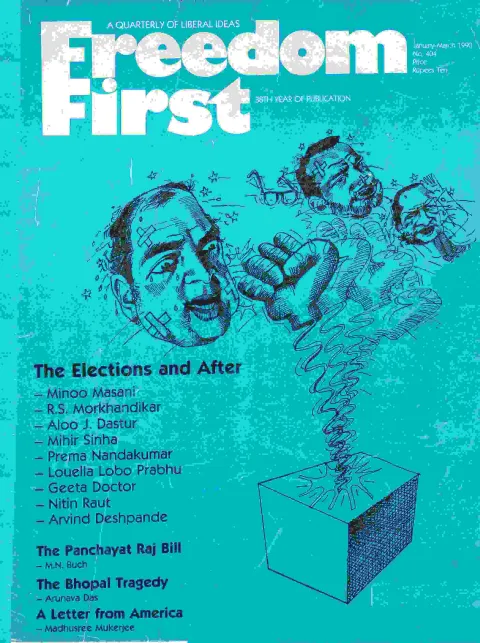
This is issue No. 404 of Freedom First (January–March 1990), the Bombay-based quarterly of liberal ideas founded by Minoo Masani and published by the Democratic Research Service, edited by S.V. Raju and R. Srinivasan. The issue is dominated by a special section, ‘The Elections and After’, analysing the Ninth General Elections to the Lok Sabha (November 1989), which ended Rajiv Gandhi’s Congress majority and installed V.P. Singh’s National Front government with outside support from the BJP and the Left. Contributors including Minoo Masani, R.S. Morkhandikar, Aloo J. Dastur, Mihir Sinha, Prema Nanda Kumar, Louella Lobo Prabhu, Babu Joseph, Geeta Doctor, Nitin Raut and Arvind Deshpande assess the results region by region and debate whether the hung Parliament marks the start of coalition politics in India, the durability of the new government, and the rejection of the Bofors-tainted Congress establishment. The rendered pages also carry the Dalai Lama’s Nobel Peace Prize acceptance statement and a Liberal International resolution on Tibet, obituary tributes to Andrei Sakharov, a 1966 Rajaji piece on constitutional convention reprinted from Swarajya, and the opening of M.N. Buch’s essay on the Panchayat Raj Bill.
Key points
-
R. Srinivasan and S.V. Raju’s lead essay on the Ninth General Elections argues voters chose on issues over personalities, attributing Rajiv Gandhi’s early election call to fresh Bofors revelations and crediting the electorate with holding incumbents accountable regardless of caste or literacy.
-
Minoo Masani’s “A Hung Parliament — The Beginning of Coalition Politics in India” welcomes the hung Parliament as normal rather than aberrant, criticises Devi Lal and Chandra Shekhar’s manoeuvring against V.P. Singh’s leadership bid, and argues rural voters grasped the Bofors/corruption issue better than the educated elite.
-
Contributors including R.S. Morkhandikar, Aloo J. Dastur, Mihir Sinha, Prema Nanda Kumar, Louella Lobo Prabhu, Babu Joseph, Geeta Doctor, Nitin Raut and Arvind Deshpande assess the November 1989 election results region by region, debating whether the hung Parliament marks the start of durable coalition politics in India.
-
The issue carries the Dalai Lama’s Nobel Peace Prize acceptance statement, a Liberal International resolution on Tibet, and obituary tributes to Andrei Sakharov.
-
A 1966 C. Rajagopalachari piece on constitutional convention is reprinted from Swarajya, alongside the opening of M.N. Buch’s essay on the Panchayat Raj Bill.
Essays
The Ninth General Elections to the Lok Sabha
By R. Srinivasan & S.V. Raju
R. Srinivasan and S.V. Raju’s lead essay reviews the Ninth General Elections, arguing that voters chose on issues rather than personalities or dynastic charisma. It traces Rajiv Gandhi’s gamble in calling early elections to shed the Bofors scandal, the opposition’s seat-sharing arithmetic between the Janata Dal and BJP, and Congress disarray over dummy candidates and a delayed manifesto. The piece credits the electorate with holding incumbents accountable regardless of caste, region, or literacy, citing the fall of both Rajiv Gandhi nationally and N.T. Rama Rao in Andhra Pradesh, and closes on a note of cautious optimism about the maturing of Indian democracy.
- Frames the 1989 result as voters choosing on issues over personalities, a sign of improving democratic quality
- Attributes Rajiv Gandhi’s early election call to N. Ram’s fresh Bofors revelations and a favourable but fragile economic picture (5.7% growth, IMF pressure for devaluation)
- Describes the rapid, arithmetic-driven Janata Dal-BJP seat-sharing pact covering 221 Hindi-belt seats
- Notes Congress confusion over dummy candidates and a manifesto delayed partly by astrological timing advice
- Cites the emergence of the Bahujan Samaj Party as evidence backward-class voters no longer feel tied to Congress
- Argues the ninth elections prove no correlation between illiteracy and unconsidered voting
A Hung Parliament — The Beginning of Coalition Politics in India
By Minoo Masani
Minoo Masani welcomes the hung Parliament as the natural beginning of coalition politics in India, arguing that single-party dominance was itself an anomaly compared to the rest of the democratic world. He praises the electorate for ousting Rajiv Gandhi and other ‘miscreants’ regardless of region, criticises Devi Lal and Chandra Shekhar for trying to block V.P. Singh’s election as leader, and rebuts the notion that poor and rural voters cannot grasp corruption, arguing it was actually the affluent, educated class that underestimated the moral force of the Bofors issue. He recalls the Swatantra Party’s rural base as historical precedent for informed non-elite voting.
- Welcomes the hung Parliament as normal rather than aberrant, comparing India favourably to other democracies outside the US and UK
- Credits the electorate with punishing incumbents at both the Centre (Rajiv Gandhi) and states (N.T. Rama Rao, Ramakrishna Hegde)
- Criticises Devi Lal and Chandra Shekhar’s manoeuvring against V.P. Singh’s leadership bid as reminiscent of Janata-era infighting
- Argues the rural and ‘illiterate’ voter grasped the Bofors/corruption issue better than the affluent educated class
- Cites the Swatantra Party’s 1959-74 farmer base as evidence rural voters resist elite-driven ideological capture
Generated by the v1.5 extraction pipeline. Awaiting editorial review.
Metadata and summary are AI-extracted from the source PDF and reviewed for editorial accuracy. The original work is available via the Read PDF tab above (where present); paragraph-level citation inside the PDF is deferred to a future engagement.