periodical issue
Freedom First
A Quarterly of Liberal Ideas
Published by J.R. Patel for the Democratic Research Service and printed by him at Parsiana Publications Pvt. Ltd., 300 Perin Nariman Street, Bombay 400 001 · Bombay · 1991
58 pages
Freedom First
Summary
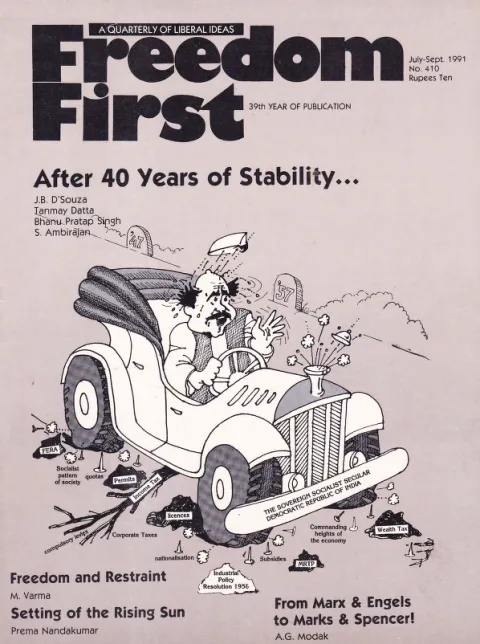
This is issue No. 410 of Freedom First (July-September 1991), the quarterly of liberal ideas founded by Minoo Masani, in its 39th year of publication, edited by S.V. Raju and R. Srinivasan. The cover cartoon depicts India as a car stalled after “40 years of stability,” mired in FERA, licences, income tax, MRTP, nationalisation, and the “socialist pattern of society” — setting the theme for the issue’s cover symposium, “After 40 Years of Stability,” in which a retired civil servant (J.B. D’Souza), a business executive (Tanmay Datta), a farmer-politician and former Union Agriculture Minister (Bhanu Pratap Singh), and an economist (S. Ambirajan) each argue that four decades of one-party Congress rule produced institutional decay, agricultural exploitation, and economic stagnation rather than genuine stability. The rendered pages also cover an editorial (“Between Ourselves”) introducing the theme and reporting on the magazine’s subscriber base and continuing mission; a reprint of Amnesty International’s 1991 report on India’s human-rights record (torture, extrajudicial killings, and detention in Punjab, Kashmir, Assam, and after the Ayodhya-related violence) under the header “What Doordarshan Didn’t Want You to Know”; a satirical roundup of public opinion on politicians (“With Many Voices”); a column on the devaluation of the Bharat Ratna award and on the handling of state mourning for dead VIPs (“Of Cabbages and Kings”); an unsigned editorial-page piece, “Economic Reforms,” praising Rajaji and Minoo Masani’s Swatantra Party as decades ahead of its time in advocating deregulation; an analysis of the BJP’s rise after the tenth general election (“BJP — The New Bogey-man of Indian Politics” by R. Srinivasan and S.V. Raju), which questions alarmist readings of the BJP’s success and argues its gains reflect local political factors as much as a ‘Hindu wave’; and the start of a reprinted Economist Survey of India extract (“India — The Tiger Caged”), which indicts four decades of state overreach and neglect for India’s underperformance relative to other Asian economies, paired with a reprinted Sunday Times piece, “Home Truths for India,” making a similar free-market critique of Nehruvian protectionism and licensing. In the rendered pages the volume’s argumentative center is a sustained critique of Nehru-era economic planning, state control, and one-party political dominance, contrasted with calls for liberalisation, deregulation, and a free-market economy.
Key points
-
J.B. D’Souza argues Indian institutions from the bureaucracy to the judiciary have decayed under four decades of Congress rule, illustrating this with a sub-collector punished for helping exploited forest workers and corruption allegations against Bombay High Court judges.
-
Bhanu Pratap Singh presents statistical tables showing static or declining real returns to wheat and rice growers between 1970-71 and 1988-89 despite productivity gains, arguing Nehruvian development strategy systematically drained wealth from agriculture.
-
S. Ambirajan questions whether “stability” is a coherent policy goal at all, noting India’s year-to-year per capita income growth ranged from -8.7% to 20.5% despite averaging about 4%.
-
A reprinted Economist Survey extract, “India — The Tiger Caged,” rejects population growth as an adequate excuse for India’s underperformance against Korea, Taiwan, Hong Kong and Indonesia, diagnosing a state that has “done far too much and far too little.”
-
A companion Sunday Times piece, “Home Truths for India,” blames Fabian-socialist policy inherited from the Nehru-Gandhi family for import bans, licensing, and entrenched bureaucratic corruption.
-
An unsigned analysis, “BJP — The New Bogey-man of Indian Politics,” questions alarmist readings of the BJP’s rise after the tenth general election, arguing its gains reflect local political factors as much as a “Hindu wave.”
-
A reprinted Amnesty International 1991 report on India’s human-rights record, headlined “What Doordarshan Didn’t Want You to Know,” documents torture and extrajudicial killings in Punjab, Kashmir, Assam and post-Ayodhya violence.
Essays
After 40 Years of Stability
By J.B. D’Souza, Tanmay Datta, Bhanu Pratap Singh, S. Ambirajan
J.B. D’Souza, a retired civil servant, argues in the rendered pages that Indian institutions — from bureaucracy to the judiciary — have decayed under four decades of Congress rule, leaving citizens without recourse to justice. He illustrates this with an anecdote about exploited forest workers whose rescuer, a sub-collector, was punished by transfer for helping them, and with an account of corruption allegations against judges of the Bombay High Court. He argues that ‘stability’ has chiefly benefited a new class of politicians and their cronies rather than the poor.
- Argues that ‘stability’ is desired by economists, businessmen, and the political/social ‘haves’, but not by the 250 million below the poverty line, for whom it means sustained exploitation
- Recounts a case of wattle-bark workers held in exploitative conditions in a forest near Kodaikanal, and the punitive transfer of the sub-collector who tried to help them
- Identifies judicial decay as the most spectacular example of institutional decline, citing corruption allegations against several Bombay High Court judges
- Quotes Shashi Tharoor’s description of hypocritical politicians who mouth socialist rhetoric while amassing private wealth
- Attributes the erosion of institutions to a process he says Indira Gandhi began
The Setting of the Rising Sun
By Prema Nandakumar
Bhanu Pratap Singh, a farmer and former Union Minister for Agriculture, argues in the rendered pages that Indian agriculture has been the chief victim of Nehruvian development strategy: procurement price controls, fertiliser subsidy design, and skewed capital formation have systematically drained wealth out of the farm sector even as production rose. He presents statistical tables showing static or declining real returns to wheat and rice growers between 1970-71 and 1988-89 despite productivity gains, and argues that consumption and income disparities between primary producers and the rest of the population widened sharply between 1980-81 and 1988-89.
- India’s rate of poverty reduction (1.04% per annum, 1972-1983) lagged behind Indonesia, Malaysia, Brazil, Pakistan, Costa Rica and Thailand
- Presents tables showing wheat and rice procurement/wholesale price indices rising much faster than real per-hectare returns to farmers between 1970-71 and 1988-89
- Argues government fertiliser subsidies chiefly prop up inefficient domestic fertiliser factories rather than farmers, who pay 10-25% more for fertiliser than international prices would imply
- Shows agriculture’s share of plan expenditure fell from 49.6% (First Plan) to 27.5% (Seventh Plan) even as its capital formation share and foodgrain growth rate both declined from the 1970s to the late 1980s
- Argues income disparities widened 1980-81 to 1988-89: primary producers (70% of the population) received only 2.15% of the real increase in national income, while legislators’ and public-sector employees’ emoluments rose far faster than consumer prices
Of Freedom and Restraint
By M. Varma
S. Ambirajan, an economics professor at IIT Madras, opens his essay by questioning whether ‘stability’ is even a meaningful or desirable single concept for economic policy, arguing that development necessarily entails a degree of instability and that year-to-year per capita income growth in India ranged from -8.7% to 20.5% over the preceding decades despite an average of about 4%. The rendered pages cut off as he begins to analyze the sources of economic instability in more depth.
- Distinguishes ‘stability’ as economists use it (firm but not static, allowing managed change) from a narrowly defined stability in the economic sphere alone
- Argues economic development inherently involves dynamic tension and thus some instability, and that even isolated societies untouched by the outside world are exceptions
- Notes India’s real per capita NNP growth has averaged around 4% but ranged year-to-year from -8.7% (1954-55) to 20.5% (1973-74)
- Frames the desirability of stability as dependent on prevailing circumstances rather than an absolute good
India - The Tiger Caged (From The Economist’s Survey of India)
A reprinted extract from The Economist’s 1991 Survey of India, ‘India — The Tiger Caged,’ argues that India’s underperformance relative to faster-growing Asian economies (South Korea, Taiwan, Hong Kong, Indonesia) cannot be excused by population growth or a supposedly harder starting position, since India had comparable or better initial advantages at independence — a functioning democracy, civil service, and entrepreneurial population. It contends the state has ‘done far too much and far too little,’ crippling the economy through overregulation while neglecting essential public functions, at great human cost. The rendered excerpt is marked ‘To be continued’ and is paired with a companion Sunday Times piece, ‘Home Truths for India,’ making a similar case against Nehruvian protectionism, licensing, and the political dynasties (Nehru and Gandhi family) blamed for entrenching it.
- Rejects population growth and inherited poverty as adequate excuses for India’s comparatively poor development record versus Korea, Taiwan, Hong Kong, and Indonesia
- Argues India at independence had a functioning democracy, a well-developed civil service, and an entrepreneurial population — advantages squandered by policy choices
- Diagnoses the core problem as a state that ‘has done far too much and far too little’ — overregulating private enterprise while failing to deliver core public services like education
- The companion piece ‘Home Truths for India’ blames Fabian-socialist policy inherited from the Nehru-Gandhi family for import bans, licensing (‘permit raj’), and entrenched bureaucratic corruption
- Both pieces call for the incoming government to dismantle licensing restrictions and open the economy to trade and foreign investment
Generated by the v1.5 extraction pipeline. Awaiting editorial review.
Metadata and summary are AI-extracted from the source PDF and reviewed for editorial accuracy. The original work is available via the Read PDF tab above (where present); paragraph-level citation inside the PDF is deferred to a future engagement.