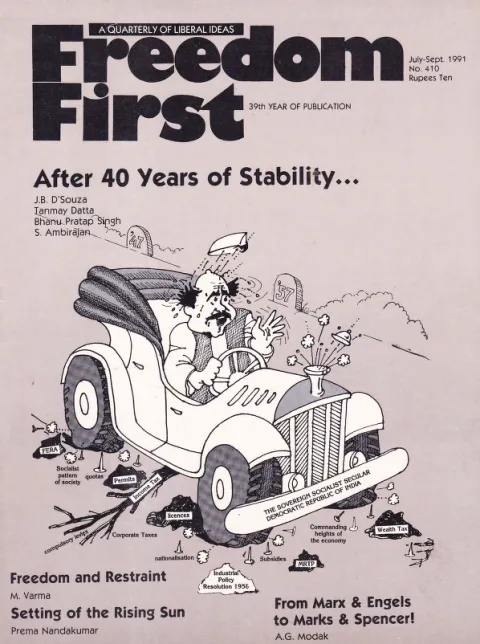
periodical issue
Freedom First
A Quarterly of Liberal Ideas
Edited by S. V. Raju
Published by J.R. Patel for the Democratic Research Service and printed by him at Parsiana Publications Pvt. Ltd., 300 Perin Nariman Street, Bombay 400 001. Democratic Research Service, 4th floor, Maneckji Wadia Bldg, 127, Mahatma Gandhi Road, Bombay 400 001 · Bombay · 1991
58 pages
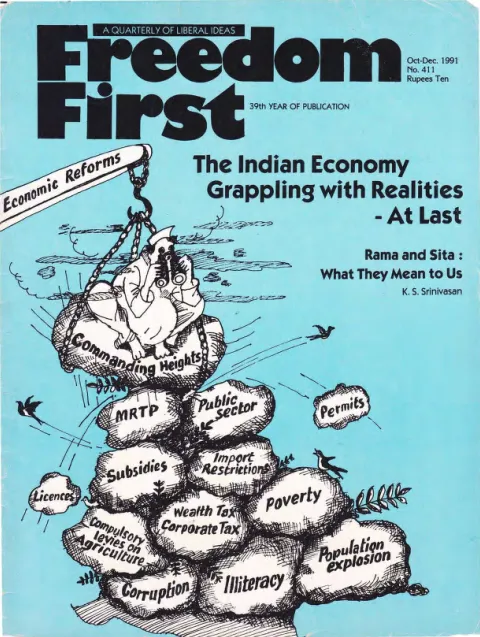
Freedom First
Summary
Freedom First No. 411 (Oct-Dec 1991), the quarterly journal founded by Minoo Masani, appeared at a watershed moment for Indian economic policy: months after Manmohan Singh’s 1991 reforms began dismantling the licence-permit raj. The issue’s editorial tone is one of vindication and cautious welcome for liberalisation, framed against decades of the magazine’s own warnings about statism. In the rendered pages, the volume opens with a report on a Freedom First Foundation seminar on the Indian economy, continues with the concluding instalment of The Economist’s ‘Survey of India’ (on the licence raj, rent-seeking corruption, agricultural neglect and rural infrastructure), and moves into a critical review of Bimal Jalan’s book on the reform package by a reviewer writing as ‘An Economist’. Recurring contributors visible in this chunk include S.V. Raju (editor) and the in-house columns ‘With Many Voices’ (press quotations) and ‘Of Cabbages and Kings’ (short editorial notes signed RS, i.e. R. Srinivasan), plus an In Memoriam section for Giovanni Malagodi, R.V. Murthy and Ramnath Goenka.
Key points
-
A report on a Freedom First Foundation seminar, “The Indian Economy - Grappling with Realities - At Last,” frames the 1991 reforms as the defeat of statism by economic reality and welcomes them as vindication of positions the magazine held for 39 years.
-
The concluding instalment of The Economist’s “Survey of India” catalogues the mechanics of the licence-permit raj, cites Robert Wade’s research on a “market for public office” in irrigation departments, and links economic grievance to separatist violence in Punjab, Kashmir and Assam.
-
A signed review credited to “An Economist” of Bimal Jalan’s “India’s Economic Crisis: The Way Ahead” praises the book’s diagnosis but criticises its prescriptions as timid and rooted in an assumption that the state should retain a dominant economic role.
-
The seminar report poses open questions about whether reform will solve mass poverty and whether India should emulate a Korea-style growth model or a Scandinavian welfare-blended one.
-
The issue carries an In Memoriam section for Liberal International’s Giovanni Malagodi, R.V. Murthy, and press baron Ramnath Goenka.
Essays
The Indian Economy - Grappling with Realities - At Last
This is a report on the proceedings of a Freedom First Foundation seminar on ‘A New Politics for India’ held in Bombay on August 31, 1991. In the rendered pages it argues that statism has been defeated everywhere by economic reality rather than by popular struggle, situates India’s 1991 reforms alongside the collapse of Soviet and East European communism, and welcomes the Congress government’s reform package as overdue vindication of positions the magazine held for 39 years. It raises open questions about whether reform will solve mass poverty and what growth model (Korea vs. a Scandinavian welfare-blended model) India should emulate, then lists seminar participants (economists, businessmen, academics, journalists, and civil rights activists).
- Frames the 1991 reforms as the defeat of statism by economic reality, not by a popular civil-liberties movement, in India as in the Soviet bloc
- Notes India’s growth was only marginal for most of the post-Independence period, improving to 5-5.5% in the 1980s under partial liberalisation before sliding toward bankruptcy
- Credits the change to a hung Parliament and a Congress government led for the first time by someone outside the Nehru family
- Freedom First claims 39 years of continuous warning against statism and ‘welcomes’ the new reform measures
- Poses unresolved questions: will reform solve poverty; should India emulate a Korea-style growth model or a Danish welfare-blended model
- Lists seminar participants including economists, an architect, a civil rights activist, journalists, and Freedom First editors S.V. Raju and R. Srinivasan
India - The Tiger Caged (Concluding instalment from The Economist’s Survey of India)
The concluding instalment of The Economist’s May 1991 ‘Survey of India’, reprinted by Freedom First to give readers the full picture behind the reform debate. In the rendered pages it catalogues the mechanics of the licence-permit raj (actual-user import rules, canalising agencies, phased manufacturing programmes, the MRTP Act’s perverse effects on firm size), the anti-export bias created by protectionism, chronic under-investment in irrigation and rural roads, and Robert Wade’s research on institutionalised corruption in irrigation and other public services, ending on the political costs of rent-seeking and separatist violence linked to economic grievance.
- Details how import licensing, canalising agencies and technology-transfer restrictions created one of the world’s most protected economies while depressing exports
- Shows the MRTP Act and small-scale reservation policy produced a polarised industrial structure of many small inefficient firms and a few large monopolists
- Documents that protected industries pay wages 70% higher and are five times more capital-intensive than unprotected ones
- Cites Robert Wade’s research on a ‘market for public office’ in irrigation departments, where postings are bought and sold based on their corruption-generating potential
- Notes the fertiliser subsidy alone (Rs 37 billion) is twice food subsidies for the poorest, yet farmers still pay 10-25% more than world prices due to policy inefficiency
- Links economic grievance to separatist and communal violence in Punjab, Kashmir, Assam and caste-reservation disputes
- Reports J.R.D. Tata’s view that Nehru, if alive, would have welcomed the reforms
Reconciling the Irreconcilable - A Statist Bureaucrat’s Prescriptions
By An Economist
A signed review, credited to ‘An Economist’, of Bimal Jalan’s book ‘India’s Economic Crisis: The Way Ahead’ (Oxford University Press, 1991). The reviewer, describing Jalan as a ‘statist bureaucrat’ by outlook, praises the book’s diagnostic chapters on India’s economic crisis but criticises its prescriptive ‘Way Ahead’ section as timid and rooted in an assumption that the state should retain a dominant role, arguing the actual reform package announced in mid-1991 goes considerably further than anything Jalan recommends.
- Reviews Bimal Jalan’s ‘India’s Economic Crisis: The Way Ahead’, noting Jalan was Chairman of the Economic Advisory Council and a former Executive Director of the IMF Board
- Praises the diagnostic (‘India’s Economic Crisis’) portion as scholastically and eminently carried out
- Criticises the prescriptive portion as unconvincing from either a liberal or pragmatic standpoint, since it is written within the framework of a dominant state model
- Argues real-world reforms (devaluation, trade liberalisation, new industrial policy, reform-oriented budget) already exceed Jalan’s proposals
- Faults Jalan for not discussing the intellectual case against government’s dominant economic role or invoking Hayek, Shenoy, Thatcher, Rajaji or Masani
- Continues (beyond the rendered chunk) into detailed critique of specific chapters on savings, balance of payments, and literacy
Generated by the v1.5 extraction pipeline. Awaiting editorial review.
Metadata and summary are AI-extracted from the source PDF and reviewed for editorial accuracy. The original work is available via the Read PDF tab above (where present); paragraph-level citation inside the PDF is deferred to a future engagement.