periodical issue
Freedom First
A Quarterly of Liberal Ideas
Edited by S. V. Raju
Democratic Research Service, 4th Floor, Maneckji Wadia Bldg., 127, Mahatma Gandhi Road, Bombay 400 023. Published by J. R. Patel for the Democratic Research Service and printed by him at Parsiana Publications Pvt. Ltd., 300 Perin Nariman Street, Bombay 400 001. · Bombay · 1994
52 pages
Freedom First
Summary
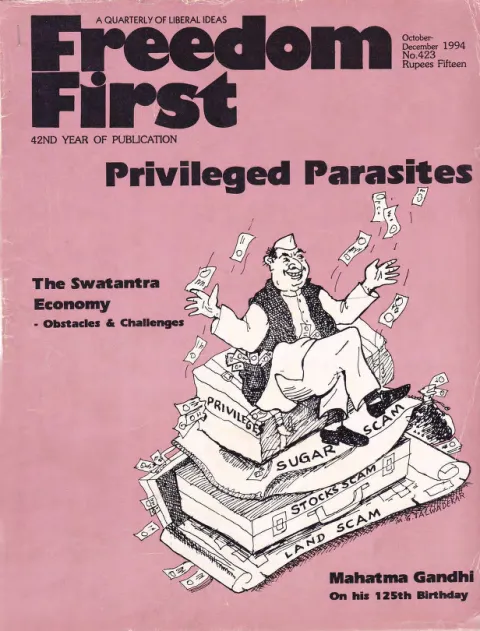
This is No. 423 (October-December 1994) of Freedom First, the Bombay-based quarterly of liberal ideas, marking the magazine’s 42nd year of publication. The issue is anchored by J. B. D’Souza’s cover essay “Privileged Parasites,” a polemic against the perks, allowances, and impunity enjoyed by India’s elected legislators ahead of a fresh round of state elections. It is paired with Madhu Limaye’s “The Enemy Within,” which lays out in granular, name-by-name detail the 1991 Jain hawala diaries seizure and the political and bureaucratic figures implicated, alongside official parliamentary answers tabulating unpaid rent owed by former MPs and ministers occupying government housing. Y. D. Altekar’s “Making Democracy Work” continues an earlier debate on separating executive from legislative power as a check on corruption. A substantial block of the issue (in the rendered pages) is devoted to the 125th birth anniversary of Mahatma Gandhi, with two generationally contrasting reader responses to his autobiography (Renuka Sinha’s admiring “One Step Towards Gandhi” and Nagindas Sanghavi’s more critical “Gandhi - His Trials and Triumphs”) followed by Adi H. Doctor’s “Gandhi’s Place in Today’s Politics,” which argues for the contemporary relevance of Gandhian ideas on sustainable development, trusteeship, and limited government. The front matter includes the regular “With Many Voices” quotations column and the “Of Cabbages and Kings” editorial notes (on the Surat plague, Coca-Cola’s return to India, and the politicisation of school textbooks), plus a publisher’s notice announcing that from January 1995 the magazine would be published by the Indian Committee for Cultural Freedom.
Key points
-
J. B. D’Souza’s cover essay “Privileged Parasites” attacks the perks Indian legislators award themselves, free telephones, air and rail tickets, subsidised housing, while huge numbers of MPs and ministers default on rent and dues owed to the public exchequer, naming three former Prime Ministers as owing the IAF Rs. 8.5 crores collectively.
-
Madhu Limaye’s “The Enemy Within” uses the 1991 Jain hawala diaries seizure, which recovered over Rs. 93 lakhs in unaccounted cash, to argue that corruption has overtaken plague and disease as India’s most dangerous scourge, naming Rajiv Gandhi, L. K. Advani and Devi Lal among recipients listed in the diaries and excoriating the CBI for stalling the case for over three years.
-
Y. D. Altekar’s “Making Democracy Work” continues an earlier proposal to separate executive from legislative power as a check on corruption, but concedes the reform can only be enacted by the MPs and MLAs who benefit from the status quo.
-
Marking Gandhi’s 125th birth anniversary, Renuka Sinha’s “One Step Towards Gandhi” offers an admiring reading of his autobiography that rebuts caricatures of him as a chauvinist or fanatic, while Nagindas Sanghavi’s “Gandhi - His Trials and Triumphs” counters that the autobiography is an inadequate and even misguiding source for understanding his public achievements.
-
Adi H. Doctor’s “Gandhi’s Place in Today’s Politics” argues for the continuing relevance of Gandhian ideas, including sustainable development over GNP-driven growth, the trusteeship doctrine, and empowering people rather than government, framing Gandhian non-violence as a practical strategy rather than absolute pacifism.
-
The issue’s front matter carries the regular “With Many Voices” quotations column and the “Of Cabbages and Kings” editorial notes, and announces that from January 1995 the magazine would be published directly by the Indian Committee for Cultural Freedom.
Essays
Privileged Parasites
By J. B. D’Souza
J. B. D’Souza’s cover essay is a sustained, sardonic attack on the material privileges Indian legislators award themselves - free telephones and calls, air and rail tickets, secretariat allowances, subsidised housing - while a huge number of MPs and ministers default on rent and dues owed to the public exchequer. D’Souza cites specific cases (Tavleen Singh’s reporting, the Nikhil Wagle-Sharad Pawar episode in Maharashtra, MP Virender Singh’s ticketless-travel letter, Chandrashekhar’s air-conditioned “hut”) to argue that legislators combine the freedom to extend their own privileges at will with near-total escape from accountability for misconduct or unpaid dues, and he closes by asking whether voters are about to elect yet another “fresh gang of crooks.”
- MPs enjoy extensive perks: free telephones (50,000 calls/year), 16 air/rail tickets annually, secretariat and constituency allowances, subsidised housing, and eventual pensions.
- Three former Prime Ministers (Chandrashekhar, Rajiv Gandhi, V. P. Singh) are named as owing the IAF Rs. 8.5 crores collectively for non-official use of aircraft.
- A list of defaulting ministers/former ministers cites Dinesh Singh (Rs. 8.4 lacs), Vasant Sathe (Rs. 7.8 lacs), Bhajan Lal (Rs. 1.8 lacs), and Eduardo Faleiro (Rs. 93,000) owed on housing.
- Prime Minister Chandrashekhar’s publicised austerity gesture - living in a hut in his MP bungalow compound - is described as bamboo-roofed but properly air-conditioned.
- D’Souza argues each hour of Parliament costs the nation Rs. 1.54 lakhs, yet much time is spent on walkouts, thumping desks, and gossip rather than legislative work.
- The piece cites the case of editor Nikhil Wagle, jailed by Maharashtra’s legislature over criticism of a corrupt, criminally-implicated MLA, as an example of legislators using ‘privilege’ to suppress press freedom.
The Enemy Within
By Madhu Limaye
Madhu Limaye’s essay, written on the 125th anniversary of Gandhi’s birth, argues that corruption has overtaken plague and disease as India’s most dangerous scourge, and uses the 1991 Jain hawala diaries case as its central evidence. He lays out the CBI’s own account of the May 1991 raids on J. K. Jain and S. K. Jain’s properties (recovering over Rs. 93 lakhs in unaccounted cash, foreign currency, gold, and Indira Vikas Patra), links the funds to Kashmiri terrorists via Hawala dealers, and reproduces detailed tables of politicians and bureaucrats named in the diaries as recipients of payments, including Rajiv Gandhi, L. K. Advani, Devi Lal, Arif Mohammad Khan, and senior bureaucrats at NTPC, RAW, and the Ministry of Power. Limaye excoriates the CBI for stalling the investigation for over three years and calls for ruthless action against everyone implicated, framing corruption, not Pakistan, as “the enemy within.”
- The May 3, 1991 CBI raids on J. K. Jain and S. K. Jain recovered Rs. 93,52,755 in unaccounted cash, Rs. 3,69,307 in foreign exchange, Indira Vikas Patra worth Rs. 10,50,000, and 4,430 kg of gold bearing across five locations.
- Diaries recovered link Hawala payments to Kashmiri terrorists, politicians, and bureaucrats; the CBI itself admitted diary entries were not difficult to decode.
- A detailed table lists named politicians (e.g., Rajiv Gandhi - Rs. 2 crores, L. K. Advani - Rs. 60 lakhs, Arif Mohammad Khan - Rs. 7.5 crores) and bureaucrats (including a RAW Secretary and NTPC officials) as recipients.
- Limaye reports the investigation into Ashfaq Hussain Lone and Shahabuddin Ghauri (a JNU student) as the initial thread that led to the wider Jain hawala exposure.
- He accuses the CBI of prevarication, noting interrogation of the Jains was delayed until mid-1993 and charge-sheets initially omitted reference to the May 1991 seizure.
- Limaye concludes that ruthless action against all implicated, regardless of party, is necessary to cleanse Indian public life, framing corruption as more dangerous than any external threat.
Making Democracy Work
By Y. D. Altekar
Y. D. Altekar continues an argument begun in Freedom First No. 417 (April-June 1993) for separating the executive from the legislature as a remedy for corruption and weak accountability. Responding to objections raised in conversation, he examines whether such separation would actually curb corruption, pointing to municipalities (where the Commissioner is already independent of elected corporators) as a case where the problem persists because the Commissioner is still politically appointed and pressured by the ruling party. He acknowledges that any reform must be enacted by the very MPs and MLAs who benefit from the status quo, making implementation the central practical obstacle.
- Altekar reprises an earlier proposal (Freedom First No. 417, April-June 1993) to separate executive and legislative power as a check on corruption.
- He uses the example of municipal commissioners - appointed rather than elected - to show that formal separation alone does not eliminate political pressure or corruption.
- He argues genetic/technical fixes (citing the mosquito-genetics analogy) are as futile for curbing corruption as moral uplift campaigns, given how entrenched self-interest is.
- The reform he proposes would strip legislators of bargaining power gained by winning elections and would strengthen real legislative oversight of the executive.
- He concedes the central difficulty: the needed changes can only be enacted by MPs and MLAs who have no incentive to reduce their own power.
One Step Towards Gandhi
By Renuka Sinha
Renuka Sinha’s personal reflection on reading Gandhi’s autobiography, written as one of two inter-generational assessments commissioned for the 125th birth anniversary, frames Gandhi as a stylish, independent-minded experimenter rather than a conventional ‘wise old man’ - someone who invented his own fashion, diet, architecture, and politics alike. She uses a question-and-answer format to rebut common caricatures (that he was a wife-bullying chauvinist, a religious fanatic, an authoritarian personality) and closes by admitting her own contradictions and hope that the encounter with Gandhi’s life might, in some sense, make them friends.
- Sinha frames Gandhi as glamorous and independent rather than merely saintly, citing his self-designed clothing, diet, architecture, and farming experiments.
- She rebuts the charge that Gandhi was a wife-bullying chauvinist by noting he regretted past behaviour and encouraged his wife’s full participation in public life.
- She argues Gandhi was not a religious fanatic: he founded no sect and treated Truth itself, not blind faith, as God.
- She addresses whether Gandhi was ‘political,’ concluding his politics were inseparable from his personal life and his opposition to discriminatory laws.
- The essay closes on Sinha’s own unresolved contradictions - continuing to value credentials and consumer comforts despite admiring Gandhi’s asceticism.
Gandhi - His Trials and Triumphs
By Nagindas Sanghavi
Nagindas Sanghavi’s companion assessment, seen only through its opening page in this chunk, argues that Gandhi’s autobiography is an inadequate and even misguiding source for understanding his public achievements, since Gandhi deliberately avoids the limelight and omits sustained discussion of major events and personalities, including his South African satyagraha campaigns and his seminal role in Indian public life.
- Sanghavi argues the autobiography is ‘quite inadequate, nay even a misguiding volume’ for understanding Gandhi’s life and achievements.
- He notes Gandhi deliberately avoids self-focus, leaving out significant events and figures central to his historical role.
- He cites the omission of Gandhi’s South African satyagraha campaign as an example of the book’s gaps.
- The essay (as far as rendered) contrasts with Sinha’s more admiring companion piece.
Gandhi’s Place in Today’s Politics
By Adi H. Doctor
Adi H. Doctor, Head of the Department of Politics at Goa University, argues for the continuing relevance of Gandhian thought to contemporary Indian politics. He enumerates several ideas he considers valuable: that development should not be measured by GNP alone since it can mask unequal distribution; the case for balanced, decentralised growth against unchecked urban-industrial concentration; sustainable development achieved through non-polluting, renewable technologies; Gandhi’s critique of mindless competition and the trusteeship doctrine, which holds that ownership carries moral rather than merely legal obligations; and the notion of empowering people rather than government, which Doctor connects to a liberal, minimal-state agenda. He closes with a defence of Gandhi’s doctrine of non-violence as a practical strategy for durable social change rather than an absolute pacifist creed.
- Doctor argues rising GNP can mask unequal distribution and does not by itself indicate genuine human development.
- He credits Gandhi as a forerunner of sustainable-development thinking, citing Gandhi’s warnings against resource-exhausting growth and his openness to renewable energy sources.
- He cites Gandhi’s Hind Swaraj on the corrupting effect of unchecked competition, even on professions meant to serve (doctors, lawyers).
- Doctor frames Gandhian trusteeship as holding that ownership is a matter of spirit, not just law, obliging the wealthy to reinvest surplus for communal welfare.
- He argues Gandhi wanted less government not because he opposed the state per se, but because he wanted to empower people to act voluntarily rather than depend on the state.
- Doctor reframes Gandhian non-violence (Ahimsa) as a practical rejection of permanent change through violent means, not an absolute pacifist creed.
Generated by the v1.5 extraction pipeline. Awaiting editorial review.
Metadata and summary are AI-extracted from the source PDF and reviewed for editorial accuracy. The original work is available via the Read PDF tab above (where present); paragraph-level citation inside the PDF is deferred to a future engagement.