periodical issue
Freedom First
A Quarterly of Liberal Ideas
By Minoo Masani
Indian Committee for Cultural Freedom, 3rd floor, Army & Navy Building, 148, Mahatma Gandhi Road, Bombay 400001 · Bombay · 1995
52 pages
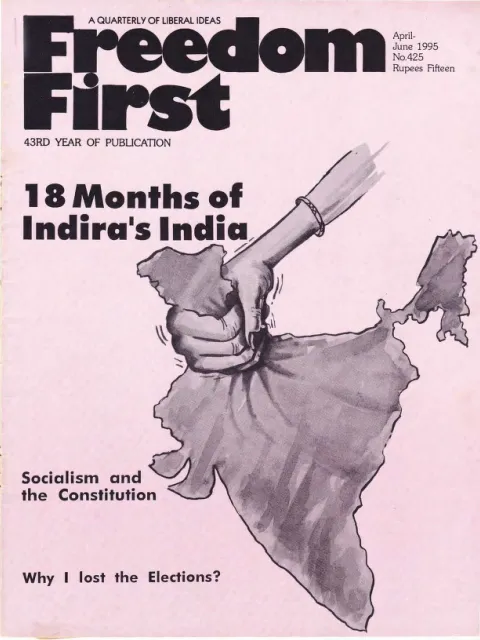
Freedom First
Summary
This is issue No. 425 (April-June 1995) of Freedom First, “A Quarterly of Liberal Ideas,” in its 43rd year of publication, edited by S. V. Raju with Minoo Masani as founder. The issue is built around a twentieth-anniversary retrospective on the Emergency (declared by Indira Gandhi on 26 June 1975), packaged under the cover line “18 Months of Indira’s India.” In the rendered pages, contributors recount the imposition of press censorship and the legal battles Freedom First and the Gujarati periodical Bhumiputra fought against it, the detention of political leaders and lawyers under MISA, and the judiciary’s mixed record (including the Habeas Corpus Case) during those eighteen months. The issue opens with regular features — a “With Many Voices” digest of press quotations, the “Of Cabbages and Kings” column on civic affairs, a report on a Friedrich Naumann Foundation environmental seminar in Germany, and birthday greetings to the Dalai Lama — before turning to the Emergency retrospective essays by Minoo Masani, S. P. Aiyar and S. V. Raju, and M. A. Rane. The rendered pages then move into the start of Subhash C. Kashyap’s essay on “Socialism and Secularism in the Constitution of India,” which traces the constitutional debates on secularism and communalism.
Key points
-
The issue is built around a twentieth-anniversary retrospective on the Emergency, packaged as “18 Months of Indira’s India”, covering press censorship, detentions under MISA, and the judiciary’s mixed record.
-
Minoo Masani’s “Why the Emergency was not Unexpected” recounts the Allahabad High Court’s June 1975 judgment against Indira Gandhi, the midnight arrests of opposition leaders, and his own experience as editor of Freedom First fighting censorship through to the magazine’s 1976 vindication in the Bombay High Court.
-
S. P. Aiyar and S. V. Raju’s essay on the battle against the censors details how Masani submitted deliberately provocative material to test the limits of pre-censorship, leading to the Bombay High Court’s February 1976 ruling that most objections were “fanciful and far-fetched”, and a parallel Gujarati periodical Bhumiputra case in which the Gujarat High Court went further, striking down the censor’s guidelines as exceeding statutory authority.
-
M. A. Rane’s “When Lawyers Did Indian Democracy Proud” recounts lawyers led by Chagla, Tarkunde and Jethmalani protesting the Emergency, early habeas corpus successes in several High Courts, and the Supreme Court’s Habeas Corpus Case in which a five-judge bench upheld the government with only Justice Khanna dissenting, who was subsequently superseded for Chief Justice.
-
N. G. Jog’s “A Letter to Comrade K. A. Abbas”, written during the Emergency, rebuts the claim that the crackdown targeted only smugglers and violent elements, describing the collapse of a free press under Information Minister Shukla and the government’s hypocrisy in blacking out foreign criticism while broadcasting praise from Algeria, Libya and Moscow.
-
Subash C. Kashyap’s essay, begun in the rendered pages, opens a discussion of “Socialism and Secularism in the Constitution of India”, tracing the constitutional debates on secularism and communalism.
-
The issue’s regular features include a report reprinting the Gummersbach Declaration from a Friedrich Naumann Foundation seminar on deregulation, founding an Asian Association for Environmental Protection, and a birthday tribute to the Dalai Lama on his 60th birthday.
Essays
Many Voices
A miscellany column collecting short quotations from the Indian and international press on topics of the day — BJP-BSP caste politics, film censorship, Salman Rushdie’s death sentence, market regulation, press freedom in the post-Emergency generation, and China-Taiwan tensions — followed by a birthday tribute to the Dalai Lama on his 60th birthday with a quoted statement on compassion, in the rendered pages.
- Compiles press commentary from India Today, The Economist, The Times of India, Indian Express, Business Today, Span, Mid-day and Time, dated June-July 1995
- Comments range across caste politics, censorship, economic deregulation, press courage during the Emergency, and cross-strait tensions
- Closes with a birthday greeting to the Dalai Lama on his 60th birthday from the ‘Freedom First Fraternity’, including a quoted appeal for compassion and a ‘Please Help Save Tibet’ banner
Of Cabbages and Kings
A column of civic commentary, opening with a Lewis Carroll epigraph, on Bombay’s flyover politics — how two nearly identical flyover projects near Bandra were named (or left unnamed) along partisan lines by successive governments — and closing with wry observations on India’s habit of naming public infrastructure after political figures.
- Contrasts the Bandra flyover, quickly named ‘Prabodhankar Thackeray Flyover’ by the incoming RSS-BJP/Shiv Sena government, with a second flyover left without a name amid inter-party rivalry
- Criticises the waste of fuel and public inconvenience caused by delayed completion and politically timed openings of infrastructure
- Argues that India’s political class prefers symbolic naming battles to substantive governance, comparing the practice to naming streets after Lenin or Saddam Hussein
Essay 3
A short report (bylined SVR) on a Friedrich Naumann Foundation seminar in Gummersbach, Germany, on ‘De-regulation and Responsibility in State and Society,’ attended by participants from 19 countries. The piece reprints the resulting Gummersbach Declaration of 16 June 1995 establishing an ‘Asian Association for Environmental Protection,’ with international headquarters in Amman, Jordan, and signatures from delegates including India.
- Twenty participants from 19 countries, including politicians, businessmen and lawyers, discussed deregulation and privatisation across differing national contexts
- Common concerns identified: bureaucratic overreach, corruption, judicial delay, and weak basic education across the participating societies
- A Jordanian professor initiated the founding of an Asian Association for Environmental Protection, formalised in the reprinted Gummersbach Declaration
Not the End of Remembering
By Rabbi Albert Friedlander
An unrelated reprinted piece, ‘Not the End of Remembering’ by Rabbi Albert Friedlander of Westminster Synagogue, London, reflecting on the fiftieth anniversary of the liberation of Auschwitz (27 January 1945). The essay meditates on the difficulty of fully commemorating the Holocaust, connects it to ongoing atrocities such as ‘ethnic cleansing’ in Bosnia, and recalls the author’s own childhood in Nazi Berlin and later friendships, including with the family of a July 20 plotter against Hitler. Not part of the numbered table of contents but printed ahead of it in the rendered pages, introduced by a note from Ian Tickle of Swiss Press Review.
- Marks the 50th anniversary of the Red Army’s discovery of Auschwitz and argues observance risks becoming a way to ‘forget’ rather than truly remember
- Connects Holocaust remembrance to other twentieth-century atrocities, including Soviet gulags and Bosnian ethnic cleansing among Croats, Serbs and Muslims
- Recounts the author’s personal history: hiding from Nazis as a child in Berlin, later solidarity work with Sinti-Roma communities and with Martin Luther King in America
- Describes a visit to a memorial for Adam von Trott zu Solz, executed for the July 20 plot against Hitler, whose home village refused to honour him
18 Months of Indira’s India: Why the Emergency was not Unexpected
By Minoo Masani
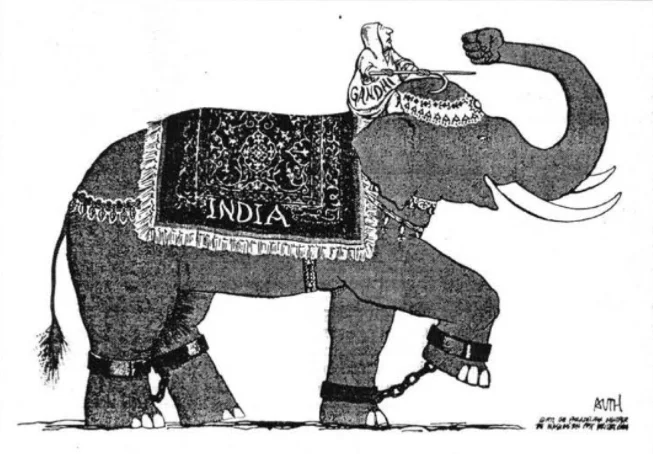
Minoo Masani’s essay ‘Why the Emergency Was Not Unexpected’ opens the ‘18 Months of Indira’s India’ retrospective section. Masani recounts the 12 June 1975 Allahabad High Court judgment against Indira Gandhi’s election, her choice to cling to power rather than resign, the midnight arrests of opposition leaders on 25-26 June, and his own experience of news blackouts and rumours about Jayaprakash Narayan’s detention. He reflects on the proper role of a liberal democrat under authoritarian pressure, his own battle with censors as editor of Freedom First, the eventual 1976 Bombay High Court judgment vindicating the magazine, and the broader failure of the press (quoting Khushwant Singh’s later self-critical account) alongside a short honour roll of journalists who resisted, including Ram Nath Goenka, Kuldip Nayar and A. D. Gorwala. In the rendered pages the essay is not shown to its end; it appears to continue past page 20 given the printed page numbering.
- Recounts the Allahabad High Court’s June 1975 finding against Mrs Gandhi and her decision not to resign
- Describes the midnight arrests of Jayaprakash Narayan, Morarji Desai and other opposition leaders and the imposition of censorship
- Argues the proper liberal response was to ‘eschew romanticism’ and ‘craven fear’ and assert citizens’ rights within the limits of legality
- Details Freedom First’s own suspension and legal fight against pre-censorship, culminating in the 1976 Division Bench judgment in the magazine’s favour
- Quotes Khushwant Singh’s 1977 self-critical account of the press’s general capitulation to Information Minister Shukla’s censorship, naming a small honour roll of journalists who resisted
18 Months of Indira’s India: When Freedom First and Bhumiputra battled the Censors
By S. P. Aiyar & S. V. Raju
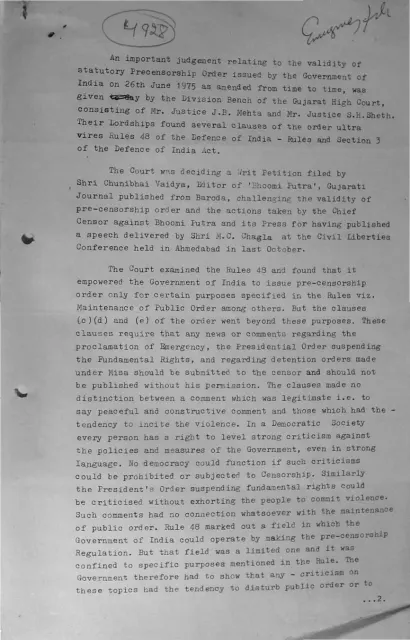
S. P. Aiyar and S. V. Raju recount the legal battles Freedom First and the Gujarati periodical Bhumiputra fought against pre-censorship during the Emergency. It details how Masani submitted the August 1975 issue with deliberately provocative but legally defensible content, leading to a writ petition and a landmark February 1976 Bombay High Court ruling (Justices D. P. Madon and M. H. Kania) that most of the censor’s objections were ‘fanciful and far-fetched.’ A parallel account covers the Bhumiputra case, in which the Gujarat High Court (Justices J. B. Mehta and S. H. Sheth) went further than the Bombay bench in striking down the censor’s guidelines as exceeding statutory authority.
- Masani submitted carefully chosen material for the August 1975 Freedom First issue to test the limits of censorship, prompting a writ petition to the Bombay High Court
- Justice R. P. Bhatt’s November 1975 ruling struck down the censor’s orders; the Division Bench’s February 1976 final judgment (Madon and Kania JJ) upheld the censor only on two of eleven items
- The Court held that censorship must not force the press to ‘trim their sails to one wind’ and called such interference the ‘nurse-maid of democracy’
- The parallel Bhumiputra case (Gujarat High Court, March 1976) went further, ruling the Chief Censor’s guidelines exceeded Rule 48 of the Defence and Internal Security Rules
18 Months of Indira’s India: When Lawyers Did Indian Democracy Proud
By M. A. Rane
M. A. Rane’s essay ‘When Lawyers Did Indian Democracy Proud’ recounts how lawyers across India protested the Emergency’s midnight arrests and censorship, the wave of habeas corpus petitions filed on behalf of political detenus in various High Courts, and the eventual Supreme Court Habeas Corpus Case in which a five-judge bench (Chief Justice A. N. Ray and Justices Khanna, Beg, Chandrachud and Bhagwati) upheld the government’s position, with Justice Khanna dissenting alone. The essay also covers the transfer and supersession of judges seen as insufficiently pliant, including Justice Khanna’s supersession by Justice Beg for Chief Justice of India.
- Lawyers led by Chagla, C. J. Shah, V. M. Tarkunde, Ram Jethmalani and others protested the Emergency and abstained from courts on 26 June 1975
- Early habeas corpus petitions succeeded in several High Courts (Delhi released Kuldip Nayar and others) though the Kerala High Court was an exception
- Chagla successfully argued habeas corpus petitions for Vajpayee and Madhu Dandavate in the Karnataka High Court, though they were re-arrested under fresh detention orders
- The Supreme Court’s Habeas Corpus Case (bench headed by Chief Justice A. N. Ray) upheld the constitutional validity of the Emergency and suspension of Article 21 rights, with Justice Khanna dissenting
- Justice Khanna was subsequently superseded for Chief Justice of India in February 1976; several other High Court judges seen as unfavourable to the government were transferred
18 Months of Indira’s India: A Letter to Comrade K. A. Abbas
By N. G. Jog
N. G. Jog’s letter to ‘Comrade K. A. Abbas,’ written during the Emergency and reprinted from a commemoration volume, is a sharp personal rebuttal to a defence of the Emergency. Jog argues the crackdown was directed not at ‘smugglers, black-marketers… and violent elements’ as claimed, but at dissent itself, describes the collapse of a free press under Information Minister Shukla, and criticises the hypocrisy of a regime that suppressed foreign publications critical of Mrs Gandhi while broadcasting praise from Algeria, Libya and Moscow.
- Jog rejects the claim that the Emergency was aimed only at smugglers, black-marketers and violent elements like the RSS and Anand Margis
- Describes leading Delhi papers unable to publish for days due to a ‘conveniently’ timed power failure in the Bahadur Shah Jafar Marg press district
- Notes that even avowedly leftist papers like Mainstream confessed it was ‘neither feasible nor permissible’ to attempt honest weekly appraisal under the conditions
- Criticises the government for blacking out foreign publications like Time while broadcasting praise for the crackdown from Algeria, Libya, Timbuctoo and Moscow
- Closes with a reflection on Indian emigrants abroad, revising his earlier view that emigration was unpatriotic ‘brain drain’
Socialism and Secularism in the Constitution of India
By Subash C. Kashyap
No summary was extracted for this article. Listed for completeness.
The Sovereign Nation State at the Crossroads of History
By B. Ramesh Babu
No summary was extracted for this article. Listed for completeness.
Generated by the v1.5 extraction pipeline. Awaiting editorial review.
Metadata and summary are AI-extracted from the source PDF and reviewed for editorial accuracy. The original work is available via the Read PDF tab above (where present); paragraph-level citation inside the PDF is deferred to a future engagement.