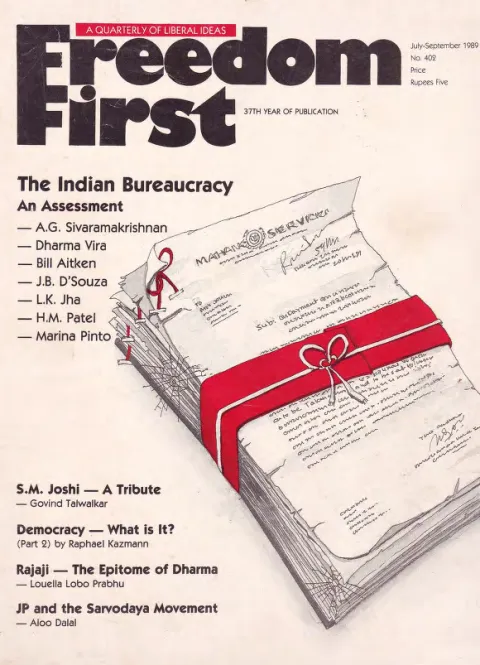
periodical issue
Freedom First
The Bureaucrat: Public Servant Or Government Servant?
Published by J. R. Patel for the Indian Committee for Cultural Freedom, 3rd Floor, Army & Navy Building, 148, Mahatma Gandhi Road, Mumbai 400 001, and printed by him at Kaiser-E-Hind Private Ltd., 300, Perin Nariman Street, Mumbai 400 001 · Mumbai · 1999
52 pages
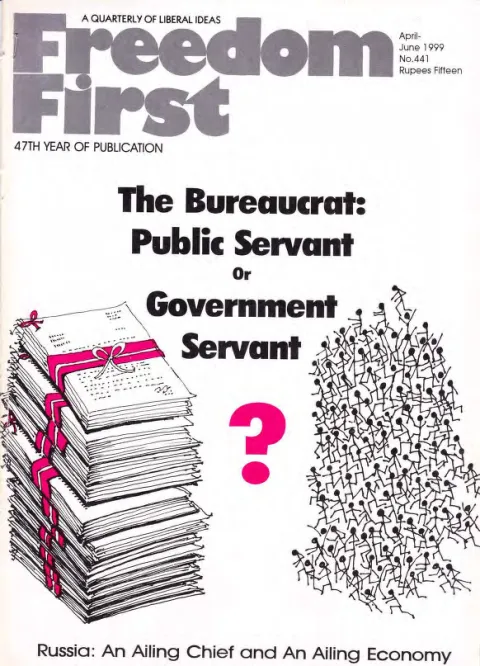
Freedom First
Summary
This is issue No. 441 of Freedom First (April–June 1999, the 47th year of publication), a quarterly published by the Indian Committee for Cultural Freedom under editor S. V. Raju. The cover feature, “The Bureaucrat: Public Servant or Government Servant?”, assembles a symposium of essays by former civil servants and commentators on the decline of professionalism, integrity, and independence in the Indian bureaucracy since Nehru’s time, with an emphasis on how political pressure, the Emergency, and the rise of a ‘committed’ civil service eroded the ICS/IAS tradition of neutral, rule-bound administration. In the rendered pages, contributors J. B. D’Souza, Ashok V. Desai, A. D. Moddie, and Marina Pinto each give first-hand or analytical accounts of bureaucratic subservience, corruption, and politicisation. The issue opens with the regular front-matter sections (masthead, ‘Between Ourselves’ editorial note on civil servants like Keshav Varma and Arun Bhatia, ‘With Many Voices’ press-quote digest, ‘Of Cabbages and Kings’ commentary column, and obituary notices for industrialist Nanubhai Amin and, separately, for musician Sheik Chinna Maulana Saheb and scholar Prof. K. R. Srinivasa Iyengar) before moving into the main symposium.
Key points
-
The cover symposium “The Bureaucrat: Public Servant or Government Servant?” assembles former civil servants examining the decline of professionalism and independence in the Indian bureaucracy since Nehru’s time.
-
J. B. D’Souza, a retired Chief Secretary of Maharashtra, argues bureaucratic complicity with politicians, not just bad policy, explains why land reform failed, recounting his own resistance to ministerial pressure over a road realignment and a Backbay land-lease rate hike, and insisting officials must see themselves as public servants first.
-
Ashok V. Desai contrasts the careers of I. G. Patel and Manmohan Singh at the RBI, including the BCCI licensing episode, to argue that ministers’ historic deference to bureaucratic judgment collapsed under Indira Gandhi, who began promoting “malleable” bureaucrats over independent-minded ones.
-
A. D. Moddie, a retired ICS officer, recounts witnessing entrenched corruption from his 1949 Bihar posting onward, including a police officer who personally committed an armed dacoity, and describes resigning from the ICS after finding no colleague could justify staying on.
-
Marina Pinto traces the civil service’s arc from the British-era “steel frame” ethos of neutrality through Nehruvian-era respect for that neutrality to its decline from the late 1960s as a doctrine of “committed” bureaucracy rewarded compliant officials, citing the Shah Commission’s findings on Emergency-era subservience.
Essays
Professionalism and Commitment in the Civil Service
By J. B. D’Souza
J. B. D’Souza, a retired Chief Secretary of Maharashtra, argues that repeated policy reforms in India (especially land reform) have failed not for lack of good laws but because of bureaucratic complicity with politicians who want them frustrated. He recounts his own experience as Urban Affairs Secretary in Maharashtra, including a case where a minister’s pressure to narrow a planned 60-foot road (to protect a Chief Minister relative’s nursing home) was resisted via careful, on-the-record file documentation, and another where he refused to roll back a land-lease rate hike despite ministerial pressure. He closes by insisting officials must see themselves as public servants first, government servants only secondarily.
- Argues bureaucratic complicity, not just bad policy, explains why land reform and other declared socialist policies failed to help the rural poor
- Frames Indira Gandhi’s Emergency-era demand for ‘commitment’ from civil servants as demanding personal loyalty rather than loyalty to law or public interest
- Describes lack of legal whistleblower protection for Indian civil servants (citing Arun Bhatia’s case) compared to the US Whistle-Blowers Act
- Recounts a Maharashtra Urban Affairs case where he used ‘extra-mural’ file documentation to resist a minister’s attempt to narrow a planned road to protect a politically-connected nursing home
- Recounts resisting Minister Vartak’s attempt to block a favorable Backbay land-lease rate revision benefiting the state treasury
- Concludes civil servants must regard themselves primarily as public servants, only secondarily as government servants
The Making of Malleable Bureaucrats
By Ashok V. Desai
Ashok V. Desai contrasts the careers of I. G. Patel and Manmohan Singh, two top economic bureaucrats, to argue that the norm of ministers deferring to bureaucratic judgment collapsed between the 1950s-60s and the 1970s-80s. He details I. G. Patel’s resistance to political interference as RBI governor (including the BCCI licensing episode involving Charan Singh and Manmohan Singh) and argues that under Indira Gandhi, bureaucratic malleability became a criterion for promotion, corroding decision-making consistency, hierarchy, and discipline across government.
- Compares I. G. Patel and Manmohan Singh’s parallel career paths to the RBI governorship, diverging after that point
- Argues ministers historically deferred to bureaucrats’ professional judgment, a norm reversed by the 1970s
- Recounts the BCCI licensing episode: I. G. Patel as RBI governor refused a licence to BCCI under political pressure; his successor Manmohan Singh later granted it
- Describes Indira Gandhi’s 1980 return to power as accelerating promotion of ‘malleable’ bureaucrats over independent-minded ones
- Warns that selecting bureaucrats for malleability breaks down decision-making consistency, hierarchy, and discipline, risking government becoming a ‘chaotic melange of mafias’
A Tradition of Corruption
By A. D. Moddie
A. D. Moddie, a retired ICS officer, writes a personal memoir of witnessing entrenched corruption from his earliest posting in Bihar (1949) onward — including cheating in departmental exams, an armed dacoity committed by a Deputy Inspector General of Police, land-grabbing by powerful families, and political indifference to Kosi flood victims. He describes discovering that a predecessor was removed from his post as Textile Controller not for corruption per se but for channeling funds to the ‘wrong’ political faction, and recounts contemplating resignation from the ICS after finding no colleague could give him a reason to stay. He states he ultimately resigned and never regretted it.
- Describes witnessing mass cheating by IAS/provincial officers in 1949 departmental exams in Patna, aided by invigilators
- Recounts a Deputy Inspector General of Police (CID, Bihar) who personally committed an armed dacoity to seize a Mahant’s land for personal gain
- Describes Bihar’s Kosi flood relief work and the indifference of Bihar’s ‘khadi-clad’ political class, including a Chief Minister more concerned with press optics than victims
- Recalls being transferred abruptly to Textile Controller, later learning his predecessor was removed only for funding the wrong political faction’s leader, not for corruption itself
- Concludes with his decision to resign from the ICS after finding no senior colleague could justify staying on, a decision he says he never regretted
Civil Service Activism
By Marina Pinto
Marina Pinto traces the historical arc of civil service ethos in India: from the British-era ‘steel frame’ prizing neutrality, anonymity, and rule-bound administration, through the early independence period when Nehruvian-era politicians largely respected that neutrality, to a steady politico-administrative decline from the late 1960s onward as the ideology of a ‘committed’ bureaucracy took hold. She argues this created a culture in which compliant ‘Yes Men’ were rewarded and defiant officials were sidelined, culminating in coerced subservience during the Emergency, as documented by the Shah Commission’s findings on civil servants bending rules to please superiors.
- Describes the British-era ‘steel frame’ civil service ethos of neutrality, anonymity, impartiality, and loyalty
- Notes that in the Nehruvian era, politicians largely respected civil service neutrality and avoided political interference
- Traces the ‘decline’ beginning in the late 1960s as administrators were asked to be agents of ‘Economics of Growth’ and ‘Development Administration’
- Argues the doctrine of a ‘committed’ bureaucracy displaced neutrality, rewarding compliant officials and sidelining independent ones
- Cites the Shah Commission’s findings on civil servants who chose to ‘crawl’ and bend rules to ingratiate themselves with superiors during the Emergency
Generated by the v1.5 extraction pipeline. Awaiting editorial review.
Metadata and summary are AI-extracted from the source PDF and reviewed for editorial accuracy. The original work is available via the Read PDF tab above (where present); paragraph-level citation inside the PDF is deferred to a future engagement.