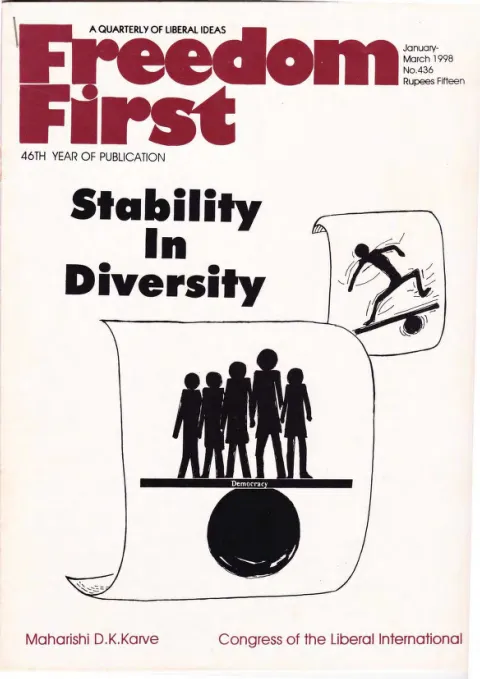
periodical issue
Freedom First
A Quarterly of Liberal Ideas
Edited by S. V. Raju
Indian Committee for Cultural Freedom, 3rd Floor, Army & Navy Building, 148, Mahatma Gandhi Road, Mumbai 400 001. Published by J. R. Patel for the Indian Committee for Cultural Freedom and printed by him at Kaiser-E-Hind Private Ltd., 300, Perin Nariman Street, Mumbai 400 001. · Mumbai · 1999
52 pages
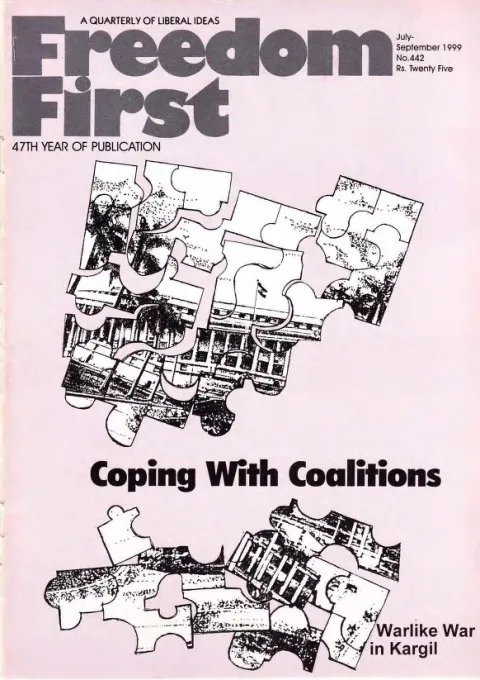
Freedom First
Summary
Freedom First No. 442 (July–September 1999), the 47th year of publication of this Bombay-based quarterly of liberal ideas edited by S. V. Raju, opens with a cover feature on “Coping with Coalitions,” prompted by the country’s third general election in three years amid the fall of the Vajpayee government. The editorial notes the Kargil conflict intruded on the planned space for the cover feature, and previews a follow-up on federalism and the election results for the next issue. In the rendered pages, four contributors debate whether coalition government is a viable, even desirable, arrangement for a plural country like India, or a symptom of instability requiring electoral and constitutional reform; a fifth essay, on the Kargil war, examines the intelligence failures and strategic logic behind Pakistan’s intrusion. The issue also carries the regular curated-quotations column “With Many Voices,” the editorial commentary column “Of Cabbages and Kings” (touching on Hungary’s 1956 revolt, Hong Kong’s autonomy, Kerala’s state-funded EMS Namboodiripad hagiography, and a debate with Professor S. Ambirajan on Hindu businessmen and the Ganga), and a memorial tribute to J. M. Lobo Prabhu, a former ICS officer and Swatantra Party parliamentarian, written by his widow Louella Lobo Prabhu.
Key points
-
The cover feature “Coping with Coalitions” debates whether coalition government is viable for India: Subhash C. Kashyap argues coalitions succeed only with pre-election alliances and ideological affinity, criticising India’s first-past-the-post system and proposing a constructive vote of no-confidence.
-
Seetha Parthasarathy argues a fractured mandate reflects genuine social churning as OBCs, Dalits, women and regional communities outgrew Congress’s old umbrella coalition, and that coalition government handled with sagacity could mature Indian democracy.
-
Nagindas Sanghavi describes the 1999 elections as the “Keralisation” of national politics, marking a shift from post-election parliamentary coalitions to pre-election electoral fronts, with no clear successor to Congress’s dominant-party role.
-
S. R. Kelkar defends the parliamentary system against calls for a presidential model, pointing to unstable presidential regimes elsewhere and arguing that coalition ministries under the 11th and 13th Lok Sabhas still delivered reasonable economic management.
-
Major General (Retd.) E. D’Souza’s essay on the Kargil war argues Pakistan deliberately exploited high-altitude terrain and Indian complacency after Lahore bus diplomacy, with at least six months of pre-planning, and calls the episode an intelligence failure at every level despite shepherd reports of unusual activity reaching the Cabinet.
-
The issue also carries a memorial tribute to J. M. Lobo Prabhu, a former ICS officer and Swatantra Party parliamentarian, written by his widow Louella Lobo Prabhu.
Essays
Coalitions Can Work Provided…
By Dr. Subash Kashyap
Subhash C. Kashyap argues, in the rendered pages, that Indian politics has always had a coalitional character, with the Congress itself functioning historically as an umbrella coalition of diverse ideological currents. He traces the post-1969 history of coalition and minority governments (Janata 1977, V.P. Singh’s Janata Dal in 1989, the Gowda and Gujral ministries) and contends coalitions can succeed only when built on pre-election alliances with genuine ideological affinity, a dominant nucleus party, few constituent parties, and functioning coordination mechanisms. He criticizes India’s first-past-the-post electoral system, borrowed from a British model whose social preconditions (a stable two-party system) do not exist in India, and proposes reforms: raising the vote-share threshold for national/state party recognition, restricting Lok Sabha contests to national parties or pre-election coalitions, considering a Gandhian bottom-up multi-tier governance model or German-style subsidiarity, and amending Rule 198 to require a constructive vote of no-confidence naming a successor premier.
- Indian politics has been coalitional in nature since before independence, with the Congress itself an ‘umbrella organisation’ of diverse ideological currents.
- Genuine coalition success requires pre-election alliances, ideological affinity among partners, a dominant nucleus party, few constituent parties, and regular coordinating committees.
- India’s first-past-the-post system, borrowed from Britain, lacks the preconditions (a stable two-party system) needed for it to function as intended, producing hung houses.
- Proposes raising vote-share thresholds for party recognition and restricting Lok Sabha contests to national parties or declared pre-election coalitions.
- Advocates a constructive vote of no-confidence (amending Rule 198) so no-confidence motions must simultaneously name an alternative PM, to avoid instability like the Vajpayee government’s one-vote defeat.
Not a Problem but An Opportunity
By Ms. Seetha Parthasarathy
Seetha Parthasarathy argues, in the rendered pages, that a fractured electoral mandate reflects genuine social churning in India rather than a mere managerial problem to be engineered away. She traces how newly assertive social groups (OBCs, Dalits, women, regional and linguistic communities) outgrew the Congress’s old umbrella coalescence and gave rise to a proliferation of regional and identity-based parties that neither the BJP’s Hindutva plank nor Congress’s old idiom could fully absorb. She reviews the 1996–1999 sequence of unstable coalition and minority governments (Deve Gowda, Gujral, Vajpayee) and concludes coalition government, handled with sagacity, could actually mature Indian democracy by forcing parties to rise above sectarian outlooks, though she is uncertain political leaders currently possess that sagacity.
- A fractured mandate is a manifestation of deep social churning (rise of OBCs, Dalits, women, regional groups) rather than simply a problem to be solved administratively.
- The Congress’s decline left a vacuum that no single successor party (Janata Dal, BJP) has been able to fill, driving voters toward regional and identity-based parties.
- Reviews the instability of the 1996-99 period: Gowda and Gujral coalitions as a ‘fraud on representative democracy’ given weak mandates; Narasimha Rao’s minority government surviving five years by co-opting support.
- Coalition government, done right, could give participating parties a national perspective and push India toward a maturing democracy, rather than being an inherently inferior arrangement.
- Smaller parties currently treat coalitions as an opportunity for political blackmail rather than genuine power-sharing, as shown by the Congress’s flip-flop on coalitions at Pachmarhi.
Coalition Politics Have Come to Stay
By Professor Nagindas Sanghavi
Nagindas Sanghavi contends, in the rendered pages, that the 1999 elections represent the ‘Keralisation’ of national politics — i.e., the permanent entrenchment of coalition and front-based contests, following the precedent set in Kerala since 1977. Using Lok Sabha data tables (1984-1998), he documents the steady decline of Congress and the combined national parties’ seat and vote share, alongside the rapid rise of regional parties, and argues no single national party can plausibly replace the Congress. He predicts the 1999 election will be fought between multi-party fronts/morchas rather than individual parties, marking a shift from parliamentary coalition-formation after elections to electoral coalition-formation before them, a shift he says could have significant long-term effects on how Indian political parties organize.
- Describes the 1999 elections as the ‘Keralisation’ of national politics — coalition politics has come to stay, following the model set by Kerala since 1977.
- Presents Lok Sabha data tables for 1984-1998 showing Congress and BJP vote/seat trends and the rising seat/vote share of regional parties.
- Argues the dominant-party system is fading and needs replacement at both the national and regional level, with no clear single successor to Congress.
- The BJP’s growth is capped by Hindutva being both its strength and its liability in a plural society.
- 1999 marks a shift from post-election parliamentary coalitions to pre-election electoral fronts/morchas contesting as blocs.
In Defence of the Parliamentary System
By Mr. S. R. Kelkar
S. R. Kelkar defends the parliamentary system against calls (citing Farooq Abdullah, among others) for a switch to a presidential model. He rebuts the argument from stability by pointing to unstable presidential regimes (much of Africa, Pakistan, Portugal and Spain under Salazar and Franco) and stable parliamentary ones, and argues India’s Congress-era prime ministers already wielded more effective power than the U.S. president, making the presidential-stability argument moot. He warns a presidential system in a developing country like India risks sliding toward authoritarianism, argues coalition ministries under the 11th and 13th Lok Sabhas nonetheless delivered reasonable economic management (controlled inflation, record tax collection), and recommends reforming rather than replacing the parliamentary system, gradually decentralising along lines suggested by the European Union’s evolving model.
- Rebuts the case for a presidential system by pointing to unstable presidential regimes (much of Africa, Pakistan, Salazar’s Portugal, Franco’s Spain) and stable parliamentary ones (Italy, Japan among G7 states).
- Argues Indian Congress prime ministers historically wielded more power than the U.S. president, so lack of accountability, not the parliamentary system itself, was the real problem.
- Warns a presidential system in a country like India risks greater corruption and a slide toward dictatorial tendencies given weaker checks.
- Notes multi-party coalition governments (11th and 13th Lok Sabha) still delivered functional administration — income tax collection records, inflation held below 5-6%, passage of the Prasar Bharati Act.
- Recommends improving the parliamentary system incrementally rather than replacing it, drawing loosely on the European Union’s move toward gradual harmonisation while preserving national/local autonomy.
The Warlike War in Kargil
By Major General (Retd.) E. D’Souza
Major General (Retd.) E. D’Souza analyzes, in the rendered pages, the strategic logic and intelligence failures behind Pakistan’s 1999 intrusion into the Dras-Kargil-Batalik sector. He argues Pakistan chose the high-altitude, snow-bound, hard-to-detect terrain deliberately, exploiting Indian complacency after the Lahore bus diplomacy, and that at least six months of pre-planning (recruiting foreign mercenaries via Afghanistan, stockpiling cold-weather gear, identified Northern Light Infantry units from Minimarg) preceded the operation. He calls the episode an unambiguous intelligence failure at every level — external (RAW, the High Commission in Islamabad) and field (IB, Army FIUs) — despite local shepherd reports of unusual activity reaching the Cabinet without translating into countermeasures. He lists Pakistan’s likely objectives (opening a second front, cutting the Srinagar-Leh road, raising the spectre of nuclear war to invite American intervention, internationalising Kashmir, exploiting India’s caretaker-government uncertainty) and credits India’s integrated use of air power, artillery and ground troops for successfully evicting the intruders and signalling that such incursions would no longer be tolerated, while noting high Indian casualties reflected the well-known military disadvantage of attacking an entrenched enemy holding the high ground.
- Pakistan deliberately chose the Dras-Kargil-Batalik sector for its snowbound, hard-to-detect terrain, exploiting complacency after the Lahore Agreement bus diplomacy.
- At least six months of pre-planning preceded the intrusion, including recruitment of foreign mercenaries via Afghanistan and identification of Northern Light Infantry units based in Minimarg.
- Calls the episode an intelligence failure at every level — RAW/High Commission Islamabad externally, and IB/Army Field Intelligence Units internally — despite shepherd (Gujjar) reports of unusual activity reaching the Cabinet.
- Lists Pakistan’s likely strategic aims: opening a second front, cutting the Srinagar-Leh supply road, provoking a scenario inviting American/international intervention, and diverting attention from Pakistan’s domestic economic troubles.
- Credits India’s integrated air power, artillery, and ground troop operations with successfully evicting the intruders, while attributing heavy Indian casualties to the standard military disadvantage of assaulting a dug-in enemy on high ground.
- The rendered excerpt is cut off mid-essay in a ‘Some Failings’ section critiquing early missteps, including the government’s premature public claim of ISI/Pakistan Army ignorance of the plan.
Generated by the v1.5 extraction pipeline. Awaiting editorial review.
Metadata and summary are AI-extracted from the source PDF and reviewed for editorial accuracy. The original work is available via the Read PDF tab above (where present); paragraph-level citation inside the PDF is deferred to a future engagement.