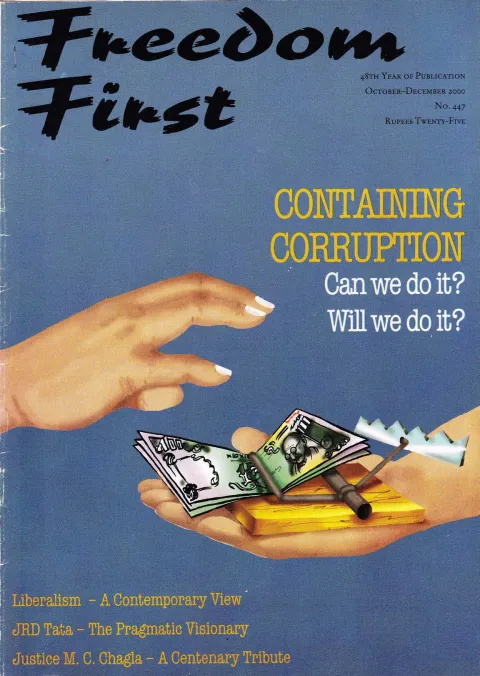
periodical issue
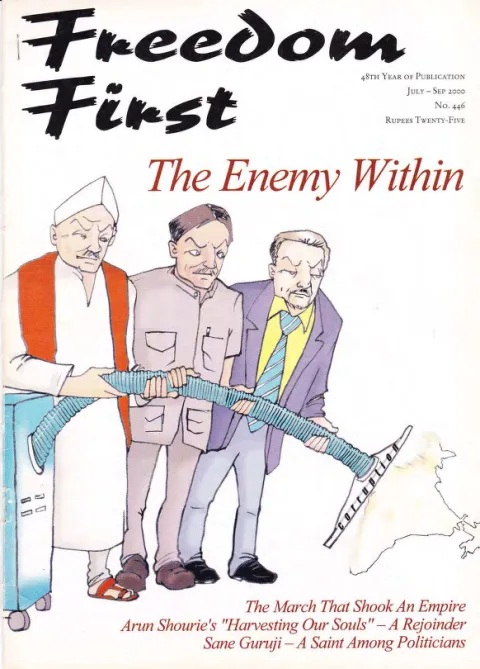
Freedom First
The Enemy Within
Edited by S. V. Raju
Publishers: Indian Committee for Cultural Freedom, 3rd Floor, Army & Navy Building, 148, Mahatma Gandhi Road, Mumbai 400 001. Published by J. R. Patel for the Indian Committee for Cultural Freedom and printed by him at Kaiser-E-Hind Private Ltd., 300, Perin Nariman Street, Mumbai 400 001. · Mumbai · 2000
52 pages
Freedom First
Summary
Freedom First No. 446 (July–September 2000), published by the Indian Committee for Cultural Freedom under editor S. V. Raju, leads with a two-part cover feature, “The Enemy Within: Corruption – The Enemy of Dharma,” prompted by the magazine’s June 24 Mumbai seminar on corruption. In the rendered pages the issue prints S. S. Bankeshwar’s essay “The Monster of Corruption” (an extract from his seminar paper) followed by an edited, footnoted transcript of the seminar discussion itself, in which named participants (Mr. Satish Sahney, Mr. Ashok Karnik, Dr. B. N. Colabawalla, Dr. Nagraj Huilgol, Dr. Usha Mehta, Mr. A. D. Moddie, Prof. V. K. Sinha, and others) analyze the causes, sociology, and possible remedies of corruption in India, ranging from the license-permit-quota raj and bureaucratic “slavery” of transfers to value education, decentralization, technology, and electoral reform. The front matter carries a tribute to the late S. P. Godrej, the “Between Ourselves” editorial note, the “With Many Voices” page of quotations, and “Of Cabbages and Kings,” S. V. Raju’s column touching on Count Otto von Lambsdorff’s Holocaust-compensation work, press freedom in Kashmir and Sri Lanka, and Indian electronic-media regulation. The TOC also lists further pieces beyond the rendered range: “The March that Shook an Empire” by Prem Vaidya, a tribute to Sane Guruji by V. C. Phadke, a rejoinder to Arun Shourie’s “Harvesting Our Souls” by Lonella Lobo Prabhu, a tribute to Ramashray Prasad Choudhary, an India-U.S. relations section (B. Ramesh Babu and Nitin G. Raut), and book reviews — none of which were seen in this chunk.
Key points
-
The cover feature “The Enemy Within: Corruption - The Enemy of Dharma” opens with S. S. Bankeshwar’s “The Monster of Corruption”, arguing India ranks among the world’s ten most corrupt countries, distinguishing predictable “organised” corruption from more destructive “chaotic” corruption, and citing South Korea’s swift prosecution of corrupt former presidents as a model India cannot match.
-
A footnoted transcript of the magazine’s June 24 Mumbai seminar on corruption records panelists invoking Sudhir Kakar’s research on authoritarian Indian child-rearing as a root of official venality, and calling for stripping politicians of their power to transfer bureaucrats at will.
-
Seminar participants critique the Prevention of Corruption Act’s sanction-to-prosecute clause as a structural enabler of impunity and ground the discussion in first-person anecdotes of everyday bribery, from an RTO clerk to capitation-fee medical admissions.
-
Proposed remedies discussed include computerised land records, decentralisation to the panchayat level, simplified laws, contested value-education proposals, and the Indian Liberal Group’s plan to publicise honest role models starting with Raja Rammohun Roy.
-
The front matter carries a tribute to the late industrialist S. P. Godrej and an “Of Cabbages and Kings” column touching on Count Otto von Lambsdorff’s Holocaust-compensation work and press freedom in Kashmir and Sri Lanka.
-
The discussion explicitly continues into the next issue as part two of a two-part treatment of corruption.
Essays
Many Voices
S. S. Bankeshwar’s “The Monster of Corruption” argues, in the rendered pages, that corruption has reached epidemic, near-terminal proportions in India, placing the country among the ten most corrupt in the world by IMF/World Bank/IBRD reckoning. He distinguishes “organised” corruption (predictable bribe schedules that at least let business proceed) from more destructive “chaotic” corruption (uncoordinated demands from multiple officials that halt enterprise), cites South Korea’s harsh, swift prosecution of corrupt former presidents as a model India cannot match, and contends that liberalisation without character has produced only “liberalised corruption” — a new avatar of the permit-license raj via bogus finance companies. He closes by cataloguing India’s culture of “fixing” (cricket, exams, medicine, religion) and quotes the late underworld don Haji Mastan’s cynical view that politicians of every party bow to gangsters’ money and muscle.
- India ranks among the world’s ten most corrupt countries per IMF, World Bank, and IBRD reports, with corruption undermining stability, deterring foreign investment, and hurting the poor most.
- Distinguishes organised corruption (fixed, predictable bribes) from chaotic corruption (multiple uncoordinated bribe demands), arguing the latter is more economically destructive.
- Blames ‘pseudo liberalisation’ for merely liberalising corruption, citing the boom and bust of fly-by-night non-banking finance companies as a new Permit-Licence-Raj avatar.
- Cites South Korea’s severe, swift punishment of two former presidents for bribery as a contrast to India’s decades-long, ultimately toothless prosecutions.
- Frames bribery as a rational response to low probability of detection, using a live-or-die railway-ticket example to argue bribe-givers are not always as culpable as bribe-takers.
- Lists ‘fixing’ across cricket, education, medicine, and religious quackery as evidence India has become a ‘nation of Fixers, Scamsters and Gangsters.’
- Quotes the late Bombay don Haji Mastan’s remark that politicians of all parties secretly rely on gangsters’ money and muscle power.
Of Cabbages & Kings
The unbylined ‘Report of the Discussions’ transcribes the June 24 Freedom First seminar on corruption, threading together numbered contributions from named panelists and audience members. Topics in the rendered portion include Sudhir Kakar’s socio-psychological account of authoritarian, patriarchal Indian child-rearing as a root of the ‘New Class’ mindset; proposals to strip politicians of the power to transfer bureaucrats at will (India’s ‘second largest slavery system’); critiques of the Prevention of Corruption Act’s sanction-to-prosecute clause and the theatre of departmental suspension; testimony on everyday bribery (an RTO official, a taxi driver) and on capitation-fee-driven ‘creating crooks’ in management and medical education; debate over whether technology, decentralisation, the Right to Information, simplified laws, value/religious education, and a citizens’ panel to vet corruption allegations can check the problem; and closing remarks on judicial independence, electoral reform, and the Indian Liberal Group’s plan to publicise honest role models. The piece ends ‘(to be continued)’, confirming this is part one of a two-part treatment.
- Sudhir Kakar’s research is invoked to argue Indian upbringing produces an authoritarian, patronage-seeking male psyche that maps onto the corrupt ‘New Class’ of officials and politicians.
- Panelists call for abolishing politicians’ unilateral power to transfer bureaucrats, comparing it to a ‘slavery system’ that should instead run through a Civil Service Commission.
- The Prevention of Corruption Act’s sanction-to-prosecute requirement and prolonged departmental-suspension procedures are singled out as structural enablers of impunity, illustrated by a minister let off in the ‘Chate Classes case’ for want of gubernatorial sanction.
- First-person anecdotes (an RTO clerk taking Rs.300 for a car-passing certificate, a taxi driver’s account, a professor’s ‘Creating Crooks’ sidebar on capitation-fee medical/management education) ground the discussion in lived bribery.
- Proposed remedies include computerised land records and online police-complaint registration, decentralisation to the panchayat level, a Benthamite simplification of laws, value education (contested as potentially communalising), reform of recruitment to include moral criteria, and a jurist panel to vet corruption allegations.
- The Indian Liberal Group’s plan to publicise honest role models (starting with Raja Rammohun Roy) and to use Right-to-Information-style transparency tools is presented as part of the constructive response.
- The discussion explicitly continues into the magazine’s next issue as part two of the feature.
Generated by the v1.5 extraction pipeline. Awaiting editorial review.
Metadata and summary are AI-extracted from the source PDF and reviewed for editorial accuracy. The original work is available via the Read PDF tab above (where present); paragraph-level citation inside the PDF is deferred to a future engagement.