periodical issue
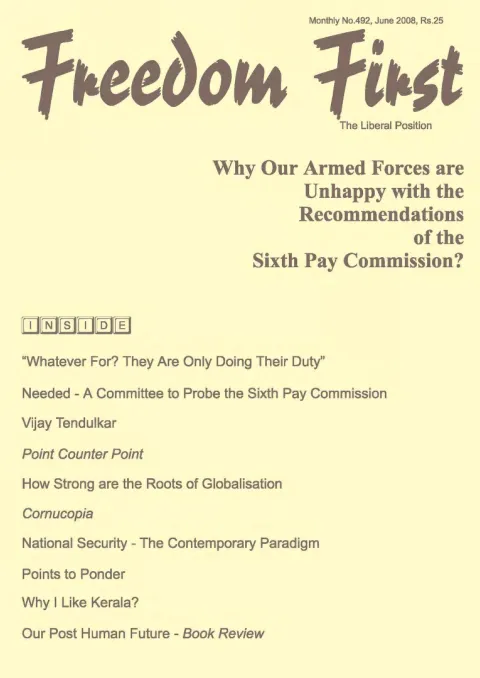
Freedom First
The Liberal Position
Published by J. R. Patel for the Indian Committee for Cultural Freedom (ICCF), 3rd Floor, Army & Navy Building, 148, Mahatma Gandhi Road, Mumbai 400 001. Printed by him at Kaiser-E-Hind Private Ltd., Plot No.A-191, Road No.16A, MIDC, Wagle Industrial Estate, Thane (W) - 400 604. · Mumbai · 2006
12 pages
Freedom First
Summary
Sharad Bailur argues that India, having built a strong software industry, should now launch a national nanotechnology initiative modeled on Bill Clinton’s 2000 US National Nanotechnology Initiative. He explains the concept of molecular manufacturing (citing Ralph Merkle of Zyvex), traces its lineage from Feynman’s 1959 ‘Plenty of Room at the Bottom’ speech through the scanning tunneling microscope to buckytube ‘tweezers’ capable of atomic-precision manipulation, and speculates about a post-scarcity future in which the ‘Assembler’ could replicate any object from atoms, ending the economic problem of scarce means and unlimited ends. He also warns of the technology’s dual-use dangers (nano-weapons deployed ‘for kicks’) and urges India’s Prime Minister, IITs, and firms like Infosys to take up molecular engineering seriously before Japan, China, Taiwan, Singapore, and Europe pull further ahead.
Key points
-
Calls for an Indian national nanotechnology initiative modeled on the US 2000 initiative launched under President Clinton
-
Defines nanotechnology/molecular engineering as atomic-scale manipulation, distinct from mere miniaturization
-
Traces the field’s history: Feynman’s 1959 speech, the scanning tunneling microscope, IBM’s atom-scale ‘IBM’ logo, and buckytube tweezers
-
Describes a hypothetical ‘Assembler’ that could replicate any object from atoms, ending scarcity and rendering economics obsolete
-
Flags dual-use risk: nanomachines could be weaponized to ‘tyrannise’ mankind
-
Urges the Indian government, IITs, and companies like Infosys to prioritize molecular engineering research
Generated by the v1.5 extraction pipeline. Awaiting editorial review.
Metadata and summary are AI-extracted from the source PDF and reviewed for editorial accuracy. The original work is available via the Read PDF tab above (where present); paragraph-level citation inside the PDF is deferred to a future engagement.