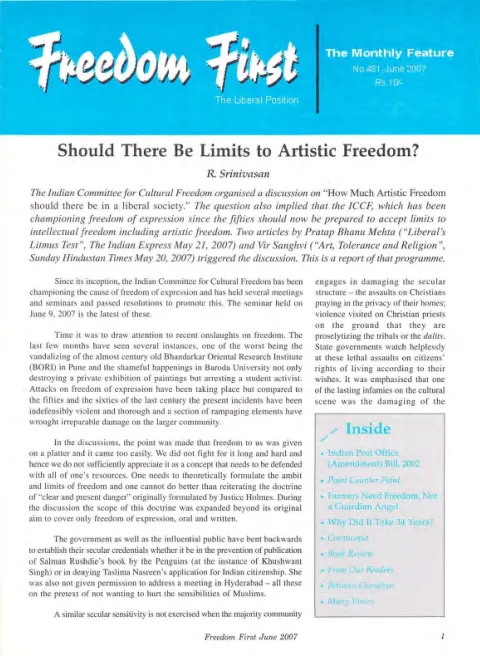
periodical issue
Freedom First
The Liberal Position
By Sharad Joshi
Published by J. R. Patel for the Indian Committee for Cultural Freedom (ICCF) and printed by him at Kaiser-E-Hind Private Ltd., Plot No.A-191, Road No.16A, MIDC, Wagle Industrial Estate, Thane (W) - 400 604. · Mumbai · 2007
12 pages
Freedom First
Summary
Freedom First No. 478 (March 2007) is the monthly magazine of the Indian Committee for Cultural Freedom, edited by S. V. Raju. The issue’s featured piece, based on a half-day discussion sponsored by the magazine, examines discipline and morale in the Indian Army against a backdrop of procurement scandals, Kargil-era grievances, and rising appeals to civilian courts. A second lead article argues that the government’s decision to pull wheat and paddy out of futures trading was a populist misstep that hurts farmers by denying them price discovery and forward-selling tools. The rest of the issue carries the magazine’s regular columns: a point-counterpoint on civic elections, the Afzal Guru case, and cricket match-fixing; a column on gender roles prompted by a viral wedding-ceremony incident; a satirical column on the Quattrocchi extradition affair and the Samjhauta Express bombing; the first installment of a three-part book review of an edited volume of women’s personal narratives; reader letters; and the editor’s note and press-clippings column that close the issue.
Key points
-
Freedom First No. 478 (March 2007) features a discussion on discipline and morale in the Indian Army, and a second essay on agricultural futures trading.
-
Brig. S. C. Sharma surveys procurement scandals, Kargil-era grievances, and rising court appeals over postings, arguing these reflect India’s litigious culture rather than genuine indiscipline, and faults Nehru-era governments for never implementing an Army Council-style grievance mechanism.
-
Sharma defines morale as decisive but unmeasurable, citing political interference, poor pay, and confused counter-insurgency signalling as threats, and calls for compulsory military service if volunteer numbers keep falling.
-
Sharad Joshi’s “Why Futures are Farmer Friendly” argues the government’s ban on wheat and paddy futures trading, announced the day after farmers’ groups planned to sell through a futures exchange, was a populist move that cornered farmers into low Food Corporation of India procurement prices.
-
Joshi cites government inflation data showing non-futures-traded food items rose comparably or more than futures-traded ones, arguing this refutes the claim that futures trading drives price rises.
Essays
Discipline and Morale in the Indian Army
By S. C. Sharma
Brig. (Retd) S. C. Sharma surveys a string of controversies — procurement irregularities, alleged dereliction during Kargil, court appeals over postings and promotions, and violence against superior officers — and asks whether they signal a broader decline in Indian Army discipline. He argues they do not: rising litigation reflects an Indian-specific rush to the courts rather than systemic unfairness, and he contrasts this with figures like Field Marshal Wavell who accepted being eased out without protest. He faults Nehru-era governments for promising but never delivering a grievance-redressal mechanism akin to the UK Army Council. Turning to morale, he argues it is a decisive but unmeasurable force, invoking Tolstoy, Napoleon, and the Afghan Mujahiddin’s assessment of Indian soldiers versus Soviet forces, and lists judgment, enthusiasm, and confidence in leadership and weapons as its indicators. He closes by blaming political interference, poor pay and procurement, and confused counter-insurgency signaling (citing Tamil Nadu’s stance toward the LTTE and Andhra’s toward Naxalites) for eroding morale, and calls for compulsory military service if volunteer numbers keep falling.
- Surveys recent Army controversies (Barak missile/coffin procurement inquiry, Kargil dereliction allegations, court appeals over postings/promotions, violence against officers) and asks if they indicate systemic rot.
- Argues the rise in court appeals reflects a uniquely Indian rush to litigation, not an unfair military justice system; cites Wavell’s quiet acceptance of being eased out as contrast.
- Criticizes Nehru for promising Army Council-style grievance reform after the Thimayya resignation debate but never implementing it.
- Defines morale as decisive and unmeasurable, drawing on Tolstoy, Napoleon, Field Marshal Ayub Khan’s directive about Indian troops, and Afghan Mujahiddin views of Indian soldiers versus Soviet gunships.
- Blames the Assam Rifles/Manipur episode’s mistaken attribution to Army discipline on the Ministry of Defence’s poor communication.
- Cites political interference, inadequate pay/procurement, and mixed signals during counter-insurgency (Tamil Nadu-LTTE, Andhra-Naxalites) as morale threats.
- Calls for compulsory military service if the Army cannot attract enough volunteer officers.
Why Futures are Farmer Friendly
By Sharad Joshi
Sharad Joshi, founder of Shetkari Sanghatana, argues that the government’s decision to remove wheat and paddy from futures trading — announced the day after farmers’ organisations said they planned to sell through a futures exchange — was a reactive, populist move that hurts the very farmers it claims to protect. He contends the massive wheat imports blamed on private-trader competition had actually been decided earlier for unrelated reasons, and that the ban, combined with instructions barring private traders and railway wagons from competing with the Food Corporation of India, left farmers with no option but to accept the FCI’s low procurement price. Joshi explains how futures markets let farmers get price advances, use warehousing receipts, and access price discovery via the internet, and cites government data showing that non-futures-traded food items (jowar, bajra, moong, etc.) saw comparable or higher inflation than futures-traded ones (wheat, maize, gram), arguing this refutes the claim that futures trading drives price rises.
- Government banned futures trading in wheat and paddy the day after farmers’ groups announced plans to sell through a futures exchange — Joshi calls this no coincidence.
- Argues the year’s large wheat imports were decided earlier and were wrongly blamed on private-trader competition and inflation politics after Congress’s poor showing in Punjab/Uttarakhand polls.
- Describes how private traders and railway wagons were informally blocked from competing with the FCI, cornering farmers into low FCI procurement prices.
- Explains mechanics of futures trading for farmers: warehousing receipts, 70-75% price advances, and internet-based price discovery across spot and futures prices.
- Cites Economic Adviser data: non-futures items (jowar, bajra, moong, fruit, coriander, tea, coffee) rose 9.6-35.7%, while futures-traded items (wheat, maize, gram, urad, pepper, chillies) rose 14.5-61.3%, arguing this undercuts the theory that futures trading causes inflation.
- Predicts farmers’ organisations will retaliate by boycotting FCI procurement, making for a contentious wheat season.
Generated by the v1.5 extraction pipeline. Awaiting editorial review.
Metadata and summary are AI-extracted from the source PDF and reviewed for editorial accuracy. The original work is available via the Read PDF tab above (where present); paragraph-level citation inside the PDF is deferred to a future engagement.