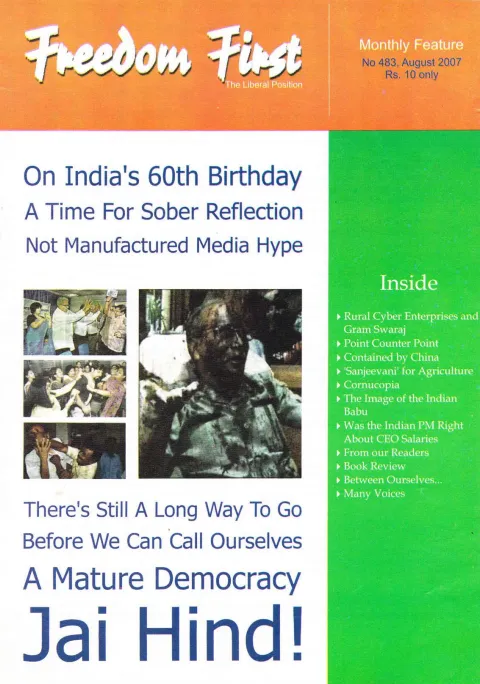
periodical issue
Freedom First
The Liberal Position
By Sharad Joshi
Published by J. R. Patel for the Indian Committee for Cultural Freedom (ICCF) and printed by him at Kaiser-E-Hind Private Ltd., Plot No.A-191, Road No.16A, MIDC, Wagle Industrial Estate, Thane (W) - 400 604. Publishers: Indian Committee for Cultural Freedom (ICCF), 3rd Floor, Army & Navy Building, 148, Mahatma Gandhi Road, Mumbai 400 001. · Mumbai · 2007
12 pages
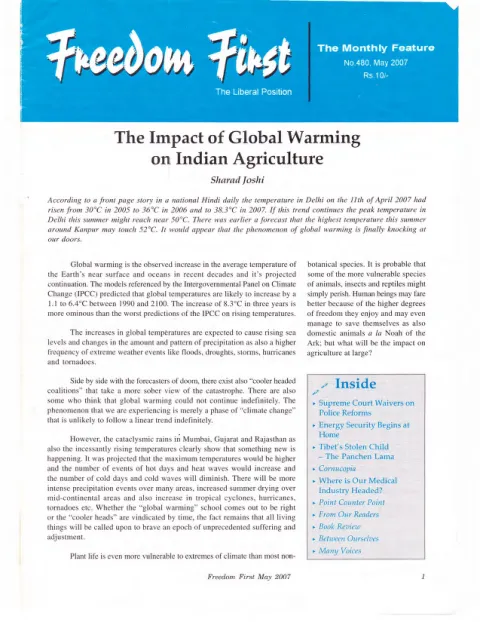
Freedom First
Summary
Freedom First No. 480 (May 2007) is a monthly issue of the Bombay-based liberal magazine, opening with a cover feature by Sharad Joshi on the threat global warming poses to Indian agriculture, food security and livestock. The rest of the issue ranges across the magazine’s usual mix of policy commentary and opinion: Nitin Pai argues India’s energy security lies in domestic port and pipeline infrastructure rather than the Iran-Pakistan-India gas pipeline; Shibayan Raha reports on the twelfth anniversary of the Chinese state’s abduction of the Panchen Lama; a Supreme Court report tracks the stalled implementation of police reform directives; Firoze Hirjikaka’s ‘Cornucopia’ column excoriates political interference in universities and a lenient hit-and-run verdict; Kusum Choppra critiques the neglect of rural healthcare amid a corporatising medical industry; Ashok Karnik’s ‘Point Counter Point’ debates public-morality policing and official propriety; and the issue closes with reader letters, the concluding third part of a review of ‘A Space of Her Own’ (personal narratives of twelve women), and the regular ‘Between Ourselves’ editorial note and ‘Many Voices’ press-quote roundup.
Key points
-
Freedom First No. 480 (May 2007) leads with Sharad Joshi’s essay on global warming’s threat to Indian agriculture, citing Delhi’s peak temperature reportedly rising from 30°C in 2005 to 38.3°C in 2007.
-
Joshi criticises the Supreme Court’s stay on GMO trials for blocking Indian-developed drought- and salinity-resistant crops, and warns crossbred dairy cattle and food processing face mounting climate strain.
-
Nitin Pai argues India’s energy security lies in domestic port and pipeline infrastructure rather than the Iran-Pakistan-India gas pipeline, which would route gas through Baloch-contested territory and hand Pakistan a bargaining chip.
-
Shibayan Raha recounts the 1995 disappearance of the 11th Panchen Lama, Gendhun Choekyi Nyima, three days after the Dalai Lama’s recognition, and renews calls for his release now that he has turned 18.
-
An unsigned report tracks stalled compliance with the Supreme Court’s Prakash Singh police-reform directives, finding only 11% of states fully compliant.
-
Firoze Hirjikaka’s “Cornucopia” condemns the lenient sentence in the Alistair Pereira hit-and-run case and political interference shielding a university vandal, while Kusum Choppra critiques the corporatisation of Indian healthcare at rural healthcare’s expense.
-
The editor’s note frames Mayawati’s 2007 Uttar Pradesh victory as a potential shift away from decades of caste- and religion-based political mobilisation.
Essays
The Impact of Global Warming on Indian Agriculture
By Sharad Joshi
Sharad Joshi’s cover essay argues that global warming has already begun affecting India, citing a reported jump in Delhi’s peak April temperature from 30°C (2005) to 38.3°C (2007) as evidence that change is outpacing even IPCC projections. He surveys likely impacts on Indian agriculture: foodgrain cultivation shifting toward temperate zones, extinction risk for heat- or cold-intolerant plant varieties, strain on crossbred dairy cattle and fisheries, and the collapse of cold storage and food processing under higher temperatures. He is sharply critical of institutional unpreparedness — the ICAR’s failure to develop climate-resilient crop varieties, the Supreme Court’s stay on new GMO trials blocking Indian innovators in drought- and salinity-resistant genes, and the government’s general lack of a coordinated response comparable to its slow uptake of tsunami preparedness.
- Delhi’s peak temperature reportedly rose from 30°C in 2005 to 38.3°C in 2007, a rate the author says exceeds IPCC worst-case projections.
- Global warming is expected to shift foodgrain cultivation toward temperate regions, potentially making India import-dependent again.
- Plant and animal species unable to tolerate temperature/rainfall extremes face extinction risk within a decade if trends continue.
- The Supreme Court’s stay on new GMO trials has blocked Indian-developed drought- and salinity-resistant crop varieties while one multinational and one Indian firm retain approved anti-bollworm varieties.
- Crossbred dairy cattle (Jersey, Holstein Friesian) already require artificial cooling in moderate summers, threatening India’s crossbreeding programme.
- Food processing and cold storage industries face a paradox: more refrigeration to cope with heat means more greenhouse gas emissions and worse warming.
- Agricultural extension services are described as being in a state of collapse, per the finance minister’s own budget speech admission.
Energy Security Begins at Home
By Nitin Pai
This unsigned report tracks the decade-long Prakash Singh v. Union of India litigation on police reform. It notes the Supreme Court’s 22 September 2006 order directing the Centre and states to implement reform mechanisms within three months, the poor compliance shown in states’ affidavits (only 11% fully compliant, 40% non-compliant, 46% partially compliant), and the Court’s surprising decision on 9 April 2007 to allow further review applications despite its earlier no-extension stance — a shift the piece frames as risking dilution of the original judgment.
- Two retired Directors General of Police filed the original 1996 PIL, known as Prakash Singh v. Union of India.
- The Supreme Court ordered police reform mechanisms on 22 September 2006, giving three months for compliance.
- State affidavits showed only 11% total compliance, 40% non-compliance, and 46% partial compliance.
- On 9 April 2007 the Court agreed to hear review/extension applications, reversing its earlier firm no-extension stance of 11 January.
- Maja Daruwala of the Commonwealth Human Rights Initiative is quoted warning that without continued Court monitoring, reform will not happen.
Tibet’s Stolen Child – The Panchen Lama
By Shibayan Raha
Nitin Pai argues that Petroleum Minister Mani Shankar Aiyar was right to prioritize energy security but wrong to tie it to the Iran-Pakistan-India (IPI) gas pipeline, which routes gas through Pakistani-controlled (and Baloch-contested) territory and hands Islamabad a bargaining chip over India. He argues the durable solution is domestic: state-of-the-art ports with integrated oil and gas processing terminals on India’s West Coast, connected by pipelines and highways to major cities, letting India import from multiple vendors via LNG shipping rather than a single pipeline monopoly. This, he argues, requires no diplomatic negotiation with Iranian, Pakistani, or American counterparts, only domestic infrastructure and market mechanisms.
- The IPI pipeline crosses Balochistan, an area of active rebellion where Pakistan has only nominal control.
- Pakistan would earn roughly US$500 million in transit fees while gaining leverage over India’s energy jugular.
- The Bush administration and US Congress have opposed the IPI project over Iran’s nuclear programme.
- A proposed alternative: West Coast ports with integrated oil/gas terminals feeding domestic pipelines and highways, enabling LNG imports from multiple countries.
- A study by American analyst Roger Stern is cited suggesting Iran may be unable to deliver all the gas it has contracted to sell.
- The piece argues energy security requires only domestic infrastructure and market mechanisms, not negotiation with foreign governments.
s initial denial and later admission (1996) that it held the boy and his family in
Shibayan Raha recounts the 1995 disappearance of six-year-old Gendhun Choekyi Nyima, recognized by the Dalai Lama as the 11th Panchen Lama, three days after his recognition, and the Chinese government’s installation of its own choice, Gyaltsen Norbu, as a rival Panchen Lama. Raha describes China’s initial denial and later admission (1996) that it held the boy and his family in ‘protective custody,’ the 1998 refusal to grant UN Human Rights Commissioner Mary Robinson access to him, and calls for his release now that he has turned 18 in April 2007 and is legally no longer a minor requiring state ‘protection.’
- Gendhun Choekyi Nyima was recognized as the 11th Panchen Lama by the Dalai Lama on May 14, 1995, at age six.
- He and his family disappeared three days later and have not been seen since, making him the youngest political prisoner in the world.
- China installed its own choice, Gyaltsen Norbu (son of a Tibetan Communist Party official), as a rival Panchen Lama in December 1995.
- China admitted in 1996 to holding the family in ‘protective custody’ but has denied all access requests, including to UN Human Rights Commissioner Mary Robinson in 1998.
- The Panchen Lama turned 18 on April 25, 2007, prompting renewed calls for his release.
- A footnote records that the author and fellow activist Migmar Tsering were arrested on April 9, 2007 while attempting to storm the Chinese Embassy in New Delhi.
Cornucopia (“An Inoperable Cancer” and “Yet Another Travesty of Justice”)
By Firoze Hirjikaka
Firoze Hirjikaka’s ‘Cornucopia’ column runs two short pieces. ‘An Inoperable Cancer’ argues that political patronage has corroded Indian institutions beyond redemption, citing police corruption, a vandalized Gujarat art exhibition where the vandal was let off while the vandalized was blamed, and politically appointed university heads shielding a vandal rather than students. ‘Yet Another Travesty of Justice’ condemns the lenient sentence given to Alistair Periera in a hit-and-run case that killed seven labourers, arguing that in India ‘the value of a human life is directly proportional to the financial worth of the individual concerned.’
- A Mumbai survey found over 85% of citizens distrust local police, approaching them only as a last resort.
- A BJP ‘activist’ who vandalized a Gujarat Faculty of Fine Arts exhibition went unpunished while the vandalized exhibitors were pressured to apologize.
- University vice-chancellors are described as political appointees prioritizing patrons over students.
- The Alistair Periera hit-and-run case (seven labourers killed) resulted in a light sentence, which the column attributes to money ‘talking’ through a conveniently glasses-less RTO officer.
- The column argues Indian justice effectively prices human life according to the offender’s wealth.
Where is Our Medical Industry Headed?
By Kusum Choppra
Kusum Choppra critiques the direction of India’s medical industry, arguing that five-star corporate hospitals catering to medical tourists are thriving while public and rural healthcare atrophy. She recounts two anecdotes of young doctors gaming mandatory rural postings — checking in only nominally while pulling strings to transfer closer to cities — and argues the resulting neglect of rural patients, combined with rising corporate healthcare costs, is pushing the poor back onto unregulated home remedies and quack medicine.
- Corporate five-star hospitals are drawing medical tourists while public hospitals decline.
- Two anecdotes describe young doctors nominally fulfilling mandatory rural service requirements without actually treating patients.
- The author argues neither doctor used the rural posting opportunity to study or address real rural health problems.
- Middle classes, the poor, senior citizens, and villagers are described as the ultimate losers as public hospitals decline.
- Rising corporate medical costs are pushing patients back toward home remedies and unregulated quacks.
Point Counter Point (“Public Morality” and “Officers and Gentlemen”)
By Ashok Karnik
Ashok Karnik’s recurring ‘Point Counter Point’ column stages both sides of two debates. On ‘Public Morality,’ one side defends police crackdowns on public displays of affection and rave parties as protecting social decency, while the other warns against ceding moral guardianship to an already unaccountable police force. On ‘Officers and Gentlemen,’ one side argues officials should be judged only by legal compliance (defending the Maharashtra DGP’s property acquisitions since he disclosed them), while the other laments the lost propriety of an era when officials like C. D. Deshmukh avoided even the appearance of conflicts of interest.
- One side of the ‘Public Morality’ debate supports police action against PDA and rave parties as necessary to protect social decency.
- The counter-view warns that an unaccountable police force should not be given expanded moral-policing powers.
- The Thane Police Commissioner’s softer approach (asking offenders to be conscious of others rather than treating them as criminals) is cited approvingly.
- The ‘Officers and Gentlemen’ debate uses the Maharashtra DGP property controversy to contrast legal compliance against a lost ethic of propriety.
- C. D. Deshmukh’s refusal to let his lawyer brother take Finance Ministry cases is cited as a historical example of propriety.
From Our Readers
The letters section carries three reader contributions: M. A. Rane praises Khushwant Singh’s support for Taslima Nasreen’s residency request in India and his backing of her call for Muslim women to discard the burkha; B. P. Rastogi comments on a review of ‘Religion, Power and Violence’ by S. H. Deshpande, arguing all religions and cultures are subject to ongoing evolutionary change; and Jyotibhai Desai and Hina Manerikar debate whether Freedom First should use plastic or recycled paper envelopes.
- M. A. Rane praises Khushwant Singh’s column supporting Taslima Nasreen’s request for permanent Indian residency and her call for Muslim women to discard the burkha.
- B. P. Rastogi responds to a review of ‘Religion, Power and Violence,’ arguing religions and cultures are all subject to slow evolutionary change.
- Two letters debate the environmental merits of plastic versus recycled-paper envelopes for mailing the magazine.
Book Review: A Space of Her Own: Personal Narratives of Twelve Women, edited by Leela Gulati and Jasodhara Bagchi (Part III, concluded)
By Dhiren Narain
This is the third and concluding part of Dhiren Narain’s extended review of ‘A Space of Her Own: Personal Narratives of Twelve Women’ (ed. Leela Gulati and Jasodhara Bagchi). Narain summarizes several of the volume’s personal narratives: Vina Mazumdar’s aunt (Pishima), who left an unexplained marriage at 14 and became a champion of female education; the wife-abuse recounted by Mary Roy (Arundhati Roy’s mother) and her decades-long legal battle for daughters’ inheritance rights against Syrian Christian law; and Leela Gulati’s account of her own mother’s difficult, itinerant confinements and eventual life in the USA and West Indies. Narain closes by praising the volume’s Introduction and Afterword (‘The Colonised Coloniser’) and appends a short retelling of Phaneendranath Renu’s story ‘Samvadiya.’
- The review covers narratives including Vina Mazumdar’s aunt (Pishima), a pioneering advocate of female education who left her marriage at 14.
- Mary Roy’s account describes her father’s violent wife-beating and her own long legal battle, ultimately reaching the Supreme Court, to establish daughters’ inheritance rights under Syrian Christian law; the review identifies her as Arundhati Roy’s mother.
- Leela Gulati’s narrative describes her mother’s difficult confinements, sense of resentment and dependence, and eventual settled life split between the USA and Trivandrum.
- Mary Roy is noted as having founded a kindergarten in Kerala that has run for 35 years and is considered one of the best schools in India.
- The reviewer praises the book’s Introduction and its Afterword, ‘The Colonised Coloniser,’ as masterful and insightful.
- The review closes with a retelling of Phaneendranath Renu’s story ‘Samvadiya’ about a poverty-stricken woman’s message to her affluent brothers.
Between Ourselves …
By Editor
The editor’s ‘Between Ourselves’ note discusses the significance of Mayawati’s BSP victory in the 2007 Uttar Pradesh assembly election as a possible shift from divisive caste/religious politics toward a broader social coalition, and previews upcoming issues (the June lead story on the UP result, and a July cover story on India-China relations).
- The editor frames Mayawati’s UP victory as a potential milestone in India’s democratic evolution, breaking from decades of caste- and religion-based political mobilization.
- Readers are invited to submit their interpretations of the UP result by June 10 for the June lead story.
- The July issue’s cover story is previewed as ‘India-China relations: China: Friend or Foe?‘
Many Voices
The ‘Many Voices’ column reprints short press quotations on current issues from several commentators: Kuldip Nayar on criminals and money dominating elections; Varsha Kale on bar girls’ right to perform during campaigns; Salman Rushdie on the danger of self-censorship; a satirical remark on euthanasia debates; and a quip on India’s GDP growth rate. It closes with a cartoon by Unny on the 150th anniversary of the 1857 uprising and MPs/MLAs implicated in human trafficking.
- Kuldip Nayar is quoted (Janata, April 22) on criminals, casteists and money-bags gaining ground in Indian elections.
- Varsha Kale, president of the Bharatiya Bar Girls Union, argues bar girls should be allowed to perform legitimately during election campaigns.
- Salman Rushdie is quoted warning against self-censorship out of fear.
- A cartoon by Unny juxtaposes the 150th anniversary of the 1857 freedom struggle with contemporary allegations of MPs/MLAs involved in human trafficking.
Generated by the v1.5 extraction pipeline. Awaiting editorial review.
Essay 11
No summary was extracted for this article. Listed for completeness.
Metadata and summary are AI-extracted from the source PDF and reviewed for editorial accuracy. The original work is available via the Read PDF tab above (where present); paragraph-level citation inside the PDF is deferred to a future engagement.