periodical issue
Freedom First
The Liberal Position
Edited by S. V. Raju
Published by J. R. Patel for the Indian Committee for Cultural Freedom (ICCF) and printed by him at Kaiser-E-Hind Private Ltd., Plot No.A-191, Road No.16A, MIDC, Wagle Industrial Estate, Thane (W) - 400 604. · Mumbai · 2008
16 pages
Freedom First
Summary
Freedom First No. 490 (March 2008) is the monthly issue of the Bombay-based liberal periodical, published under the Indian Committee for Cultural Freedom with S. V. Raju as editor and R. Srinivasan as associate editor. The issue opens with an unsigned front-page editorial, “Tibet Will Be Free,” invoking the fall of the Berlin Wall and the magazine’s own 1959 editorial stance to argue that the Chinese occupation of Tibet cannot endure, followed by a tribute to the late Justice H. R. Khanna for his lone dissent in the 1976 ADM Jabalpur habeas corpus case. Contributors across the issue address domestic politics (migration and the Raj Thackeray-driven Mumbai backlash, corruption, TV advertising regulation), international affairs (Obama-mania in the US primaries, the passing of General Suharto, elections in Pakistan), and recurring cultural/institutional features (a Holi-themed instalment of the “Rites, Rituals and Festivals” series, a book review of a Marathi satyagraha history, an obituary for Radical Humanist thinker Sibnarayan Ray, reader letters, and press-quote round-ups). The volume’s argumentative center is a consistent classical-liberal/anti-authoritarian stance: hostility to communist and dictatorial regimes (China, the old Soviet Union, Suharto’s Indonesia), suspicion of both mob politics and unaccountable state power in India, and support for individual liberty, free expression, and constitutional restraint.
Key points
-
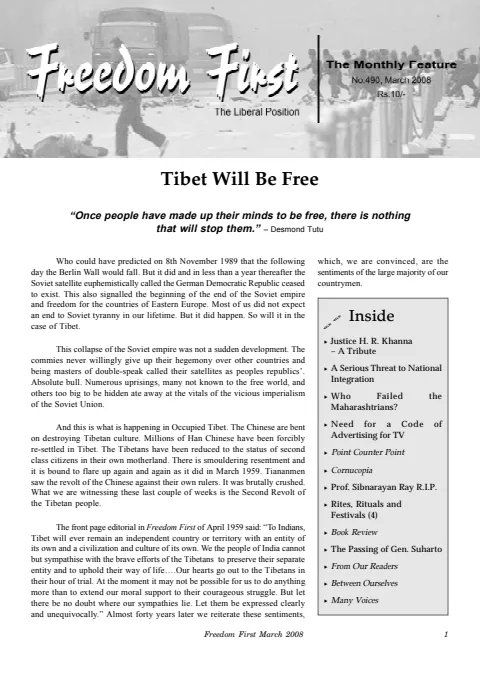
The unsigned front-page editorial “Tibet Will Be Free” compares the 2008 Tibetan unrest to the unforeseen collapse of Soviet hegemony after 1989, accuses China of demographic engineering through Han resettlement, and reaffirms the magazine’s own 1959 editorial pledge of solidarity with Tibetans.
-
An unsigned tribute marks the death of Justice H. R. Khanna, recalling his lone dissent in the 1976 ADM Jabalpur case upholding habeas corpus rights during the Emergency, his resulting supersession for the Chief Justiceship, and his authorship of the Constitution’s ‘basic structure’ doctrine.
-
Mohan Dharia and M. D. Kini both examine the Raj Thackeray-Abu Azmi migrant confrontation as a symptom of Maharashtra’s governance failure rather than migrant opportunism, tracing the state’s decline from Y. B. Chavan’s era and calling for decentralised rural development and respect for citizens’ constitutional right to migrate freely.
-
Kunwar Sinha argues for a formal UK-style Code of Advertising for Indian television, contrasting India’s unregulated ad-saturated broadcasting, including on Doordarshan, with Britain’s Advertising Standards Authority and Ofcom regime.
-
Ashok Karnik’s “Point Counter Point” debates the Thackeray-driven Mumbai backlash, the spread of corruption following the Dr. Horror kidney-transplant scandal, and the significance of Pakistan’s 2008 elections.
-
Firoze Hirjikaka’s “Cornucopia” criticises Indian media for amplifying fringe protest groups such as the Rajput Karni Sena over the film ‘Jodha Akbar,’ and faults state governments for letting such groups dictate terms, drawing a parallel to the MNS’s anti-migrant violence.
-
An unsigned piece offers a skeptical view of Obama-mania in the US primaries, questioning his foreign-policy readiness, alongside Taslima Nasreen’s first-person account of months of confinement and pressure to leave India.
-
Suman Oak’s “Rites, Rituals and Festivals” instalment on Holi traces its mythological origins and proposes ecological reforms to the bonfire tradition, while an obituary remembers Radical Humanist thinker Sibnarayan Ray, a close associate of M. N. Roy’s movement.
-
R. Srinivasan’s piece on the death of General Suharto brands him a ‘kleptomaniac and mass murderer’ responsible for hundreds of thousands of killings and decades of family enrichment, comparing his impunity to Pinochet, Stroessner, and Pol Pot, while Prof. V. C. Phadke reviews a book on the 1930 Chirner Jungle Satyagraha.
Essays
Tibet Will Be Free
The unsigned front-page editorial, “Tibet Will Be Free,” draws a parallel between the unexpected collapse of the Soviet empire after the fall of the Berlin Wall in 1989 and the ongoing unrest in Chinese-occupied Tibet in March 2008, which it calls the “Second Revolt” of the Tibetan people after 1959. It accuses China of demographic engineering through Han resettlement and reduction of Tibetans to second-class status, and reprints Freedom First’s own April 1959 editorial pledging moral solidarity with Tibetans, reaffirming that stance “almost forty years later.”
- Compares the unforeseen 1989-91 collapse of Soviet hegemony in Eastern Europe to the current unrest in Tibet
- Calls the March 2008 Tibetan protests the ‘Second Revolt’ following the 1959 uprising
- Accuses China of forced Han Chinese resettlement reducing Tibetans to second-class citizens
- Reprints and reaffirms the magazine’s own April 1959 editorial pledge of moral support for Tibetan independence
- Frames Chinese rule in Tibet as a continuation of ‘vicious imperialism’
Freedom First Salutes Justice H. R. Khanna
This unsigned tribute marks the death of Justice H. R. Khanna on 25 February 2008, recalling his lone dissent in the April 1976 Supreme Court ruling (four to one) that upheld the government’s power under MISA to deny habeas corpus to detainees during the Emergency. It recounts that Khanna knowingly sacrificed his succession to the Chief Justiceship by writing the dissent, was passed over in favour of Justice M. H. Beg, and resigned within minutes of the supersession. The piece also credits Khanna as the author of the ‘basic structure’ doctrine from the Kesavananda Bharati case, and closes with a New York Times editorial and a Hindu column praising his courage.
- Justice H. R. Khanna dissented alone (4-1 majority) in the April 1976 ruling that MISA detainees could not seek habeas corpus during the Emergency
- Chief Justice A. N. Ray held that ‘liberty is confined and controlled by law,’ which Khanna’s dissent rejected
- Khanna was superseded for the Chief Justice post (given to Justice M. H. Beg) and resigned immediately after
- Khanna is credited as author of the ‘basic structure of the Constitution’ doctrine from the Kesavananda Bharati case
- Justice Khanna died on 25 February 2008 at age 95; his portrait hangs in Court No. 2 of the Supreme Court
A Serious Threat to National Integration
By Mohan Dharia
Mohan Dharia, a former Union cabinet minister and deputy chairman of the Planning Commission, writes on the Raj Thackeray-Abu Azmi confrontation as symptomatic of a deeper migration and governance crisis. He argues that poverty, not opportunism, drives migration from poor states to cities like Mumbai, faults successive Maharashtra governments (post-Y. B. Chavan) for lacking vision, and calls for decentralised rural development, watershed management of wasteland, and respect for the constitutional right of any citizen to move anywhere in India.
- Frames the Thackeray-Azmi confrontation as a threat to national integration rather than a legitimate local grievance
- Attributes migration to poverty and lack of local employment, not disloyalty to Maharashtra
- Criticizes the Shiv Sena-BJP state government for building only flyovers and highways rather than public transport or broad-based development
- Proposes reclaiming India’s ~50% degraded/wasted land through water conservation and watershed management to generate local employment
- Insists on the citizen’s fundamental right to migrate to any part of India, calling for ‘patriotic spirit, tolerance and mature thinking’
Who Failed the Maharashtrians?
By M. D. Kini
M. D. Kini, a freelance writer, asks who is responsible for Maharashtra’s economic and social decline, tracing it from Y. B. Chavan’s early industrial vision through subsequent governments’ promotion of water-intensive sugar and cotton monopolies, and the Shiv Sena-BJP government’s narrow focus on flyovers and elite schools. He argues that industrial growth in Maharashtra owed more to Communist trade unions driving industry out of West Bengal than to state policy, and concludes that poor governance and vote-bank politics based on caste rather than vision are the deeper cause of migration-driven unrest, not migrant workers themselves.
- Traces Maharashtra’s industrial decline from Y. B. Chavan’s vision to successors’ lack of one
- Blames sugar and cotton monopoly policies for depleting water resources and impoverishing farmers, citing Vidarbha as an example
- Credits Communist trade unions in West Bengal (rather than Maharashtra state policy) for driving industry to Maharashtra
- Faults the Shiv Sena-BJP government for prioritising flyovers and elite schools over public transport and broad education
- Argues that politicians (in Maharashtra, UP and Bihar alike) rather than migrant workers are responsible for lack of jobs and development
Need for a Code of Advertising for TV
By Kunwar Sinha
Kunwar Sinha, a documentary producer trained at the BBC, argues for a formal Code of Advertising for Indian television, contrasting the unregulated, ad-saturated state of Indian TV (including Doordarshan, despite its public-service charter) with the UK’s Advertising Standards Authority and Ofcom regime. He outlines detailed UK-style rules on advertising time limits, natural break placement, separation of programme content from advertising, and restrictions on personalities appearing in both ads and adjacent programming, and closes with a personal, wry account of boycotting over-advertised products.
- Criticizes Indian TV, including Doordarshan, for excessive and poorly regulated advertising despite Doordarshan’s original public-service charter
- Cites UK ad spend regulation (max ~9 minutes/hour average, 12 minutes/hour cap, no more than four breaks per hour)
- Describes UK’s dual regulatory model: the self-regulating Advertising Standards Authority and the independent statutory Ofcom
- Calls for a similar strong, independent (non-governmental) advertising watchdog body in India
- Notes Indian channels routinely violate rules like keeping personality-linked ads out of adjacent relevant programming (e.g., cricket)
Point Counter Point
By Ashok Karnik
Ashok Karnik’s recurring “Point Counter Point” column presents paired, dialectical viewpoints on three current issues: the Raj Thackeray/MNS-driven backlash against North Indian migrants in Mumbai (dubbed “Politics of the Narrow Mind”), the pervasiveness of corruption across Indian institutions following the Dr. Horror kidney-transplant scandal (“Corruption — A Way of Life?”), and the significance and fragility of the 2008 Pakistani elections. Each topic is argued from two opposing angles without a final editorial verdict, consistent with the column’s stated aim of presenting all sides before a reader forms a considered opinion.
- Frames the Thackeray-driven Mumbai backlash as either a legitimate ‘sons of the soil’ grievance about infrastructure strain or an opportunistic, dangerous attack on culturally cohesive migrant communities
- Uses the Dr. Horror organ-transplant racket and Delhi police collusion as an entry point to argue corruption has spread system-wide, requiring police reform as a starting point
- On Pakistan’s 2008 elections, weighs the achievement of a relatively fair vote against fears that the Zardari-Sharif understanding is fragile and that any new government will be as constrained by militancy and US pressure as Musharraf was
- Column format deliberately withholds a single conclusion, instead laying out both sides of each debate
- Includes reader-contributed sidebars (Lin Yutang epigraph, Aruna Roy quote) reinforcing the anti-corruption and anti-cant themes
Cornucopia: Media-Created Monsters
By Firoze Hirjikaka
In his “Cornucopia” column, Firoze Hirjikaka criticizes the Indian media for manufacturing controversy around fringe groups, using the Rajput Karni Sena’s protest against the film “Jodha Akbar” (over a historically disputed claim about Jodha Bai’s marriage) and the earlier Gujarat ban on “Fanaa” (over Aamir Khan’s Narmada dam comments) as examples of media-amplified, socially irrelevant outrage. He argues state governments are complicit by allowing such groups to dictate terms through disruption, citing the MNS’s anti-migrant violence in Mumbai as a parallel case of governmental abdication with real economic and social costs.
- Criticizes Indian media for elevating fringe protest groups (e.g., Rajput Karni Sena over ‘Jodha Akbar’) into disproportionate national controversies
- Cites the Gujarat ban on ‘Fanaa’ over Aamir Khan’s Narmada dam remarks as a similarly manufactured, artistic-license controversy
- Argues historical/artistic distortion in cinema is not new, comparing it to 80 years of similar practice in Hollywood
- Faults state governments for abdicating responsibility by allowing disruptive groups to dictate terms rather than enforcing law and order
- Links this governmental permissiveness to the MNS-led anti-migrant violence in Mumbai as a case with real economic and social damage
Professor Sibnarayan Ray R.I.P.
An unsigned commentary, “An Outsider’s View of Senator Obama Barack,” offers a skeptical, non-American perspective on the 2008 US presidential primary enthusiasm surrounding Barack Obama. The author questions comparisons to JFK, doubts Obama’s foreign-policy substance and readiness to face leaders like Putin, and criticizes American hypocrisy around outsourcing and ‘buying American’ rhetoric, concluding that ‘fresh air alone’ may not be enough given the complexity of world affairs. A short adjoining piece reprints Taslima Nasreen’s own account of being confined and pressured to leave India after living under what she calls virtual house arrest.
- Questions the JFK comparison to Obama, arguing Kennedy’s reputation was inflated partly by his assassination
- Doubts Obama’s foreign policy readiness, contrasting him with the more internationally ‘tested’ Hillary Clinton
- Criticizes American hypocrisy on outsourcing and ‘buying American’ amid cheap imported consumer goods
- Concludes that the ‘anyone but Bush’ mood does not guarantee Obama’s foreign policy will serve broader global interests
- Includes a first-person statement by Taslima Nasreen describing nearly eight months of confinement and pressure by the Indian government to leave the country, which she attributes to vote-bank politics
Rites, Rituals and Festivals (4): Holi - The Festival of Colours
By Suman Oak
An unsigned obituary for Professor Sibnarayan Ray (20 January 1921 - 26 February 2008) profiles the Radical Humanist thinker, educationist, and literary critic, tracing his academic career from Calcutta University through Melbourne University, SOAS, Chicago and Stanford, his editorship of the Bengali journal Jijnasa, and his intellectual debt to M. N. Roy’s Radical Humanist movement, including his multi-volume edition of Roy’s works for Oxford University Press. The piece closes with a Bertrand Russell tribute calling Ray’s point of view important ‘in every part of the world.’
- Sibnarayan Ray (1921-2008) was a Radical Humanist thinker, educationist, philosopher and literary critic, associated with the movement founded by M. N. Roy
- Held academic posts at Calcutta’s City College, Melbourne University (1963-81), SOAS London, University of Chicago, Goethe University Frankfurt, and Stanford
- Edited the Bengali literary/philosophical journal Jijnasa and edited four volumes of M. N. Roy’s works published by Oxford University Press
- Was, at his death, writing a biography of M. N. Roy; earlier published works include the poetry anthology Kothara Tomar Mon (1951)
- Bertrand Russell praised Ray as representing ‘a more reasonable point of view than that of most writers of our time’
Book Review: Chirner Jungle Satyagraha: 1930 by Vasant Bhau Patil
By Prof. V. C. Phadke
Suman Oak continues her ‘Rites, Rituals and Festivals’ series with an installment on Holi, tracing its mythological origins (Kamadeva’s incineration by Shiva, the demon Putana’s death, the Dhondha Rakshasi legend) and describing the ritual bonfire and its accompanying vulgar, licentious customs. She situates Holi within a comparative frame of world spring carnivals (Japan’s Hadaka Matsuri, Italian candle-blowing customs, All Fools’ Day) and closes with a reform-minded call to restrict Holi bonfires, ban forest-cut logs, use dung cakes as fertilizer instead of fuel, and redirect food offerings to the poor, citing the Andhashraddha Nirmoolan Samiti’s constructive Holi model.
- Recounts multiple mythological origin stories for Holi, including Kamadeva’s destruction by Shiva’s third eye and the death of the demon Putana
- Describes the traditional Holi ritual: evening bonfire with dung cakes and wood, followed by a licentious ‘immodest carnival’ the next day
- Draws comparative parallels to Japan’s Hadaka Matsuri, Italian candle-extinguishing customs, and European All Fools’ Day
- Criticizes ecological and social harms: deforestation for bonfire wood, wasted dung cakes, and public health/property damage from excess
- Proposes reforms: restrict bonfire locations/numbers, use dung cakes as fertilizer, distribute food offerings to the poor, and cites the Andhashraddha Nirmoolan Samiti’s practice of building the Holi mound from collected garbage symbolizing social vices
The Passing of Gen. Suharto: A Kleptomaniac and a Mass Murderer
By R. Srinivasan
Prof. V. C. Phadke reviews “Chirner Jungle Satyagraha: 1930” by Vasant Bhau Patil (translated from Marathi by Suhasini Sinha), which documents a 1930 anti-colonial jungle satyagraha in the Kolaba (now Raigad) district village of Chirner, undertaken as part of Gandhi’s non-cooperation movement. The review recounts the killing of a Mamledar by a police officer, the subsequent violent clash between satyagrahis and police, the compromised Jamnadas Mehta inquiry committee, the post-Gandhi-Irwin Pact release of prisoners, and the erection and colonial demolition of a martyrs’ monument, calling the book ‘a must read especially for the younger generation.’ A boxed advertisement follows for S. V. Raju’s biography of Minoo Masani, published by the National Book Trust.
- Reviews ‘Chirner Jungle Satyagraha: 1930’ by Vasant Bhau Patil, translated by Suhasini Sinha, about a 1930 anti-colonial jungle satyagraha in Chirner, Kolaba (Raigad) district
- Recounts a police officer’s killing of a Mamledar and the retaliatory violence between satyagrahis and police
- Notes an independent inquiry committee under Jamnadas Mehta (with members including M. C. Chagla) was barred by the government from entering Raigad district
- Describes the 1931 martyrs’ monument, its 1932 colonial demolition, and 1935 rebuilding by the first provincial government
- Advertises S. V. Raju’s National Book Trust biography of Minoo Masani, tracing his path from Marxism to Liberalism and the rise and decline of the Swatantra Party
From Our Readers
R. Srinivasan, Associate Editor of Freedom First, writes on the death of General Suharto, describing him as a ‘kleptomaniac and mass murderer’ responsible for the killings of 500,000 political opponents in 1965 and 200,000 in East Timor, and for decades of large-scale family enrichment through looting state resources. He situates Suharto’s impunity within a broader pattern of unpunished dictators (Pinochet, Stroessner, Pol Pot, Milosevic) who evaded justice through death, amnesty, or exile.
- Suharto is charged with the killing of 500,000 political opponents in 1965 and 200,000 East Timorese citizens
- Describes decades of Suharto family enrichment (an estimated $1 billion/year, $5.4 billion annually across the family) from transport, mining, agriculture, telecom, media and other sectors
- Notes Suharto received a state funeral attended by dignitaries including Lee Kuan Yew despite his record
- Compares Suharto’s impunity to Pinochet (Chile), Stroessner (Paraguay), Pol Pot, and Milosevic, who each evaded justice through amnesty, exile, or death
- Frames Suharto’s record as among the worst for mass murder, ‘with the exception of Pol Pot’
Generated by the v1.5 extraction pipeline. Awaiting editorial review.
Metadata and summary are AI-extracted from the source PDF and reviewed for editorial accuracy. The original work is available via the Read PDF tab above (where present); paragraph-level citation inside the PDF is deferred to a future engagement.