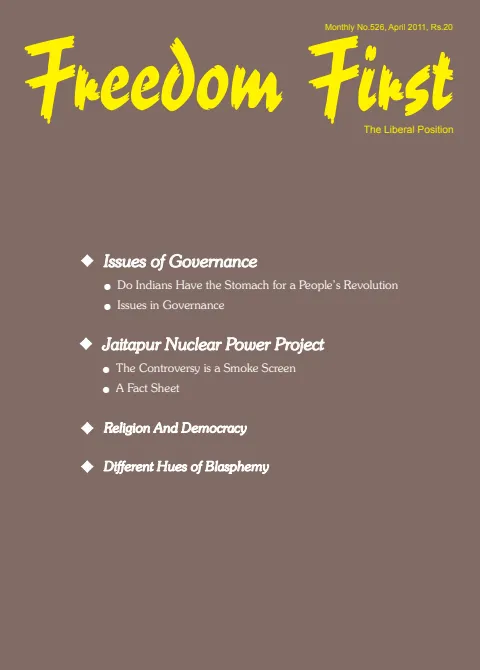
periodical issue
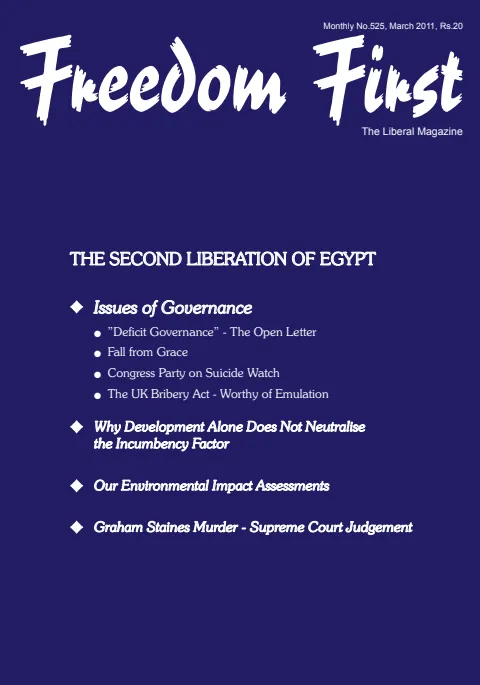
Freedom First
The Liberal Magazine
By Zafar Futehally, Rabindranath Tagore
Published by J. R. Patel for the Indian Committee for Cultural Freedom (ICCF) and printed by him at Union Press, 13 Homji Street, Fort, Mumbai 400 001. · Mumbai · 2011
40 pages
Freedom First
Summary
In the rendered pages, the March 2011 issue of Freedom First frames itself around deteriorating governance, corruption, and democratic accountability in India, while opening with B. Ramesh Babu’s cover essay on Egypt’s popular uprising against Hosni Mubarak. The editor’s note asks whether a liberal magazine needs to rethink its role amid institutional erosion, corruption, crony capitalism, and public disillusionment.
In the rendered pages, the issue moves from the Arab Spring to Indian governance failures: an open letter from concerned citizens on “deficit governance,” articles on political scandals and Congress credibility, and later pieces listed in the contents on development, environmental impact assessments, the Graham Staines judgment, and Rabindranath Tagore. Only the first 20 of 40 PDF pages were rendered, so later articles from page 22 onward are not summarized here.
Key points
-
S. V. Raju’s editorial asks whether Freedom First needs a new paradigm amid deteriorating governance, defining the magazine’s goal as building a liberal society with a liberal temper and warning against accepting institutional erosion as inevitable.
-
B. Ramesh Babu’s cover essay “The Second Liberation of Egypt” reads the 2011 uprising as a second liberation after Nasser’s era, praises the disciplined protestors in Tahrir Square, and contrasts Egypt’s military restraint with Tiananmen Square while warning that toppling a dictator is not enough without democratic institutions.
-
The open letter “On ‘Deficit Governance’: An Open Letter from some concerned Citizens,” signed by prominent figures from business, economics, law and public life, calls for independent regulatory bodies and empowered Lok Ayuktas, linking good governance to poverty alleviation and growth.
-
Firoze Hirjikaka’s “Congress Party On Suicide Watch” argues the Congress party’s half-hearted response to scandals - the Commonwealth Games affair, Suresh Kalmadi, the cabinet reshuffle, A. Raja, foreign black money and P. J. Thomas - is destroying its own credibility.
-
The editorial recalls the magazine’s earlier anti-communist and pro-market educational work while identifying rapidly worsening governance, stagnating reforms and crony capitalism as the present, more urgent problem.
-
The issue’s table of contents also lists later pieces on development, environmental impact assessments, the Graham Staines judgment and Rabindranath Tagore, though these fall outside the rendered pages and are not digested here.
Essays
Between Ourselves
By S. V. Raju
The rendered page’s “Between Ourselves” column asks whether Freedom First should adjust its role in a climate of deteriorating governance. The editor argues that a liberal society requires the rule of law, ethical public life, and resistance to the erosion of institutions rather than fatalistic acceptance of corruption and disorder.
The column recalls earlier anti-communist and pro-market educational work by the magazine but says the present problem is rapidly worsening governance, stagnating reforms, crony capitalism, and the need to ask basic questions about India’s priorities.
- Asks whether Freedom First needs a new paradigm for current circumstances.
- Defines the magazine’s broad objective as developing a liberal society with a liberal temper.
- Warns against accepting institutional erosion as inevitable.
- Contrasts earlier economic reform advocacy with current concerns over governance and crony capitalism.
The Second Liberation of Egypt
By B. Ramesh Babu
In the rendered pages, B. Ramesh Babu reads Egypt’s 2011 uprising as a second liberation after the earlier anti-colonial moment associated with Nasser. He praises the protestors’ discipline in Tahrir Square, the army and police for not crushing the popular will, and the striking contrast with Tiananmen Square.
The essay argues that Egypt’s revolution may inspire unfinished struggles elsewhere in the Arab world, but it also warns that removing a dictator is not enough: history could still produce another authoritarian order unless democratic institutions and liberty take root.
- Praises the peaceful discipline of protestors in Tahrir Square.
- Contrasts Egypt’s military response with Tiananmen Square.
- Places the 2011 uprising in a longer history from Nasser to Mubarak.
- Frames Arab revolts as unfinished revolutions against oppression and poverty.
On “Deficit Governance” An Open Letter from some concerned Citizens
In the rendered pages, the open letter on “deficit governance” presents a group of prominent citizens alarmed by deterioration in public ethics, corruption, discretionary decision-making, and weakened confidence in the state, business, and public institutions. The letter says the authors are not merely joining the outrage over scandals but seeking concrete recommendations for better governance.
The letter calls for restoring public confidence, creating independent regulatory bodies, addressing corruption on a war footing, strengthening Lok Ayuktas, and improving the national environment for growth and poverty alleviation.
- Lists public figures from business, economics, law, and public life as signatories.
- Frames corruption and discretionary decision-making as national governance failures.
- Calls for independent regulatory bodies and empowered Lok Ayuktas.
- Links good governance with poverty alleviation and growth potential.
Congress Party On Suicide Watch
By Firoze Hirjikaka
In the rendered pages, Firoze Hirjikaka argues that the Congress party’s half-hearted response to corruption scandals is destroying its own credibility. The article discusses the Commonwealth Games scandal, Suresh Kalmadi, the cabinet reshuffle, A. Raja, foreign-bank black money, and the P. J. Thomas controversy as examples of a government unable or unwilling to act decisively.
Only the beginning of this article is rendered in the checked pages; its continuation past the visible portion is not summarized here.
- Frames corruption scandals as the main source of public outrage.
- Criticizes Congress for cosmetic gestures rather than decisive action.
- Uses the Commonwealth Games and black-money controversies as examples.
- Argues that delayed action gives opposition parties political ammunition.
Generated by the v1.5 extraction pipeline. Awaiting editorial review.
Metadata and summary are AI-extracted from the source PDF and reviewed for editorial accuracy. The original work is available via the Read PDF tab above (where present); paragraph-level citation inside the PDF is deferred to a future engagement.