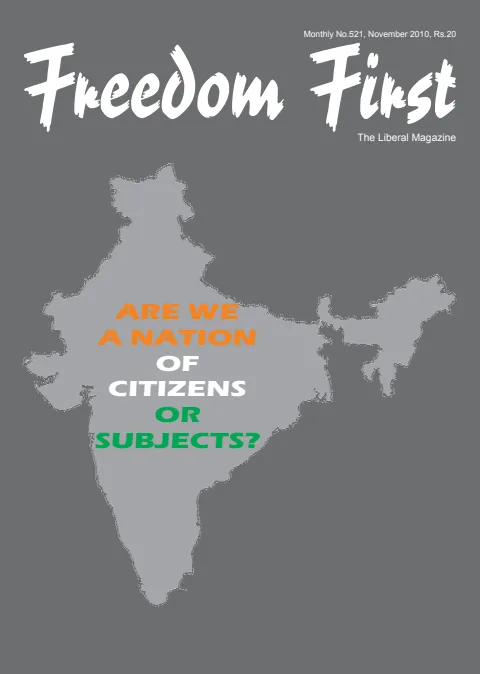
periodical issue
Freedom First
The Liberal Position
Published by J. R. Patel for the Indian Committee for Cultural Freedom (ICCF) and printed by him at Union Press, 13 Homji Street, Fort, Mumbai 400 001. · Mumbai · 2011
44 pages
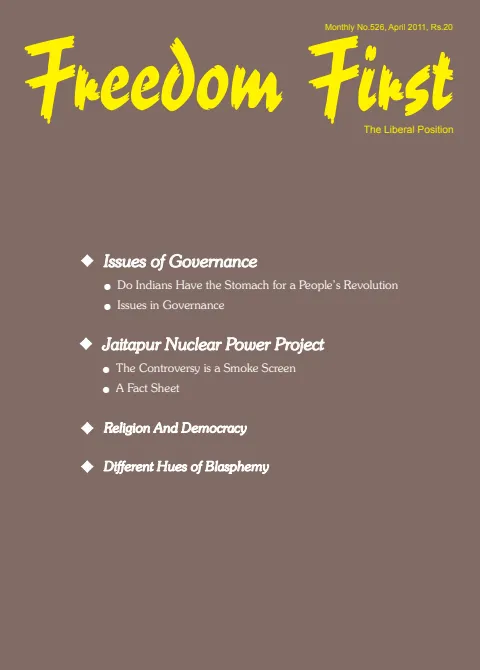
Freedom First
Summary
In the rendered pages, the April 2011 issue of Freedom First responds to the Fukushima disaster while continuing the magazine’s recent focus on governance, corruption, and public accountability. The editor explains that the advisory board had already planned articles on the Jaitapur Nuclear Power Project before Fukushima, and chose to publish them while inviting dispassionate liberal debate.
In the rendered pages, the issue includes reader responses, obituaries, governance essays by Firoze Hirjikaka and N. Vittal, a Tagore-anniversary item, Ashok Karnik’s point-counterpoint column, and the opening of Bal Phondke’s pro-nuclear Jaitapur essay. Later articles on religion, blasphemy, the Union Budget, nuclear disarmament, and book reviews begin after the rendered range and are not summarized here.
Key points
-
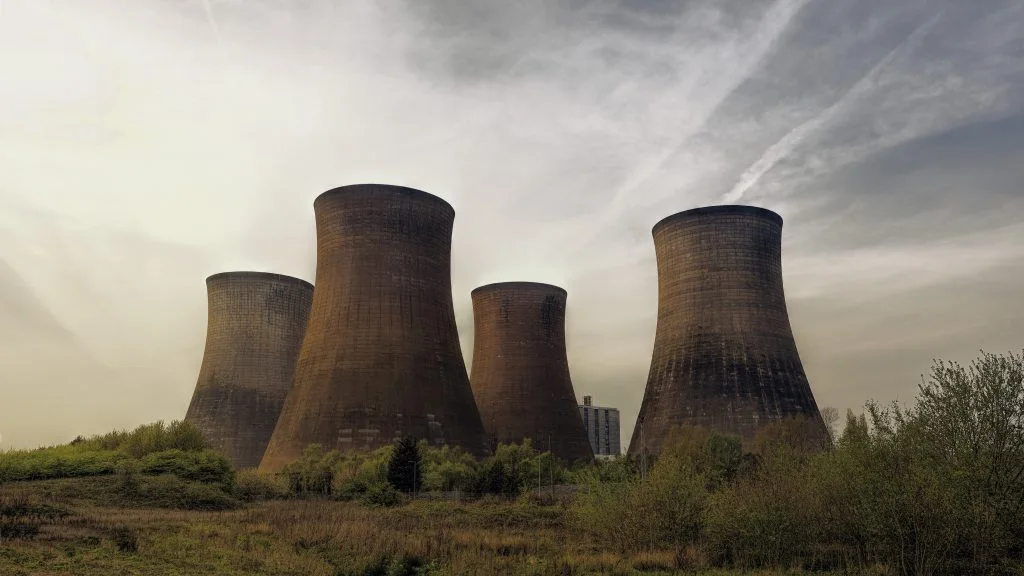
S. V. Raju’s editorial acknowledges the Fukushima disaster and expresses sympathy for Japan, explaining why Freedom First is still publishing planned articles on the Jaitapur Nuclear Power Project and calling for dispassionate liberal debate on nuclear energy.
-
Firoze Hirjikaka’s “Do Indians Have the Stomach for a People’s Revolution” uses Egypt’s uprising as a mirror for India, arguing Indian democracy has been manipulated by rulers through inherited colonial habits of secrecy and patronage, while crediting the RTI Act and media scrutiny as partial signs of change.
-
N. Vittal’s “Issues In Governance” continues the issue’s public-accountability theme, situated within the magazine’s ongoing cluster of essays on corruption and institutional reform.
-
Bal Phondke’s “The Controversy is a Smoke Screen” argues opposition to the Jaitapur nuclear project is overstated, describing India’s three-stage nuclear programme and thorium ambitions and responding to Chernobyl- and Fukushima-type fears by citing France’s and Japan’s heavy reliance on nuclear power.
-
The editorial notes that no reader responded to the March issue’s question of whether India should seek superpower status or focus on poverty, health, education and infrastructure.
-
The issue’s table of contents also turns to religion, blasphemy, the Union Budget, nuclear disarmament and book reviews, though these lie beyond the rendered chunk.
Essays
Between Ourselves
By S. V. Raju
The rendered page’s editorial note opens with sympathy for Japan after the earthquake, tsunami, and Fukushima nuclear plant explosions. It explains why Freedom First is publishing articles on the Jaitapur nuclear project despite the changed context, arguing that the subject should be debated dispassionately.
The column also notes that no reader responded to a question posed in the March issue about whether India should seek superpower status or focus on poverty, health, education, and infrastructure, then turns provocatively to India’s foreign-policy choices during and after the Cold War.
- Acknowledges Fukushima and expresses sympathy for Japan.
- Explains why Jaitapur nuclear articles are still being published.
- Calls for dispassionate liberal debate on Fukushima and Jaitapur.
- Returns to the magazine’s broader question about Indian national priorities.
Do Indians Have the Stomach for a People’s Revolution
By Firoze Hirjikaka
In the rendered pages, Firoze Hirjikaka uses Egypt’s people’s revolution as a mirror for India, asking whether Indians have the courage and organization to challenge corrupt and lethargic governance. He says he is not advocating overthrow, but argues that India’s democracy has been manipulated by rulers who inherited colonial habits and converted secrecy, patronage, and impunity into normal politics.
The essay notes some hopeful signs, especially the Right to Information Act, media scrutiny, and greater exposure of ministerial wrongdoing, but doubts whether those pressures have yet produced real accountability.
- Compares public anger in Egypt with Indian tolerance of bad governance.
- Argues Indian democracy has been manipulated by rulers for decades.
- Identifies secrecy, corruption, and compliant policing as entrenched problems.
- Credits RTI and media exposure as partial signs of change.
Issues In Governance
By N. Vittal
In the rendered pages, N. Vittal’s governance essay continues the issue’s public-accountability theme. The visible section is listed under issues of governance and follows the Hirjikaka article; it is treated as part of the issue’s broader concern with corruption, public institutions, and reform.
The first 20 pages indicate this article is fully within the rendered range, but only portions were visually checked for this continuation pass.
- Continues the issue’s governance focus.
- Belongs to a cluster of essays on corruption and public accountability.
- Appears in the rendered range before the Tagore anniversary and Point Counter Point items.
The Controversy is a Smoke Screen
By Bal Phondke
In the rendered pages, Bal Phondke’s Jaitapur article argues that opposition to the nuclear power project is overstated and that nuclear energy is necessary for India’s power needs. The essay presents conventional energy sources as ecologically and socially limited, describes India’s three-stage nuclear programme and thorium ambitions, and says the Indo-US nuclear deal has improved access to uranium.
The visible continuation responds to Chernobyl, Three Mile Island, Fukushima-type fears, and radiation concerns by comparing nuclear risks with other accepted risks and by citing France and Japan’s heavy nuclear-power use. The article is not complete in the rendered range.
- Argues India needs nuclear power to bridge demand and support growth.
- Frames conventional power sources as polluting, finite, or socially costly.
- Presents India’s nuclear fuel-cycle work as a strategic advantage.
- Responds to Chernobyl and radioactivity concerns by emphasizing probability, modern safety systems, France, and Japan.
Generated by the v1.5 extraction pipeline. Awaiting editorial review.
Metadata and summary are AI-extracted from the source PDF and reviewed for editorial accuracy. The original work is available via the Read PDF tab above (where present); paragraph-level citation inside the PDF is deferred to a future engagement.