periodical issue
Freedom First
The Liberal Position
By D. R. Pendse
Published by J. R. Patel for the Indian Committee for Cultural Freedom (ICCF) and printed by him at Union Press, 13 Homji Street, Fort, Mumbai 400 001. · Mumbai · 2011
40 pages
Freedom First
Summary
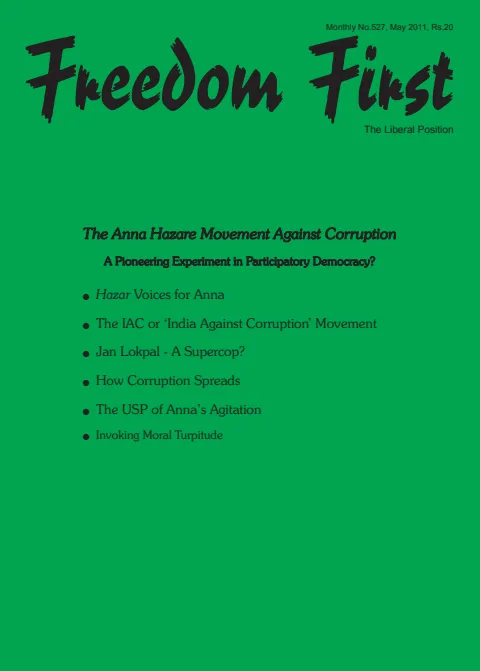
In the rendered pages, the May 2011 issue of Freedom First is built around the Anna Hazare movement against corruption and asks whether it represents a pioneering experiment in participatory democracy. The editor’s note says the cover story reveals the difficulty of being a liberal: contributors range from skepticism about constitutional damage to hope that Hazare’s movement might jolt India out of normalized corruption.
In the rendered pages, the cover feature includes several voluntary contributions on Anna Hazare, India Against Corruption, Jan Lokpal, corruption, moral pressure, and citizen mobilization. The first 20 of 40 PDF pages also include Ashok Karnik’s Point Counter Point, D. R. Pendse on India’s 2011 World Cup win, and the opening of Tenzin Tsundue’s piece on Dharamsala; later articles are outside the rendered range.
Key points
-
S. V. Raju’s editorial frames the Anna Hazare movement as a test case for liberals, balancing anti-corruption urgency against concern for constitutional democracy and arguing that democracy is not exhausted by elections.
-
Firoze Hirjikaka’s “Hazar Voices for Anna” takes a skeptical view of the Hazare agitation, doubting whether a Lokpal bill can cleanse governance and arguing politicians are unlikely to pass laws that seriously threaten themselves.
-
Ranga Rao DS’s “The IAC or India Against Corruption Movement” addresses the institutional meaning of the campaign as part of the issue’s cover-feature cluster on Anna Hazare and participatory democracy.
-
Ashok Karnik’s Point Counter Point continues the magazine’s recurring format of weighing multiple sides of current public issues, appearing after the anti-corruption cover feature.
-
D. R. Pendse’s “India Wins World Cup 2011” marks India’s cricket World Cup victory as a cultural and current-affairs item under the Changing Times section.
-
The cover feature as a whole gathers several voluntary contributions on Anna Hazare, India Against Corruption, the Jan Lokpal and citizen mobilisation, framed by the editor as revealing the difficulty of being a liberal amid hope and constitutional caution.
Essays
Between Ourselves
By S. V. Raju
The rendered page’s editorial note frames the Anna Hazare movement as a test case for liberals, who may support anti-corruption energy while worrying about constitutional shortcuts and damage to democratic procedure. The editor stresses that democracy is not exhausted by elections and that a participatory public may have a legitimate role in demanding reform.
The note ends with cautious support for movements that dislodge those who place private interest above public welfare, while warning that India need not imitate Arab revolts or throw away democracy while fighting corruption.
- Frames the Anna Hazare movement as difficult terrain for liberals.
- Balances anti-corruption urgency against concern for constitutional democracy.
- Argues that democracy does not begin and end with elections.
- Calls for critical support for genuine public-interest movements.
Hazar Voices for Anna
By Firoze Hirjikaka
In the rendered pages, Firoze Hirjikaka’s “Hazar Voices for Anna” takes a skeptical but not dismissive view of Anna Hazare’s anti-corruption agitation. He asks whether Hazare is a saint, opportunist, or Gandhian idealist, and doubts whether a Lokpal bill can cleanse the ethical rot in governance.
The essay argues that politicians are unlikely to pass laws that truly put them at risk, criticizes asset-declaration exercises as weak, and notes that even if a Lokpal is passed, it may mostly make politicians more discreet rather than fundamentally honest.
- Questions whether the Hazare movement can translate symbolic energy into actual reform.
- Doubts politicians will enact laws that seriously threaten themselves.
- Criticizes asset declarations as largely meaningless without scrutiny of wealth sources.
- Warns that Lokpal may not cleanse the deeper ethical rot in governance.
The IAC or India Against Corruption Movement
By Ranga Rao DS
In the rendered pages, Ranga Rao DS’s article on the India Against Corruption movement is part of the cover-feature cluster and addresses the institutional meaning of the campaign. It appears after Hirjikaka’s opening skepticism and before Shyam Ashtekar’s Jan Lokpal discussion.
The full article lies within the rendered pages, but only its location and cover-feature context were visually checked in this continuation pass.
- Treats India Against Corruption as a central expression of the Anna Hazare movement.
- Belongs to the issue’s discussion of participatory democracy and anti-corruption reform.
- Sits between the opening Hazare essay and the Jan Lokpal critique.
Point Counter Point
By Ashok Karnik
In the rendered pages, Ashok Karnik’s Point Counter Point appears after the cover-feature essays and before the World Cup article. The column is part of the issue’s usual format of presenting multiple sides of current public issues.
The full text was not individually inspected beyond its placement in the rendered range.
- Continues the magazine’s recurring Point Counter Point format.
- Appears after the anti-corruption cover feature.
- Falls within the rendered range.
India Wins World Cup 2011
By D. R. Pendse
In the rendered pages, D. R. Pendse’s “India Wins World Cup 2011” is listed under Changing Times and marks India’s cricket World Cup victory. The article occupies printed pages 18-19 and is complete within the rendered chunk.
Only its title, byline, and placement were inspected in this continuation pass.
- Marks India’s 2011 World Cup victory.
- Appears as a cultural/current-affairs item after Point Counter Point.
- Is complete within the rendered pages.
Generated by the v1.5 extraction pipeline. Awaiting editorial review.
Metadata and summary are AI-extracted from the source PDF and reviewed for editorial accuracy. The original work is available via the Read PDF tab above (where present); paragraph-level citation inside the PDF is deferred to a future engagement.