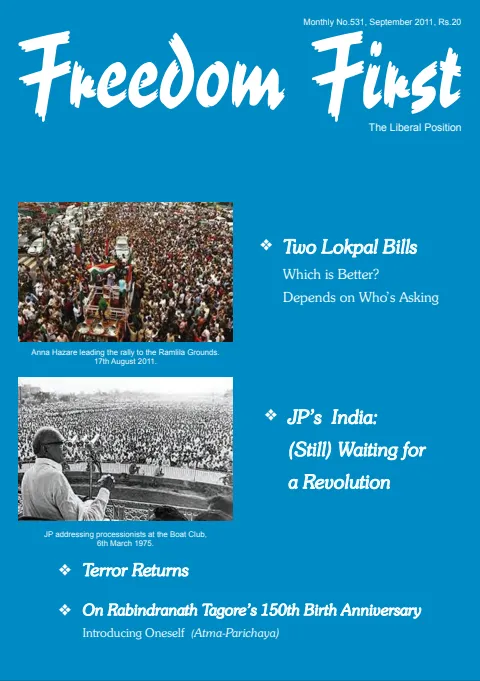
periodical issue
Freedom First
The Liberal Position
Published by J. R. Patel for the Indian Committee for Cultural Freedom (ICCF) and printed by him at Union Press, 13 Homji Street, Fort, Mumbai 400 001. · Mumbai · 2011
36 pages
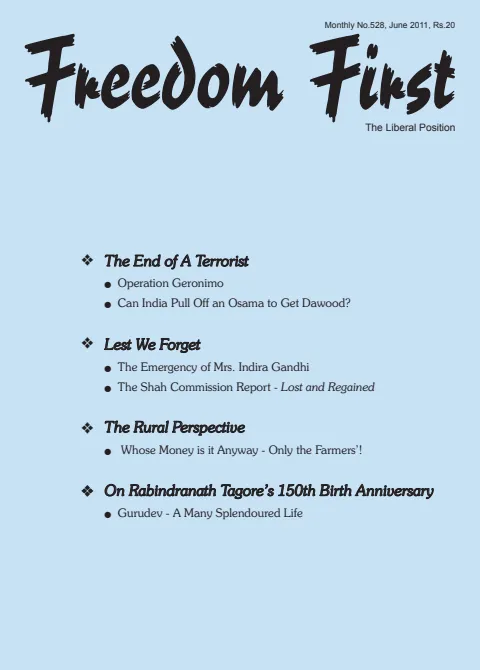
Freedom First
Summary
The June 2011 issue of Freedom First combines international security, Indian governance, Emergency memory, state politics, rural economics, and cultural history. The cover frames Osama bin Laden’s killing as the end of a terrorist and immediately asks whether India could mount a comparable effort against Dawood Ibrahim. The editor’s note explicitly links the issue to Operation Geronimo, the 1993 Bombay blasts, and the continuing need to remember the Emergency and the Shah Commission Report.
Within the rendered pages, the issue moves from Ashok Karnik on Operation Geronimo and Firoze Hirjikaka on Dawood Ibrahim to R. Srinivasan and Era Sezhiyan on the Emergency and the Shah Commission Report. Later rendered pieces include Point Counter Point, Tamil Nadu electoral change, P. M. Kamath on Anna Hazare, Girdhar Patil on farmers’ money, and Christie Davies on Kashmir and Amritsar. The remaining Tagore, correspondence, obituary, and review material begins after the rendered range.
Key points
-
The editorial frames Osama bin Laden’s killing as an occasion to examine terrorism and state capacity, asking readers not to join processions celebrating a terrorist’s memory and contrasting the American operation with India’s failure to act against Dawood Ibrahim.
-
Ashok Karnik’s “Operation Geronimo” treats the bin Laden raid as a strategic and political operation rather than mere revenge, emphasising its symbolic value in demonstrating that long-delayed accountability can still arrive.
-
Firoze Hirjikaka’s “Can India Pull Off An Osama To Get Dawood?” argues the obstacle to capturing Dawood Ibrahim, tied to the 1993 Bombay bomb blasts, is political will and state resolve rather than operational capacity.
-
P. M. Kamath’s “Hazare Must Plan for Evolutionary Changes!” argues Anna Hazare’s anti-corruption movement needs durable institutional reform rather than reliance on agitation alone.
-
The editorial also marks June as the anniversary month of the Emergency and notes Tamil Nadu’s election results and a tribute to Nausheryan Framji Suntook.
Essays
Between Ourselves
By S. V. Raju
The editorial note frames the issue around the killing of Osama bin Laden, asking readers not to join public processions celebrating a terrorist’s memory and praising the issue’s paired treatment of Operation Geronimo and India’s failure to act similarly against Dawood Ibrahim. It also highlights June as the anniversary month of the Emergency and introduces Era Sezhiyan’s recovery of the Shah Commission Report.
The editor connects current politics with historical memory, noting Tamil Nadu’s election results, a tribute to Nausheryan Framji Suntook, and continued attention to Tagore’s anniversary.
- Frames Osama bin Laden’s killing as a moment to examine terrorism and state capacity.
- Contrasts the United States’ operation with India’s inability or unwillingness to capture Dawood Ibrahim.
- Uses the June issue to remember the Emergency and the Shah Commission Report.
- Introduces Tamil Nadu election analysis, Suntook’s obituary, and Tagore anniversary material.
Operation Geronimo
By Ashok Karnik
Ashok Karnik’s “Operation Geronimo” examines the killing of Osama bin Laden as a strategic and political operation rather than merely a moment of revenge. The article places the raid in the context of global counterterrorism and the symbolic value of demonstrating that long-delayed accountability can still arrive.
In the rendered pages, the article is complete and serves as the first half of the issue’s cover treatment on terrorism.
- Treats the bin Laden raid as a major counterterrorism event.
- Emphasizes the political and symbolic dimensions of the operation.
- Sets up the issue’s comparison with India’s pursuit of Dawood Ibrahim.
Can India Pull Off An Osama To Get Dawood?
By Firoze Hirjikaka
Firoze Hirjikaka asks whether India could, or would, conduct an Osama-style operation to capture Dawood Ibrahim. The article argues that the issue is not simply operational capacity but political will, state resolve, and the consequences of allowing a fugitive accused in the 1993 Bombay bombings to remain beyond reach.
The piece completes the issue’s opening security pair by moving from the American raid to India’s unresolved terrorism cases.
- Uses the bin Laden raid to ask why Dawood Ibrahim remains outside India’s reach.
- Frames the question as one of political will as much as capability.
- Links Dawood Ibrahim to the 1993 Bombay bomb blasts.
The Shah Commission Report Lost, and Regained
By Era Sezhiyan
Era Sezhiyan’s essay explains how the Shah Commission Report, a crucial record of Emergency abuses, was lost and then recovered. It situates the report as a democratic document that helps later generations understand the misuse of power under Indira Gandhi’s Emergency.
The article is part of the issue’s explicit “Lest We Forget” section and reinforces Freedom First’s long-running concern with civil liberty and accountable government.
- Reintroduces the Shah Commission Report as a vital record of Emergency-era abuses.
- Frames archival recovery as part of democratic accountability.
- Connects Emergency memory with contemporary vigilance against executive overreach.
Hazare Must Plan for Evolutionary Changes!
By P. M. Kamath
P. M. Kamath’s article argues that Anna Hazare’s anti-corruption movement must plan for evolutionary institutional change rather than rely only on agitation. In the context of the issue’s governance concerns, the essay treats anti-corruption pressure as important but incomplete without durable reform.
The piece is complete within the rendered range.
- Supports anti-corruption reform while warning against merely episodic agitation.
- Calls for evolutionary institutional change.
- Places Anna Hazare’s movement in a broader governance reform frame.
Generated by the v1.5 extraction pipeline. Awaiting editorial review.
Metadata and summary are AI-extracted from the source PDF and reviewed for editorial accuracy. The original work is available via the Read PDF tab above (where present); paragraph-level citation inside the PDF is deferred to a future engagement.