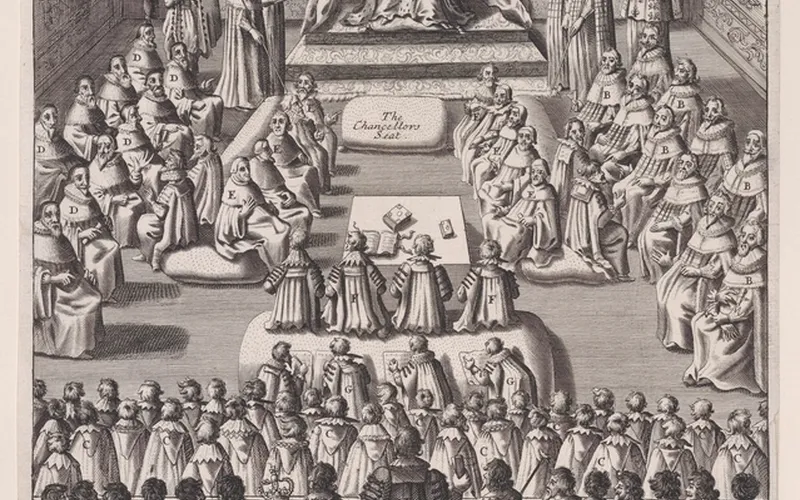
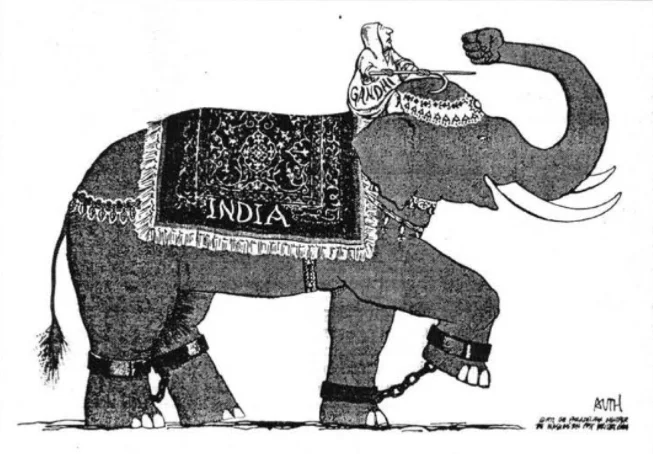
periodical issue
Freedom First
The Liberal Position
By Sharad Bailur, Rabindranath Tagore
Published by J. R. Patel for the Indian Committee for Cultural Freedom (ICCF) and printed by him at Union Press, 13 Homji Street, Fort, Mumbai 400 001. · Mumbai · 2011
36 pages
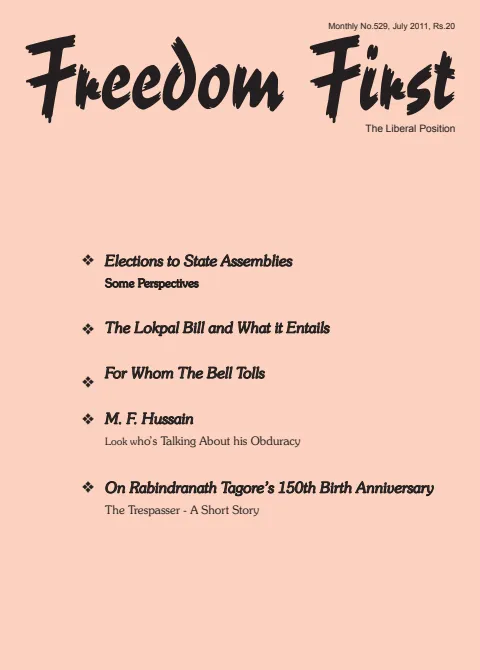
Freedom First
Summary
The July 2011 issue of Freedom First centers on democratic politics and civil society after state assembly elections and the Lokpal agitation. The editor’s note contrasts India’s history of one-party dominance, the Emergency, the Janata interlude, and coalition politics with the current tension between government and civil society over anti-corruption demands.
The rendered pages include a cover feature on elections to five state assemblies, Ashok Karnik’s Point Counter Point on Baba Ramdev’s fast and the Karachi attack, Sharad Bailur’s liberal critique of the Lokpal idea, H. R. Bapu Satyanarayana on corruption and black money, and the opening of Firoze Hirjikaka’s essay on the decline of Western dominance. Later pieces on M. F. Hussain, Rajagopalachari correspondence, Tagore, Russia, and book reviews lie outside the rendered range.
Key points
-
S. V. Raju’s editorial contrasts India’s history of one-party dominance, the Emergency, the Janata interlude and coalition politics with the present tension between government and civil society, arguing civil society should strengthen rather than confront Parliament.
-
The cover feature “The Recent Elections to Five State Assemblies: Some Perspectives” argues that local issues and regional political cultures, rather than a uniform national ideology, shaped the results, citing Kerala’s volatility and Tamil Nadu’s distinct electoral logic.
-
Ashok Karnik’s Point Counter Point criticises the government’s handling of Baba Ramdev’s anti-corruption fast and reads the Karachi naval-base attack as evidence of danger inside Pakistan while cautioning against reckless interpretation of its instability.
-
Sharad Bailur’s “The Lokpal and What It Entails” warns against ceding large constitutional power to unelected civil society representatives, proposing instead performance-linked appointments, recall of representatives and transparent political finance.
-
H. R. Bapu Satyanarayana’s “For Whom the Bell Tolls” links public anger over Anna Hazare and Baba Ramdev to the government’s reluctance to address black money and to the CVC appointment, 2G, CWG and Kanimozhi controversies.
-
The editorial warns that the Lokpal confrontation risks becoming a collision course between civil society and Parliament even as it welcomes signs of anti-corruption energy.
Essays
Between Ourselves
By S. V. Raju
The editor reflects on India’s post-independence political trajectory from Congress dominance to the Emergency, the Janata Party, the coalition era, and a chaotic present in which parliamentary government feels fragile. The note argues that civil society could strengthen parliamentary democracy, but warns that the Lokpal confrontation risks becoming a collision course with Parliament.
It introduces the state election discussion and Sharad Bailur’s Lokpal essay as a liberal response to current anti-corruption politics.
- Contrasts one-party dominance, the Emergency, Janata politics, and coalition instability.
- Argues that civil society should strengthen parliamentary democracy.
- Warns that the Lokpal confrontation could pit civil society against Parliament.
- Highlights the state assembly election discussion and the Lokpal article.
The Recent Elections to Five State Assemblies: Some Perspectives
The cover feature on the recent elections to five state assemblies asks whether Indian voters have matured, whether franchise choices are issue-based or symbolic, and whether caste, religion, and money power are receding. The introductory remarks by Ashok Karnik and the reproduced background paper stress that local issues, regional histories, and distinctive political cultures matter more than a uniform national ideology.
The essay notes Kerala’s volatility, Tamil Nadu’s regional political logic, and the wider lesson that voters have repeatedly cut leaders and parties down to size through the ballot box.
- Frames the state elections as evidence for examining voter maturity and discrimination.
- Argues that local issues and regional political cultures shape election results.
- Treats Kerala and Tamil Nadu as examples of distinct electoral logic.
- Presents voting as a strong political educator and final arbiter in Indian democracy.
Point Counter Point
By Ashok Karnik
Ashok Karnik’s Point Counter Point takes up Baba Ramdev’s fast and the Karachi attack. On Ramdev, it criticizes both the haste and preparation of the agitation and the government’s midnight crackdown, arguing that blaming the RSS/BJP misses the depth of public anger over corruption.
On the Karachi attack, the column reads the strike on Pakistan’s Mehran naval base as evidence of militants within Pakistan and cautions India against simplistic celebration or reckless interpretation of Pakistan’s internal crisis.
- Criticizes the government’s handling of Baba Ramdev’s anti-corruption fast.
- Warns that public anger about corruption cannot be dismissed as partisan manipulation.
- Treats the Karachi naval attack as evidence of danger inside Pakistan.
- Cautions India against misreading Pakistan’s instability.
The Lokpal and What It Entails
By Sharad Bailur
Sharad Bailur’s “The Lokpal and What It Entails” is skeptical of handing large constitutional power to unelected civil society representatives. It argues that democracies usually take ombudsman-style institutions cautiously because good intentions can create dangerous institutional consequences.
Bailur proposes more mundane but structural reforms: performance-linked government appointments, recall of representatives, transparent costing of public employment, stricter corruption punishment, and transparent political finance. The rendered page notes that the piece continues beyond the visible chunk.
- Warns against empowering unelected civil society representatives without constitutional legitimacy.
- Critiques a powerful Lokpal as potentially dangerous despite good intentions.
- Proposes performance accountability, recall, transparent public costs, harsher corruption rules, and cleaner political finance.
- Contrasts institutional reform with televised agitation.
For Whom the Bell Tolls
By H. R. Bapu Satyanarayana
H. R. Bapu Satyanarayana’s “For Whom the Bell Tolls” argues that the public eruption over Anna Hazare and Baba Ramdev began with government reluctance to address black money and corruption. It criticizes complacency around Prime Minister Manmohan Singh, cites controversies around the CVC appointment, 2G, CWG, and Kanimozhi, and presents the Jan Lokpal agitation as a sign of silent rage against the corporate-bureaucrat-politician nexus.
The article also notes the government’s handling of Baba Ramdev and the role of the Supreme Court and media in keeping corruption cases alive.
- Asks why the government is reluctant to bring back black money from foreign banks.
- Links public anger to 2G, CWG, CVC, and other corruption controversies.
- Treats the Anna Hazare movement as an eruption of silent rage.
- Credits judicial and media scrutiny with sustaining pressure in corruption cases.
Generated by the v1.5 extraction pipeline. Awaiting editorial review.
Metadata and summary are AI-extracted from the source PDF and reviewed for editorial accuracy. The original work is available via the Read PDF tab above (where present); paragraph-level citation inside the PDF is deferred to a future engagement.