periodical issue
Freedom First
The Liberal Position
By Sharad Bailur, Rabindranath Tagore
Published by J. R. Patel for the Indian Committee for Cultural Freedom (ICCF) and printed by him at Union Press, 13 Homji Street, Fort, Mumbai 400 001. · Mumbai · 2011
40 pages
Freedom First
Summary
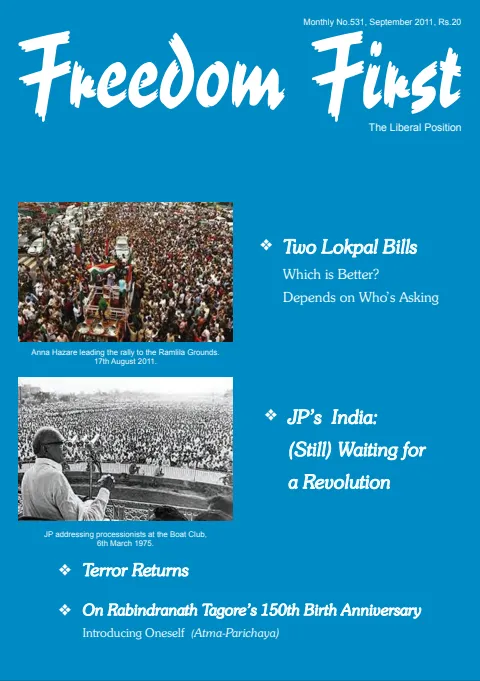
The September 2011 issue of Freedom First is shaped by the Anna Hazare fast, the Lokpal debate, and the wider question of whether liberal democracy can accommodate intense civil-society pressure without damaging Parliament. The cover pairs Hazare’s Ram Lila rally with an older image of Jayaprakash Narayan addressing crowds in 1975, explicitly linking the moment to earlier mass politics.
Within the rendered pages, the issue includes D. S. Ranga Rao comparing Lokpal drafts, Sharad Bailur on active citizenship and democracy, Ashok Karnik on the return of terror, and articles on India’s social divisions, religious politics, water strategy, and fake encounter killings. Several later pieces, including T. J. S. George on JP’s India and Rabindranath Tagore’s Atma-Parichaya, begin after the rendered range.
Key points
-
The editorial explains the issue was delayed by the question of whether liberals should back Anna Hazare’s Jan Lokpal or the government’s weaker bill, worrying about confrontation between Parliament and civil society while recognising ordinary citizens’ attraction to Hazare.
-
D. S. Ranga Rao’s “Two Lokpal Bills: Which is Better? Depends on Who’s Asking” compares the competing drafts and argues that judgments about the better bill depend on the standpoint of the person asking.
-
Sharad Bailur’s “Active Citizenship, Democracy and Anna Hazare” examines whether citizen action strengthens democratic accountability or slips into pressure politics.
-
Ashok Karnik’s “Terror Returns” addresses renewed terrorist violence, broadening the issue’s agenda beyond the Lokpal debate to national security.
-
The cover pairs Hazare’s Ram Lila rally with an older image of Jayaprakash Narayan addressing crowds in 1975, explicitly linking the moment to earlier mass politics.
-
The issue’s table of contents also lists pieces on India’s social divisions, religious politics, water strategy and fake encounter killings, alongside T. J. S. George on JP’s India and Rabindranath Tagore’s Atma-Parichaya, though most fall beyond the rendered pages.
Essays
Between Ourselves
By S. V. Raju
The editorial says the issue was delayed by the question of whether liberals should support Anna Hazare’s movement pressing for Jan Lokpal or the weaker government bill. It worries about confrontation between Parliament and civil society, but also recognizes the ordinary people drawn to Hazare because he seems to speak to everyday harassment and misery.
The note concludes with relief that a consensual Lokpal Act may emerge and that Parliament may not be overthrown by street pressure.
- Frames the Lokpal debate as a difficult liberal choice.
- Acknowledges ordinary citizens’ attraction to Hazare’s anti-corruption appeal.
- Warns against a disastrous confrontation between Parliament and civil society.
- Welcomes signs of compromise that could produce a Lokpal law.
Two Lokpal Bills: Which is Better? Depends on Who’s Asking
By D. S. Ranga Rao
D. S. Ranga Rao’s “Two Lokpal Bills” compares competing drafts and argues that which bill is seen as better depends on the standpoint of the person asking. In the issue’s context, the article helps readers distinguish between government and Jan Lokpal proposals rather than treating the anti-corruption demand as a single unified object.
The piece is complete within the rendered range.
- Compares the competing Lokpal proposals.
- Emphasizes that judgments about the better bill depend on institutional interests and perspective.
- Places the technical bill debate inside the broader Anna Hazare agitation.
Active Citizenship, Democracy and Anna Hazare
By Sharad Bailur
Sharad Bailur’s article on active citizenship, democracy, and Anna Hazare examines whether citizen action strengthens democratic accountability or slips into pressure politics. It sits at the heart of the issue’s liberal concern: how to support anti-corruption anger while keeping constitutional institutions intact.
The article is visible and complete in the rendered pages.
- Treats the Hazare movement as a test of active citizenship.
- Balances anti-corruption pressure against constitutional procedure.
- Continues the magazine’s debate over Parliament, civil society, and Lokpal.
Terror Returns
By Ashok Karnik
Ashok Karnik’s “Terror Returns” addresses renewed terrorist violence and its implications for Indian public life. In the issue’s structure it broadens the agenda beyond Lokpal, bringing national security back into a magazine otherwise dominated by corruption and democratic-process questions.
The article is complete within the rendered chunk.
- Marks the return of terrorism as a public concern.
- Places national security alongside corruption and democratic accountability.
- Continues Karnik’s role as a recurring current-affairs commentator.
Generated by the v1.5 extraction pipeline. Awaiting editorial review.
Metadata and summary are AI-extracted from the source PDF and reviewed for editorial accuracy. The original work is available via the Read PDF tab above (where present); paragraph-level citation inside the PDF is deferred to a future engagement.