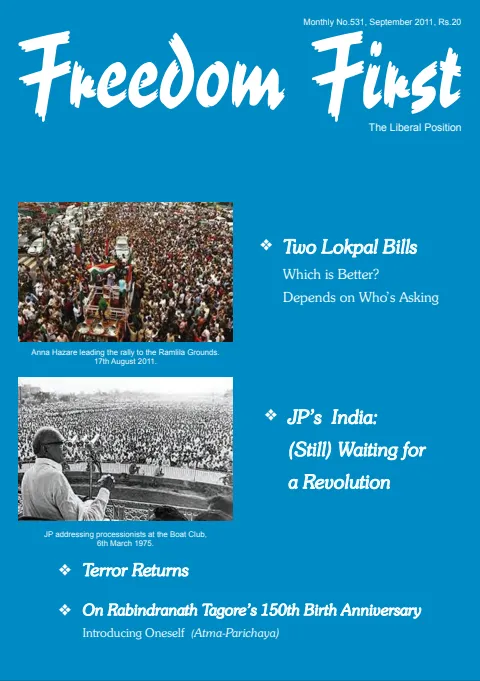
periodical issue
Freedom First
The Liberal Magazine
Published by J. R. Patel for the Indian Committee for Cultural Freedom (ICCF) and printed by him at Union Press, 13 Homji Street, Fort, Mumbai 400 001. · Mumbai · 2011
44 pages
Freedom First
Summary
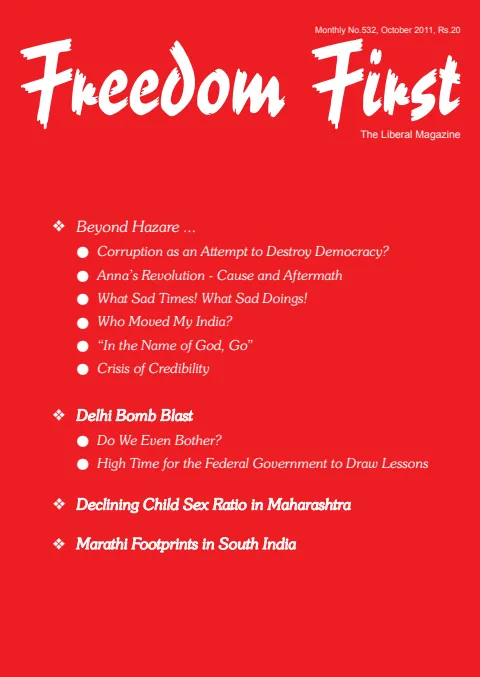
The October 2011 issue of Freedom First looks beyond the immediate Anna Hazare moment while still treating the movement as the largest field agitation since Jayaprakash Narayan’s movement. The editor credits Hazare with waking a somnolent people and invigorating democracy, but now asks readers to wait for the parliamentary Standing Committee and to defend democratic institutions even when many representatives are undesirable.
The rendered pages include a cover-feature cluster on corruption, democracy, Anna Hazare’s revolution, credibility, and political decay, followed by an article on Maharashtra’s declining child sex ratio. The later Delhi bomb blast and policing articles lie outside the rendered range.
Key points
-
The editorial compares the Anna Hazare movement to Jayaprakash Narayan’s Total Revolution as history’s largest field agitation, and argues liberals should respect Parliament as “democracy’s temple” and let the Standing Committee do its work on the Lokpal drafts.
-
Jagdeep S. Chhokar’s “Beyond Hazare” asks what comes after charismatic protest and how institutional reform can proceed once public agitation has forced anti-corruption onto the national agenda.
-
Sharad Bailur’s “Corruption or An Attempt to Destroy Democracy?” continues his skeptical liberal line, questioning whether anti-corruption agitation risks undermining constitutional balance and procedure.
-
Firoze Hirjikaka’s “Anna’s Revolution - Cause and Aftermath” reflects on the public causes behind the Hazare movement and what may follow the fast and its parliamentary referral.
-
J. S. Apte’s article on the declining child sex ratio in Maharashtra shifts the issue from corruption politics to gendered social reform and demographic imbalance.
-
The editor credits Hazare with waking a “somnolent people” and invigorating democracy even while urging patience for the Standing Committee process over street pressure.
Essays
Between Ourselves
By S. V. Raju
The editorial compares the Anna Hazare movement with Jayaprakash Narayan’s Total Revolution, saying both were large field agitations led by single charismatic personalities who galvanized the people. It says the summoning of Parliament, the Sense of the House statement, Hazare ending his fast, and the referral of Lokpal drafts to a Standing Committee make the issue less about street pressure and more about parliamentary work.
The editor insists that liberals should respect Parliament as democracy’s temple and allow the Standing Committee to do its work.
- Frames Hazare’s movement as the biggest field agitation since JP’s Total Revolution.
- Credits it with waking citizens and invigorating democracy.
- Shifts attention from fasting to the Standing Committee process.
- Defends Parliament despite the poor quality of many representatives.
Beyond Hazare
By Jagdeep S. Chhokar
Jagdeep S. Chhokar’s “Beyond Hazare” opens the cover feature and places anti-corruption politics in a longer democratic frame. It asks what comes after charismatic protest and how institutional reform can proceed once the public agitation has forced the issue onto the national agenda.
The article is complete in the rendered range.
- Moves from Hazare as symbol to the broader anti-corruption agenda.
- Asks how protest energy can become institutional reform.
- Introduces the issue’s wider cover discussion.
Corruption or An Attempt to Destroy Democracy?
By Sharad Bailur
Sharad Bailur’s “Corruption or An Attempt to Destroy Democracy?” continues the magazine’s skeptical liberal line on whether anti-corruption pressure can undermine democratic institutions. It treats the Lokpal debate as a question not only of corruption control but of constitutional balance and procedure.
The article is visible and complete in the rendered pages.
- Questions whether anti-corruption agitation risks damaging democracy.
- Frames corruption reform as inseparable from constitutional process.
- Extends the magazine’s debate over civil society and Parliament.
Anna’s Revolution - Cause and Aftermath
By Firoze Hirjikaka
Firoze Hirjikaka’s “Anna’s Revolution - Cause and Aftermath” reflects on why Hazare’s movement drew public support and what may follow after the fast and parliamentary referral. In the issue’s structure it provides a political reading of the agitation’s causes and its likely consequences.
The article is complete within the rendered pages.
- Explains the public causes behind the Hazare movement.
- Considers the aftermath of the fast and parliamentary response.
- Treats the movement as both moral protest and political pressure.
Declining Child Sex Ratio in Maharashtra
By J. S. Apte
J. S. Apte’s article on the declining child sex ratio in Maharashtra begins within the rendered range and shifts the issue from corruption politics to social reform. The article is only partly visible because the rendered images reach about printed page 18 while the table of contents places the piece on pages 18-19.
The visible placement shows the magazine connecting democratic and governance concerns with gender and demographic imbalance.
- Addresses Maharashtra’s declining child sex ratio.
- Broadens the issue beyond Lokpal and corruption.
- Connects governance concerns with gendered social reform.
Generated by the v1.5 extraction pipeline. Awaiting editorial review.
Metadata and summary are AI-extracted from the source PDF and reviewed for editorial accuracy. The original work is available via the Read PDF tab above (where present); paragraph-level citation inside the PDF is deferred to a future engagement.