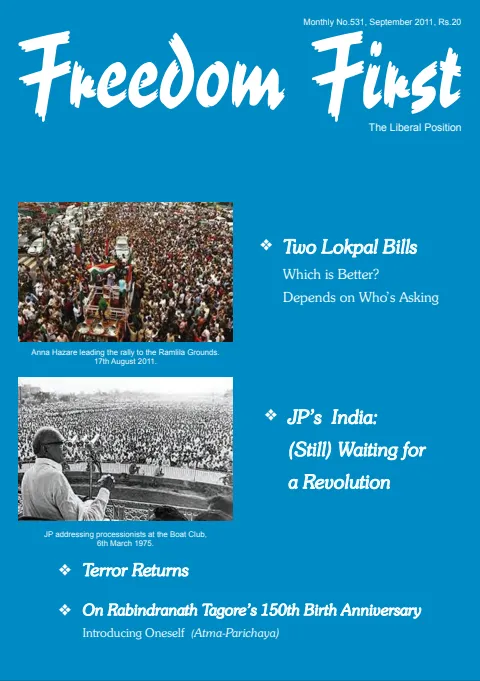
periodical issue
Freedom First
The Liberal Magazine
Published by J. R. Patel for the Indian Committee for Cultural Freedom (ICCF) and printed by him at Union Press, 13 Homji Street, Fort, Mumbai 400 001. · Mumbai · 2011
40 pages
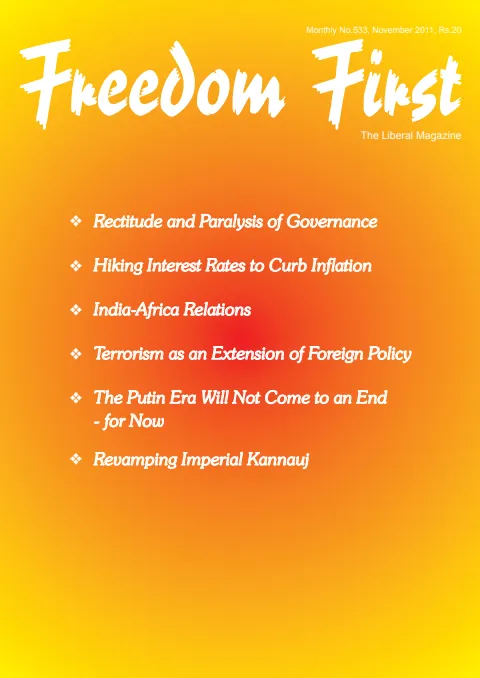
Freedom First
Summary
The November 2011 issue of Freedom First steps back from the intense Hazare focus of the preceding months and turns toward governance, economic policy, security, and international affairs. The editor notes appreciative reader response to the anti-corruption issue but explains that the magazine will await the Standing Committee on the Lokpal bills before further analysis.
The rendered pages include Sharad Bailur on rectitude and paralysis of governance, Vasant G. Gandhi on interest rates and inflation, Neelakant Patri on wealth, Ashok Karnik’s Point Counter Point, D. B. Shekatkar on terrorism as an extension of foreign policy, Furdoon S. B. Mehta on the Army needing its own voice, and the opening of Firoze Hirjikaka’s article on Narendra Modi.
Key points
-
The editorial reports strong reader appreciation for the October anti-corruption issue but explains the magazine will defer further Lokpal analysis until the parliamentary Standing Committee reports.
-
Sharad Bailur’s “Rectitude and Paralysis of Governance” argues good intentions and institutional caution can themselves produce governance paralysis, warning that excessive caution can disable public administration.
-
Vasant G. Gandhi’s article discusses India’s interest-rate hikes as a response to inflation, raising the growth-inflation tradeoff facing monetary policy.
-
D. B. Shekatkar’s “Terrorism as Extension of Foreign Policy” frames terrorism as a tool used in pursuit of state and strategic objectives, expanding the issue’s scope from governance to national security.
-
The issue also carries Neelakant Patri on wealth, Ashok Karnik’s Point Counter Point, Furdoon S. B. Mehta arguing the Army needs its own voice, and the opening of Firoze Hirjikaka’s article on Narendra Modi.
-
The editor also reflects on reader discomfort with serious articles and comments on political vindictiveness and coalition weakness.
Essays
Between Ourselves
By S. V. Raju
The editorial reports reader appreciation for the October anti-corruption issue and explains why Freedom First will not yet publish a planned article on the parliamentary Standing Committee and the Lokpal bills. It says the magazine should wait for the committee’s work and instead discuss larger questions of enabling or disabling legislation.
The note also reflects on reader discomfort with serious articles, defends the magazine’s communication philosophy, and comments on political vindictiveness and coalition weakness.
- Reports strong reader response to the October anti-corruption issue.
- Defers further Lokpal analysis until the Standing Committee reports.
- Defends serious public-affairs writing when events require it.
- Comments on political vindictiveness, weak coalitions, and reader engagement.
Rectitude and Paralysis of Governance
By Sharad Bailur
Sharad Bailur’s “Rectitude and Paralysis of Governance” continues his concern that good intentions and institutional caution can produce paralysis. In the post-Lokpal context, the article treats governance as a problem of principled action, decision-making, and the consequences of avoiding responsibility.
The article is complete in the rendered pages.
- Examines how rectitude can coexist with governance paralysis.
- Connects anti-corruption debate to decision-making capacity.
- Warns that excessive caution can disable public administration.
India Hikes Interest Rate to Curb Inflation
By Vasant G. Gandhi
Vasant G. Gandhi’s article discusses India’s interest-rate hikes as a response to inflation. It situates monetary policy within the broader economic anxieties visible in the issue and asks whether higher rates can curb price pressure without damaging growth.
The article is complete within the rendered range.
- Explains interest-rate hikes as an anti-inflation measure.
- Links monetary tightening to wider economic stress.
- Raises the growth-inflation tradeoff.
Terrorism as Extension of Foreign Policy
By D. B. Shekatkar
D. B. Shekatkar’s “Terrorism as Extension of Foreign Policy” treats terrorism as an instrument used in the pursuit of state or strategic objectives. In the issue’s table of contents it is one of the major cover-advertised security pieces and is complete within the rendered pages.
The article broadens the issue’s governance and economic concerns into national security and foreign-policy strategy.
- Frames terrorism as a tool of foreign policy.
- Places security threats in a strategic rather than merely criminal frame.
- Expands the issue’s focus from domestic governance to external threats.
Generated by the v1.5 extraction pipeline. Awaiting editorial review.
Metadata and summary are AI-extracted from the source PDF and reviewed for editorial accuracy. The original work is available via the Read PDF tab above (where present); paragraph-level citation inside the PDF is deferred to a future engagement.