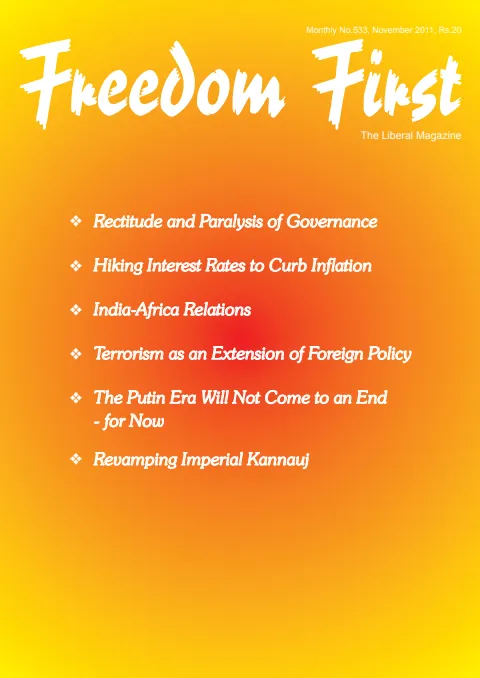
periodical issue
Freedom First
The Liberal Magazine
By Sunil S. Bhandare, Sharad Bailur, Sharad Joshi
Published by J. R. Patel for the Indian Committee for Cultural Freedom (ICCF) and printed by him at Union Press, 13 Homji Street, Fort, Mumbai 400 001. · Mumbai · 2012
44 pages
Freedom First
Summary
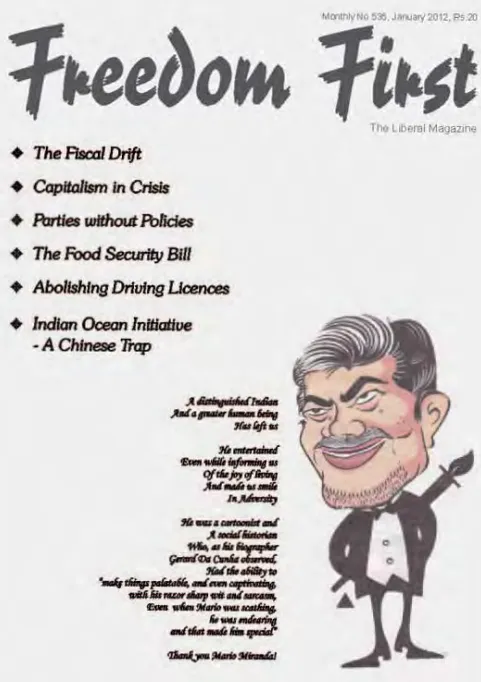
The January 2012 issue of Freedom First opens the new year by returning to older liberal anxieties about the state, planning, corruption, and party politics. The editorial recalls the Second Five Year Plan, the Swatantra Party’s opposition to state control, and the earlier idea of an Ombudsman before the word Lokpal was current, while criticizing contemporary party maneuvering and parliamentary paralysis.
The rendered pages include Sunil S. Bhandare on fiscal drift, Sharu S. Rangnekar on capitalism in crisis, H. R. Bapu Satyanarayana on the Licence Permit Raj’s new avatar, K. K. Pathak on parties without politics, Ashok Karnik’s Point Counter Point, Sharad Bailur on abolishing driving licences, and Sharad Joshi on the Food Security Bill. Later pieces on British riots, the Indian Ocean Initiative, Quest, books, leadership deficit, and Koondakulam lie beyond the rendered range.
Key points
-
The editorial recalls the Second Five Year Plan’s role in India’s near-pauperisation and traces the Swatantra Party’s 1960 call for a grievance-hearing authority as an anticipation of the Ombudsman/Lokpal idea, crediting Narasimha Rao with helping India escape one economic disaster.
-
Sunil S. Bhandare’s “The Fiscal Drift: 2011-12” opens the issue’s economic-policy cluster, raising concerns about public finance discipline and state spending.
-
Sharu S. Rangnekar’s “Capitalism in Crisis” considers anxieties around capitalism after global economic turbulence, pairing a liberal defence of markets with concern for governance and fiscal responsibility.
-
Sharad Joshi’s rural-perspective article on the Food Security Bill, 2011 brings farmers’ and rural-economy concerns into the issue’s debate over state intervention and entitlement policy.
-
The editorial criticises both the ruling coalition and the opposition for putting party interest above national interest amid parliamentary paralysis.
-
The issue also includes H. R. Bapu Satyanarayana on the Licence Permit Raj’s “new avatar,” K. K. Pathak on parties without politics, Ashok Karnik’s Point Counter Point, and Sharad Bailur arguing for abolishing driving licences.
Essays
Between Ourselves
By S. V. Raju
The editorial links the Second Five Year Plan to India’s near-pauperisation and later corruption, then recalls the Swatantra Party’s 1960 statement calling for an authority to hear citizens’ grievances, essentially anticipating the Ombudsman/Lokpal idea. It argues that India avoided one disaster through Narasimha Rao’s reforms but remains trapped in corruption and self-destructive politics.
The editor criticizes both the ruling coalition and opposition for putting party interest above national interest and ends by asking citizens to accept responsibility.
- Criticizes the Second Five Year Plan’s command-economy legacy.
- Recalls Swatantra Party support for an Ombudsman-like authority.
- Credits Narasimha Rao with helping India escape one economic disaster.
- Condemns contemporary party politics for paralysing governance.
The Fiscal Drift: 2011-12
By Sunil S. Bhandare
Sunil S. Bhandare’s “The Fiscal Drift: 2011-12” addresses India’s fiscal position and drift in public finances. It opens the issue’s economic-policy cluster and connects the magazine’s liberal concerns to deficits, state spending, and macroeconomic discipline.
The article is complete in the rendered pages.
- Examines fiscal drift in 2011-12.
- Raises concerns about public finance discipline.
- Begins the issue’s economic-policy focus.
Capitalism in Crisis
By Sharu S. Rangnekar
Sharu S. Rangnekar’s “Capitalism in Crisis” considers the anxieties surrounding capitalism after global economic turbulence. In the issue’s context, the piece pairs liberal economic defense with concern for credibility, governance, and fiscal responsibility.
The article is complete within the rendered range.
- Addresses claims that capitalism is in crisis.
- Places global economic turbulence in a liberal policy frame.
- Pairs market concerns with governance and fiscal discipline.
Food Security Bill, 2011
By Sharad Joshi
Sharad Joshi’s rural-perspective article examines the Food Security Bill, 2011. It brings farmers’ and rural-economy concerns into the issue’s debate over state intervention and entitlement policy.
The article is complete in the rendered pages.
- Discusses the Food Security Bill, 2011.
- Frames food security in relation to rural policy and state intervention.
- Continues Joshi’s rural-perspective contributions.
Generated by the v1.5 extraction pipeline. Awaiting editorial review.
Metadata and summary are AI-extracted from the source PDF and reviewed for editorial accuracy. The original work is available via the Read PDF tab above (where present); paragraph-level citation inside the PDF is deferred to a future engagement.