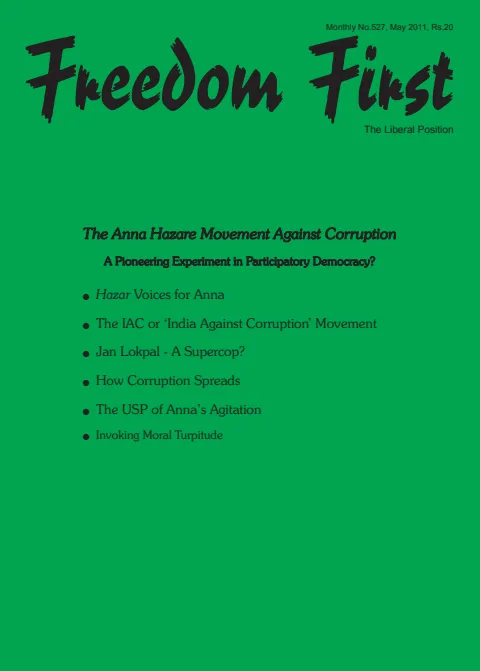
periodical issue
Freedom First
The Liberal Magazine
Published by J. R. Patel for the Indian Committee for Cultural Freedom (ICCF) and printed by him at Union Press, 13 Homji Street, Fort, Mumbai 400 001. · Mumbai · 2012
44 pages
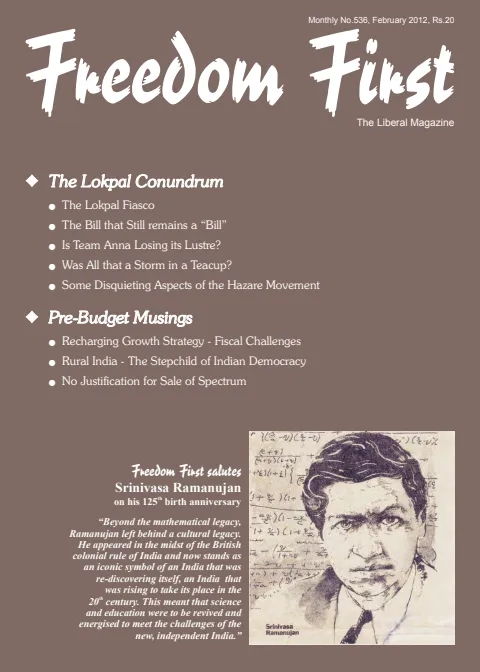
Freedom First
Summary
The February 2012 issue of Freedom First combines pre-budget economic commentary with a cover feature on the Lokpal conundrum after the apparent decline of the Anna Hazare agitation. The editor says what began with a bang has been reduced to a whimper, while insisting that corruption and the need for a Lokpal remain central to Indian public life.
The rendered pages include pre-budget essays on fiscal challenges, rural India, and spectrum, followed by articles on the Lokpal fiasco, the bill that remains only a bill, Team Anna’s fading lustre, and unease about the Hazare movement. Later material includes Cornucopia, Point Counter Point, Srinivasa Ramanujan, Vaclav Havel, book reviews, and adult education.
Key points
-
The editorial says the Anna Hazare movement went “from a bang to a whimper” after the Bombay fast exposed the campaign’s limits, criticising Congress’s dynastic politics while insisting corruption and the Lokpal remain central to public life.
-
Sunil S. Bhandare’s pre-budget essay “Recharging Growth Strategy - Fiscal Challenges” looks ahead to the Union Budget and the fiscal pressures facing India’s growth strategy.
-
Ashok Karnik’s “The Lokpal Fiasco” treats the stalled Lokpal process as a disappointment after months of high public expectation.
-
Firoze Hirjikaka’s “Is Team Anna Losing Its Lustre?” questions whether the campaign’s moral authority and public appeal are fading, treating the movement’s credibility as distinct from the corruption issue itself.
-
R. C. Saxena’s article raises further disquieting aspects of the Hazare movement, continuing the issue’s critical reassessment of Team Anna after its momentum slowed.
-
The editor also notes the issue’s Ramanujan tribute on the cover and introduces a new Adult Education feature.
Essays
Between Ourselves
By S. V. Raju
The editorial says the Anna Hazare movement has gone from a bang to a whimper, partly because Hazare walked into a political web and the Bombay fast exposed the limits of the campaign. It criticizes the Indian National Congress, especially its dynastic core, but stresses that corruption and Lokpal remain at the top of the public agenda.
The editor also notes the Ramanujan tribute on the cover, points readers to pre-budget musings, and introduces a new Adult Education feature.
- Argues that the Hazare agitation lost force after the Bombay fast.
- Criticizes Congress’s dynastic politics and defense of the first family.
- Maintains that corruption and Lokpal remain central issues.
- Introduces the issue’s Ramanujan tribute, pre-budget section, and adult education feature.
Recharging Growth Strategy - Fiscal Challenges
By Sunil S. Bhandare
Sunil S. Bhandare’s pre-budget essay “Recharging Growth Strategy - Fiscal Challenges” looks ahead to the Union Budget and focuses on fiscal pressures facing India’s growth strategy. It begins the issue’s economic-policy section before the Lokpal cover feature.
The article is complete in the rendered pages.
- Looks ahead to the Union Budget.
- Links growth strategy to fiscal challenges.
- Opens the issue’s pre-budget section.
The Lokpal Fiasco
By Ashok Karnik
Ashok Karnik’s “The Lokpal Fiasco” opens the cover feature and treats the Lokpal process as a disappointment after months of high public expectation. The piece fits the issue’s broader judgment that the Hazare-led campaign lost momentum even while the need for anti-corruption reform remained.
The article is complete within the rendered range.
- Frames the Lokpal process as a fiasco.
- Connects public disappointment to the decline of the Hazare agitation.
- Keeps corruption reform at the center of the issue.
Is Team Anna Losing Its Lustre?
By Firoze Hirjikaka
Firoze Hirjikaka’s “Is Team Anna Losing Its Lustre?” asks whether the campaign’s moral authority and public appeal are fading. It is part of the issue’s multi-author Lokpal conundrum cluster and pairs with pieces on the still-unpassed bill and disquieting aspects of the movement.
The article is complete in the rendered pages.
- Questions whether Team Anna’s public appeal is fading.
- Treats the movement’s credibility as distinct from the corruption issue itself.
- Adds a skeptical political reading to the Lokpal cover feature.
Some Disquieting Aspects of the Hazare Movement
By R. C. Saxena
R. C. Saxena’s article on disquieting aspects of the Hazare movement begins within the rendered range and continues the issue’s critical reassessment of the anti-corruption agitation. Because the first rendered chunk reaches only about printed page 18, the article is marked partial.
Its placement shows the issue collecting multiple skeptical perspectives on Lokpal and Team Anna after the movement’s momentum slowed.
- Raises concerns about the Hazare movement.
- Continues the issue’s skeptical reassessment of Team Anna.
- Falls only partly within the rendered pages.
Generated by the v1.5 extraction pipeline. Awaiting editorial review.
Metadata and summary are AI-extracted from the source PDF and reviewed for editorial accuracy. The original work is available via the Read PDF tab above (where present); paragraph-level citation inside the PDF is deferred to a future engagement.