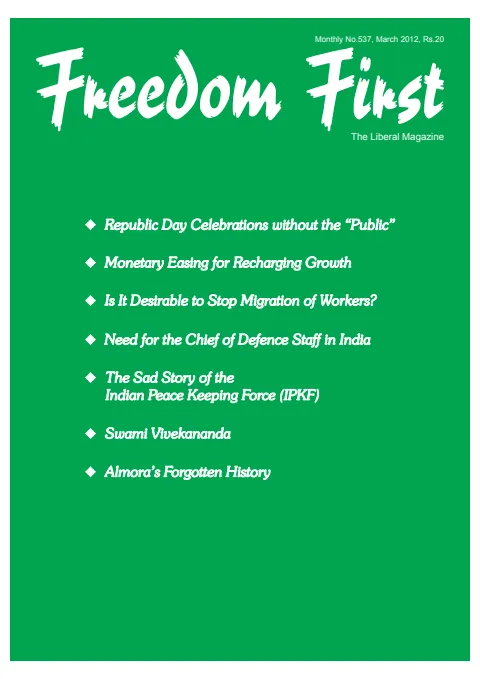
periodical issue
Freedom First
The Liberal Magazine
Published by J. R. Patel for the Indian Committee for Cultural Freedom (ICCF) and printed by him at Union Press, 13 Homji Street, Fort, Mumbai 400 001. · Mumbai · 2012
44 pages
Freedom First
Summary
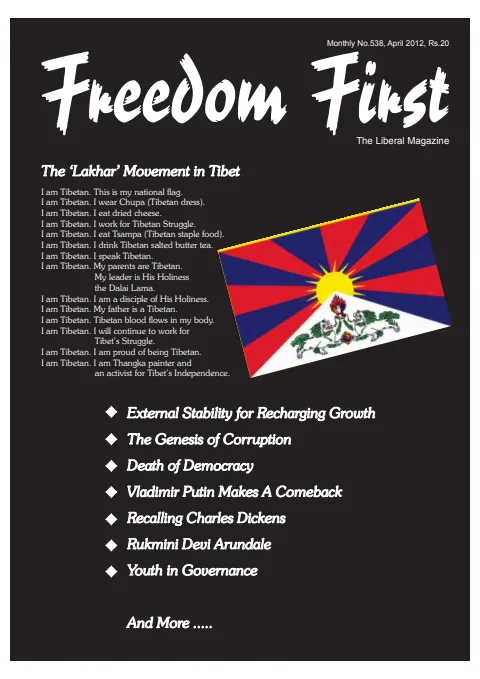
The April 2012 issue of Freedom First ranges from Tibetan identity politics to Indian electoral disillusionment, macroeconomic stability, corruption, democracy, disaster management, Russia, Dickens, and Indian cultural institutions. The cover foregrounds the Lakhar movement in Tibet and a Tibetan flag, while the editorial reflects on election results in Uttar Pradesh, Mumbai municipal politics, and the return of licence-permit-style budget anxieties.
The rendered pages include B. Raman on Lakhar, Sunil S. Bhandare on external stability for growth, K. K. Pathak on corruption’s historical genesis, Firoze Hirjikaka on the death of democracy, and several current-affairs columns. Later material on Putin, Dickens, Rukmini Devi, reviews, and adult education lies outside the visible chunk.
Key points
-
The editorial reads recent Uttar Pradesh election results as evidence that voters get the governments they deserve, criticising UPA2’s budget direction and warning about a return to licence-permit-quota habits.
-
B. Raman’s article introduces the Lakhar movement in Tibet, grounding the cover’s Tibetan flag in a political and cultural assertion of Tibetan nationhood.
-
Sunil S. Bhandare argues for external stability as a condition for recharging India’s growth, treating macroeconomic and investor confidence as a policy concern.
-
K. K. Pathak’s “The Genesis of Corruption: An Historical Perspective” treats corruption as a long-running institutional and social problem rather than only a current scandal.
-
The issue’s table of contents also lists Firoze Hirjikaka on “the death of democracy” and later material on Putin, Dickens, Rukmini Devi and Indian cultural institutions.
-
The cover foregrounds the Lakhar movement in Tibet alongside the editorial’s reflections on Mumbai municipal politics.
Essays
Between Ourselves
By S. V. Raju
The editorial reads recent electoral results as evidence that voters get the governments they deserve, criticizing UP politics, UPA2, Mumbai municipal politics, and a Union Budget that seems to revive licence-permit instincts. It asks readers where India should go from here.
- Comments on UP election results and coalition politics.
- Criticizes UPA2’s budget direction and political survival instincts.
- Warns about a return to licence-permit-quota habits.
- Asks readers what should be done next.
The Lakhar Movement in Tibet
By B. Raman
B. Raman’s article introduces the Lakhar movement in Tibet, grounding the cover’s Tibetan identity declaration in a political and cultural assertion of Tibetan nationhood.
- Explains the Lakhar movement in Tibet.
- Centers Tibetan identity and cultural resistance.
- Connects the cover’s national-identity statement to Tibetan struggle.
External Stability for Recharging Growth
By Sunil S. Bhandare
Sunil S. Bhandare argues for external stability as a condition for recharging growth. The article fits the issue’s concern that macroeconomic policy and external confidence affect India’s development prospects.
- Links external stability to growth revival.
- Continues the magazine’s economic-policy thread.
- Treats investor and macroeconomic confidence as policy concerns.
The Genesis of Corruption: An Historical Perspective
By K. K. Pathak
K. K. Pathak’s historical perspective on corruption treats corruption as a long-running institutional and social problem rather than only a current scandal. It is complete within the rendered pages.
- Gives corruption a historical frame.
- Connects present concerns to deeper institutional habits.
- Adds background to the magazine’s anti-corruption coverage.
Generated by the v1.5 extraction pipeline. Awaiting editorial review.
Metadata and summary are AI-extracted from the source PDF and reviewed for editorial accuracy. The original work is available via the Read PDF tab above (where present); paragraph-level citation inside the PDF is deferred to a future engagement.