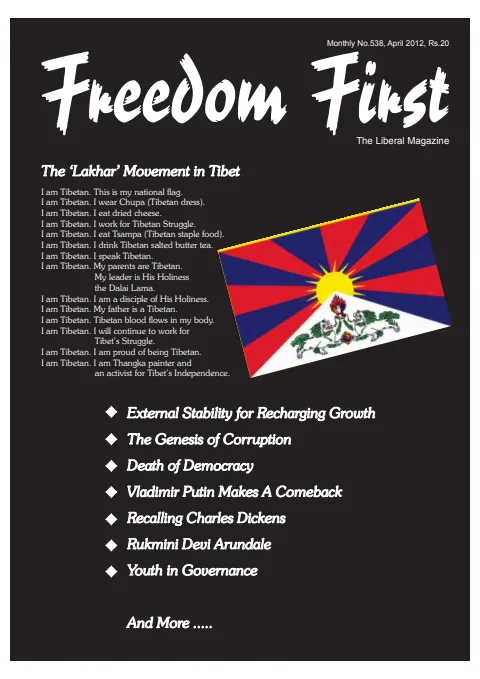
periodical issue
Freedom First
The Liberal Magazine
Edited by S. V. Raju
Published by J. R. Patel for the Indian Committee for Cultural Freedom (ICCF) and printed by him at Union Press, 13 Homji Street, Fort, Mumbai 400 001. · Mumbai · 2012
40 pages
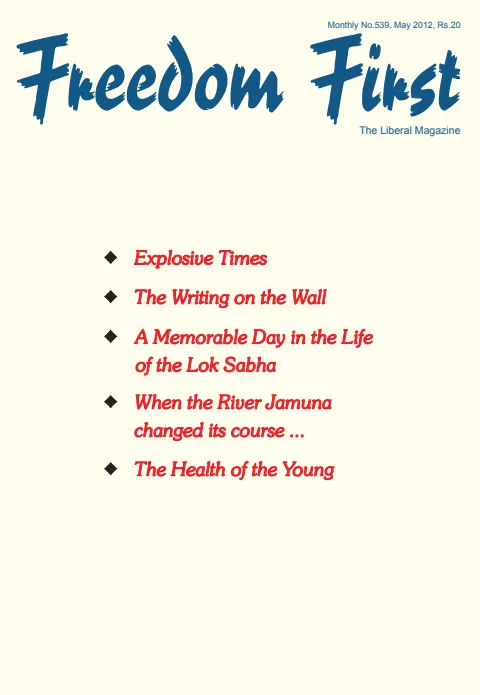
Freedom First
Summary
The May 2012 issue of Freedom First is framed by an editorial asking readers for remedies to corruption, negligence, and mal-governance rather than only diagnosis. It discusses a paper from Subhash Athale and Harihar Khumbhojkar on national peril, corruption, criminalisation of politics and bureaucracy, and national security, then turns to D. R. Pendse’s alarm over the 2012-13 Union Budget, GAAR, and retroactive amendments.
The rendered pages cover explosive times, parliamentary warning signs, political drama around Dinesh Trivedi, Point Counter Point, and military matters including Kargil and General V. K. Singh. Later security and review material lies outside the visible chunk.
Key points
-
The editorial asks readers to move from diagnosis to remedies for corruption and misgovernance, summarising a four-front anti-corruption strategy of moral education, raising the cost of corruption, electoral reform and reducing opportunities for it, while criticising the 2012-13 budget’s GAAR and retrospective tax provisions.
-
K. K. Pathak’s “Explosive Times” responds to the turbulent political and policy climate described in the editorial.
-
Era Sezhiyan’s “The Writing on the Wall” reads visible warning signs in contemporary politics and public life.
-
Suresh C. Sharma’s Kargil War article opens the issue’s Military Matters section, pairing with a further piece on General V. K. Singh and military controversy.
-
The editorial also references a paper by Subhash Athale and Harihar Khumbhojkar on national peril, corruption and the criminalisation of politics and bureaucracy.
-
The issue also covers D. R. Pendse’s alarm over the 2012-13 Union Budget and the political drama around Dinesh Trivedi’s resignation.
Essays
Between Ourselves
By S. V. Raju
The editorial asks readers to move from obvious criticism to remedies for corruption and misgovernance. It summarizes proposed fronts of attack: moral education, making corruption costly, electoral reform, and reducing room for corruption, then connects these to budget worries over GAAR and retrospective taxation.
- Asks readers to suggest remedies, not just identify problems.
- Summarizes a four-front anti-corruption strategy.
- Criticizes the 2012-13 budget, GAAR, and retrospective amendments.
- Calls for re-examining fundamentals.
Explosive Times
By K. K. Pathak
K. K. Pathak’s “Explosive Times” opens the issue’s article sequence and responds to the turbulent political and policy climate described in the editorial.
- Frames the current moment as politically explosive.
- Connects to corruption, governance, and policy anxieties.
- Begins the issue’s reform-minded discussion.
The Writing on the Wall
By Era Sezhiyan
Era Sezhiyan’s “The Writing on the Wall” suggests that warning signs are visible in public life and politics. It sits prominently after the opening article and before later pieces on political drama and military matters.
- Reads current politics as containing visible warning signs.
- Extends the issue’s concern with governance and reform.
- Falls within the rendered pages.
The Kargil War
By Suresh C. Sharma
Suresh C. Sharma’s Kargil War article begins the military-matters section, followed by another Sharma piece on General V. K. Singh. Together they shift the issue from corruption and budget policy to defence institutions and national security.
- Introduces the Military Matters section.
- Discusses the Kargil War.
- Pairs with a later piece on General V. K. Singh and military controversy.
Generated by the v1.5 extraction pipeline. Awaiting editorial review.
Metadata and summary are AI-extracted from the source PDF and reviewed for editorial accuracy. The original work is available via the Read PDF tab above (where present); paragraph-level citation inside the PDF is deferred to a future engagement.