periodical issue
Freedom First
The Liberal Magazine
By N. Vittal
Published by J. R. Patel for the Indian Committee for Cultural Freedom (ICCF) and printed by him at Union Press, 13 Homji Street, Fort, Mumbai 400 001. · Mumbai · 2012
40 pages
Freedom First
Summary
The July 2012 issue resumes after Freedom First’s sixtieth anniversary and reasserts its commitment to the open society. The editorial reflects on the decline of the international communist movement, the persistence of authoritarian habits, and the continuing distance from an honest open society, then announces that the magazine has gone online at www.freedomfirst.in.
The rendered pages include monsoon forecasting, austerity, the presidential election, Point Counter Point, India Wins Freedom, and the opening of N. Vittal’s pragmatic approach to cleaning up India. Later foreign-relations, China, environmental, review, and adult-education material lies outside the visible chunk.
Key points
-
The editorial marks Freedom First’s resumption after its sixtieth anniversary, contrasting the collapse or compromise of international communist movements with India’s still-unfinished task of building an honest open society, and announces the magazine’s launch online at freedomfirst.in.
-
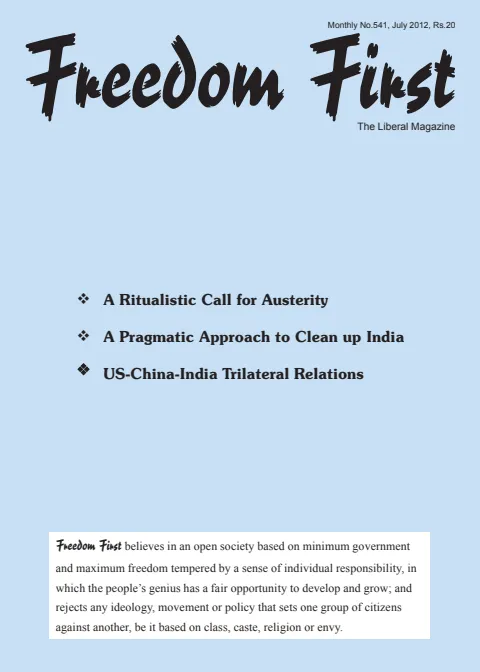
Sunil Bhandare’s “A Ritualistic Call for Austerity!” critiques calls for austerity as often ritualistic rather than serious fiscal policy.
-
N. Vittal’s “A Pragmatic Approach to Clean up India” aligns with the magazine’s anti-corruption and governance concerns, though only its opening is rendered.
-
The issue’s table of contents also lists pieces on monsoon forecasting, the presidential election, Ashok Karnik’s Point Counter Point, and a discussion of Maulana Azad’s India Wins Freedom.
-
Later material on foreign relations, China and the environment is listed in the contents but falls outside the rendered pages.
Essays
Between Ourselves
By S. V. Raju
The editorial says Freedom First resumes its next sixty years by recommitting to the open society. It contrasts the collapse or compromise of communist movements with India’s unfinished task of building an honest open society, and announces the launch of freedomfirst.in.
- Recommits to the open society after the 60-year milestone.
- Treats international communism as spent but authoritarian habits as persistent.
- Introduces a coming discussion of secularism and open-society concepts.
- Announces the magazine’s online presence at freedomfirst.in.
A Ritualistic Call for Austerity!
By Sunil Bhandare
Sunil Bhandare’s article on austerity critiques ritualistic calls for austerity and places fiscal restraint in the issue’s economic-policy frame.
- Examines calls for austerity.
- Distinguishes ritual austerity from serious fiscal policy.
- Continues the magazine’s economic-policy thread.
A Pragmatic Approach to Clean up India
By N. Vittal
N. Vittal’s pragmatic approach to cleaning up India begins within the rendered range and aligns with the magazine’s anti-corruption and governance concerns. It is marked partial because the first chunk reaches only about printed page 18.
- Offers a practical approach to cleaning up India.
- Connects governance reform with anti-corruption concerns.
- Only partly visible in the rendered chunk.
Generated by the v1.5 extraction pipeline. Awaiting editorial review.
Metadata and summary are AI-extracted from the source PDF and reviewed for editorial accuracy. The original work is available via the Read PDF tab above (where present); paragraph-level citation inside the PDF is deferred to a future engagement.